Passionately unconvinced
Foreword
“The best lack all conviction, while the worst
Are full of passionate intensity.”
– WB Yeats, The Second Coming
A year full of geopolitical, economic and financial challenges is now two-thirds done. Securities markets – the short-lived drama of Liberation Day aside – look remarkably composed. Most local stock and bond indices have so far delivered inflation-beating returns, and as we write, global stock returns even in euros, francs and pounds are close to break-even.
It’s not a huge surprise. We have written often about the ‘crisis’ mindset, and the misplaced urgency and polarised perspective it fosters.
We know markets can be impersonal. Unless (for example) energy costs or shipping are disrupted, then global profitability and interest rates – and with them, security prices – may be little affected by human trauma.
We know Mr Trump’s comments should not be taken at face value, and that Making America Great Again is not something that can be delivered by tariffs and exchange rates (not least because America has never not been great to begin with, at least in economics and finance – a point which dollar bears may have forgotten).
As we note below, the tariffs currently in prospect are certainly putting sand in the wheels of commerce, but those wheels are not yet falling off. Economic resilience, rather than the tariffs themselves, in turn means that inflation, not deflation, ought to be the main concern of monetary policy, and that interest rates may not fall dramatically in the months immediately ahead.
We also know that stock valuations on their own are a poor guide to short-term returns, particularly when a market leading theme is well-established and backed by healthy earnings growth – which still seems to be the case for today’s preoccupation with Artificial Intelligence (AI), which we also discuss below.
We know too that government borrowing is not usually, or even often, the main driver of bond market returns (as we’ve noted here and here). The broad stability of most Western yield curves in the face of high and rising debt ratios, and many pundits’ obsession with them, is also not a big surprise.
Knowing all this, and being long-term, ‘glass half full’ investors, from our top-down viewpoint we have advised staying invested.
But whereas in most years we have usually felt able to champion stocks in particular, as of November 2024 we have been effectively indifferent, from our top-down viewpoint, between stocks, bonds and cash. It has felt too soon to be expecting all of these issues to be, if not resolved (that crisis mindset!), then at least to move off stage.
Being neither especially bullish nor bearish can be a difficult stance. It is hardly a table-thumping call – and if you stand in the middle of the road, you are at risk of being run over from both directions. Nonetheless, we enter the final third still passionately unconvinced.
Kevin Gardiner / Victor Balfour / Anthony Abrahamian
Global Investment Strategists
AI: hope or hype?
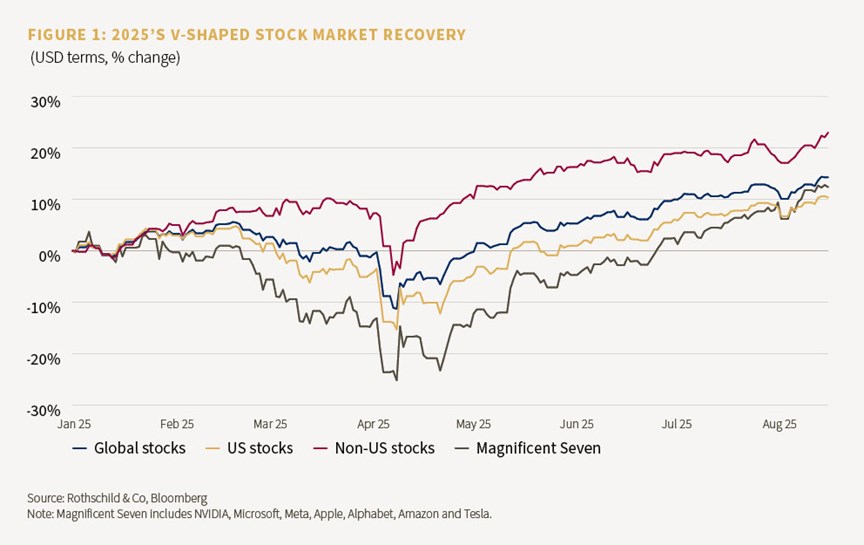
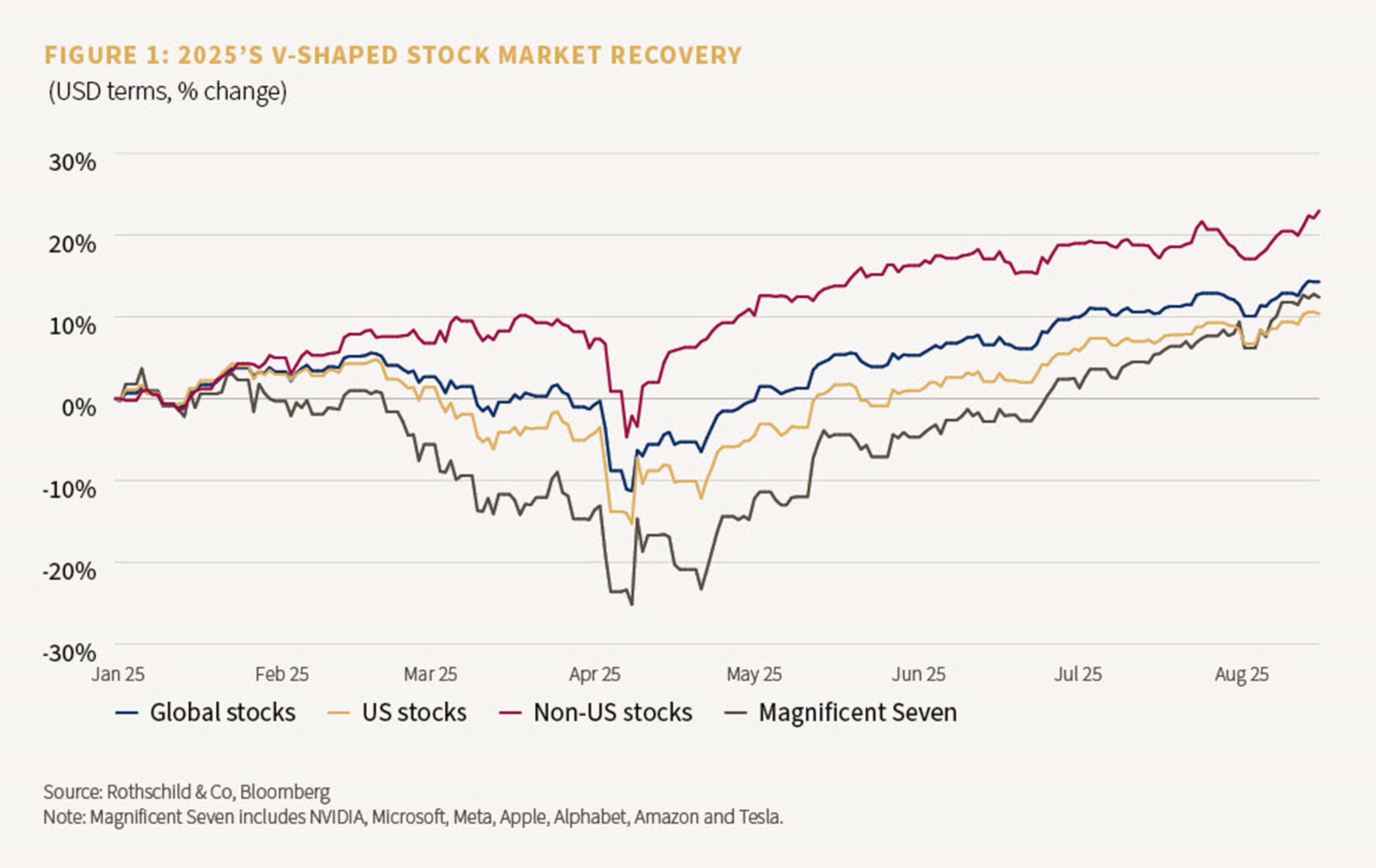
Reports of the demise of US exceptionalism have been overstated it seems. After a brief period of underperformance, technology-related momentum has resumed in recent months – and with it, US stock market leadership (figure 1). A combination of robust earnings growth, unbridled AI optimism and a belief that the tariff confusion won’t deliver a stinging riposte to the global growth model.
The Magnificent Seven-led rebound may be more soundly based than we might first imagine, but that doesn’t mean that artificial intelligence enthusiasm – and spending – hasn’t run ahead of economic reality.
RATIONAL EXUBERANCE
In 1996, then-Federal Reserve Chairman Alan Greenspan famously made his comments about the stock market’s “irrational exuberance”. At the time, stock prices and trading volumes soared, as investors rode a gathering momentum that would eventually develop into the “TMT” (Technology, Media, Telecoms) or “dotcom” bubble. Growth in earnings fell far short of upbeat expectations, and valuations became disconnected from reality. When the music eventually stopped, a painful reckoning followed.
Some TMT echoes – exuberance and hype – have re-emerged today. Meme stocks are surging; some companies are capitalising on Bitcoin enthusiasm through questionable cryptocurrency treasury strategies, perhaps echoing those who in 2000 added “.com” to their name. Most recently, retail investor prominence has risen – perhaps accounting for a third of daily volumes – and may explain some of the furious dip-buying activity evident in recent months.
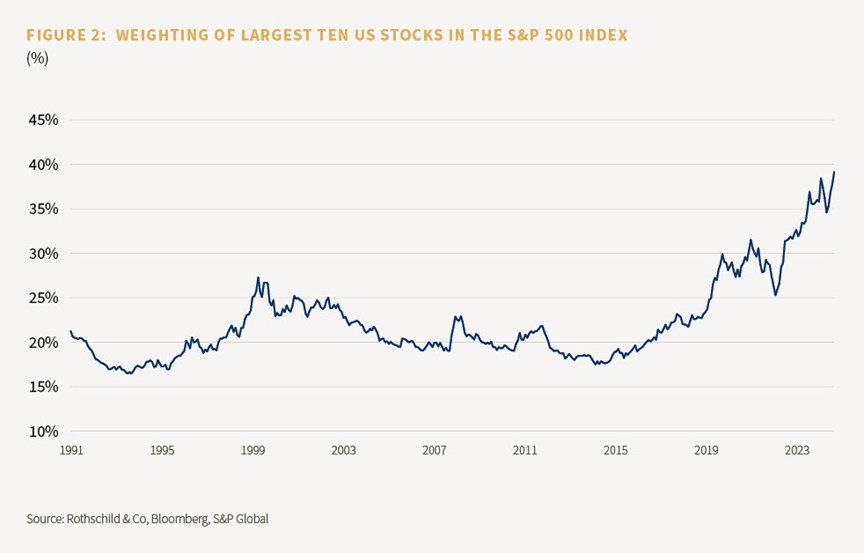
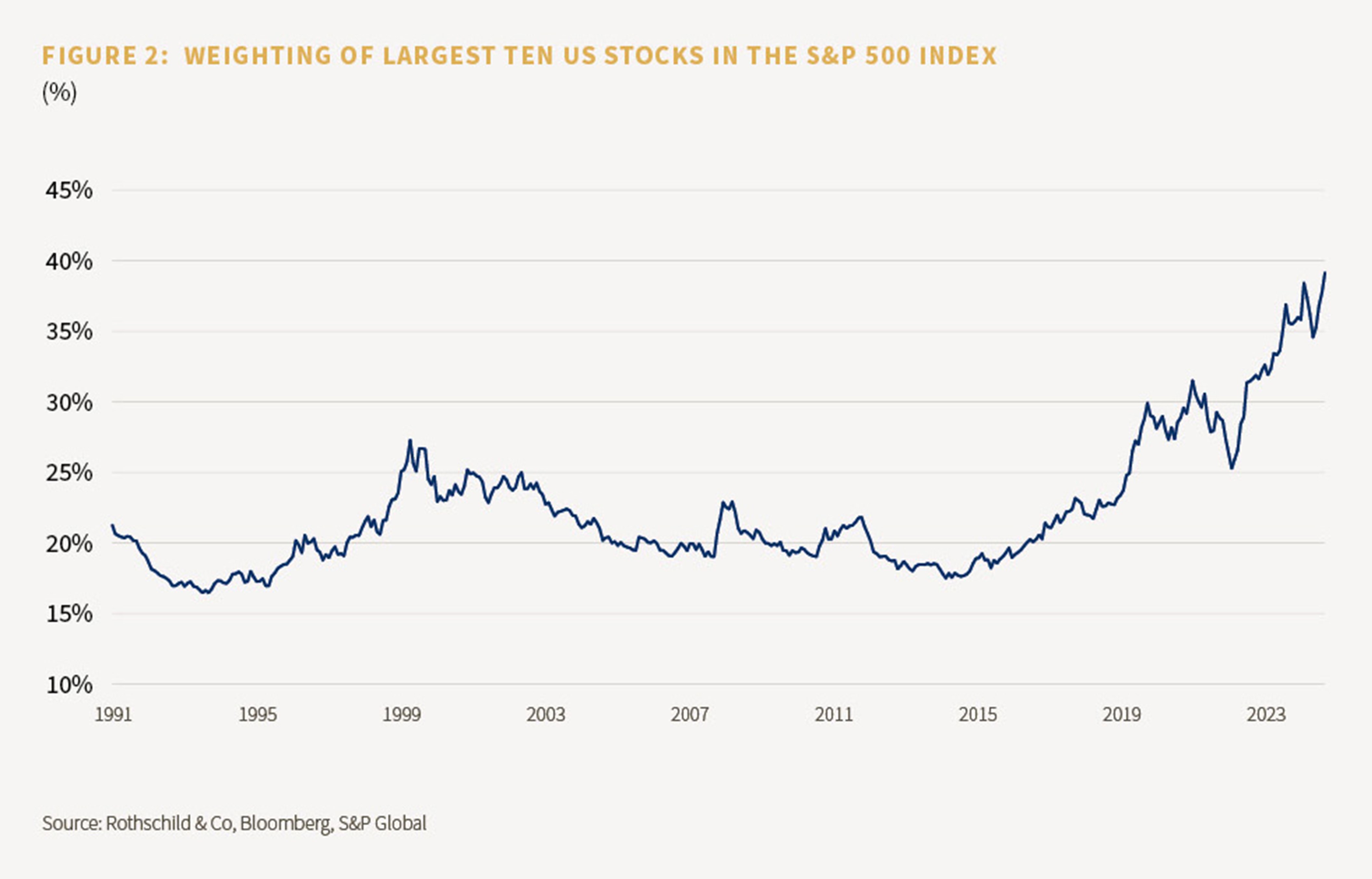
This has been accompanied by increasingly exceptional market concentration. The ten largest stocks – eight of which have a technology tilt – make up two fifths of the US stock market (figure 2), or over a quarter of the wider MSCI All Country World index. Perhaps more remarkable, the largest two stocks were each briefly valued at more than $4tn, which combined is close to the entire size of continental Europe’s MSCI index.
But bandwagon behaviours and a concentrated market are not necessarily indicative of an outright market bubble. For such a development, we’d likely need to see more exponential ascent, and more obviously stretched average valuations.
That said, the S&P 500 index is undeniably expensive – relative to its own trend or other regional equity markets. Our US cyclically-adjusted price-to-earnings (CAPE) ratio is tracking at a lofty one fifth premium to its trend – placing it in the top valuation percentile going back over a century. Other earnings or balance sheet based metrics will point to a similarly elevated level – one which is eclipsed only by that TMT episode.
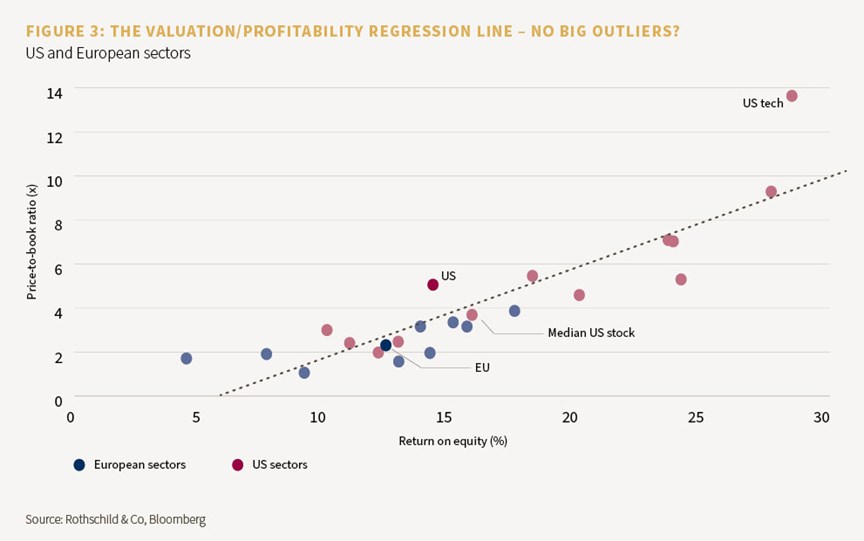
To some extent, higher valuations are warranted. A steady rerating in multiples over the past couple of decades has coincided with a period when real interest rates have mostly fallen, and profitability has risen. Today, US companies are amongst the most profitable ever: a combination of solid earnings growth with restrained capital requirements means that their return on equity has tended to outstrip both earlier US businesses, and that of most of the developed world – and the gap has widened significantly in the last few years. Meanwhile, the real cost of funds – even now that interest rates have ‘normalised’ – has remained historically subdued. Intuitively it stands to reason that better and more profitable businesses, discounted at low real interest rates, might justify a higher valuation multiple.
Meanwhile, the median US stock is significantly cheaper than the index suggests –though profitability is generally correspondingly lower too (figure 3).
This suggests that fundamentals, not sentiment, may have been in the driving seat when it comes to recent returns. And concentration on its own is little guide to short-term tactical prospects. There are plenty of global and historical examples in which markets have become less diversified, or agglomeration has led to narrow leadership. Concentration can be a sign of unbalanced competition or collusion, but it can also reflect technological circumstance and the evolving product cycle.
Of course, a narrow market doesn’t mean we need to have narrow portfolios. Genuine diversification comes from owning different business lines – which is what some of today’s big technology-linked businesses offer.
THE AI ARMS RACE
AI has gone from the wings to centre stage in the space of a few short years. Excitement today ranges from the merely exuberant through to the swivel-eyed.
However, the wider economic boost from AI-led productivity gains is yet to be seen. Meanwhile, the capex expense which is supposed to deliver it is already appearing in the data. It contributed more to US output growth than consumer spending in the first half of 2025.
In the background, AI use cases are growing. Routine administrative tasks are steadily becoming more reliably computable. In our own work, we are using various tools to scrape data, summarise documents and synthesise reports. But the much vaunted and long awaited ‘AI inflection point’ – a transformation of our day-to-day lives – still seems some way off.
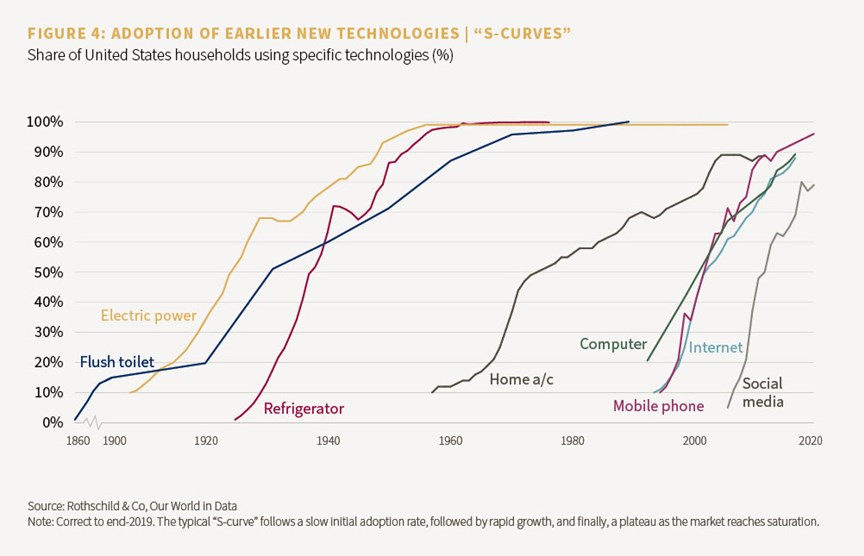
Proponents will suggest that technology is diffuse and that AI’s influence will likely be more subtle than previous innovations. When it does arrive, the speed of adoption will likely be faster too – the old technology adoption curves may not be a useful reference point (figure 4). But talk of AGI, or Artificial General Intelligence, remains premature. Computer scientists are no closer than they ever were to understanding consciousness, which seems likely to remain a non-computable phenomenon – along with many, many others. Meanwhile, for those problems which are computable, trust, reliability and altered human habits are all necessary conditions for widespread adoption.
Despite this, the expectation (hope?) of dramatic automation and imminent AI-driven efficiency gains has fostered a rapidly growing ecosystem that includes sprawling large language models, vast data centres and new energy supplies. Capital outlays by the big four ‘hyperscalers’ – Alphabet, Amazon, Meta, and Microsoft – will likely exceed all other US industrial and energy capex this year. Meta is building a data centre the size of Manhattan, and Microsoft has re-opened Three Mile Island to satisfy its growing energy needs. And, of course, at the centre of this AI revolution lies NVIDIA – the GPU producer commands two-thirds of the market and is one of the key beneficiaries of such spending.
The grail of first mover advantage and data dominance is motivating the ‘picks and shovel’ producers – which includes the dominant semiconductor producers and hyperscalers – to keep spending. But misallocation of capital and overinvestment must be a real risk – and is arguably reminiscent of the initial telecoms outlays in the TMT episode. Thankfully there are important distinctions today: there is no IPO or M&A frenzy, and spending is funded from existing cash flows (not through the issuance of equity or debt – indeed, collectively, these businesses have no debt).
Much of the investment assumes exponentially rising demand for processing power: the deployment of AI models is expected to accelerate significantly. Some AI patrons believe that the Jevons Paradox (which is perhaps less paradoxical than it sounds) applies here: greater efficiency and lower cost will lead to greater demand. However, even if it does, competition may spread, delivering efficiency gains for new entrants. When China’s DeepSeek model emerged earlier this year it was reportedly much cheaper to run and much less computationally intensive. If genuine, its threat suggests that ‘Big Tech’ may enjoy a narrower economic moat than previously thought. This points to a more democratised outcome for consumers, but perhaps a less profitable one for the big data center providers.
More prosaically, one of the original attractions of the megacap technology stocks was their huge operational leverage. A lasting shift towards a more capital intensive, and more tangible, operation undermines this enviable trait. Rapid obsolescence might mean they face the Sisyphean task of having to deploy ever greater capital investment just to stand still.
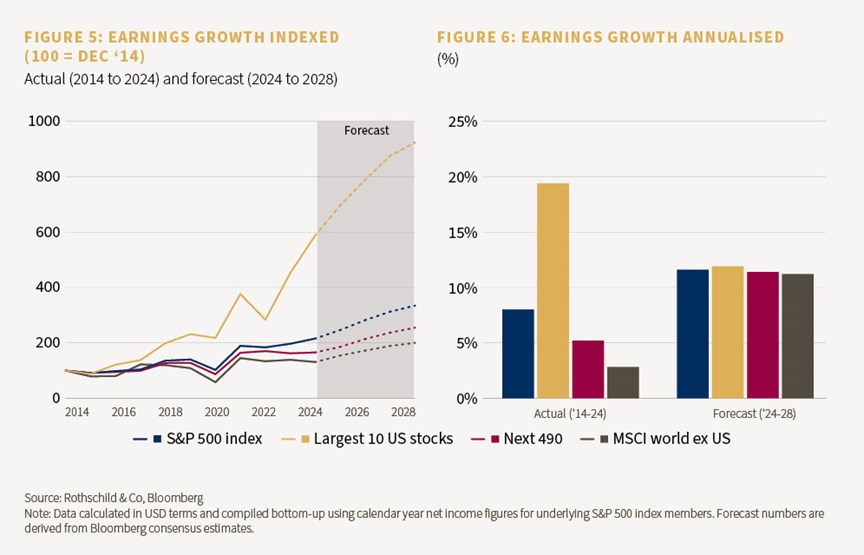
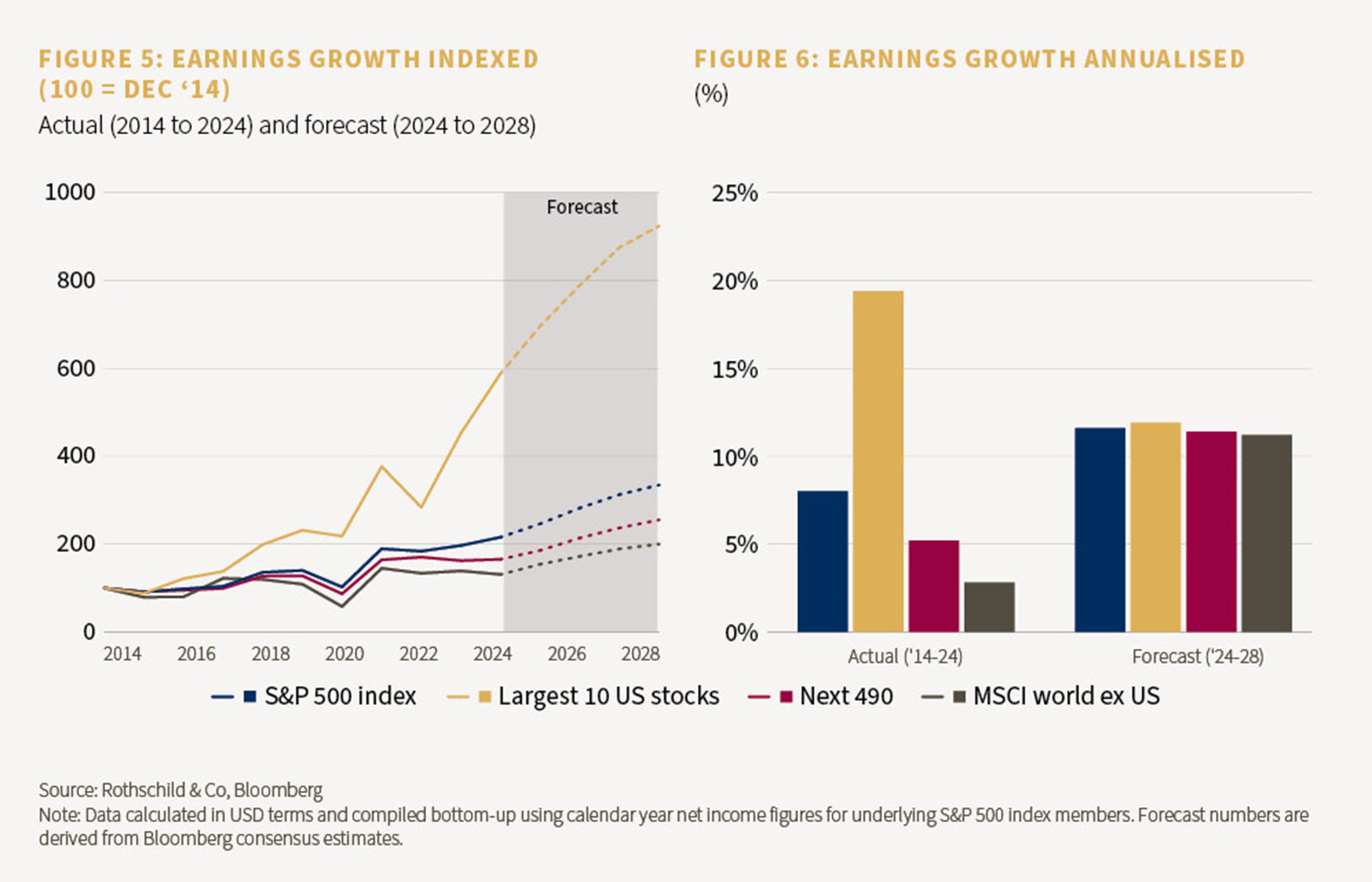
For many reasons, then, today’s profit margins – wider even than we have become accustomed to these last few decades – are perhaps unsustainable. Earnings growth may normalise ahead – indeed, analysts seem to share this view (figures 5 and 6).
THE MAGNIFICENT SEVEN ARE NOT THE ONLY GAME IN TOWN
None of this should detract from AI’s long-term potential possibilities nor the initial quality of US technology firms: many companies in the TMT episode had few sales, let alone profits, and were over-leveraged. But once again, a lot of good (or improved) news is already in the price and there must be less valuation headroom now.
The reality is that there’s often a lag between market expectations and the implementation of new technological innovations. AI is a broad church and opportunities lie beyond the ‘picks and shovels’, dominated by the Magnificent Seven. History suggests that the long-term beneficiaries of new technologies – printing, canals, railroads, internal combustion engines, basic telephony, the internet – are their users, not their purveyors.
Meanwhile, other regions have still outpaced US stocks in 2025 – notably Europe, Japan and China. This, of course, has coincided with a period when the US administration is said to be attempting to re-write the liberal post-war international order. Tariffs permitting, Europe – buttressed by Germany – may yet be one of the economic beneficiaries of a plan to rearm and invest domestically. Even if the AI trade doesn’t stumble, relative growth prospects and expectations are shifting.
Inflation revisited
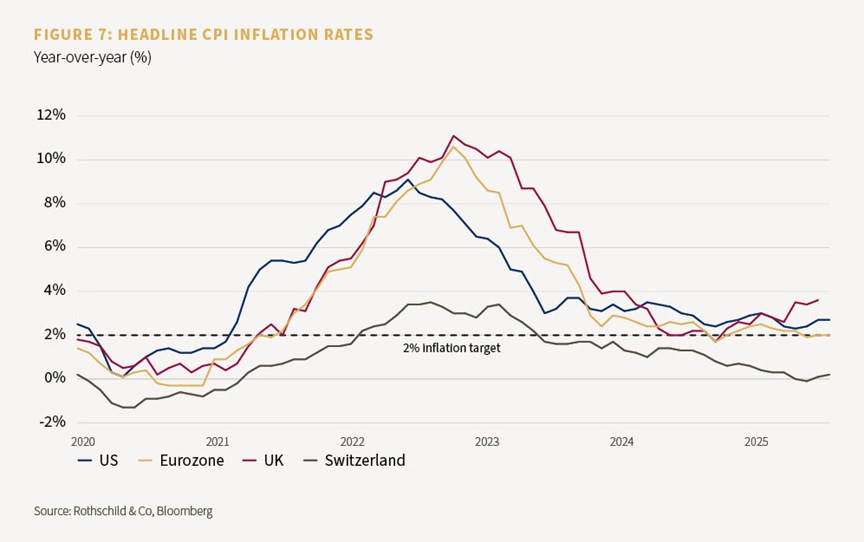
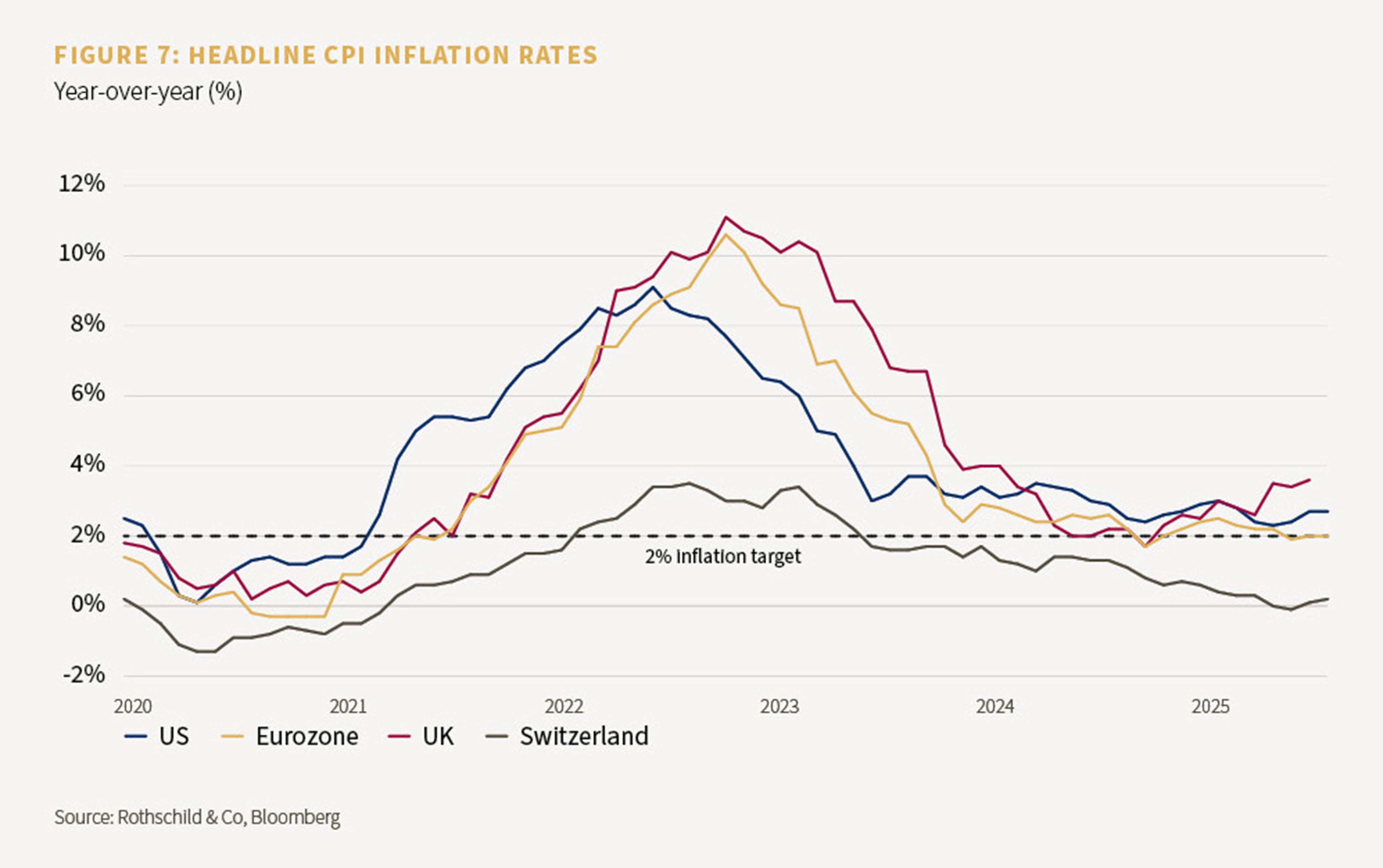
Inflation risk may be dialing higher again. US CPI (Consumer Price Index) inflation has discretely edged up in recent months, after failing to return to its 2% target. On this side of the Atlantic, UK inflation has risen more sharply – to almost double its target – though inflation on the continent has stayed softer, particularly in Switzerland (which never really had an inflation problem to begin with – figure 7).
We have previously suggested that developed-market inflation could experience some stickiness in the final leg of its descent, and it has indeed mostly trended in the 2-4% region we thought might prevail. While we have felt that this should be manageable for businesses with strong pricing power – which it has been – it may become trickier if inflation starts to drift even higher, and as it stands it argues for some caution in monetary policy. Ahead, the limited passthrough from tariffs may start to make themselves felt.
For context, there are four main categories in the CPI: food, energy, goods and services (the latter is usually the majority weight in developed-market baskets)
TRUMP’S TARIFFS
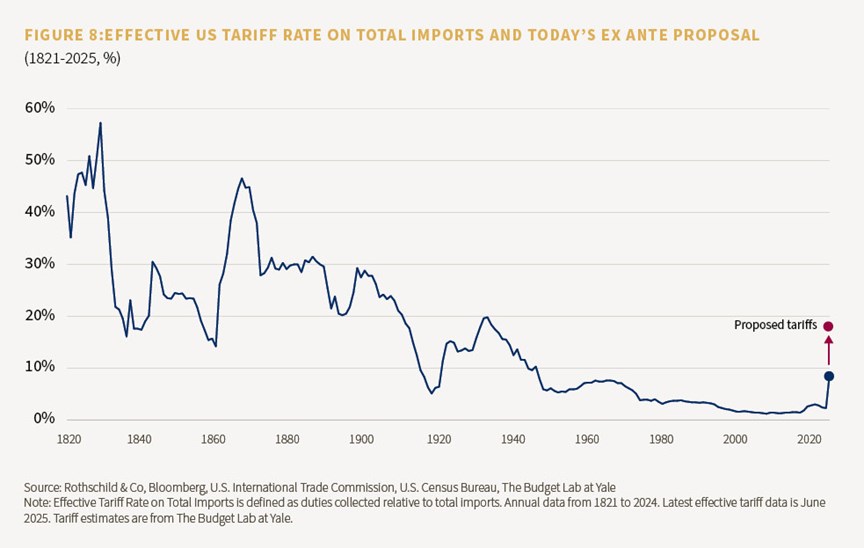
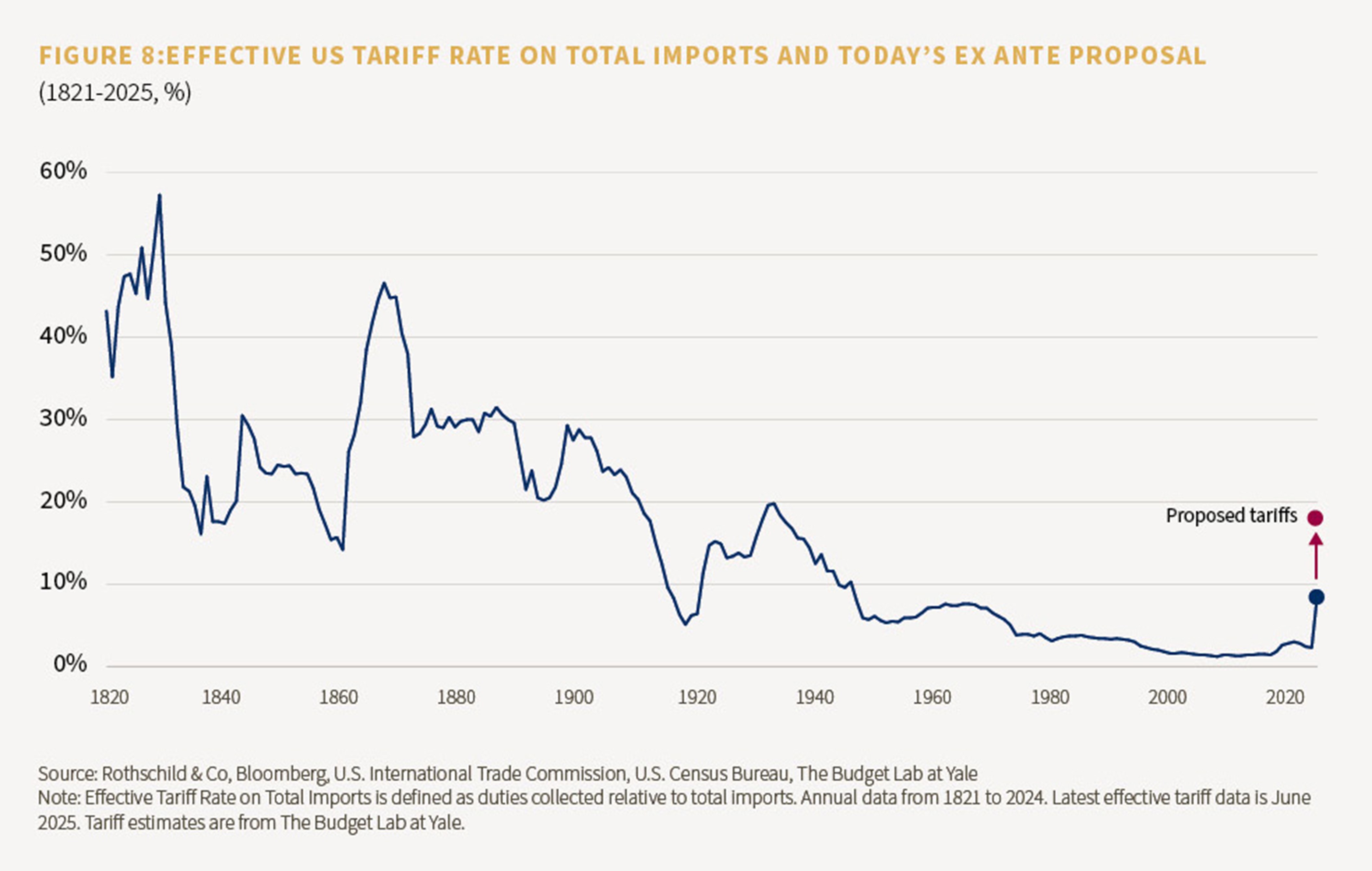
While we can debate whether ‘tariff’ is indeed the most beautiful word in the dictionary (as President Trump likes to say), it’s certainly been a widely used one this year. The US effective (or actual) tariff rate has risen from just over 2% in 2024, to nearly 10% in June 2025 – and with the ultimate destination still unclear, as ongoing trade talks are still underway with many countries, some estimates suggest that it may even double from here, to its highest rate since the Smoot-Hawley duties of the 1930s (figure 8).
Some of the increase in US tariffs will filter through to the domestic consumer, mostly via goods prices. However, this does not necessarily mean that US CPI inflation is about to rocket higher – and stay elevated – again.
US goods CPI inflation has not risen meaningfully this year, even though tariffs have already been rising, which suggests that the cost burden has been spread across and absorbed by the supply chain (to start with, at least). It may also have been muted by the US’s lower import intensity: it is a relatively closed economy, with goods imports accounting for less than a fifth of total household consumption (versus roughly 30-40% in the eurozone and UK). And the effective tariff rate may not rise as high as the ex-ante level shown in figure 8 anyway: import origins may be misreported; trade might be re-routed through lower-tariff nations; some imports can be substituted; and as noted, Trump could strike further trade ‘deals’.
Are tariffs really inflationary anyway? This sounds like a strange question: they push prices up, so how might they not be? However, inflation is a sustained increase in the general price level, whereas tariffs are initially at least a one-off change in the relative price of imports. We would argue that tariffs eventually have more of a more deflationary impact, as they reduce spending power and economic activity – at least, unless or until the revenues are recycled as tax cuts or government spending.
In Europe, the deflationary impact could be more visible even in the near term, given that the bloc has chosen not to respond with retaliatory domestic duties of its own so far, while European exports will be hit by the US tariffs. The magnitude of the growth hit will of course depend on several factors, such as exports as a proportion of GDP, export dependence on America, and the final US tariff rate – all of which vary across the UK, eurozone and Switzerland. For now, consensus GDP growth estimates suggest that the negative shock should be manageable for all these economies, and so the deflationary impact may be small. Perhaps of more practical importance will be the broad-based weakness in the US dollar, which is adding to deflationary pressures by making Europe’s imports cheaper to begin with (the inverse is true for the US).
THE COMMODITY CHANNEL
Meanwhile, energy and food price developments have been mixed.
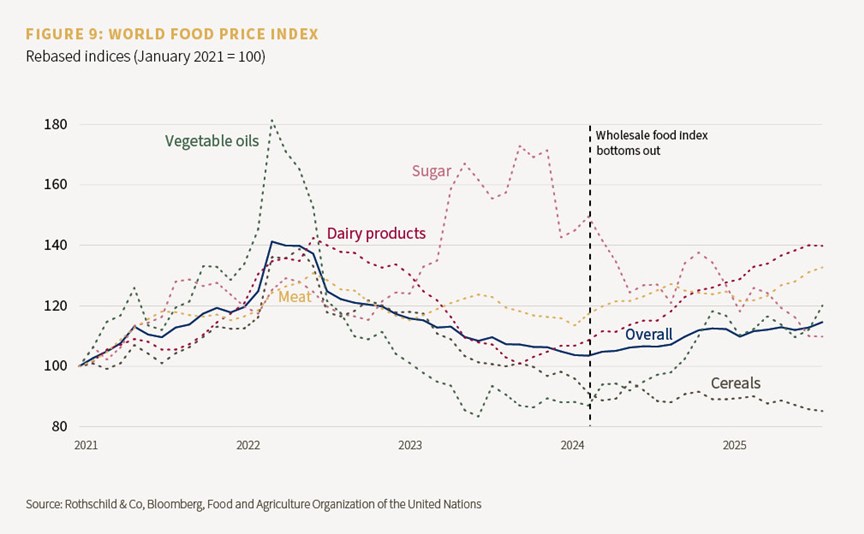
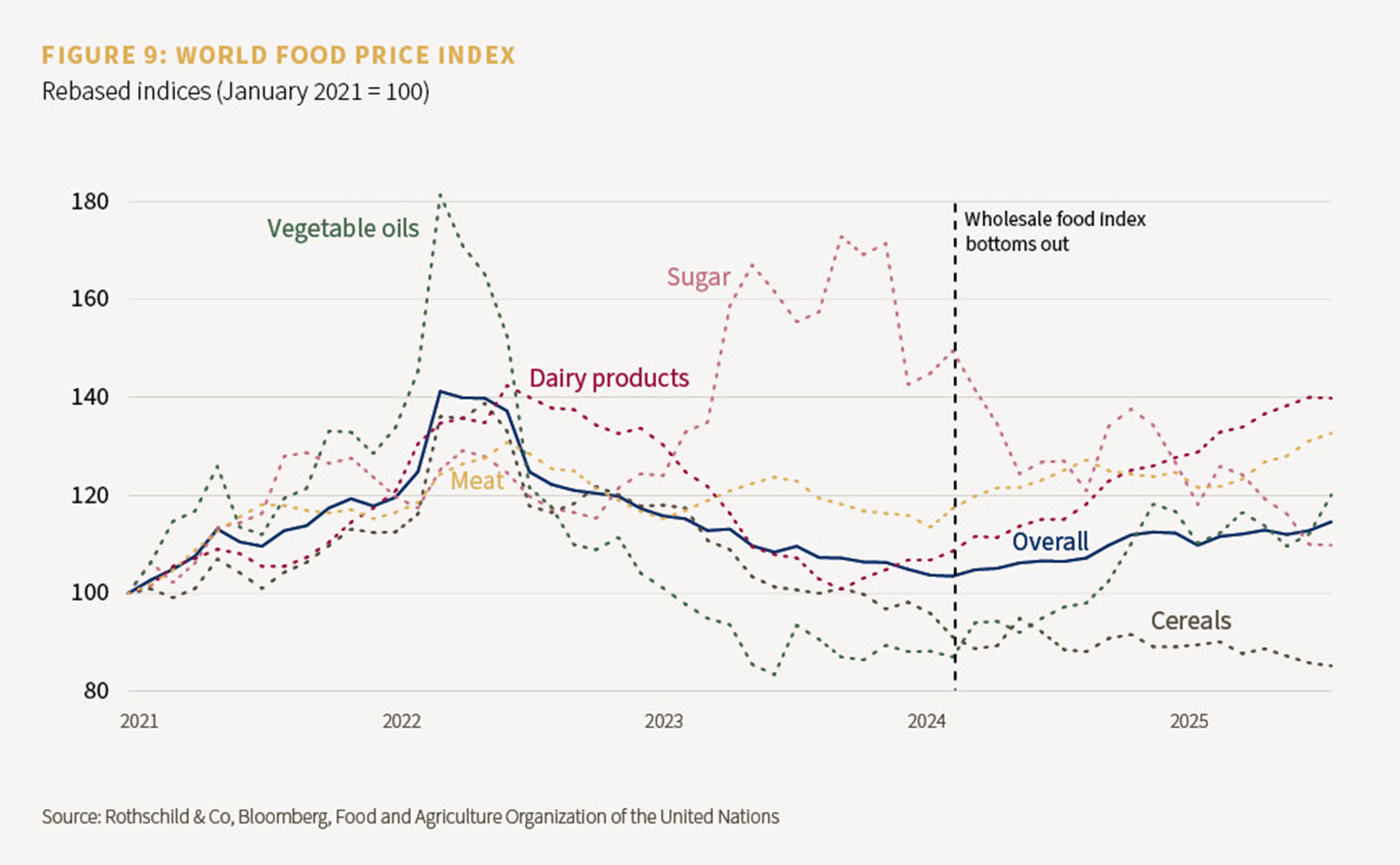
Aside from any tariff effects, food CPI inflation has risen slightly for underlying reasons on both sides of the Atlantic, though most notably in the UK (which relies heavily on food imports). At the global level, wholesale food prices have been steadily rising since early 2024 and tend to lead developed-market food CPI inflation by around nine months, so the prices we see on our supermarket shelves may continue to drift higher for a while longer. Promisingly, the rise in wholesale food prices does not appear to have been as sharp nor as broad based as the post-pandemic surge in 2021 (figure 9).
Higher US tariffs are also expected to raise the price of most imported US food items both directly (raw foods) and indirectly (other materials for processing and packaging). That said, food imports account for less than a fifth of domestic food and beverage spending according to the US Department of Agriculture, so the tariff impact here is likely to be less visible than in goods CPI inflation.
Energy CPI inflation developments conversely appear unambiguously subdued: US, UK and eurozone energy CPIs have fallen on a year-over-year view. Tariffs are unlikely to affect US energy CPI inflation, given that almost all energy products are exempt (a 10% duty on Canadian energy is the exception). Despite wider conflict, Brent crude oil is down by more than a tenth this year in dollar terms, while the wholesale European natural gas benchmark has fallen by a third in euro terms. The OPEC+ cartel have been raising production quotas this year, while there appears to have been tentative progress on resolving the conflict in Ukraine.
TIGHT LABOUR MARKETS
The largest CPI category, services inflation, is also the stickiest one. It has flatlined at just under 4% and 5% in the US and UK (respectively) and remains above 3% in the eurozone.
Country-specific factors can partly explain why services inflation is still elevated. For instance, US shelter CPI – a gauge of house and rent price growth – unusually accounts for more than a third of the entire basket. In the UK, last autumn’s ‘tax and spend’ budget has led to several one-off price hikes (such as the introduction of VAT to private school fees).
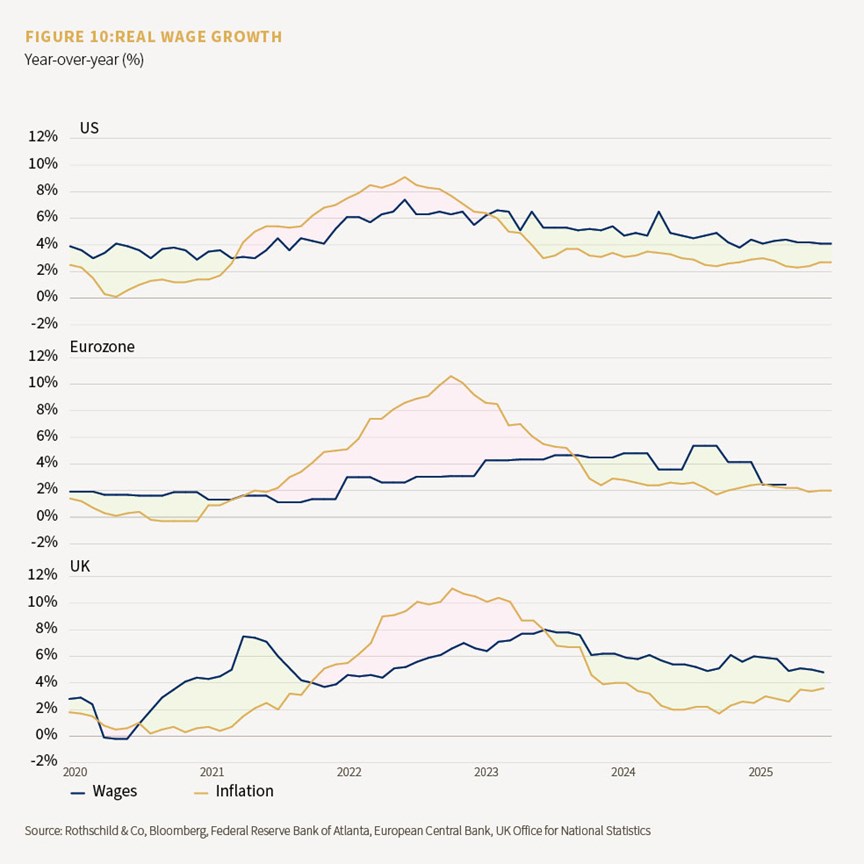
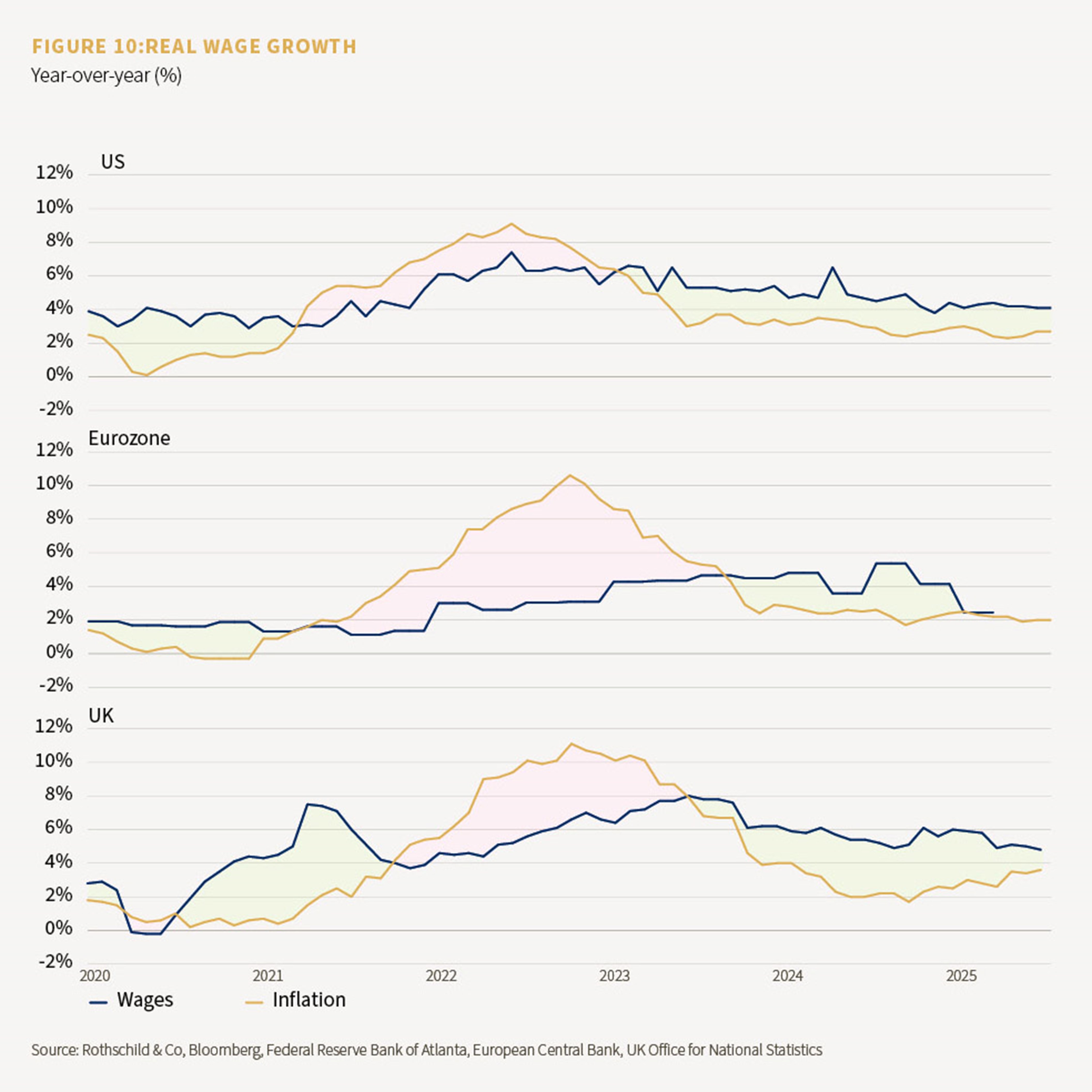
More widely, tight labour markets continue to be the main driver of services inflation. Unemployment remains low, and wage growth has been above trend – and is still outpacing inflation in the US, UK and eurozone (figure 10). Wages tend to be the dominant input cost for service sector firms and have also helped keep consumer momentum – final demand – intact. Eagle-eyed readers may spot that real (or inflation-adjusted) eurozone wage growth has been relatively softer, albeit on the evidence of patchier data in figure 10. However, the next update might show eurozone real wage growth turning more positive again, given that the bloc’s unemployment rate is still at a record low and CPI inflation has actually dipped further, to 2%, in contrast to inflation rates in the US and UK.
Tariffs are unlikely to have a direct impact on US services inflation, as they mostly focus on goods imports. They might however cause some slack into the labour market, which in turn may soften wage growth a little: US hiring slowed considerably during May and June, coinciding with what was arguably peak tariff uncertainty.
There are non-tariff risks in the US too. As we’ve highlighted before (see here), President Trump’s implementation of tighter immigration controls and deportations may yet tighten the US labour market, though there are – as always – nuances to these proposed policies, and the US labour market currently appears unaffected (aside from the noted payrolls softness).
CONCLUSION: INFLATION TO STICK ABOVE TARGET
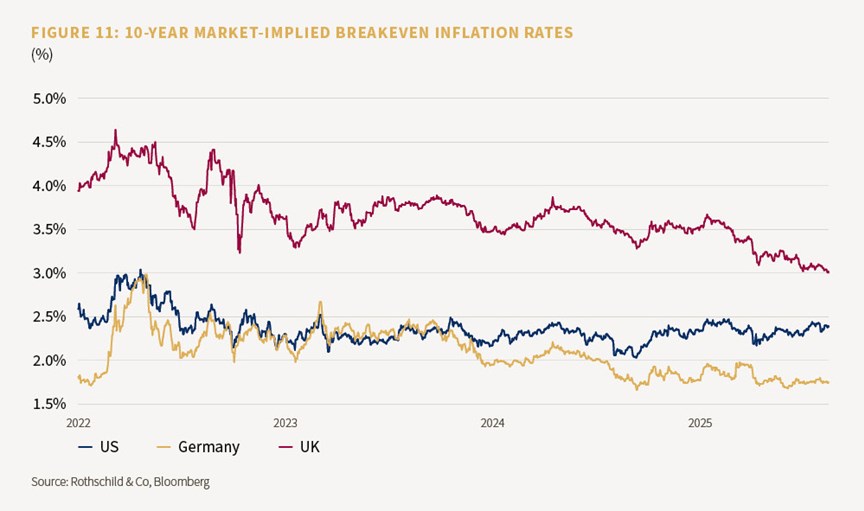
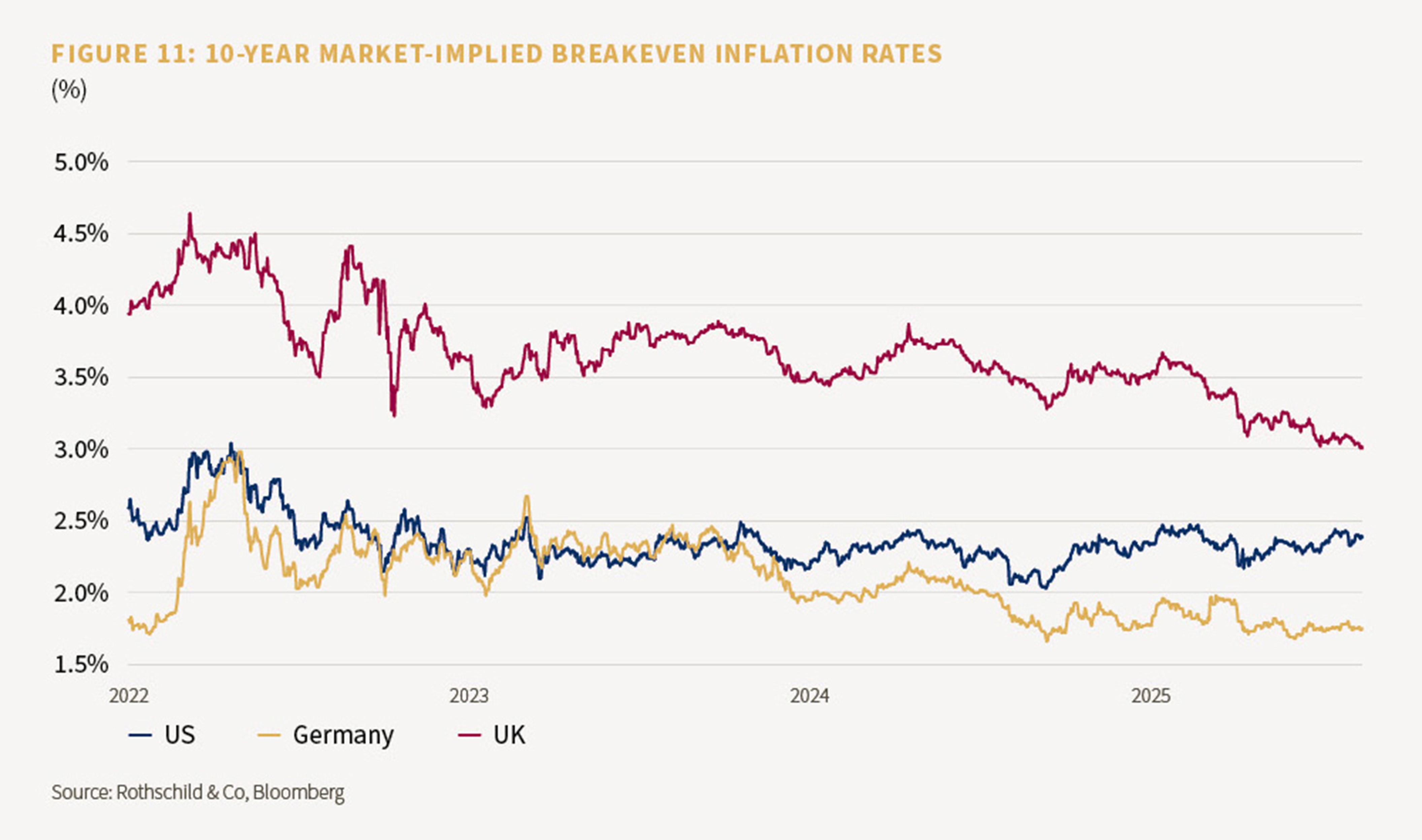
On balance, it still seems as though developed-market inflation may not return sustainably to target soon – but equally, we see little chance of it blowing out again either. Market pricing for longer-dated US inflation expectations has remained rangebound in recent years, and for the UK and Germany has actually moved slightly lower (though in the case of the UK, this may be partly due to technical reasons as well, namely the gradual transition from RPI to CPI linking for inflation-linked gilts – figure 11).
We continue to think that developed-market inflation will trend in the 2-4% range for a while longer, provided that the US trade war does not re-escalate and economic resilience remains intact.
If we’re right, central banks may need to proceed with caution, particularly in the US and UK where inflation appears stickier – further rate cuts may stimulate demand. Even the traditionally more dovish European Central Bank may not have much room to reduce its deposit rate either, with fiscal policy loosening notably: there is a significant spending package pending in Germany.
Our judgement that interest rates may not fall as far as markets had been expecting earlier in the year has been one of the reasons for our tactical indifference on stocks, bonds and cash noted above.
Ready to begin your journey with us?
Speak to a Client Adviser in the UK or Switzerland
Past performance is not a guide to future performance and nothing in this blog constitutes advice. Although the information and data herein are obtained from sources believed to be reliable, no representation or warranty, expressed or implied, is or will be made and, save in the case of fraud, no responsibility or liability is or will be accepted by Rothschild & Co Wealth Management UK Limited as to or in relation to the fairness, accuracy or completeness of this document or the information forming the basis of this document or for any reliance placed on this document by any person whatsoever. In particular, no representation or warranty is given as to the achievement or reasonableness of any future projections, targets, estimates or forecasts contained in this document. Furthermore, all opinions and data used in this document are subject to change without prior notice.