
Chips: Moore spending

Middle East hostilities are intensifying; not one, but two maritime chokepoints are supposedly closed, and Brent crude has hit the psychologically threatening $100/bbl level once again. Arguably, however, the bigger market risk is not (yet) this renewed geopolitical shock, but whether the AI capital cycle is moving from earnings-led momentum to capital-discipline scrutiny.
The lauded semiconductor stocks have stumbled over the past month. Despite staging an unconvincing rebound in recent days, some of this year’s AI darlings have fallen back by as much as a half. Collectively, the global semiconductor cohort briefly gave back nearly $3tn in combined market value over the past month — broadly somewhere between the value of Switzerland’s and the UK’s stock markets. Of course, this still leaves the group roughly 50% higher than at the start of the year.
There are a number of possible reasons for these moves: profit-taking, AI-spending unease and even impenetrable ‘technical’ factors, including the unwind of leveraged positions. At first sight, it does not seem to reflect the crossing of some sort of valuation threshold: buoyant earnings growth has been keeping a lid on forward-looking PE ratios. But perhaps that is where the anxiety lies: just how sustainable are those earnings?
The hyperscalers — including Microsoft, Amazon, Alphabet, Meta, and Oracle — have been generously funding the immense AI-infrastructure rollout, mostly from existing cash flow, to the benefit of the big chip producers. Capex (capital expenditure) guidance and revenues appear intact, suggesting we are not yet at the peak of this investment cycle.
But how big and durable is this story? What indicators might signal when this boom is getting a little long in the tooth?
AI-related spending and revenues ($, bn)
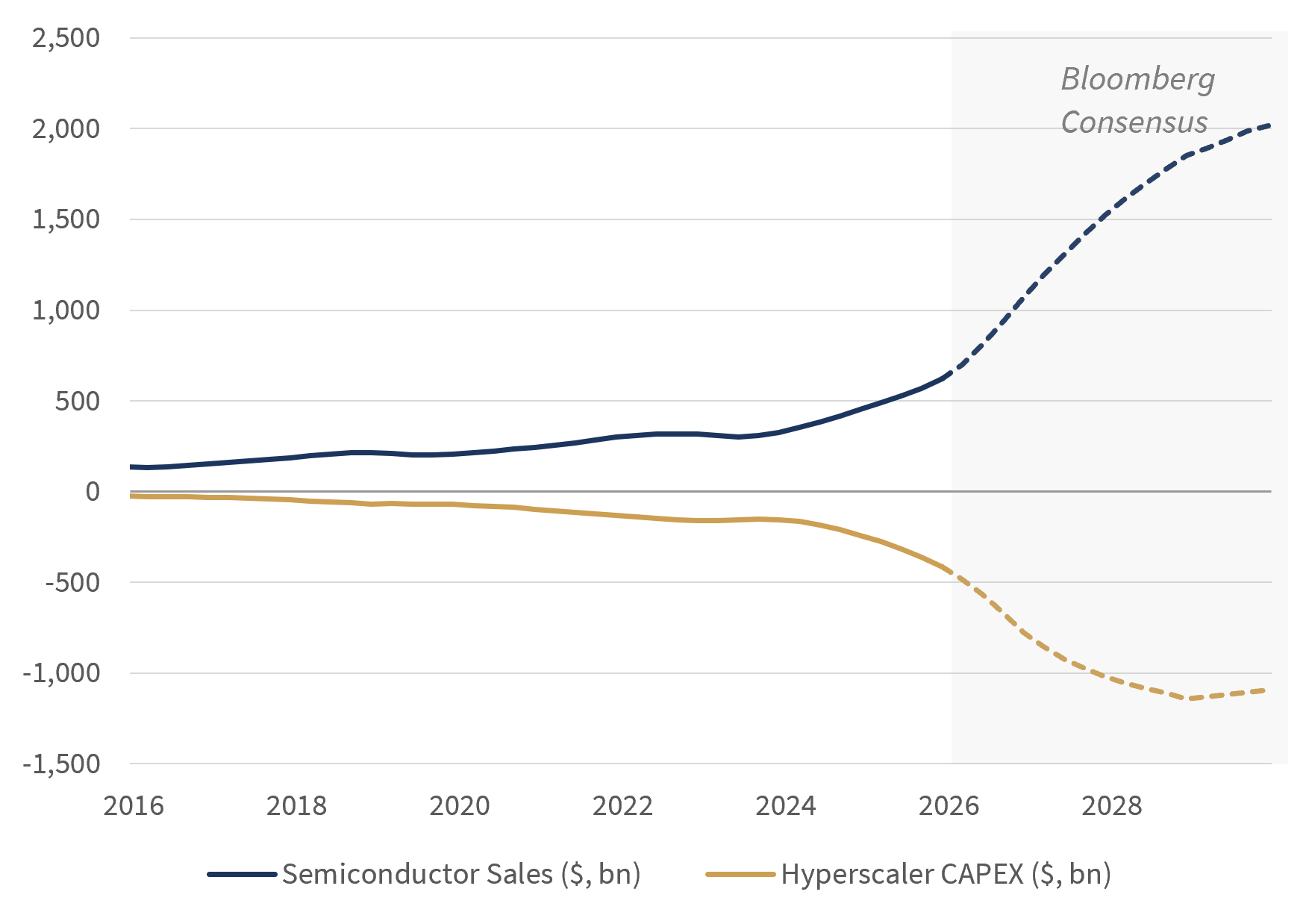
Source: Rothschild & Co, Bloomberg. Note: Hyperscalers: Alphabet, Microsoft, Meta, Amazon, and Oracle; Semiconductors: NVIDIA, Broadcom, Micron, ASML, TSMC, Applied Materials and LAM.
1. Memory prices
One of the biggest bottlenecks over the past year has been the shortage of specialised High Bandwidth Memory (HBM) — a crucial component of AI GPU chipsets, facilitating vast data processing at speed. The cost of commoditised memory — proxied in the chart below by DRAM — has surged nearly tenfold over the past 12 months, in turn boosting the earnings and share prices of the companies that produce it. While flash memory (NAND) prices appear to have levelled-off, HBM supply remains highly specialised, and shortages are unlikely to be resolved imminently. But we should not forget that this is an inherently cyclical industry prone to boom-and-bust cycles: today's exceptional profitability is unlikely to persist indefinitely.
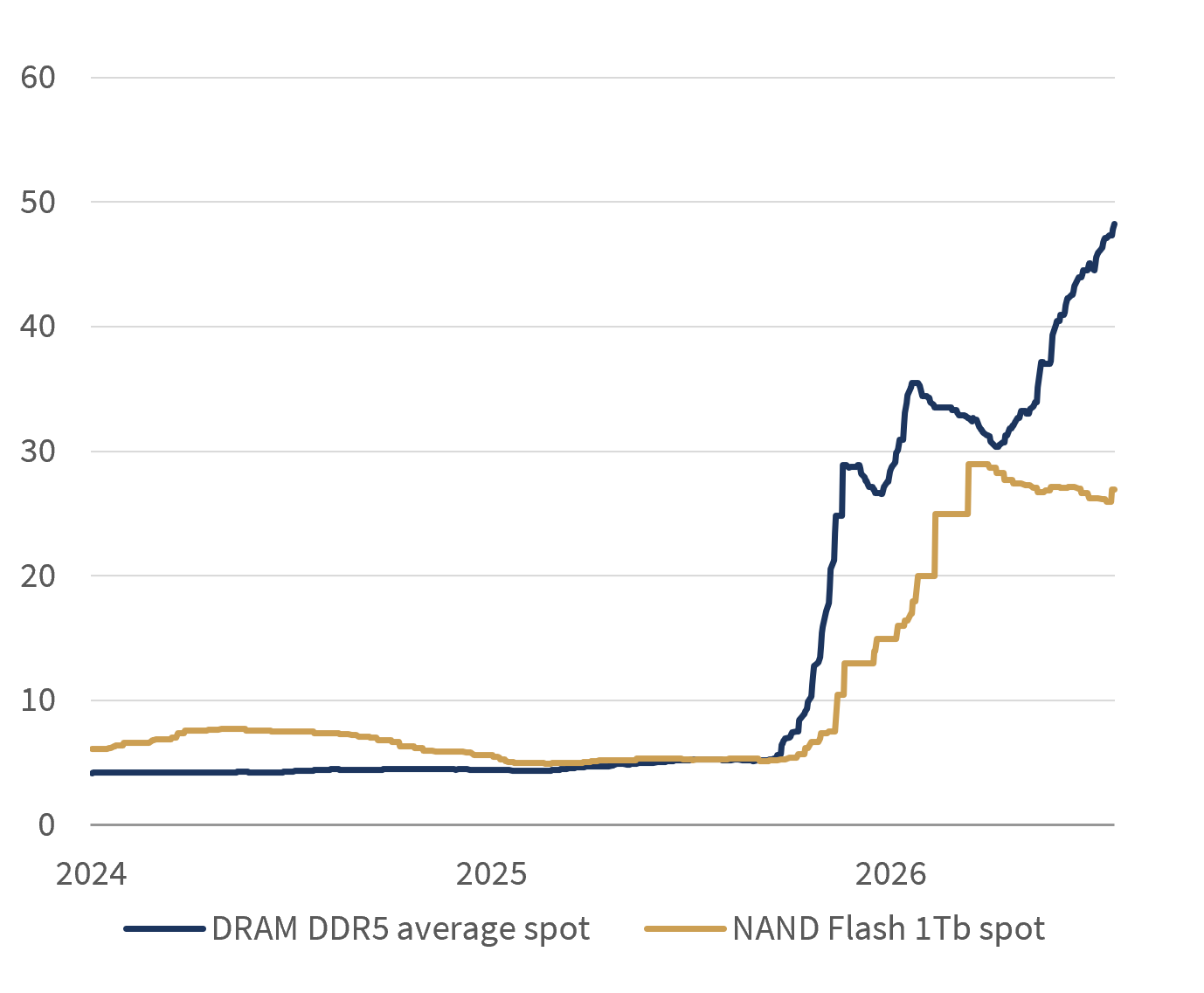
Source: Rothschild & Co, Bloomberg, inSpectrum Tech. Note: DRAM DDR5 reflects a basket of consumer-grade modules, which capture the wholesale cost of memory but are distinct from bespoke, high-performance High Bandwidth Memory (HBM) used in GPUs. In addition, DRAM scaling is hitting physical limits for massive AI models, prompting a move to High Bandwidth Flash, which uses dense NAND flash directly tied to the memory bus.
2. Server demand and token expenditure
Rising server rental rates suggest AI demand continues to significantly outpace the supply of new datacentre compute. However, expenditure on LLM tokens — a standardised unit measuring the cost of processing a query — has been falling more recently. While this might indicate corporate restraint — less token-maxing, more token-managing — it might also mistake efficiency improvements for weaker demand. The cost of tokens has been falling, but overall expenditure has been rising, in a sort of contemporary Jevons paradox. The key point is that today’s datacentres are not yet underutilised assets.
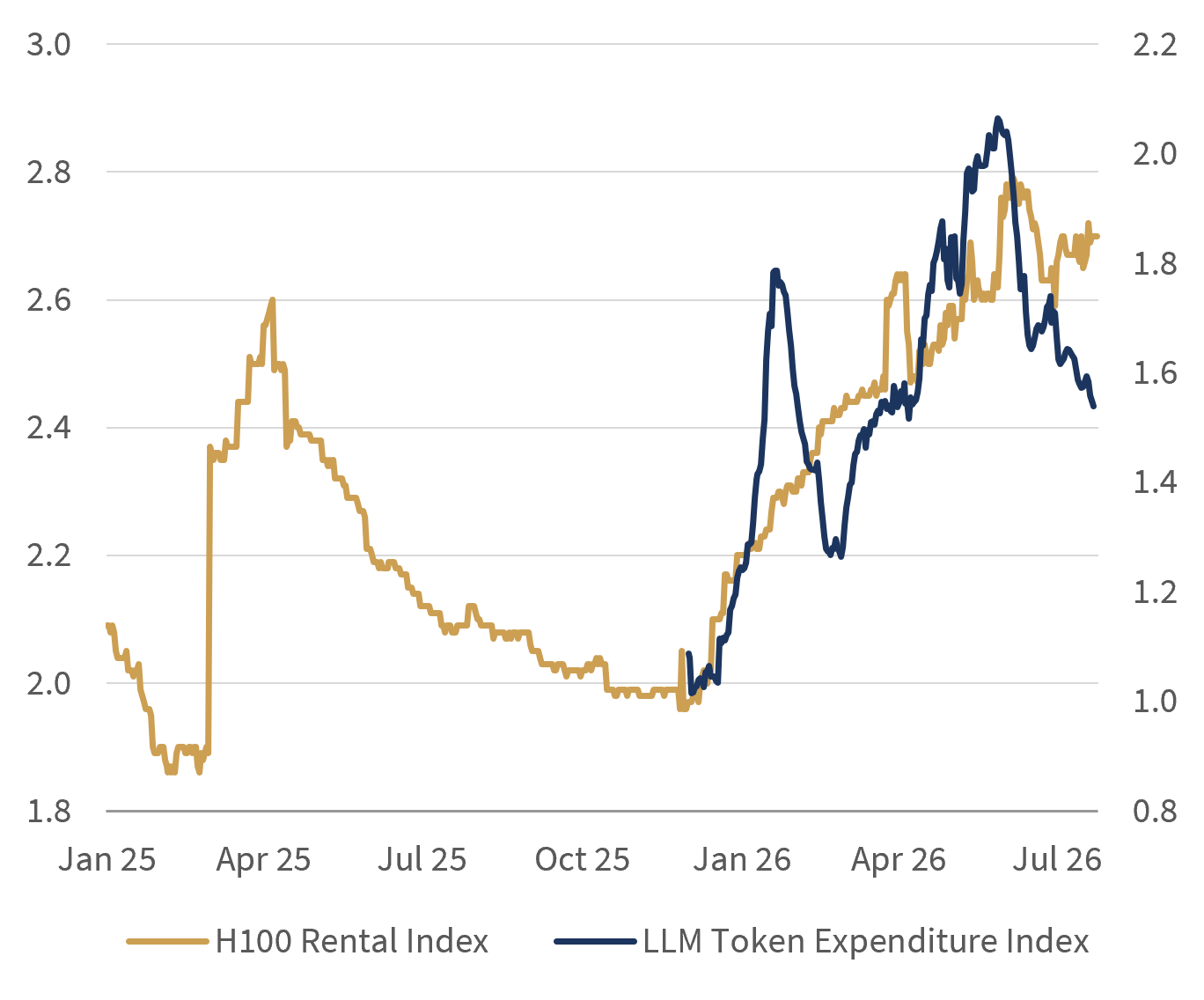
Source: Rothschild & Co, Bloomberg, Silicon Data. Note: H100 rental index is a benchmark tracking the average hourly market cost of renting an NVIDIA H100 graphics processing unit (GPU). The Silicon Data LLM Token Expenditure Index (SDLLMTK tracks the usage-weighted average price paid per million Large Language Model tokens across the market.
3. Adoption rates
Perhaps the biggest determinant of a prolonged investment cycle is the willingness of businesses and consumers to embrace and pay for the products which the new technology will make available. The US Census Bureau’s monthly report on AI adoption points to a positive uptrend, but economy-wide business integration remains subdued at close to a fifth (with a notable step-change occurring in late 2025 when the Census question was amended). But it is not yet clear whether this rising ‘adoption’ reflects genuine AI workflow integration or something more akin to corporate experimentation. Paid usage, based on the technology-biased Ramp index, is considerably higher — perhaps close to a half. However, Ramp’s sample size is considerably smaller (less than a tenth of the Census survey) and much less representative of the wider US business community.
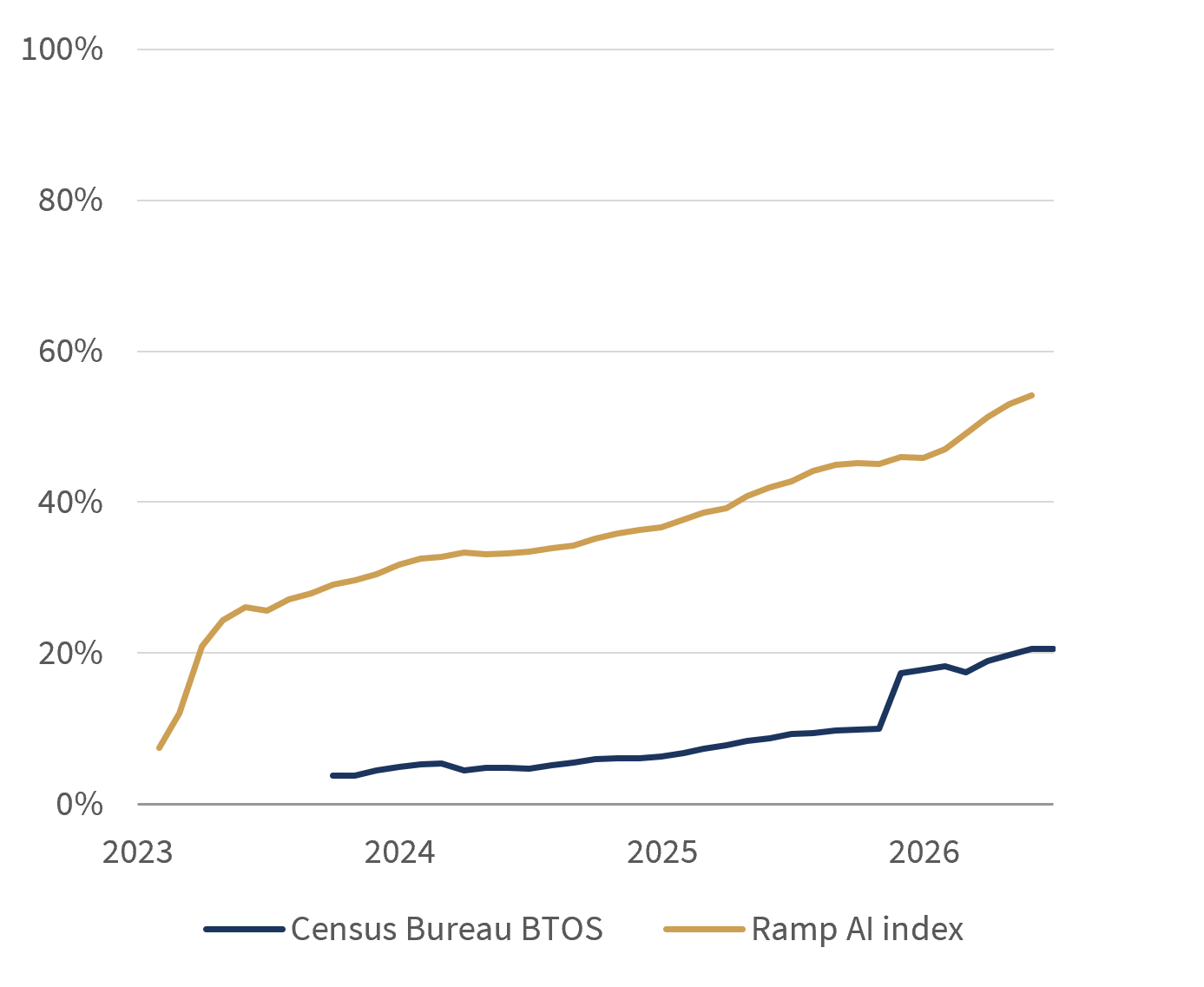
Source: Rothschild & Co, Bloomberg US Census Bureau Business Trends and Outlook Survey, Ramp Intelligence
4. Funding markets
Capital expenditure on AI capacity is growing briskly: the hyperscalers are expected to spend roughly $1tn by the end of next year, a sixfold increase on what they spent in 2023, and one consultancy suggests that wider AI-related spending could be double that. Such spending would likely far outstrip the fibre-related outlays of the late 1990s (even after allowing for inflation). Broad macro data echo this point: US non-residential investment spending is at its highest level in absolute terms and is already approaching the late nineties levels relative to GDP. But 2026 may mark an inflection point: the hyperscalers’ capital spending is set to exceed their revenue, pointing to deteriorating balance sheets: cash rundowns, or more debt — and equity — issuance. For now, new issues are in demand, and hyperscaler credit spreads — which reflect the cost of borrowing over and above US treasuries — remain relatively contained, loosely tracking the wider US investment-grade index. But the market’s willingness to absorb such issuance may be challenged if AI monetisation fails to keep pace.
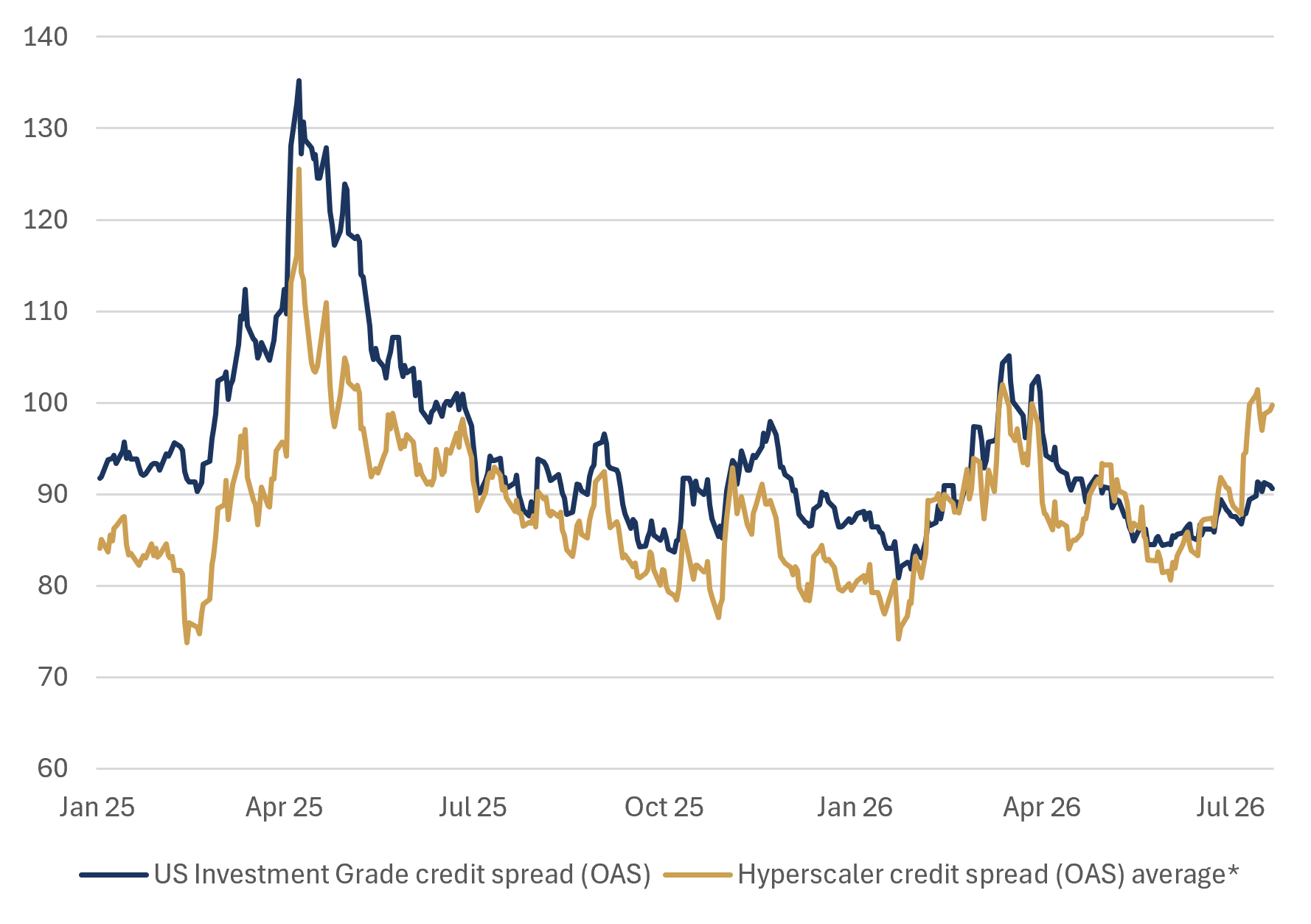
Source: Rothschild & Co, Bloomberg. Note: * Reflects the average option adjusted spread (OAS) of all 7–10-year USD paper issued by Amazon, Meta, Microsoft, and Google (excludes Oracle). The US IG index reflects 7-10 year USD corporate bond spreads.
Bottom line
Ultimately, there is no single measure that fully captures funding constraints, the pace of AI adoption or the shape of the capital-expenditure cycle. Demand for AI-related services appears intact and the investment cycle is not yet exhausted. Nonetheless, we still think the risk of longer-term capital misallocation remains high. Valuation (and earnings) risk may emerge if adoption and monetisation continue to lag capex.
However, while AI investment has become an important pillar of economic growth, it is not the whole economic story: the wider business cycle (notably consumer spending) still seems to have some momentum independent of the AI story and need not unravel if AI investment slows. Risk appetite could still be hit of course: the consequences of a technology-led sell-off can extend well beyond the sector. Recent market moves, however, suggest that a more discerning rotation is possible at least, those Middle East developments notwithstanding. Broader earnings growth remains resilient.
Meanwhile, AI is generating enormous demand for capital, and this may be having an impact beyond the GDP and EPS data. The expected wave of AI-related IPOs over the coming year is likely to reinforce existing market concentration, with credit markets increasingly narrowly active too. The result is likely to be continued upward pressure on interest rates, reinforcing the ‘higher for longer’ environment. Bond markets may have already woken up to this reality: this may be why real yields are grinding higher.
Ready to begin your journey with us?
Speak to a Client Adviser in the UK or Switzerland
Past performance is not a guide to future performance and nothing in this article constitutes advice. Although the information and data herein are obtained from sources believed to be reliable, no representation or warranty, expressed or implied, is or will be made and, save in the case of fraud, no responsibility or liability is or will be accepted by Rothschild & Co Wealth Management UK Limited as to or in relation to the fairness, accuracy or completeness of this document or the information forming the basis of this document or for any reliance placed on this document by any person whatsoever. In particular, no representation or warranty is given as to the achievement or reasonableness of any future projections, targets, estimates or forecasts contained in this document. Furthermore, all opinions and data used in this document are subject to change without prior notice.
Read more Wealth Management UK articles
-

Politics on the beach
Strategy Blog
Populism is reshaping politics across the US and Europe, drawing parties away from the traditional centre. Rather than left versus right, voters increasingly divide along establishment versus anti-establishment lines, creating opportunities for populist movements and challenging conventional political assumptions.
-

Monetary policy - behind the curtain
Strategy Blog
Interest rate expectations have shifted markedly in 2026, with markets now anticipating higher rates amid persistent inflation, economic resilience and more hawkish central banks. Despite this, strong AI-driven earnings have supported equities.
-

Stories from the road
Quarterly Letter
Through deep research and direct engagement with businesses, we seek high-quality companies with strong competitive advantages, disciplined capital allocation and the ability to compound wealth over time.
-

Bringing the right advisers together
Insights
Significant wealth brings complex financial and personal decisions. Rothschild & Co helps coordinate trusted advisers, ensuring aligned, objective guidance, long-term planning and access to specialist expertise through a personalised advisory board.
-

Five stock market talking points in 2026
Strategy Blog
Global equities rose despite geopolitical tensions, as markets looked through near-term risks. AI infrastructure spending drove returns and earnings growth, valuations sent mixed signals, and corporate activity remained subdued but showed signs of recovery.
-

The next UK Prime Minister
Strategy Blog
Following Keir Starmer’s resignation, Andy Burnham has emerged as Labour’s likely successor. Despite political uncertainty, markets remain calm, with economic and geopolitical trends outweighing domestic politics. Significant policy change appears unlikely.