

The new world order of industrial metals
We have all of us realised, when taking a closer look at the various way to invest in Artificial Intelligence, that this could be done through shares in companies developing AI apps, in companies using AI, or even in semiconductors, electricity or rare earths! No matter the point in time or the industry in question, there is usually, behind every technological or economic development, a new or increased need for certain raw materials.
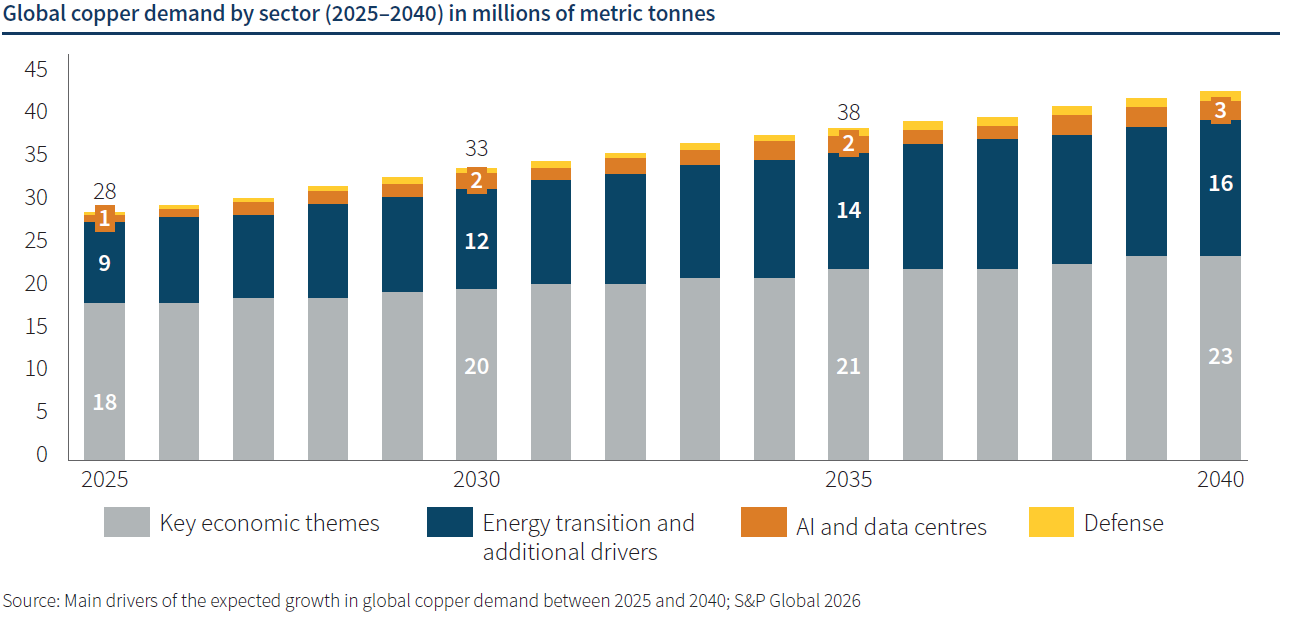
Right now, we are faced with an explosion in demand thanks to the way electricity production systems are changing, the unprecedented development of new technologies, and the historic rise of decarbonisation - all requiring massive quantities of industrial metals. That demand could increase two- or four-fold by 20401 in support of the anticipated energy transition and the requirements of so many sectors of industry: manufacturing, semiconductors and defence, to name but three. Yet supply is struggling to meet demand for a number of reasons: declining reserves, historical underinvestment, rising costs and development lead times due to ESG constraints*, the concentration of global production on a small number of projects, elevated country risk, the heavy concentration of refining in China, and insufficient recycling.
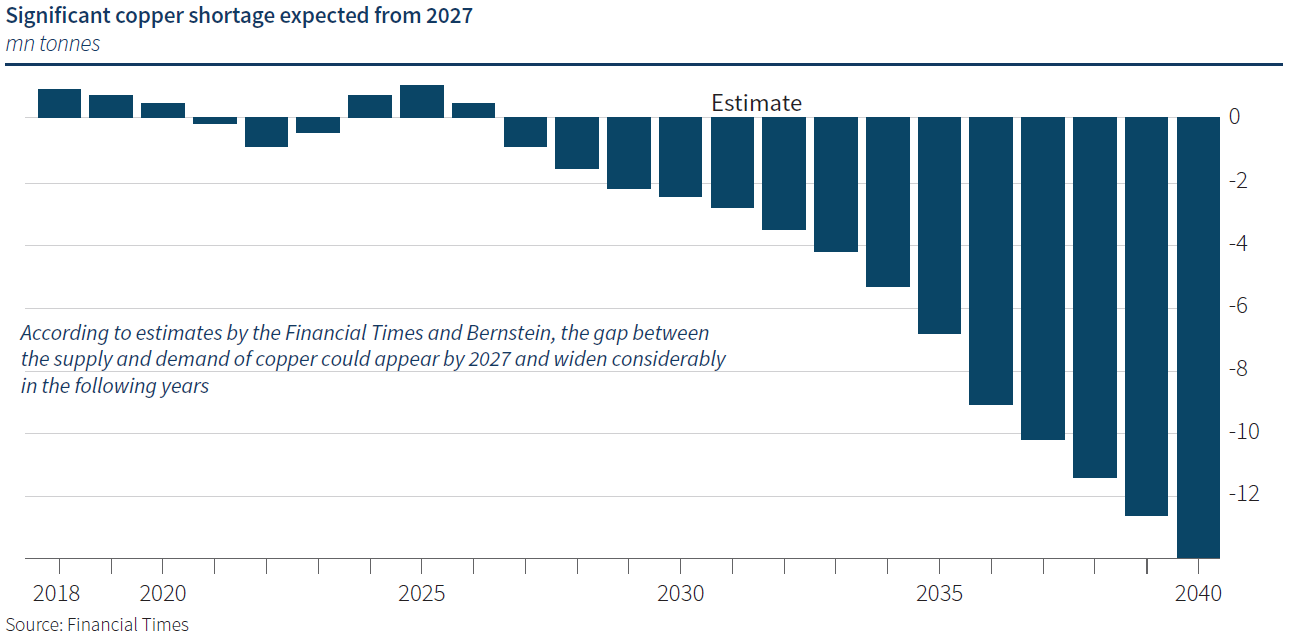
This article will therefore take a look at the investment opportunities that are emerging from the growing interest in this sector, as well as the traditionally cyclical nature of metals and mines. This cyclical nature now seems set to weaken thanks to new structural drivers of demand.
As the ‘red gold’2 rush becomes a reality, we are witnessing regional trends of building up significant strategic reserves, just like the structural and steady rise in imports into China (particularly for refining). Governments and companies alike are becoming more and more conscious of the strategic need to secure their future supplies early on so they can protect the economic and industrial systems depending on those supplies. This can be done through financial investments, tax incentives or, in the private sector, through consolidation within the sector.
A structural rather than cyclical demand
According to the UNEP and the World Bank, metal consumption is growing almost proportionally to global GDP, with metals being used in almost all sectors of the economy, particularly construction, manufacturing and the energy sector. Growth within these sectors therefore relies on increased inputs of material resources.3
Academic literature4 indicates a strong correlation between this consumption of metals and economic growth, with elasticity varying depending on the economic phases of industrialisation, maturity and the shift towards service-based economies. In reality, the shift of our economies towards services is a relatively recent phenomenon: for example, the share of services in US GDP rose from 65% in the 1990s to 72% in 2024, whilst manufacturing activity fell from 16% to 11% over the same period. Similarly, manufacturing in China accounted for 30% of GDP in 2010, compared with around 25% in 2024, whilst services rose from 50% to 58% over the same period5, illustrating the shift in the components of Chinese GDP.
However, with certain metals and minerals set to play a more significant role in the future, this cyclical nature is – at least partially – called into question by the structural trends mentioned above.
"The strategic importance of certain metals has become more apparent to the general public, particularly because of the unprecedented impacts we have experienced"
2025: an illustration of the red gold rush!
In a previous article we discussed the vital importance of metal extraction in supporting the energy transition. Since then, the strategic role of ‘red gold’ has clearly stepped up in the view of many economic actors! As a result, the strategic importance of certain metals has become more apparent to the general public, particularly because of the unprecedented impacts we have experienced: the European energy crisis and the politicisation of raw materials; the need for metals for the energy transition; new requirements for data centres; and geopolitical issues surrounding rare earths held by China, among others.
At the same time, the historic growth in the volumes of copper stocks traded on some exchanges has been particularly pronounced (see the chart below depicting the Comex).
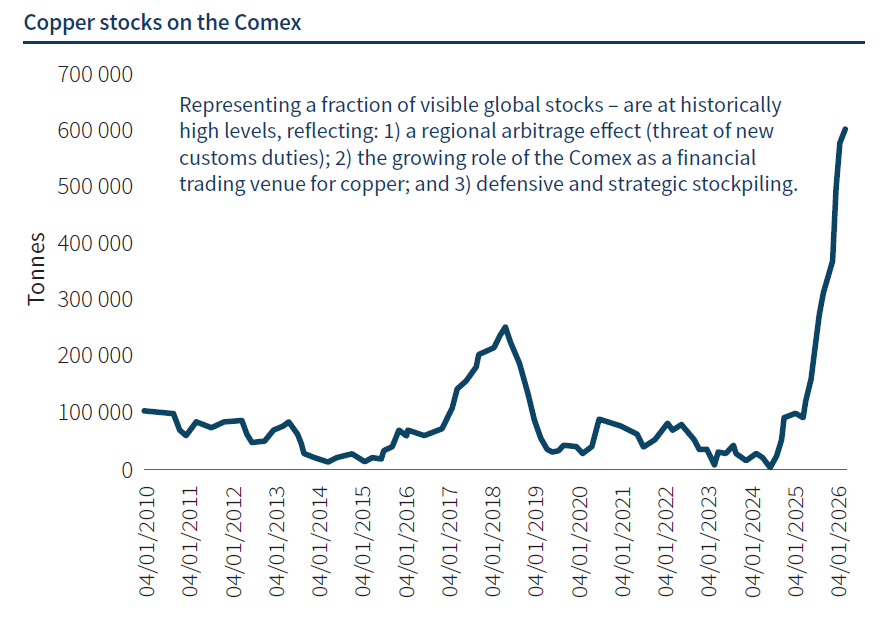 We could also illustrate this structural trend with China’s monthly copper imports6, which reached a record high in 2025, averaging 2,500 kt; compared with an average of 1,800 kt over the previous 10 years, illustrating both the increase in refining capacity in China, the strategy of building-up strategic stocks, and a geopolitical reallocation of global flows to avoid future shortages… all this despite the weakness of construction activity in China!
A fragile and complex value chain
In a fragmented world, with ever-present geopolitical tensions and potential disruptions to global trade, economic actors must define and adopt a strategy to secure their supply of strategic and industrial metals. To this end, we are seeing a growing trend towards the nationalisation of mineral resources. The escalation of Sino-American tensions in 2025 has thus highlighted the strategic importance of rare earths for new technologies.
China’s role is indeed central when it comes to rare earths, with 98% of European imports originating from the Middle Kingdom7. For its part, China has for many years been actively and directly investing in mining assets in Africa and Latin America, as well as in overseas refining capacity… becoming a key global player for certain supplies.
In response, certain economic blocs are mobilising – at their own pace – to best address this structural challenge! Some examples:
1/ The United States and its equity investments over the last six months in various mining companies (USA Rare Earth – rare earths; MP Materials – rare earths; and Trilogy Metals – critical industrial metals).
2/ Europe, which remains highly dependent, started organising itself in 2024 with the Critical Raw Materials Act: legislation targeting potential vulnerabilities; and spring 2025 saw the publication of a list of 60 strategic projects with accelerated permitting, to strengthen the European strategic value chain, alongside partnership agreements on certain critical mineral projects, with Australia and Canada in particular.
However, companies are also taking action to consolidate the sector in certain raw materials, a trend that is particularly evident in the copper and lithium sectors, with the acquisition of firms developing or owning existing projects involving strategic or industrial metals. This is often a quicker and less risky option than developing a new mine from scratch, a process that takes many years and is becoming increasingly time-consuming (with rising lead times and complexity, regulatory risks surrounding permits, and rising development costs).
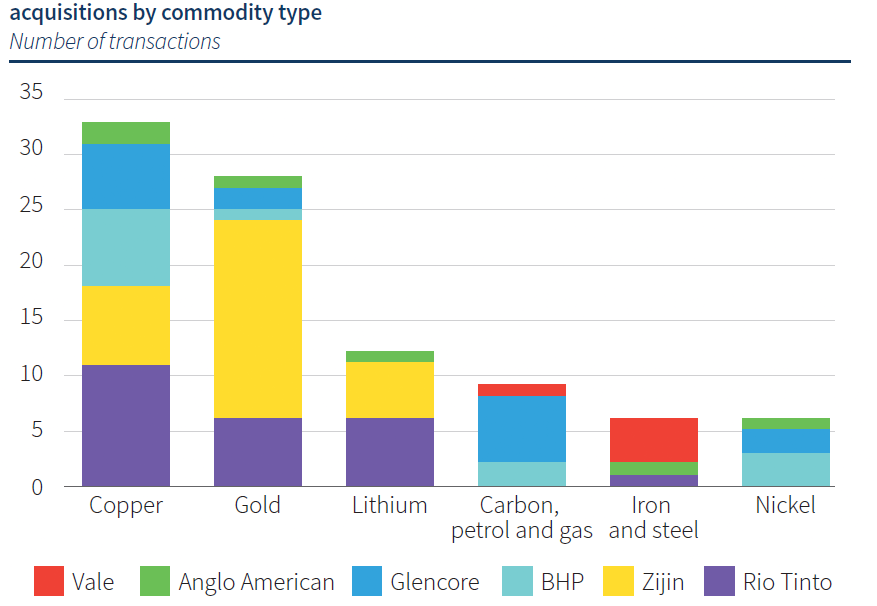
source: BNEF
Limited interest from investors
Curiously, many investors report having little or no investment in commodities in general – not just strategic and industrial metals. The highest level of investment was reportedly reached in April 2022, with 34% of investors stating they were ‘overweight’ in this segment…8
And yet this positioning is concentrated mainly in energy and gold, not necessarily in strategic and industrial metals: the weighting of metals and mining remains virtually non-existent in the major global indices: it stands at around 0.5% in the Stoxx 600 or the S&P 500 (compared with over 2% 30 years ago in the S&P 500). The total assets of trackers invested in metals and mining represent less than 1% of global financial assets9, with the segment proving to be a real blind spot in traditional portfolio allocations.
Whereas gold remains a recognised strategic asset - held by central banks, featured in many allocations and historically serving as a ‘safe haven' - copper and industrial metals have not yet found their place. Physical holdings are very low (due to logistical constraints, volatility and their industrial nature), so exposure mainly occurs through mining equities, ‘commodity’ indices or futures contracts.
The historical perception of copper’s (anti)cyclical nature – hence the nickname ‘Dr Copper’ – remains entrenched and is slowing the evolution of its status (and that of other metals) as a standalone strategic asset. This reluctance creates a disconnect with these new structural realities, which could nevertheless present long-term opportunities to invest in these major imbalances between supply and demand.
"We believe that this segment offers genuine diversification, can act as a hedge against inflation and geopolitical tensions..."
The historical perception of copper’s (anti)cyclical nature – hence the nickname ‘Dr Copper’ – remains entrenched and is slowing the evolution of its status (and that of other metals) as a standalone strategic asset. This reluctance creates a disconnect with these new structural realities, which could nevertheless present long-term opportunities to invest in these major imbalances between supply and demand.
For our part, within the portfolios we manage, we generally include exposure to strategic and industrial metals to complement our exposure to gold mining companies.
Beyond what has been outlined above, we believe that this segment offers genuine diversification, can act as a hedge against inflation and geopolitical tensions, and benefits from supply-constrained imbalances, in addition to its structural and strategic appeal driven by the energy transition, the rise of AI and the growth of data centres.
1 - IEA – Global Critical Minerals Outlook 2025
2 - Copper
3 - Global Material Resources Outlook to 2060 - OECD
4 - Dallas Fed “Industrialization and the demand for mineral Commodities “; High sensitivity of metal footprint to national GDP in part explained by capital formation Nature Geoscience
5 - World Bank, BEA, National Bureau of Statistics of China
6 - Thousands of tonnes of copper ore & concentrate
7 - Les Cahiers Verts [by Grasset]
8 - Bofa Fund Manager Survey, March 2026
9 - Investornews/Mineralfunds
Contact us
The Rothschild Martin Maurel teams are at your disposal to provide you with the best possible advice on these subjects.
Related content
-
Chips: Moore spending
Strategy Blog
Despite renewed Middle East tensions and oil price spikes, a bigger market question is whether AI investment momentum can justify soaring capital expenditure. Demand remains strong, but investors are increasingly focused on adoption, monetisation and funding sustainability, raising concerns over future earnings, valuations and capital discipline.
-

Rothschild & Co receives five major awards at Euromoney's Awards for Excellence 2026
Awards
Global Advisory has been recognised with five prestigious awards at this year’s Euromoney's Awards for Excellence.
-

Politics on the beach
Strategy Blog
Populism is reshaping politics across the US and Europe, drawing parties away from the traditional centre. Rather than left versus right, voters increasingly divide along establishment versus anti-establishment lines, creating opportunities for populist movements and challenging conventional political assumptions.
-

Rothschild & Co’s UK Wealth Management business continues to strengthen its regional presence with appointment of Samantha Beach in Manchester
Press releases
Rothschild & Co’s UK Wealth Management business continues to strengthen its regional presence with appointment of Samantha Beach in Manchester.
-
Growth Equity Update
Insights
The 52nd Growth Equity Update from Patrick Wellington, Vice-Chairman of Equity Advisory.
-

Monetary policy - behind the curtain
Strategy Blog
Interest rate expectations have shifted markedly in 2026, with markets now anticipating higher rates amid persistent inflation, economic resilience and more hawkish central banks. Despite this, strong AI-driven earnings have supported equities.
