Growth Equity Update July 2026 - Edition 52

July 2026 – Edition 52
- A new 2026 ‘transparent, fully data-driven ranking of which VC firms are actually best at what they do’ ranks the top 100 US-based VC firms, based on 230,000 investments by nearly 13,000 venture capitalists over a 30-year window. It finds that 5% of venture capitalists have generated c90% of the industry’s profits. The top two firms in the ranking, by some distance, are Sequoia and Andreessen Horowitz followed by Accel, DST Global and Tiger Global.
-
Venture Power law: VC firms as well as investments. The Strebulaev-Jackson Venture Ranking finds that, just as the bulk of returns in a venture portfolio are made by a small fraction of ‘fund returner’ investments, so amongst venture capitalists a small fraction of the firms produces the majority of the returns.
- Back to the Mansion House Accords: In early July Nest announced it will expand its investment in high-growth private companies through the creation of a dedicated venture capital sleeve, managed by Schroders Capital. It is planning to allocate an initial £200m, growing to £1bn by 2030. Nest is one of the 17 signatories to the Mansion House Accords who have pledged to invest 10% of their DC default funds in private assets that boost the UK economy.
- Burnham Would - Growth in every postcode: : Andy Burnham, MP for Makerfield ‘We will consolidate public and private investment at a place-based level and help all areas establish Good Growth Funds, as we have done here in Greater Manchester…I will back our scientists, technologists, entrepreneurs and creatives and show how Britain will be the Innovation Nation of the next decade.’
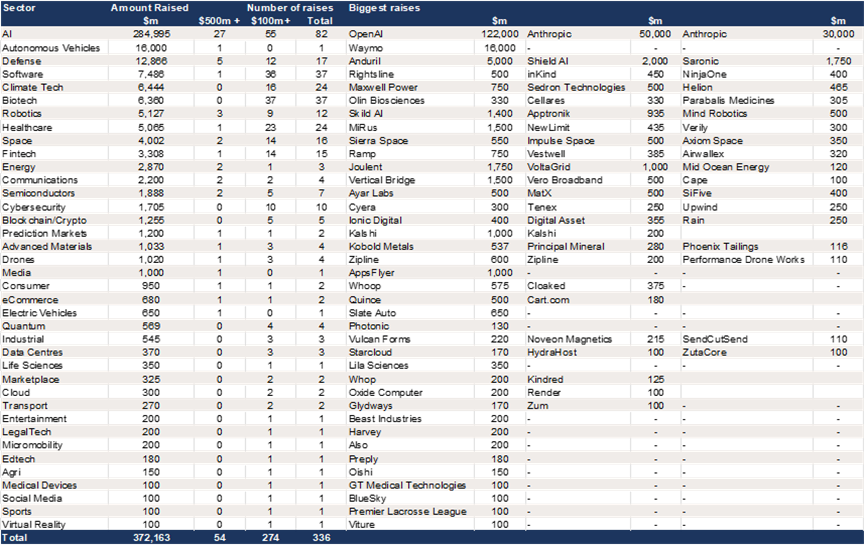
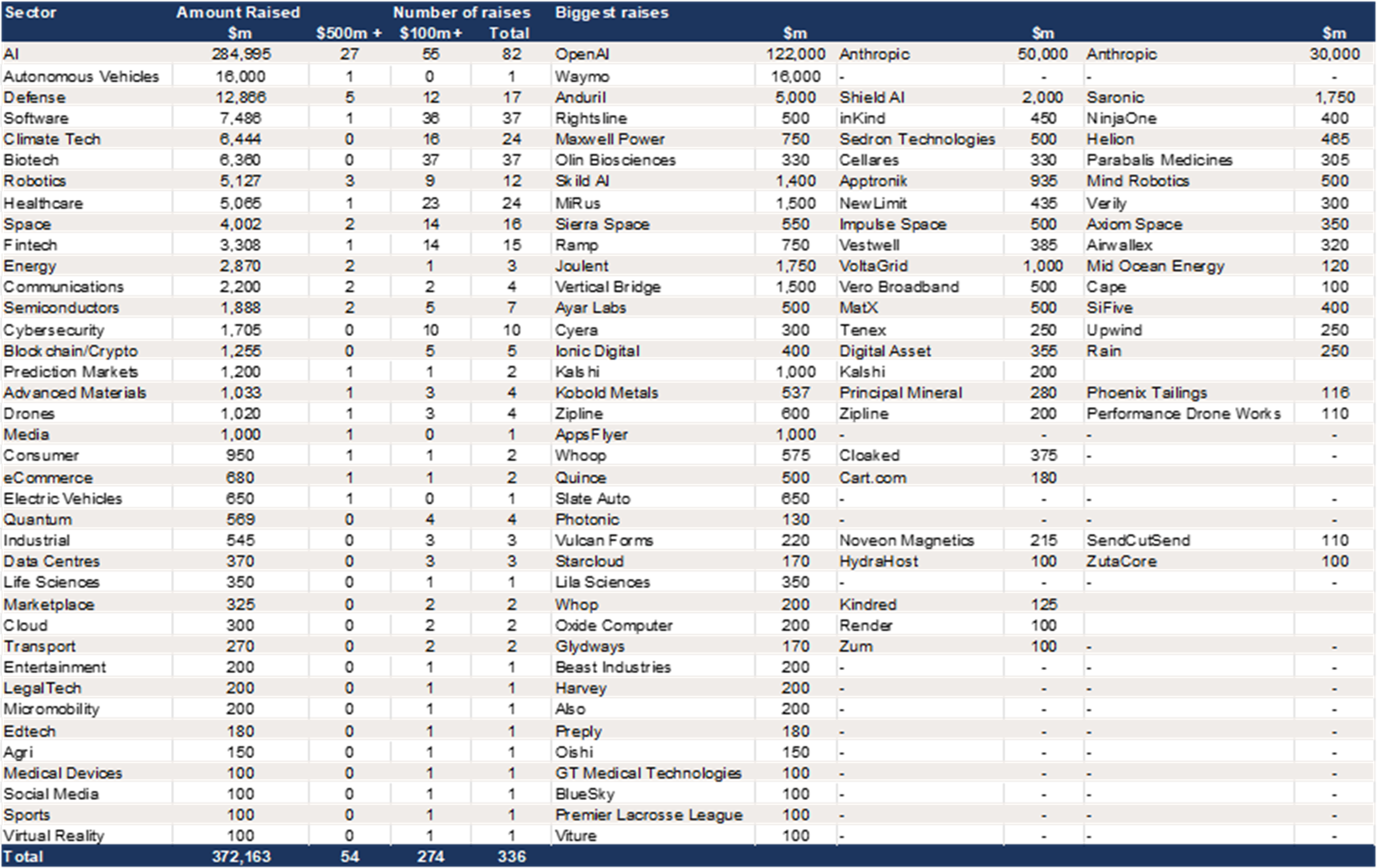
- Record breaking US H1 venture fundraising: A remarkable $372bn was raised across 336 deals in H1 2026, albeit two thirds of the total was raised by just four companies - OpenAI, Anthropic, xAI and Prometheus.
- Europe – Surging and more broadly based H1 fundraising: Europe saw very strong H1 2026 growth in fundraising with $39.3bn raised across 330 deals of $20m+, 80% higher than in H1 2025, 2.2x H1 2024 and 3x H1 2023. In a more diverse fundraising environment AI was 22% of the H1 2026 European total versus 77% of the US H1 total.
- Defense, Robotics and Space have the fundraising momentum on both sides of the Atlantic.
Download a PDF version of the 52nd Growth Equity Update
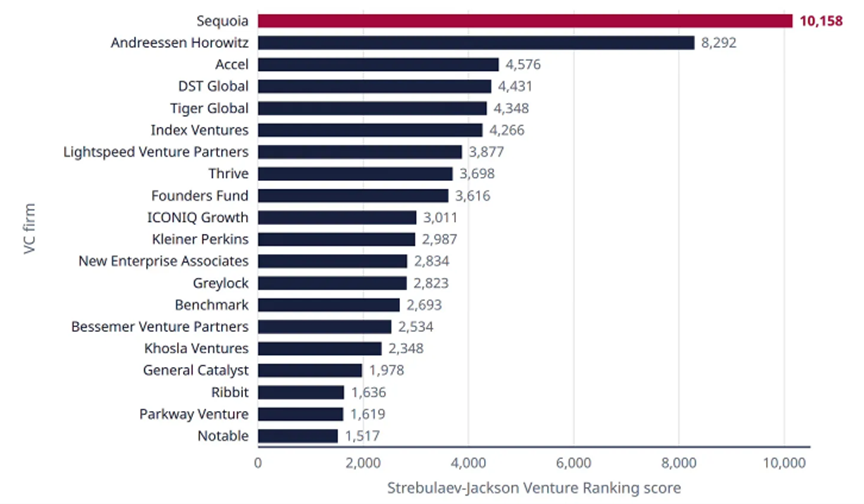
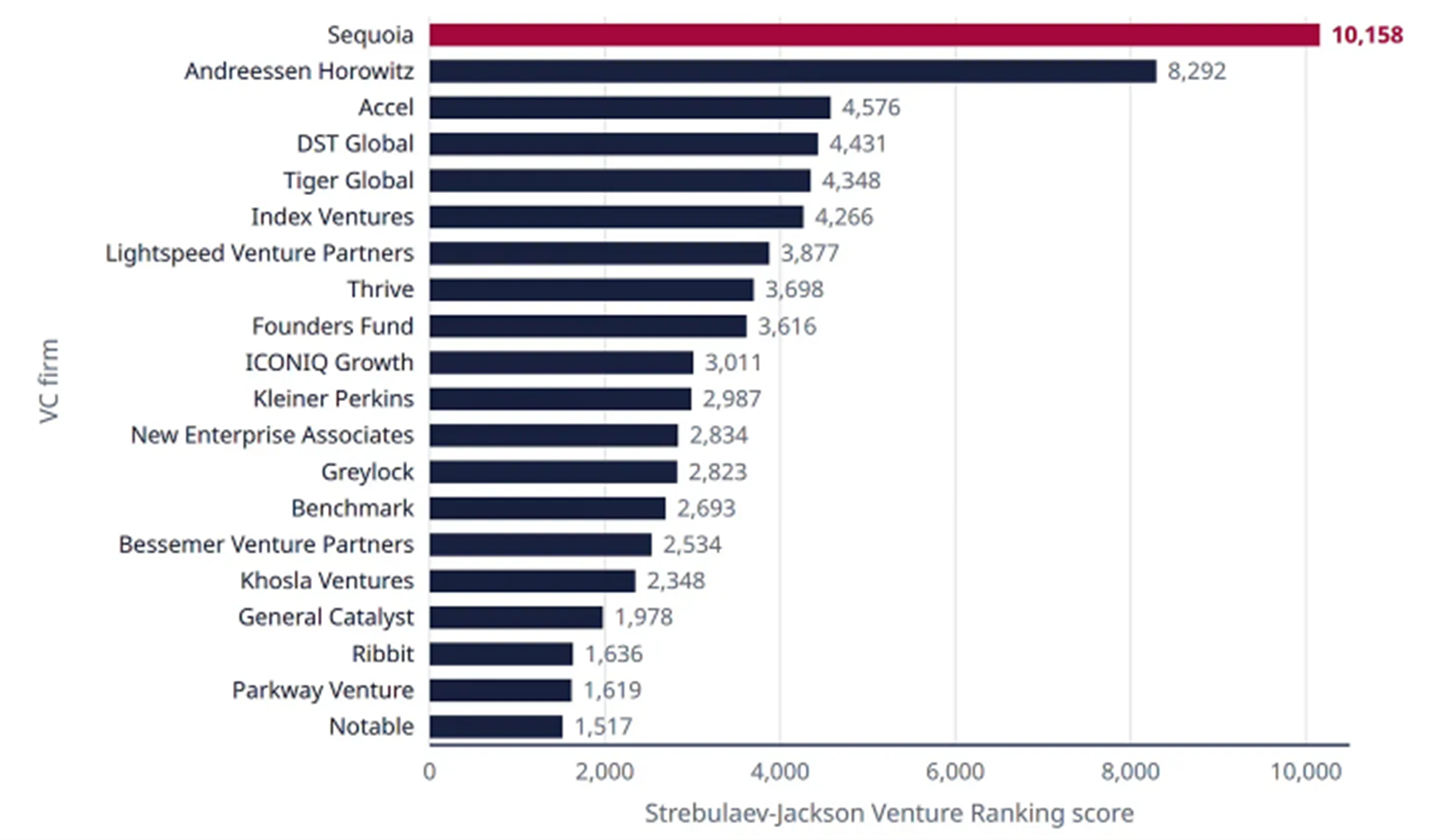
And the top VC firm is…About 5% of venture capitalists have generated roughly 90% of the industry’s profits.A fascinating study ranking venture investors was published in mid-June by Stanford University’s Ilya A. Strebulaev and Ohio University’s Blake Jackson. Their paper can be found here: https://docsend.com/view/gjgpksyptqi855he New ranking of US VC firms: The authors have developed a 2026 Venture Ranking of the top 100 US-based VC firms, drawn from more than 230,000 investments by nearly 13,000 venture capitalists over a 30-year window. Described as a ‘transparent, fully data-driven ranking of which VC firms are actually best at what they do its rankings differ sharply from the commonly cited Forbes Midas List. Its methodology, as well as its rankings, are illuminating.Identifying the 5%: The impulse to produce the ranking is the finding that 5% of venture capitalists have generated c90% of the industry’s profits. Identifying the right 5% of VCs is thus critical for founders choosing their investors and LPs allocating their capital. Key criteria: The Strebulaev-Jackson Venture Ranking uses six key criteria in building its algorithm. Valuation. The principle here is that private post-money valuations systematically overstate true value relative to public valuations, because the preferred stock VCs buy carries downside protections that common stock lacks. The algorithm discounts private valuations uniformly with the average overstatement for unicorns put at near 50%. Dilution. Early investors are diluted round after round. The algorithm tracks each investment’s ownership through every subsequent round. Net profit. Net profit is used rather than gross profit. As the authors say, ‘Turning $10 million into $2bn is a different achievement from turning $1bn into the same $2bn.’ The process subtracts the cost of every investment, rewarding capital efficiency and penalising ‘spraying large checks to produce a few headline wins.’ In the data, roughly three-quarters of investments returned negative net profits. Value added. ‘Investors who lead rounds and take board seats contribute more than passive check-writers. We award additional points for these roles, reflecting involvement in a company’s outcome.’ Keeping it current - Human-capital decay: An interesting idea here. The authors posit that a VC’s skill, network, and judgment depreciate if not continuously exercised. ‘Two investors who each turned a 20% stake into a $10 billion IPO can look identical on paper — yet if one invested in 2005 and the other in 2020, the second earned an IRR of 141.9% against 28.7%, and rests on human capital six years old rather than twenty-one.’ In the algorithm this is expressed by discounting each investment by the time elapsed since it was made, using a half-life of three years. The idea is to keep the ranking current, rewarding investors who are good now, rather than those who made a single great bet two decades ago. Credit between firm and individual. Reflecting academic evidence that most return variation traces to individuals rather than institutions, and to reflect current reality, when investors move between firms the credit for deals is split - 25% to the firm where the investment was made, 75% to the firm where the partner presently resides. Sequoia heads the rankings: The points base ranking produced by these criteria produces the top 20 in the Exhibit. The top two firms, Sequoia and Andreessen Horowitz, stand out on the ranking by some distance with Sequoia having 2.2x the score of the third ranked firm and Andreessen 1.8x. The top five is filled out by Accel, DST Global and Tiger Global with Index Ventures a close sixth.
Top 20 firms by the Strebulaev-Jackson Venture Ranking score |
Source: Strebulaev-Jackson 2026 Venture Ranking
Source: Strebulaev-Jackson 2026 Venture Ranking
|
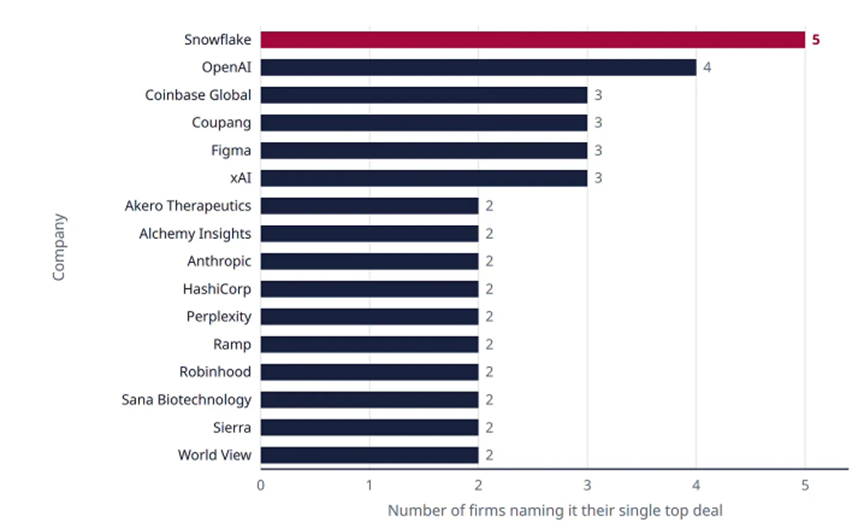
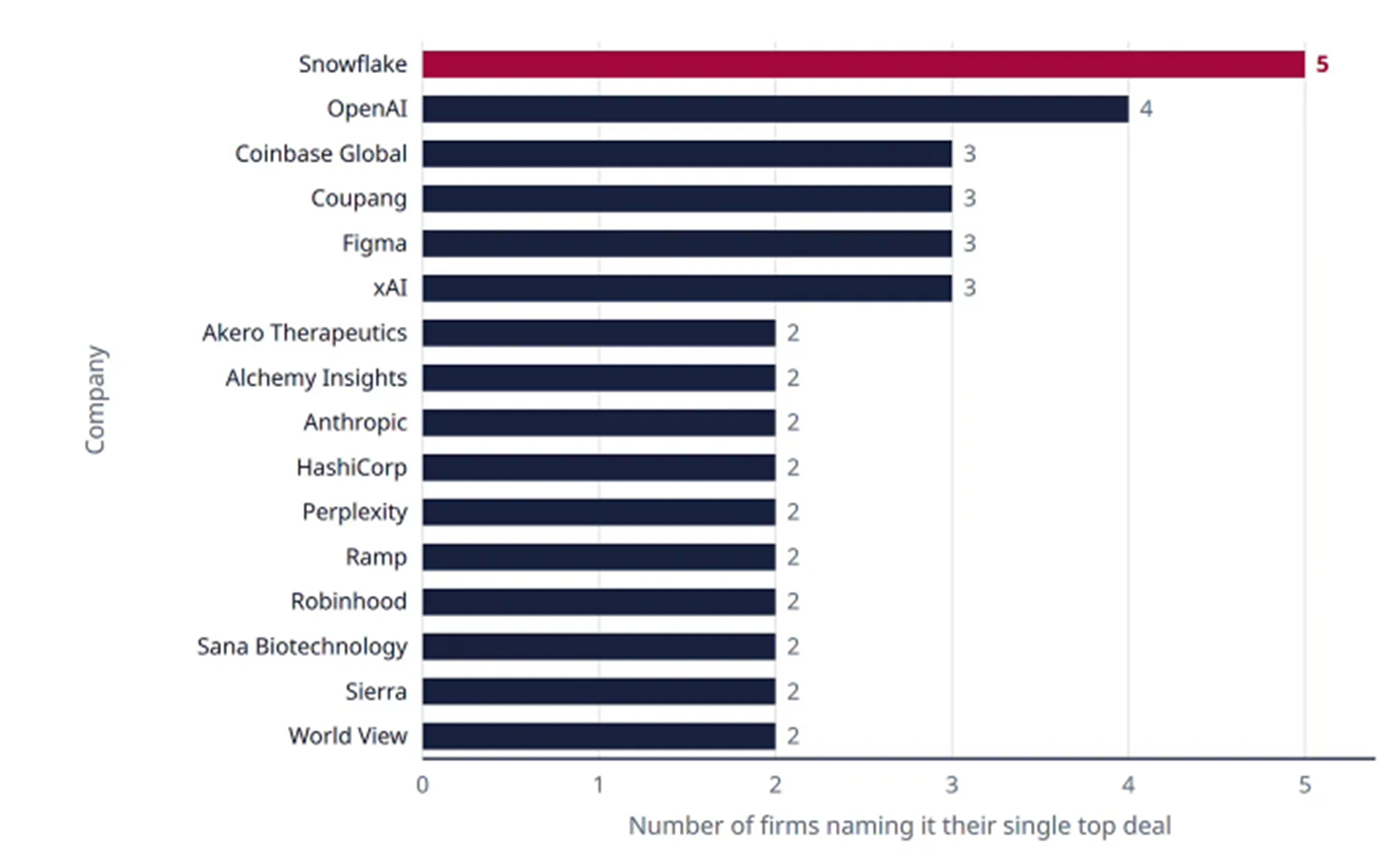
Venture Power law - VC firms as well as investments: The scale of the drop off in scoring is dramatic. The tenth ranked firm’s score is 30% of that of the leader. The 100th ranked firm has a score that is 2.4% that of the leader. The argument is that, just as the bulk of returns in a venture portfolio are made by a small fraction of ‘fund returner’ investments, so amongst venture capitalists a small fraction of the firms produces the majority of the returns. Crossover of successful firms and investments: It follows that the most successful investments are common features of the most successful firms. Across the top 100 ranked VC firms there are just 74 ‘top deal’ companies – the top deal is the same in multiple cases. The authors observe that Snowflake is the top deal for five different firms; OpenAI for four; Figma, Coinbase, Coupang, and xAI for three each. Top deals shared by two or more firms |
Source: Strebulaev-Jackson 2026 Venture Ranking
Source: Strebulaev-Jackson 2026 Venture Ranking
|
Durability of franchises: Eight of the top 20 firms predate 2000, suggesting that a successful venture franchise can be very durable. Sequoia which leads the table was founded in 1972. Accel (1983) is in third, Kleiner Perkins (1972) is in eleventh position, and NEA (1977) is twelfth. By contrast, 21 of the 100 firms were founded in 2015 or after. Several have climbed high in the rankings based on a single recent rapidly appreciating investment. Parkway Venture Capital (2019) is at 19th on the back of Figure AI while Bedrock (2018) at 33rd owes its position to an early OpenAI position. The role of AI: Which brings us to the phenomenon of AI. The single highest-scoring investment for 23 of the 100 firms is a frontier-AI or AI-infrastructure company such as OpenAI, Anthropic, xAI, Databricks, Scale AI, Mistral, Perplexity or CoreWeave. A number of firms associated with investments in key AI businesses, Thrive in OpenAI, Menlo in Anthropic, Lightspeed in Mistral, have pushed their way to the upper part of the list. Room for specialist firms: Sector specific firms rather than broad-based firms are well represented on the Top 100 list. Thus, there is a cluster of life sciences/biotech firms - OrbiMed (27), Atlas Venture (38), ARCH (49), Versant (61), and Sofinnova (75) and a set of crypto/blockchain specialists, Paradigm (34), Pantera (76), Multicoin (84), Polychain (94). There are also crossover funds Tiger Global (5), DST Global (4), Coatue (29), Altimeter (24), Dragoneer (23), Greenoaks (44) as well as more heavily involved funds like Sequoia. Rankings will change: The light from Alpha Centuri takes 4.3 years to reach Earth. The Strebulaev-Jackson 2026 Venture Ranking is based on data from 2023. A lot has happened to the valuations of the likes of OpenAI, Anthropic, Space X and others since then and the importance to a firm’s rankings of having taken part in such deals and the desirability of firms based on their access to such deals will surely be reflected in future rankings. The authors promise further releases of data and to extend the survey beyond US firms. Keep an eye on https://ilyastrebulaev.substack.com/p/the-2026-venture-ranking-the-top-1f6
Nest and venture capitalNest investing in growth equity.
The signatories to the Mansion House Accord manage around 90% of active savers defined pension contributions. They are Aegon, Aon, Aviva, Legal & General, LifeSight, M&G, Mercer, NatWest Cushon, Nest, NOW: Pensions, the People’s Pension, Phoenix Group, Royal London, Smart Pension, SEI, TPT Retirement Solutions and the Universities Superannuation Scheme (USS). The signatories to the Accord have stated that £252bn of assets are subject to the pledge. Based on historical growth rates (17% pa) and reflecting further consolidation in the pensions market, this could rise to around £740bn by 2030. Amongst the signatories Nest (National Employment Savings Trust), the UK’s largest workplace scheme with c£68bn of AUM, c14m members and c£700m of monthly contributions, has an unusually high private market exposure of c17%. Of this c8% is invested in infrastructure and private equity, c6% in UK property and 3% cent in private credit, including loans to small companies. It targets taking this exposure up to 30% over the next five years. In early July Nest announced it will expand its investment in high-growth private companies through the creation of a dedicated venture capital sleeve, managed by Schroders Capital. It is planning to allocate an initial £200m. Nest has been investing in growth stage companies since 2022 and will now ‘formalise and scale this approach, unlocking access to key companies invested in by Schroders Capital.’ The exposure will incorporate existing venture investments and providing fresh capital for new late-stage VC opportunities. The VC portfolio at Schroders Capital to which Nest is now committed includes investments in the autonomous driving business, Wayve and Synthesia, the AI video creation business. We’re really keen on trying to capture .... high-growth opportunities. [We] felt that we could move earlier in the private equity cycle [by investing in] middle- and late-stage ventures." Feedback from Nest’s members, collected through a recent “member assembly” exercise, found Nest savers were keen to see the fund invest in growing UK startups to tap into investment returns, create jobs, and contribute to economic growth. Fawcett added that Nest would seek to “build a more meaningful allocation to late-stage venture capital” over the next few years, with an emphasis on UK-based companies.
Burnham WouldAndy Burnham looking for ‘growth in all postcodes’ with his advisors suggesting tax reliefs to boost incentives for more cash to flow into British companies.The UK looks to be on track to have a new Prime Minister by the end of July with Andy Burnham, the former Mayor of Greater Manchester and now the MP for Makerfield, looking ready to step into the role. Burnham and growth: In his first policy speech Mr Burnham stressed the need for ‘Good growth in every British postcode.’ In his Manchester speech in late June he stressed:
Andy Haldane, the president of the British Chambers of Commerce and one of Andy Burnham’s economic advisers, gave a recent interview in which he
Record breaking US H1 fundraisingA remarkable $372bn raised in the US in H1 across 336 venture deals with two thirds of the total raised by just four companies - OpenAI, Anthropic, xAI and PrometheusIt has been an astonishing first half of 2026 in the US for growth equity fundraising with $372bn raised across 336 deals of $100m or more. The amount raised is more than 3x the H1 2025 total of $119bn and more than 8x the $46bn total for H1 2024. Indeed, the top two deals of H1 2026 (OpenAI $122bn and Anthropic $50bn) each raised more than the entire total of H1 2024. The next Exhibit breaks down fundraising by sector. With substantial, multiple deals from the LLMs, OpenAI, Anthropic, xAI and Prometheus it is no surprise that AI dominated fundraising. The $285bn raised for AI in H1 across 82 deals was 77% of total fundraising by value. OpenAI, Anthropic, xAI and Prometheus raised $240bn between them in H1, two thirds of the funding total between four companies. All the other AI businesses raised $45bn between them, 12% of the total. The standout mover year on year in terms of sector is Defense which climbs to third position (sixth in FY2025) with almost $13bn raised (3.5% of the total) with substantial deals from Anduril, ShieldAI and Saronic. The sector is riding the wave of AI induced new technologies in drone and battlefield command and control systems, heightened political tension and a shift towards defense spending by countries that had previously thought themselves under a larger shield of US defense assurance. There were two other key upwards movers relative to FY 2025. Robotics moved from 12th position in 2025 to seventh position in H1 2026 with the $5.1bn total easily exceeding the 2025 full year total of $3.8bn. Robotics is a key beneficiary of AI techniques. The largest raise was the $1.4bn Series C for SkildAI led by Softbank and NVentures. Skild is developing an ‘omni bodied’ brain to operate any robot for any task. Humanoid robots are able to learn rapidly from imitating human actions. Apptronik raised $935m for its Apollo humanoid robots in a Series A in February backed by Google and Mercedes Benz. Mind Robotics was founded by the CEO of Rivian and uses data from Rivian’s factory to train its humanoid industrial robots for use in manufacturing environments. Space was in 16th position in 2025 with $1.6bn raised. The first half of 2026 has seen it move to 9th position with $4bn raised. This period has obviously seen huge interest (and putative valuation) in the potential for space exploitation, as typified by the ambitions of SpaceX. This is typified by the $500m raise for Impulse Space, a business founded by one of the first employees at Space X and whose mission is to deploy ultra mobile and low cost spacecraft to, in founder Tom Mueller’s words ‘make moving around in space much more affordable, much more reliable, much more accessible.’ In June Axiom Space raised $525m to advance the development of its commercial space station to succeed the International Space Station. There is also a strong cross over with defence applications. Sierra Space initially focused on civil space infrastructure, notably its Dream Chaser reusable vehicle anchored on a NASA contract to deliver cargo the International Space Station. Subsequently it has shifted focus to defense contracts including missile tracking systems for the Pentagon. The company raised a $550m Series C at an $8bn valuation in March supported by LuminArx Capital Management. Software: Despite fears of a SaaS Apocalypse which have caused business models and valuations in software to be closely scrutinised, the sector was in fourth position in terms of fundraising in H1 (second in FY 2025) with the $7.5bn raised equivalent to 2% of total H1 venture proceeds. The largest raise was $500m for the rights and royalties SaaS platform, Rightsline, which allows IP providers to use its tools to manage and monetise content. The restaurant software and fintech commerce enablement platform, inKind, raised $450m in February. A more typical software business, NinjaOne, a cloud-based IT management platform for managed service providers and internal IT departments raised $400m at a $12.3bn valuation in June. Climate Tech held steady at fifth position. Biotech slipped to sixth from third in 2025, although $6.4bn raised is a very healthy total and Healthcare continued to see robust fundraising trends. |
Source: Rothschild & Co
Source: Rothschild & Co
|
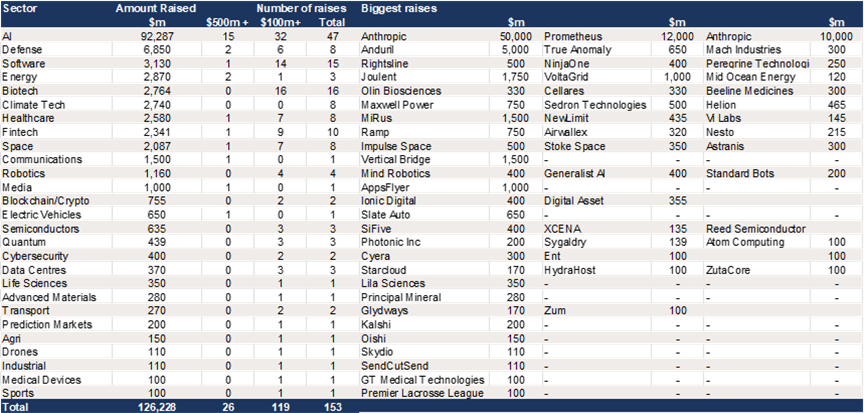
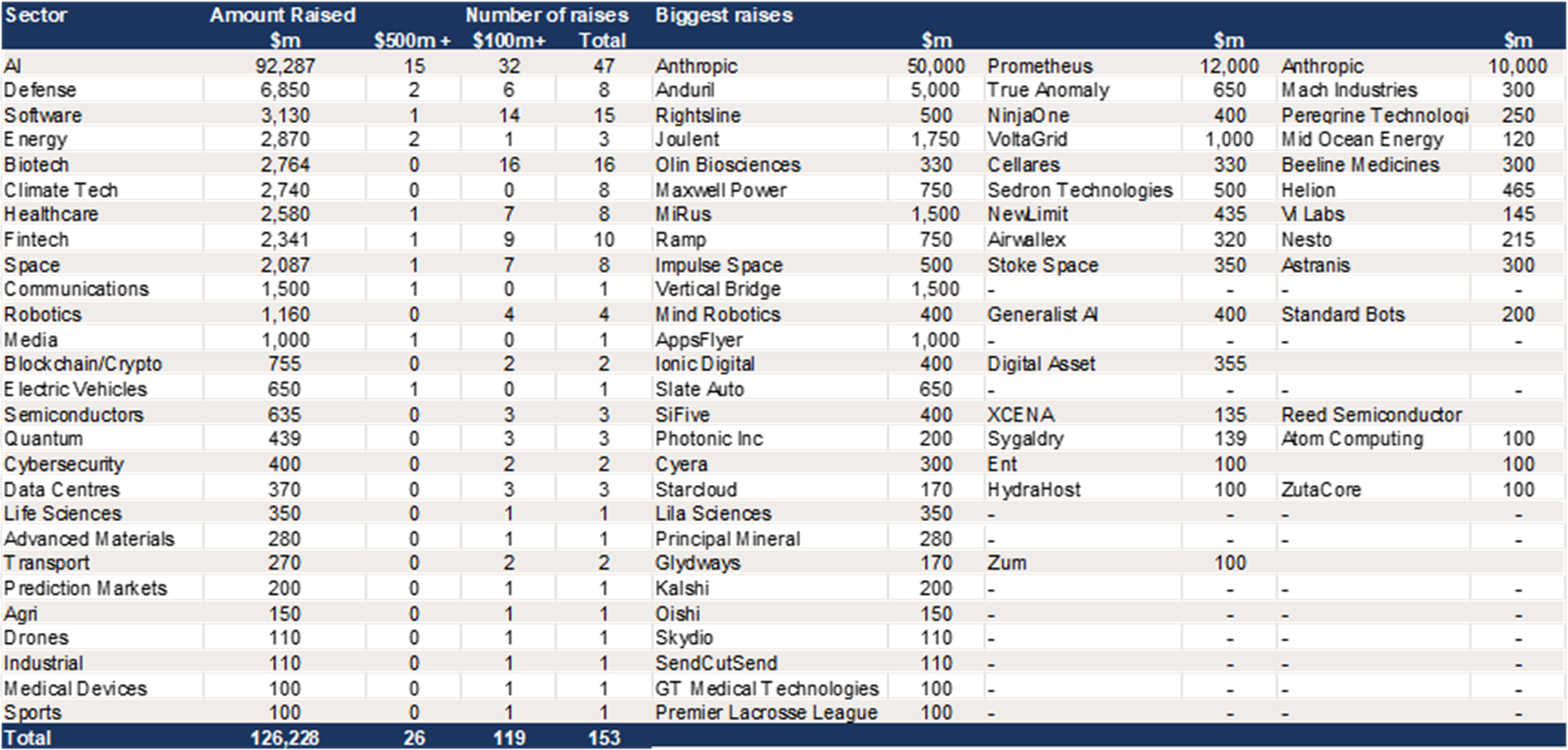
A summary of Q2 US fundraising shows that there were 153 deals of $100m or more with a total of $126.3bn being raised. AI dominated due to big raises by Anthropic and Prometheus. AI deals accounted for 73% of the total value of deals in the quarter. The figure was 78% in Q1. The resurgence in interest in defense funding and its cross over with AI as new warfare techniques based on AI and autonomous systems emerge meant that Defense was the second largest category, up from third in Q1, with $6.85bn raised in Q2 led by a $5bn deal from Anduril. Software was in third place with $3.1bn raised in the quarter. Essentially AI, defense and software held the top three underlying positions in both Q1 and Q2 if one excludes the single large Waymo deal ($16bn) in Autonomous Vehicles in Q1. Otherwise Q2 is notable for a better quarter in Fintech funding – eighth position with $2.3bn raised in Q2, the continued robust interest in Space- a crossover sector with Defense - and a pick-up in investment in Quantum, one of the key future technologies for AI.
US – Q2 fundraising of $126bn split by sector |
Source: Rothschild & Co
Source: Rothschild & Co
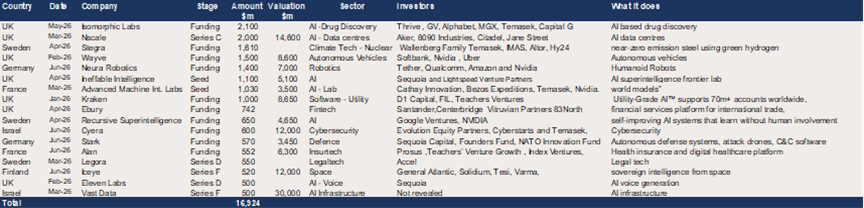
Europe – Surging H1 fundraisingEurope has seen a very strong H1 2026 in growth equity fundraising with $39.3bn raised across 330 deals of $20m or more.The value of European VC raises in H1 2026 was 80% higher than in the equivalent 2025 period ($21.8bn), 2.2x the amount raised in H1 2024 ($17.7bn) and 3x the total for H1 2023 ($13.1bn). The volume of deals, 330 in H1 2026, is similar to the 321 of H1 2025 meaning the average deal value has risen from $68m to $119m on the back of a flurry of much larger deals. There were eight rounds of more than $1bn in value in H1 2026 versus zero in H1 2025. Indeed, there were just five $1bn + deals in the entire 2023-5 period. There were nine deals of $500m-$999m in H1 2026 versus just four in H1 2025. The number of $100m plus deals was similar – 64 in 2026 versus 54 in 2025. So, the key to the value rise was the greater number of $500m plus deals. The 17 $500m+ deals raised $16.96bn, 43% of the H1 2026 total. Seven AI deals: Of these 17 seven are classified by us as being AI deals including the two largest. In May the AI powered drug discovery business, Isomorphic Labs raised $2.1bn from backers including Thrive Capital, GV, Alphabet, MGX, Temasek and Capital G for its AI drug design engine, IsoDDE. Nscale is an AI hyperscaler with its data centre sites supporting LLM platforms. Its March 2026 $2bn Series C at a valuation of $14.6bn was led by Aker ASA and 8090 Industries and included Nvidia. Nscale intends to use the proceeds to further its deployment of large-scale AI infrastructure across Europe, North America, and the Middle East, enabling the rapid rollout of the company’s “AI factory” data centres for projects like Stargate UK and Stargate Norway, and the expansion of its vertically integrated AI cloud platform. |
There were three AI lab raises.
Europe – 17 deals of $500m+ in H1 2026 |
Source: Rothschild & Co
Source: Rothschild & Co
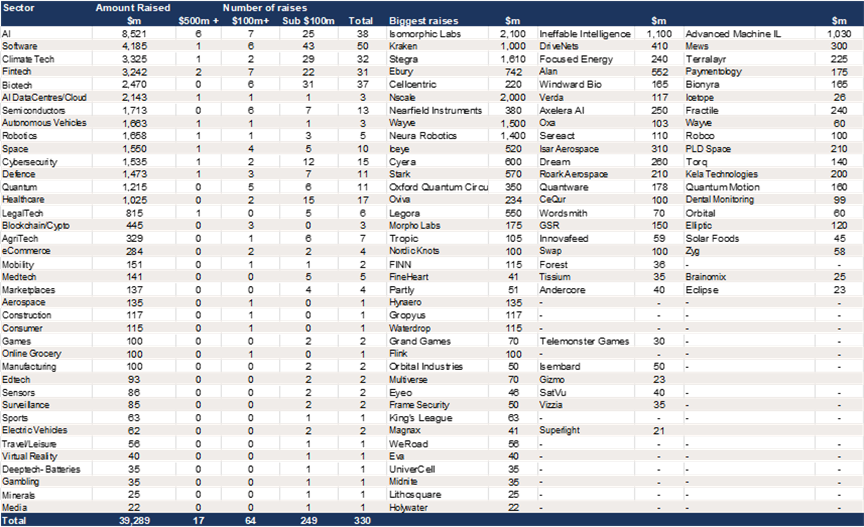
Looking at the breakdown in deals by sector
Europe – H1 2026 fundraising - $39.3bn is up 80% yoy
|
Source: Rothschild & Co
Source: Rothschild & Co
Europe– Q2 fundraising of $21.5bn split by sector- AI led
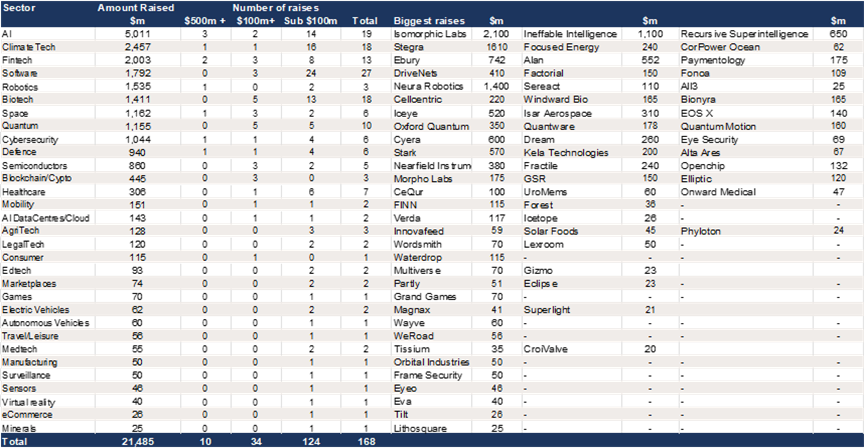
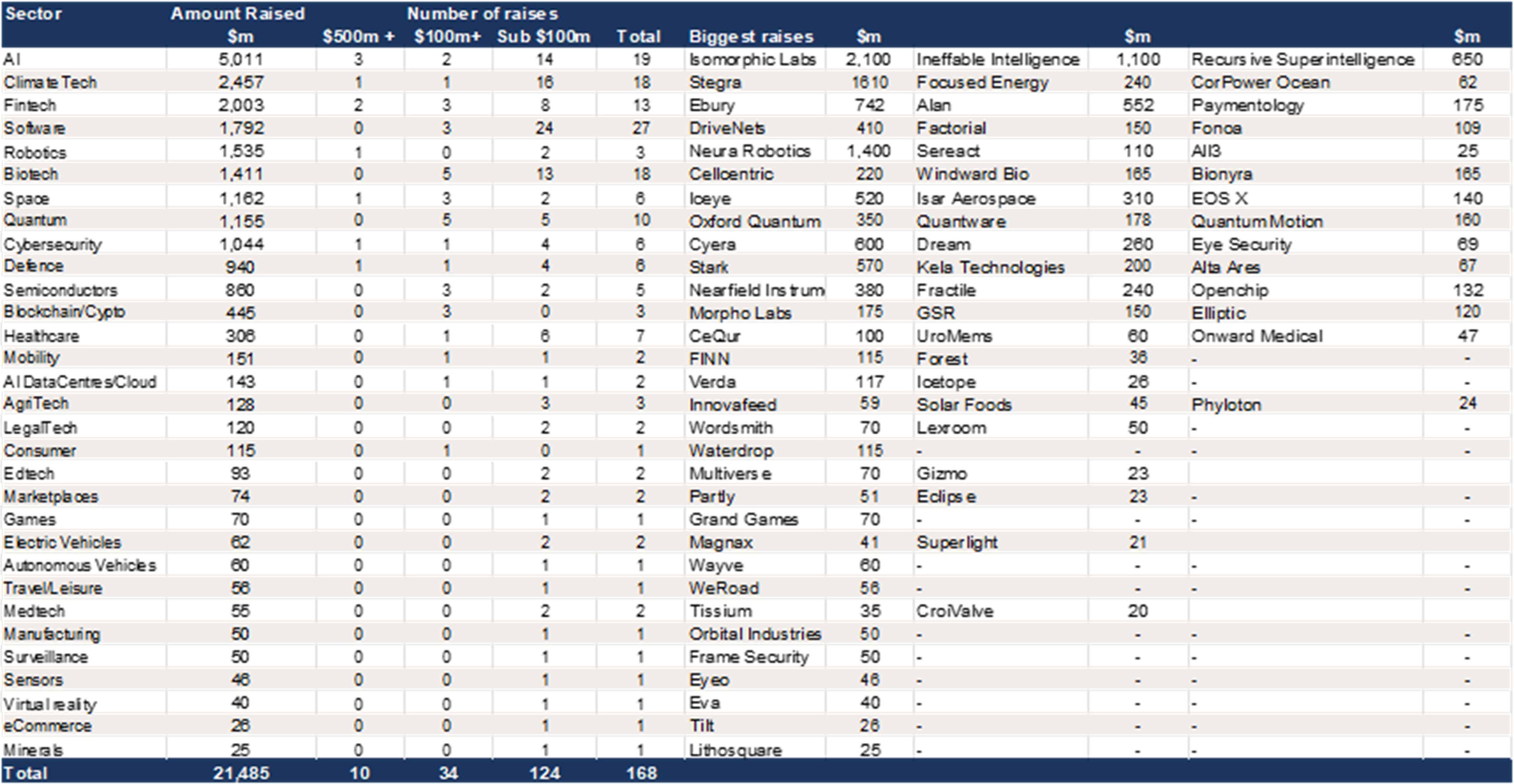
Source: Rothschild & Co
Source: Rothschild & Co
Fundraising outlook: c$35bn of impending raisesPipeline is c$25bn in impending US deals and c$10bn in Europe.Our list of impending US raises rises from $10bn at the end of May to c$25bn now. The new additions to the list are led by Jeff Bezos’ space rocket venture Blue Origin. The company is reported to be looking to raise $10bn at a $130bn pre money valuation supported by Coatue and with Jeff Bezos contributing c$2bn. Also coming onto the list is the US data centres business, Crusoe, a prolific amasser of capital, said to be looking for a further $3bn raise at a $30bn valuation. Another data centre business Switch, controlled by Digital Bridge, is reportedly looking at a $2bn raise at a $30bn valuation led by General Atlantic. As we write the impending $1bn raise for AI inference semiconductor business Sambanova is completing led by General Atlantic while Xlight, which builds lasers for semiconductor manufacturing, comes onto the list for a potential $350m raise. Falling out of the list as their deals completed are enterprise banking business Ramp which raised $750m at a $55bn valuation in a deal lead by ICONIQ and GIC, and AI infrastructure business Groq which raised $650m from Disruptive and Infinitum. |
US Growth Equity – c$25bn in reported upcoming raises
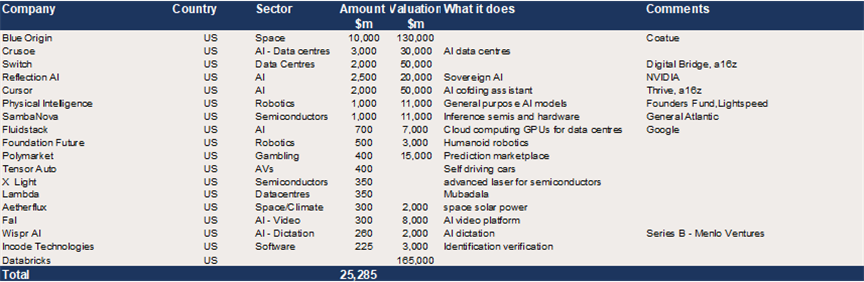
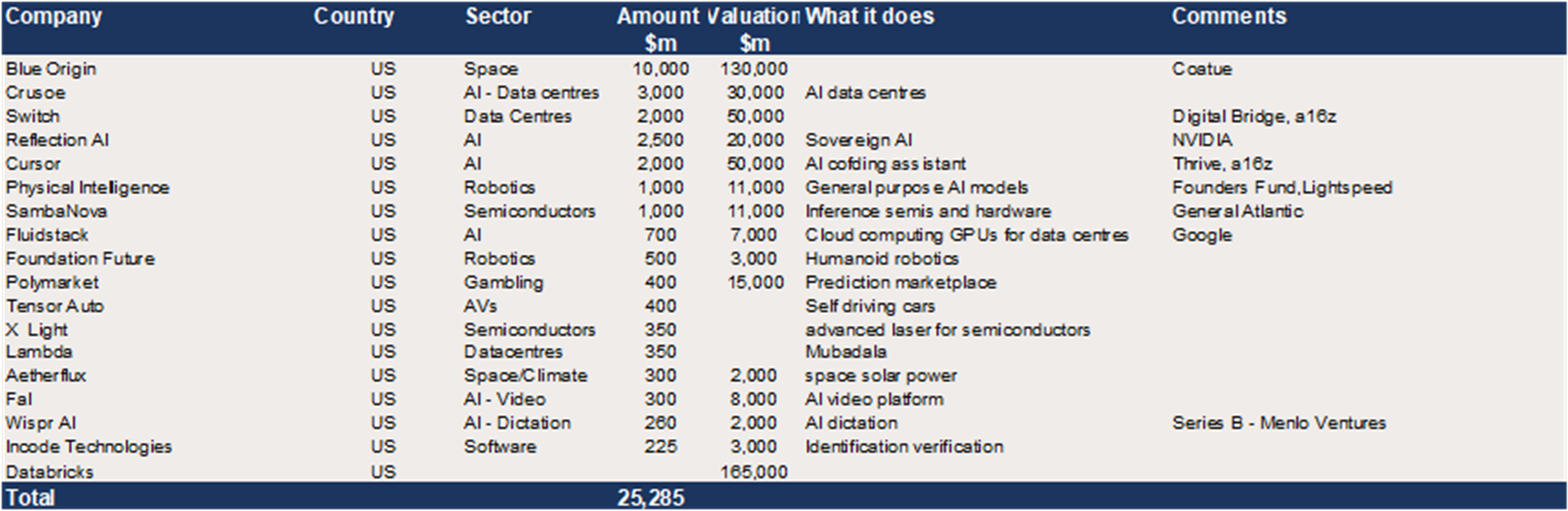
Source: Rothschild & Co; press reports
Source: Rothschild & Co; press reports
|
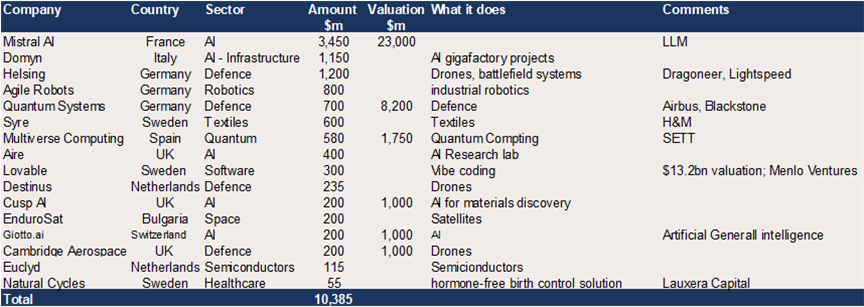
In Europe, the total of identified impending raises roses from $8.8bn to $10.4bn. This is despite us removing Neura Robotics from the list. It raised $1.4bn as opposed to our projected $2bn. In addition, Isar Aerospace raised $300m and Iceye a larger than expected $520m. Heading the list now is France’s Mistral AI with the LLM business said to be looking to raise c€3bn (c$3.45bn) at a €20bn valuation. ASML Holding is the company's largest shareholder with a c11% stake. Italian LLM and AI infrastructure business, Domyn, is said to be raising $1.15bn in an upcoming Series B. Two European defence businesses are on our list led by Helsing, reportedly looking for a $1.2bn raise in a deal led by Lightspeed and Dragoneer. Germany’s Quantum Systems will come off the list next month. The developer of drones for defence and security operations has just raised $10.4bn – twice the expected $700m level - at an c$8bn valuation in a round led by Airbus and Blackstone. |
European Growth Equity – c$10bn in reported upcoming raises
Source: Rothschild & Co; press reports
Source: Rothschild & Co; press reports
|
Public markets – Rotation After its strong rally since the end of March, it has been a tougher time for markets in June and the first week of July. This is despite the uneasy truce in the US-Iran conflict taking the price of WTI crude down from c$95 at the start of June to c$70 at the start of July and in doing so dampening inflation fears in the US. In the period June 1- July 8th, rotation out of tech stocks has meant the Magnificent Seven was down 6% with NASDAQ down 5%. The tech lighter S&P500 was down 2% and there was outperformance by the even tech-lighter international markets with the FTSE 100 up 2% and the STOXX600 up 3%. It all means that year to date relative performance has narrowed, bounded at the upper end by NASDAQ, up 11% and at the lower end by the FTSE 100, up 6%. The FTSE Venture Capital Index, after a weak start to the year caused by the fall out in software stocks, had rallied to be almost flat on the year by the end of May but has subsequently fallen back to be down 8% ytd. The rotation away from tech stocks has been fuelled by fears that AI infrastructure spend may slow, a view sparked by commentary around Samsung’s earnings that caused weakness in semiconductor stocks. Meanwhile the relative strength of small caps, value stocks and especially cyclicals tend to indicate that the market is anticipating a softer landing for the economy as the worst prognostications about the effects of the Iran War are deemed less likely to come about. US headline inflation was 2.4% in February pre-Iran conflict while the May figure was 4.2%, the highest since April 2023. Core inflation, which excludes volatile elements, including food and energy, rose by just 10bps to 2.9% from 2.8% the previous month. The yoy change in the consumer price index for fuel oil was 59%, and for energy commodities and gasoline 41%, highlighting the influence this has on the inflation outlook. With the substantial truce between the US and Iran agreed on June 17 market hopes were raised that inflationary pressures will now reduce. One year ahead household inflation expectations in the US are running at c3.7%. The US jobs market looks relatively robust although the numbers have been bouncing around. The US added an unexpectedly strong 172,000 jobs in May versus an 80,000 expectation. This was followed by a disappointing 57,000 additions in June – the market had been looking for 100,000. The May figure was also revised down to 129,000, and April from 179,000 to 148,000, leaving the overall outturn close to original expectations. The unemployment rate is running at c4.2%. The overall picture is thus of core inflation at an acceptable rate, overall inflation at an excessive rate but induced by an Iran conflict the effects of which might be about to wear off, and an overall robust jobs outlook. The Fed held rates at 3.5%-3.75% in June: Stepping into this picture is President Trump’s new head of the Fed, Kevin Warsh. He had his first Fed meeting as chair on June 17. Rates remained unchanged at 3.5%-3.75% with a unanimous vote by the market committee to hold rates. Mr Warsh has set up five Fed taskforces- Balance Sheet, Communications, Economic Data, Productivity and Jobs (focusing on the impact of AI) and the Inflation Framework. They represent a desire to change the way the Fed goes about its mission and are due to report by the end of the year. |
The market is keen to get a feel for the approach of the new Chair. Thus far he is more hawkish and independently minded on interest rates than the market had feared. His key indicators so far are:
|
|
The dot plot expectations indicator of the Monetary Committee members did though survive for the June 17th meeting. Nine of the committee members expect higher rates by the end of 2026, eight unchanged rates and one a reduction. At the start of the year three had looked for higher rates, five unchanged and nine for a reduction. As recently as the March meeting, eight had been looking for rates to reduce by year end. The next Fed meeting is on July 29th. There are three further meetings thereafter this year, in September, October and December. The market expects (67% unchanged/33% higher) rates to be unchanged in July. The swing comes in September (31% unchanged/ 69% higher) with 17% looking for a 50bps rather than 25bps rise. By the December meeting there is an 86% expectation of a rate rise – this figure was just 51% a month ago. The 86% splits 37% for a 25bps rise, 34% for 50bps and 15% for 75bps or more. Meanwhile the on-off-on state of the Iran truce and the gyrations of the oil price with its attendant threat on inflation means that market participants are uncertain of the short-term direction of travel. The longer this uncertain state prevails though, the more likely it is that the next move in Fed rates is upwards. The ECB raised rates by 25bps to 2.25% at its June meeting, the first rate increase since August 2023. The EU cited ‘a major energy shock’ and persistent inflation risks driven by the Iran conflict and disruptions to oil shipments. The ECB stated that the Middle East war is amplifying inflationary pressures and that according to ECB President Christine Lagarde ‘We are beginning to see a broadening of inflation throughout the economy.” Even as the ECB was raising rates the lull in the Iran War had policymakers reassuring markets that the interest rate response would not be as severe as it was in 2022-23 after the outbreak of the Ukraine war, Christine Lagarde observing that ‘We no longer need to act with the same force.’ At the June meeting the ECB revised its inflation forecasts upward. It now expects headline inflation to reach 3.0% in 2026 (was 2.6%) and 2.3% in 2027 (was 2.0%). The ECB forecasts that inflation will return to its 2% target during 2027. Core inflation was raised to 2.5% for 2026 and 2027, from previous estimates of 2.3% and 2.2%. The ECB lowered its Eurozone GDP projections, looking for 0.8% growth in 2026 (was 0.9%) and 1.2% in 2027 (was 1.3%). Euro area inflation then surprised positively with its June reading of 2.8%, down from 3.2% in May and better than expectations of 3%. Core inflation, ex food and energy prices, was 2.4% down from 2.6% in May and better than 2.5% expectations. Market expectations are still that European interest rates will rise by a further 25bps this year, with attention focused on the September meeting for the rate hike. The UK held rates at 3.75% in June: UK inflation in May was also better than expected with the figure holding at 2.8%, the same level as in April. As in April the market had been looking for a read of 3%, meaning that inflation beat expectations in both months. The recent inflation high was the 3.3% figure in March. Core inflation, which excludes food and energy, was 2.6% in May up from 2.5% in April. April’s slowdown was because of a new energy price cap, offsetting pressures from rising energy prices. May’s beat largely reflected lower food prices and a drop in the cost of domestic heating oil. The June 18th meeting of the Bank of England was held just as US and Iran were signing their Memorandum of Understanding. In the run up there was strong debate as to whether the BoE would raise rates given the uncertainty over the oil price. The fall in the oil price on the back of the truce meant the BoE was able to hold rates at 3.75% with the committee vote being 7-2. The minority voters supported a rate rise. The BoE now anticipates inflation of 3% Q3 and 3.25% in Q4, although these figures are below its earlier projections in April. The Governor of the Bank of England Andrew Bailey observed at the end of April that ‘higher inflation is unavoidable’ due to the Iran conflict in the Middle East. In May he indicated that higher inflation caused by the Iran energy shock is potentially tolerable if it is a temporary effect. He repeated this sentiment in June observing that: ‘Whatever happens in the future, the higher energy prices of the past four months mean there’s already some inflationary pressure in the pipeline…. I would respond promptly to any signals that an extended period of elevated energy prices could be leading to stronger possible second-round effects.’ The net effect of all this is the market still expects the Bank of England to raise interest rates by the end of the year, but with the consensus expectation has looking at just one 25bps rise, taking the rate to 4%, rather than two. Our Rothschild & Co strategists Kevin Gardiner and Anthony Abrahamian’s views on the current market outlook are summarised in the Exhibit |


Source: Rothschild & Co
Source: Rothschild & Co
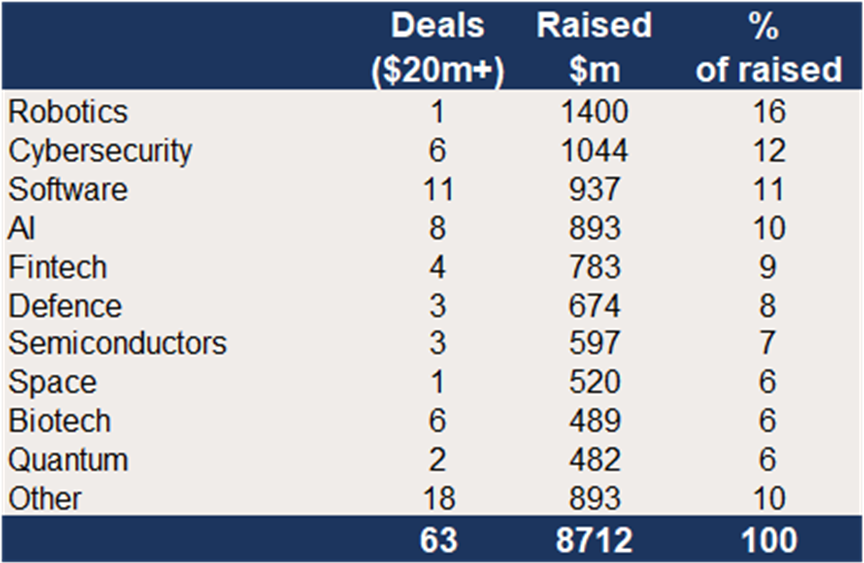
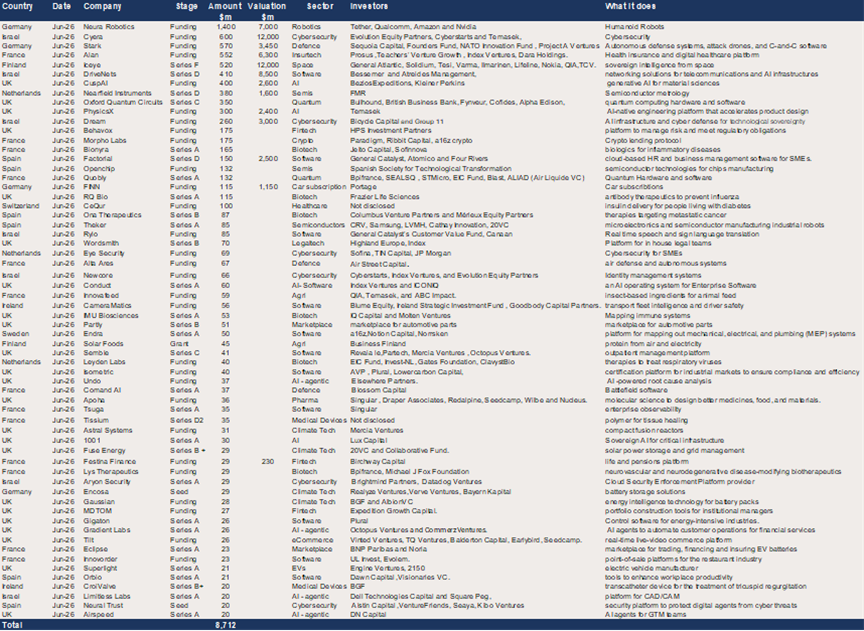
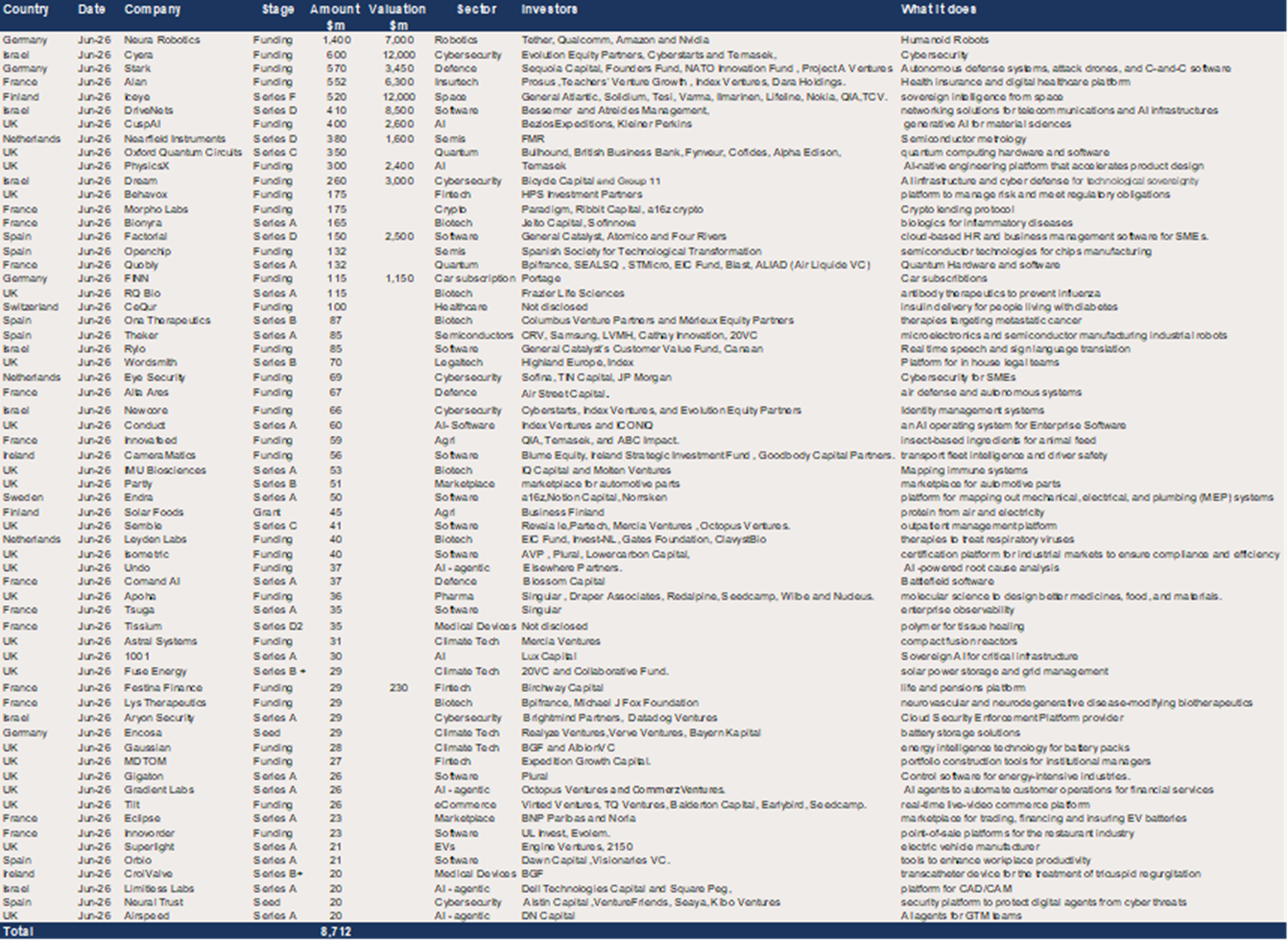
Fundraising – Europe has a standout JuneEurope’s biggest ever month - $8.7bn raised.Momentum is with Europe: June was a remarkable month for European fundraising with 62 deals of $20m+ raising a total of $8.7bn, the first time Europe has breached the $8bn barrier in a single month. The total is $1.0bn greater than the previous record month, the $7.7bn raised in March this year. The total was almost double the $4.47bn raised in the same month last year. Notably there was a flush of large deals in Europe in June. There was a total of 20 deals of $100m or more beating the previous high of 17 (again in March 2026). Of these the largest was the $1.4bn raise at a $7bn valuation for German humanoid robotics business, Neura Robotics. There were a further four deals of $500m plus (Cyera, Stark, Alan, and Iceye) and a further five deals of $300m or more including $410m for the Israeli networking solutions business, DriveNets, $400m for Cusp AI which applies AI to the materials science industry, $380m for the Dutch semiconductor metrology business, Nearfield Instruments, $350m for the UK’s Oxford Quantum Circuits, and $300m for Physics X, an engineering platform for product design. The European fundraising scene remains well diversified in terms of industry. The biggest sector in June was Robotics with the single Neura deal of $1.4bn comprising 16% of total fund raising in the month. Six cybersecurity deals, again dominated by Israeli companies, raised $1.04bn or 12% of the total. Eleven software deals pulled in $937m, 11% of the total with the $150m deal for Spanish HR software business Factorial notable. AI was the fourth ranked sector with eight raises for $893m led by the CuspAI and Physics X deals. There were three raises in Defence for $674m plus a substantial deal in Space – the $520m for Iceye. Quantum remains a feature in Europe with a flurry of raises in recent months, with the $482m raised in June led by the $350m for superconducting quantum specialist, Oxford Quantum Circuits. |
Europe – June 2026 deal value ranked by sector
Source: Rothschild & Co
Source: Rothschild & Co
Europe – 62 $20m+ deals raised a record $8.7bn in June
Source: Rothschild & Co
Source: Rothschild & Co
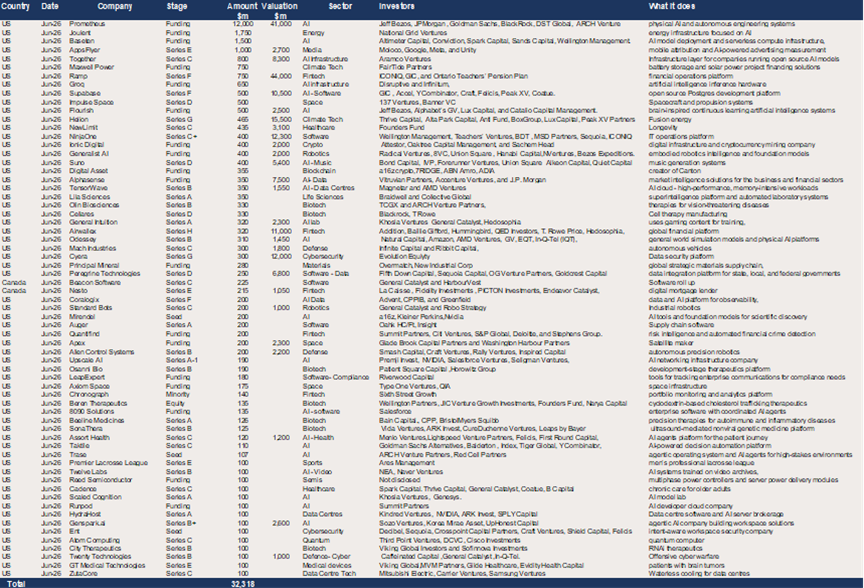
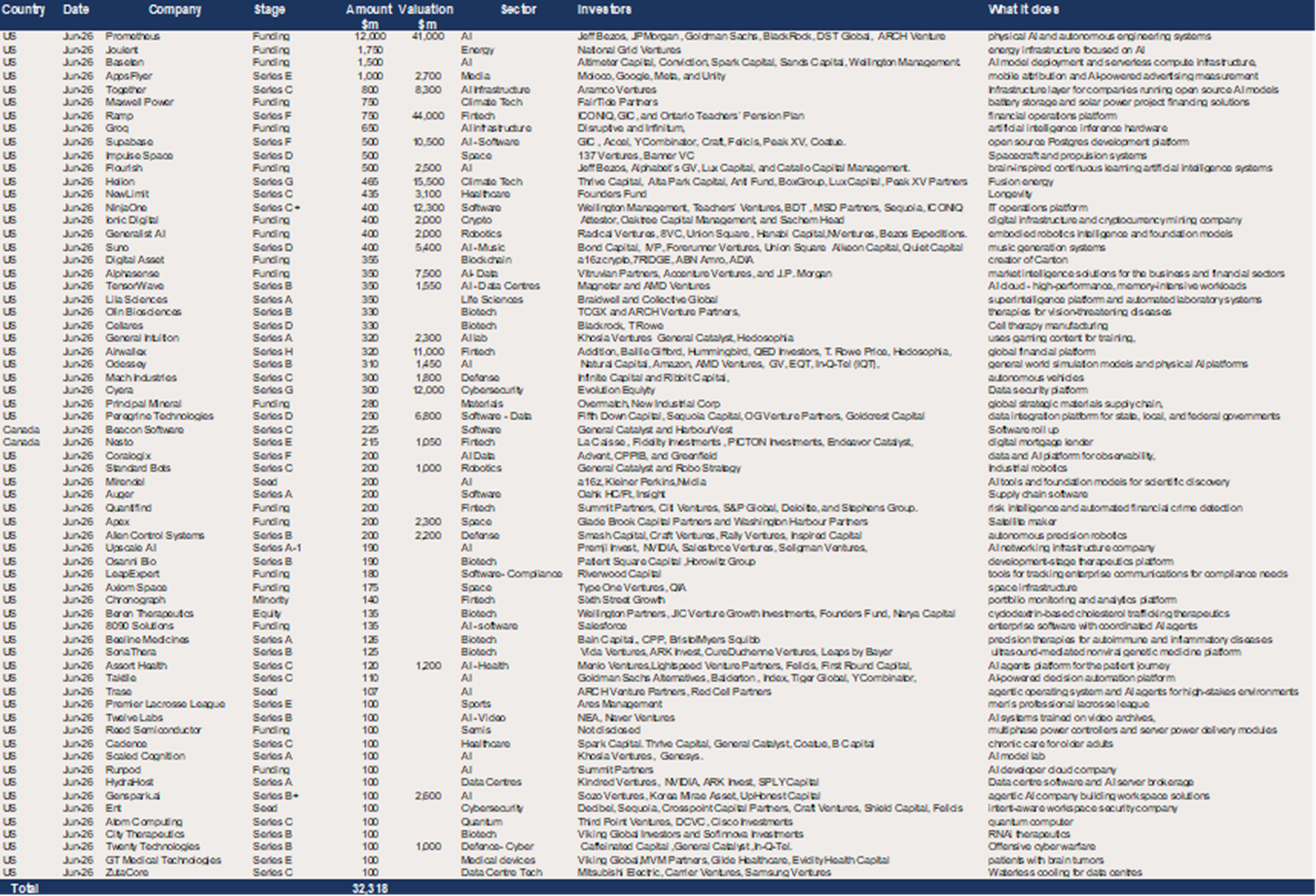
US fundraising in June – up 5% yoyJune 2026 just edged ahead of the June 2025 totalIt would be harsh to say that the US fundraising market has lost momentum given that June saw another $32.3bn raised for private companies. It was though just 5% ahead of the total raised in June 2025. It is an exceptional figure for raises and yet the opening of the IPO market and the shift of major companies like Space X, Cerebras and Quantinuum into the public markets with others like Anthropic and OpenAI having filed, shifts the focus of attention on the fundraising market from the private to the public arena. Notably the US saw just one deal of $2bn + in June, the lowest total of the year to date. It was a $12bn raise at a $41bn valuation for Jeff Bezos’ Prometheus which is focused on physical AI and autonomous engineering systems. Its aim is to build an ‘artificial general engineer’ capable of automating complex engineering design. The business raised an initial $6.2bn at the end of 2025. There were three other $1bn plus deals in the month. Joulent is an energy business focused on supplying substantial power infrastructure for the AI industry. It raised $1.75bn from the UK’s National Grid Ventures. Baseten, an AI inference company whose trained models help power AI model development, raised a $1.5 billion Series F led by Altimeter Capital, Conviction, and Spark Capital. AppsFlyer uses AI in advertising measurement and cross-platform attribution. It raised $1bn in a round valuing the business at $2.7bn and supported by Google, Meta and adtech company, Moloco. As usual AI was the leading sector for fundraising although the 55% of total funds raised– $18.8bn out of $32.8bn in June, was well beneath the 80% seen in April and May. Apart from the Prometheus and Baseten deals, there were two significant raises by AI infrastructure companies. Together raised $800m in a Series C led by Aramco Ventures which valued the company at $8.3bn. It describes itself as an ‘AI acceleration cloud company.’ It leases chips from cloud providers and re-leases them to developers as well as hosting servers in its own data centres. At the end of the month Groq raised $650m in funding led by Disruption and Infinitum to scale its AI inference cloud business. Groq operates 13 data centres in North America, Europe, the Middle East, and Asia-Pacific, serving more than five million developers. AI linked sectors also saw prominent raises with the $1.75bn Joulent raise in AI-focused energy infrastructure and there were three AI datacentre raises for a total of $550m. In total these were another 7% of the total value of June raises. Five fintech rounds raised $1.625bn led by the $750m for financial operations platform, Ramp. Seven biotech rounds raised a total of $1.34bn and five software rounds raised $1.25bn led by $400m for the IT operations platform, NinjaOne.
|
US & Canada– 65 raises of $100m+ in June for a total of $32.3bn
Source: Rothschild & Co
Source: Rothschild & Co
Our views on the state of the venture capital marketsThis revival of the growth equity market has been led by the US and by a surge of interest in artificial intelligence model providers and for companies using AI to transform a range of underlying industries. Ast the same time the venture industry has re-adopted strong underlying approaches to investment with companies in most sectors striving to achieve a better balance of growth, profitability, and cash flow. The underlying quality of the cohort of VC backed companies has improved. Our summary of the outlook:
|