FAQs II: Business cycle, bubbles and budgets
Foreword
This time a year ago, with a second Trump administration newly in prospect, we suggested that investors should:
- separate the personal from the portfolio;
- take him seriously but not literally;
- remember that positive outcomes are possible too.
It has been a noisy and occasionally traumatic twelve months, but capital markets have fared better, not worse, than we’d have hoped – and in the case of stocks, we’d thought valuations were taking a lot on trust to begin with.
Looking ahead now, geopolitics remains fraught. Ukraine is mired in conflict, the Middle East ceasefire is tentative. However, our investment concerns stay focused not on higher oil prices and disruptions to shipping – neither of which, again, have materialised – but on possible signs of economic and financial excess.
Mr Trump’s tariffs look likely to settle at levels above those expected at the beginning of the year, but firmly below those subsequently chalked onto that board in April. They are putting sand in the wheels of commerce – but not yet causing those wheels to fall off.
As a result, economies have indeed mostly remained resilient (as far as we can tell, given the shutdown-driven scarcity of recent US data). Unemployment has risen only slowly, from low levels. Europe is poised to get a shot in the arm from Germany’s public spending reboot, and US tariff revenues may be recycled (seriously, not literally…).
We pose three updated financial questions below. In tackling the business cycle, we suggest that core inflation is likely to remain in the 2-4% range we’ve had in mind since 2021 – a stickiness which we think might yet have more hawkish consequences for interest rates. In revisiting those increasingly frothy US stock valuations, we ask whether AI can deliver, and note the growing similarities (but also some important differences) with 2000. Finally, we once again address a topic about which we worry perhaps less than others do – namely, current levels of government borrowing, and what they might, or might not, mean for portfolios.
Kevin Gardiner / Victor Balfour / Anthony Abrahamian
Global Investment Strategists
The business cycle
Q1: CAN GROWTH CONTINUE?
A: Yes, the global economy often proves more resilient than pundits predict.
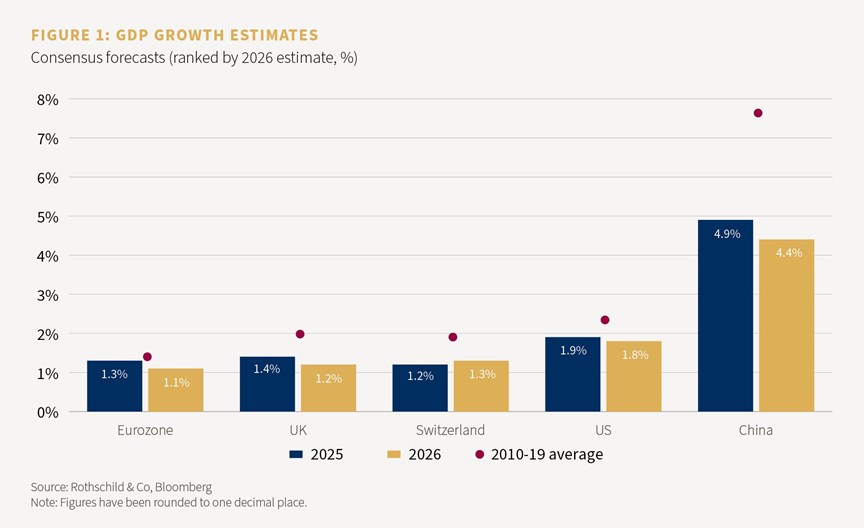
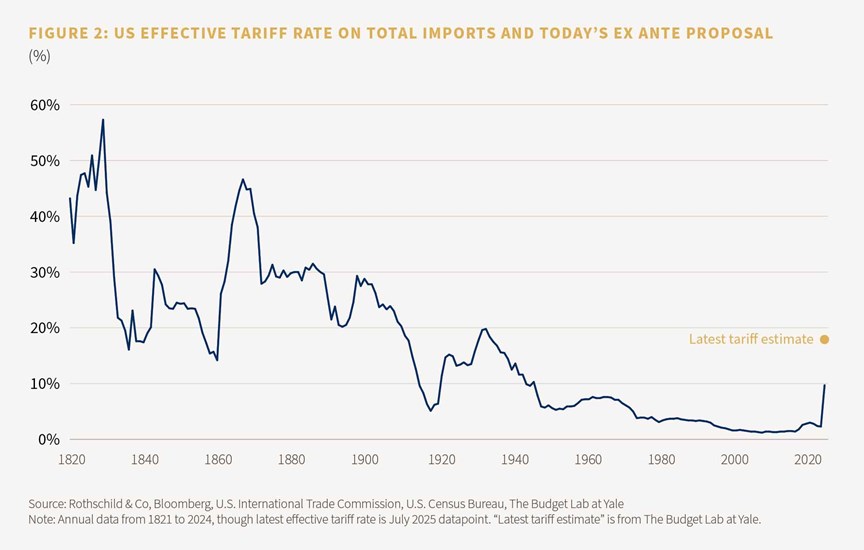
The major economies have grown this year and can do so next year, albeit perhaps at a below-trend pace (figure 1). Notably, global trade has not yet come to a standstill despite the effective US tariff rate rising to a post-war high (figure 2): indeed, world trade in goods volumes conversely rose by 3% during the first eight months of the year (later data is unfortunately not available). Much like 2022, when it was interest rates that instead rose sharply, economies did not ‘collapse’.
That is not to say that tariffs and other downside risks have disappeared. Trump’s ‘business-unfriendly’ policies – including those related to immigration and deportation – might yet do more significant damage to the US and global economy. The geopolitical backdrop also remains uneasy: an escalation in Ukraine, a resurgence in conflict in the Middle East, or (potentially the most economically damaging) an outbreak of hostilities around Taiwan could yet disrupt trade flows and energy prices more materially than has been the case to date.
Yet, as always, seemingly daunting risks are in reality more nuanced. It is not in President Trump’s interest to damage the domestic economy – and with that, his approval ratings – and his publicly-proclaimed initiatives are often watered down or even reversed. The U-turn following tariff ‘Liberation Day’ in April was perhaps the most notable example, and (as we write) it looks as though the more recent dramatic tariff increases threatened for Switzerland and China may not materialise. Legal challenges remain, too, as we await a Supreme Court ruling which may complicate how those tariffs are imposed. Meanwhile, constructive geopolitical outcomes are always possible: the tentative ceasefire and peace deal in the Middle East defied expectations, and may prove more durable than feared. Moreover, financial threats can sometimes emerge seemingly out of the blue: recent US banking and credit stress serves as a potent reminder. For now, liquidity remains plentiful and systemically-important banks’ balance sheets are well capitalised.
The business cycle still has some momentum, according to the available economic data (a smaller set of data than usual, admittedly, thanks to the US federal shutdown). Companies seem reasonably upbeat, if the widely-watched business surveys are to be believed. Labour markets have loosened only a little – unemployment remains low – on both sides of the Atlantic. Consumer spending has yet to be interrupted by higher US tariffs, perhaps because wage growth is still outpacing inflation. What’s more, some of those tariff revenues are already being recycled as tax cuts in the US and Europe are ramping up defence spending, with Germany planning an outsized spending package after voting to loosen fiscal policy earlier this year.
Clearly, a plausible backdrop exists in which economies continue to grow next year – even without any AI-related productivity gains…
Q2: WHAT DOES THIS MEAN FOR INFLATION?
A: It may stay sticky in developed economies.
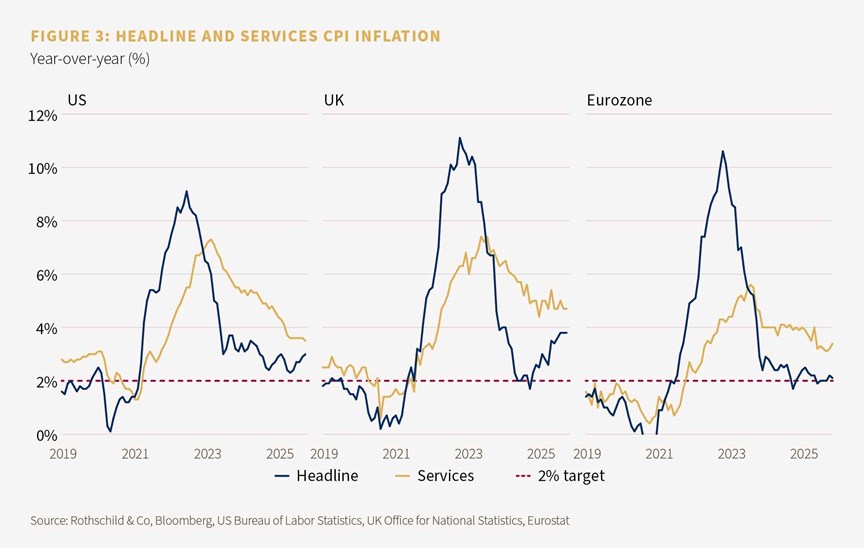
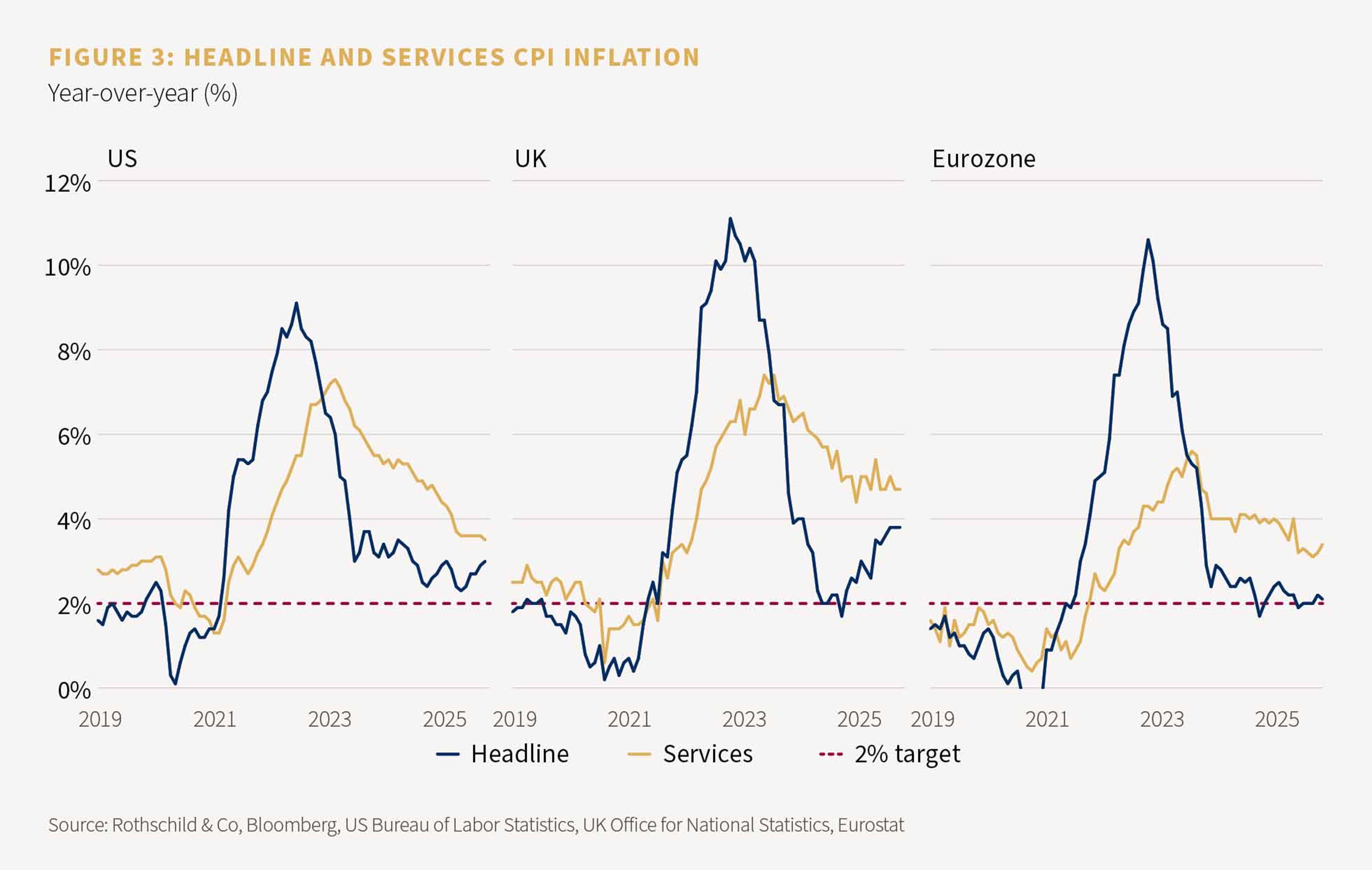
While Consumer Price Index (CPI) inflation has fallen a long way, it has not sustainably returned to target in either the US or Europe (figure 3). That may be the case for a while longer.
US headline inflation has in fact drifted higher in recent months, to 3% (year-over-year) as of September. This side of the Atlantic, inflation developments have been mixed but are also yet to stabilise at targeted levels: UK headline inflation is still nearly double the Bank of England’s 2% inflation target, though the eurozone equivalent is closer to target (Switzerland and China are notable exceptions, with effectively no inflation).
Given that wholesale energy prices for the most part have fallen this year, it might be a surprise that inflation has proven to be so sticky. However, there are three other major categories in the inflation basket – food, goods and services CPI – which may not subside quickly.
The stickiness of food inflation can partly be explained by trends in global wholesale food prices, which drifted higher since the start of 2024 according to the UN Food and Agriculture Organization. Those wholesale food prices have edged lower more recently, but may not contribute to softer CPI inflation for several months – there can be long lags between wholesale and consumer food prices. Another buffer to lower CPI prices is the cost of processing the raw foods into the finished product on our supermarket shelves.
Meanwhile, an uptick in goods inflation has been most visible in America, with higher US tariffs one possible culprit – although it pales into insignificance in comparison with the goods inflation shock of 2021–22. The tariff burden is likely being shared across the supply chain – between both US distributors and overseas exporters – limiting the pass-through to consumer prices. Existing inventories may have also provided a buffer: some US importers appeared to front-run tariffs by building stockpiles beforehand. Nonetheless, higher tariffs may filter through to the CPI basket more meaningfully in the months ahead as some of these shock absorbers fade. On a longer-term view again, the ultimate impact may arguably – and indirectly – be deflationary, given the likely hit to consumer spending power.
Services inflation is the largest – and stickiest – component of CPI baskets in developed economies, amid tight labour markets, elevated wage growth rates and (more routinely) less exposure to international competition. So, unless there is a big growth shock, services inflation may continue to moderate only gradually. Note that US services inflation also includes a ‘shelter’ component – a gauge of house and rent prices – which accounts for more than a third of the entire US CPI basket. If property market trends are anything to go by, then shelter inflation should too continue its descent, though it has also been a slow one.
Overall, we continue to think that inflation will stay above target, perhaps in the 2–4% region.
Q3: WHAT MIGHT THIS MEAN FOR INTEREST RATES?
A: Relative to market expectations, rate cuts may disappoint.
If economic growth remains intact, and inflation continues to stick above central banks’ targets, then there may not be a case for further interest rate reductions.
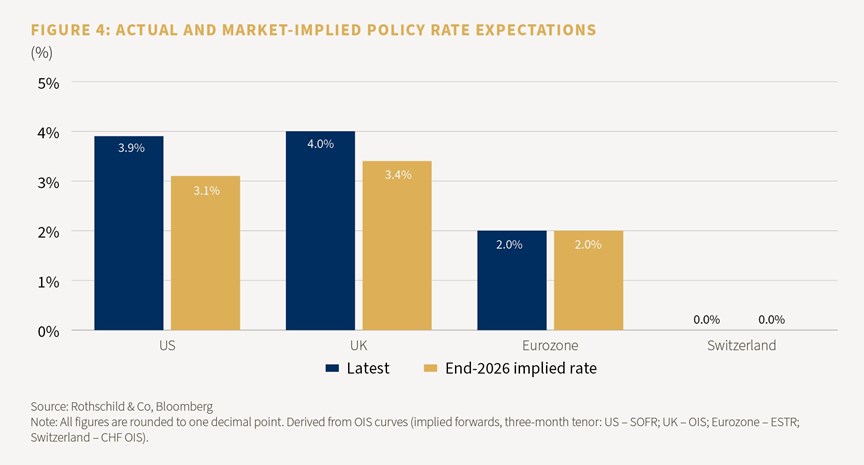
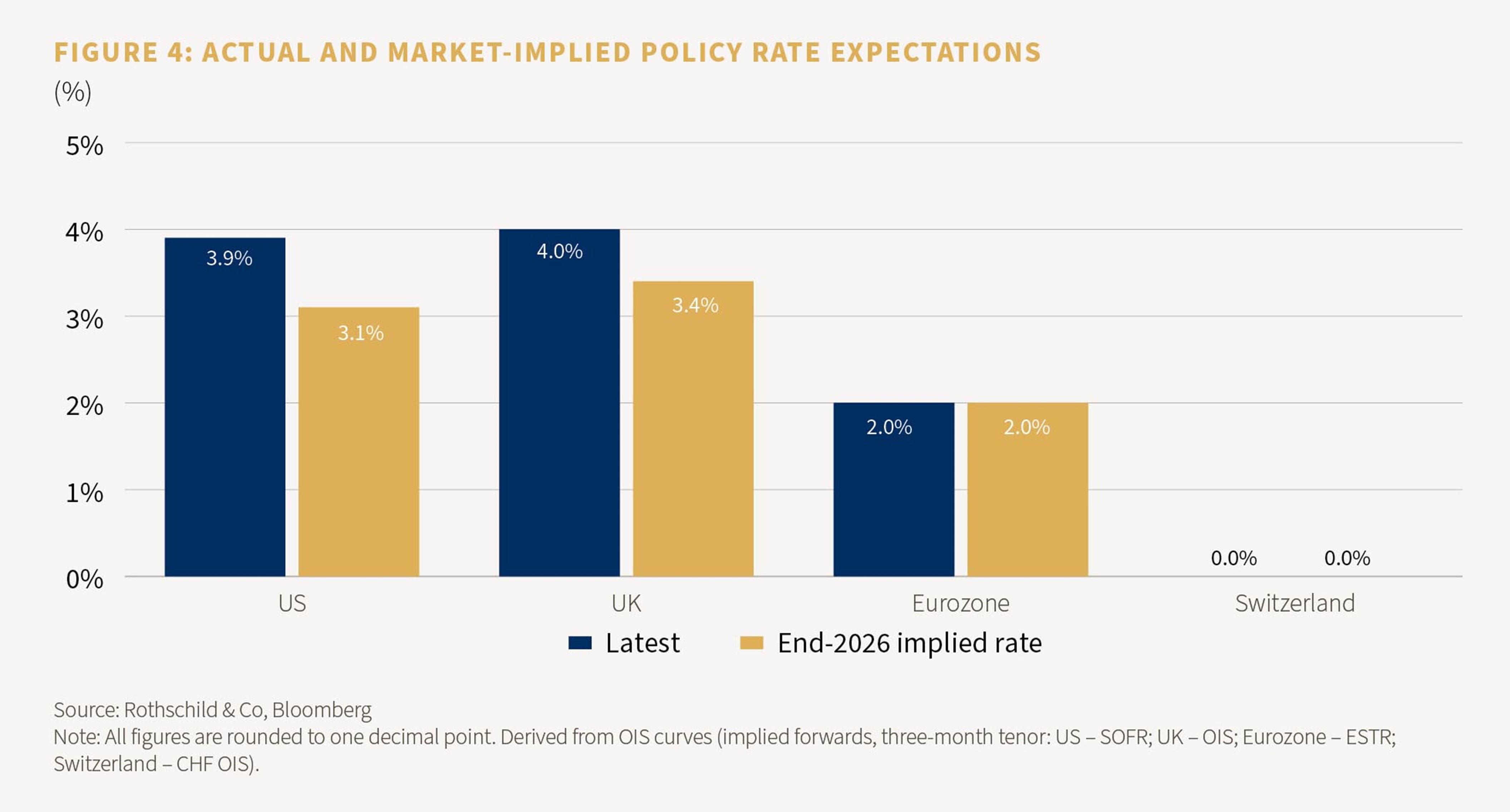
The US Federal Reserve (Fed) – the most important central bank for global capital markets – is projected to lower its policy rate to near 3% next year, according to money markets (for context, the target rate is currently in the 3.75–4.00% region, figure 4). Yet, the US still seems to be the strongest of the major economies, and as noted above, inflation has been rising, not falling there. If these market-implied rate expectations materialise, then the ‘real’ – or inflation-adjusted – US policy rate could tilt back into more accommodative territory again next year, amplifying inflation risk.
It’s possible that market expectations reflect the political intimidation of the Fed to act more aggressively, in contrast to its measured and modest reductions this year. An obvious concern for those of us who see resurgent inflation as the main macro risk is that the Fed Chair seat will become vacant in May 2026, and some of the rumoured frontrunners have close political ties to the POTUS.
That said, even if the new chair has a political bias, it need not mean a loss of Fed independence. There are still eleven other voting members in the committee and replacing them is not an easy task given the legal and logistical obstacles. In the highly unlikely event that the US government managed to exert full control over the Fed, a reckless reduction in the interest rate would likely lead to a disorderly US treasury market – which, again, is not in the President’s interest.
Elsewhere, two of the major European central banks – notably the European Central Bank (ECB) and the Swiss National Bank (SNB) – may be closer to concluding their easing cycles. The former remains in ‘wait and see’ mode with inflation relatively close to target. But with inflation tentatively edging higher again and growth stabilising, the ECB’s next move – likely well into 2026 or even 2027 – might in fact be higher, not lower. Meanwhile, Swiss policymakers are grappling with an uncomfortably strong Franc, but with the policy rate back at zero there is little appetite from the SNB to revert to negative interest rate policy for now.
The Bank of England however may have further to go. Sticky inflation – underpinned by still elevated wage growth – may be a constraint, but a weakening jobs market and possible fiscal tightening from the looming Autumn budget (see final section of Market Perspective) is encouraging markets to price-in another two rates cuts in the months ahead.
Stock valuations, and echoes of 2000
Q4: IS THIS ANOTHER 2000-STYLE ‘DOTCOM’ BUBBLE?
A: No – but AI-related valuations are certainly stretched, and expectations look ambitious.
There is no technical definition of a bubble. The notion generally applies to an asset whose price becomes so wildly detached from any sort of reasonable levels that an eventual collapse becomes inevitable, but there is no clear line in the sand that tells us when those levels have been reached. No market is immune. Stocks, property, commodities, art – and tulips – have all exhibited such tendencies at one stage or another.
Bubbles have a long and lurid history. In the 17th century the Dutch were seized by ‘Tulipomania’. In the 18th century the South Sea Company famously offered a wonderfully obscure pitch: “… a company for carrying out an undertaking of great advantage, but nobody to know what it is…”.
Today, stock market comparisons are being increasingly drawn with the 2000 ‘dotcom’ bubble. Then, as now, talk of a new paradigm prompted a dramatic technology-led stock market surge. The World Wide Web and the information superhighway, with mobile comms, digital media, and everything traded online, promised, some suggested, to abolish scarcity. If you were sceptical, you just didn’t “get it”. Liquidity was abundant, and equity valuations soared to unprecedented levels.
The stock market gains came after a period of above-trend growth, with low unemployment, rising productivity and robust investment. As early as 1996 the Fed Chairman, Alan Greenspan, was warning of “irrational exuberance” in stock prices. After a couple of setbacks – the Asian debt crisis and the Long-Term Capital Management (LTCM) fiasco – liquidity conditions were loosened, and then stayed so as the millennium, and the feared Y2K problem, approached. The major macro difference with today perhaps is that despite liquidity being abundant by the standards of the day, interest rates were materially higher in 2000 than they are now.
Between 1998 and 2000, the ‘New Economy’ frenzy took hold: capital expenditure boomed, telecom licence auction prices went through the roof, initial public offerings (IPO) and M&A activity surged, and the tech-heavy Nasdaq index (and Germany’s “Neuer Markt”) went exponential. If valuations had looked irrational to the Fed Chairman in 1996, then they had become entirely unmoored by early 2000.
When the music stopped playing, US stocks lost half their value – the Nasdaq Composite Index collapsed by more than three quarters – over the following two years. Many dotcom companies (and the Neuer Markt) disappeared, and several high-profile mergers had to be written down or unpicked. It wasn’t until 2015 that the Nasdaq Index reclaimed its previous high.
Most of the businesses leading the way up today are profitable, with healthy cash flows and clean (debt-free) balance sheets (in some cases, they are the same companies as in 2000 – Amazon, Microsoft – but in better shape). Many dotcom businesses didn’t have revenues – let alone earnings (Amazon, for example, wasn’t profitable then). Business viability mattered far less than effective branding – the suffix ‘.com’ on its own was a potent fundraising tool. The company Pets.com was perhaps the poster child for dotcom exuberance – going from high profile IPO to liquidation in less than a year. But bandwagon behaviour was widespread: some large stocks, including Qualcomm, surged more than tenfold in 1999 in the great ‘melt-up’ phase. The accompanying M&A boom was characterised by empire-building cross-industry deals and leverage.
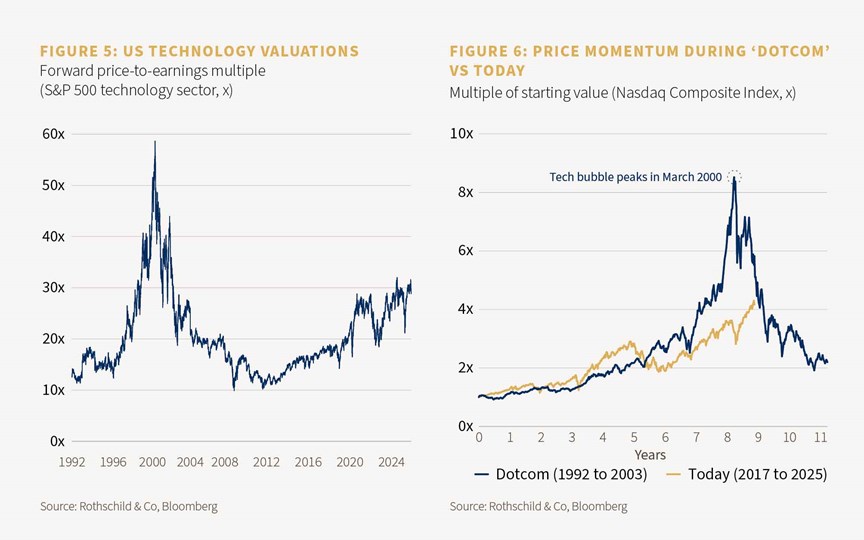
Today’s valuations do look elevated: price/earnings (PE) ratios and price/book ratios have only been higher than this once before – in 1999/2000. But the current episode is not yet as outlandish as was the case then: the richly priced US technology sector is trading at close to half its peak dotcom forward PE multiple (figure 5). Importantly too, today’s lower interest rates – and bond yields – suggest that discounted cashflow-based valuation metrics are less stretched than plain earnings-based multiples.
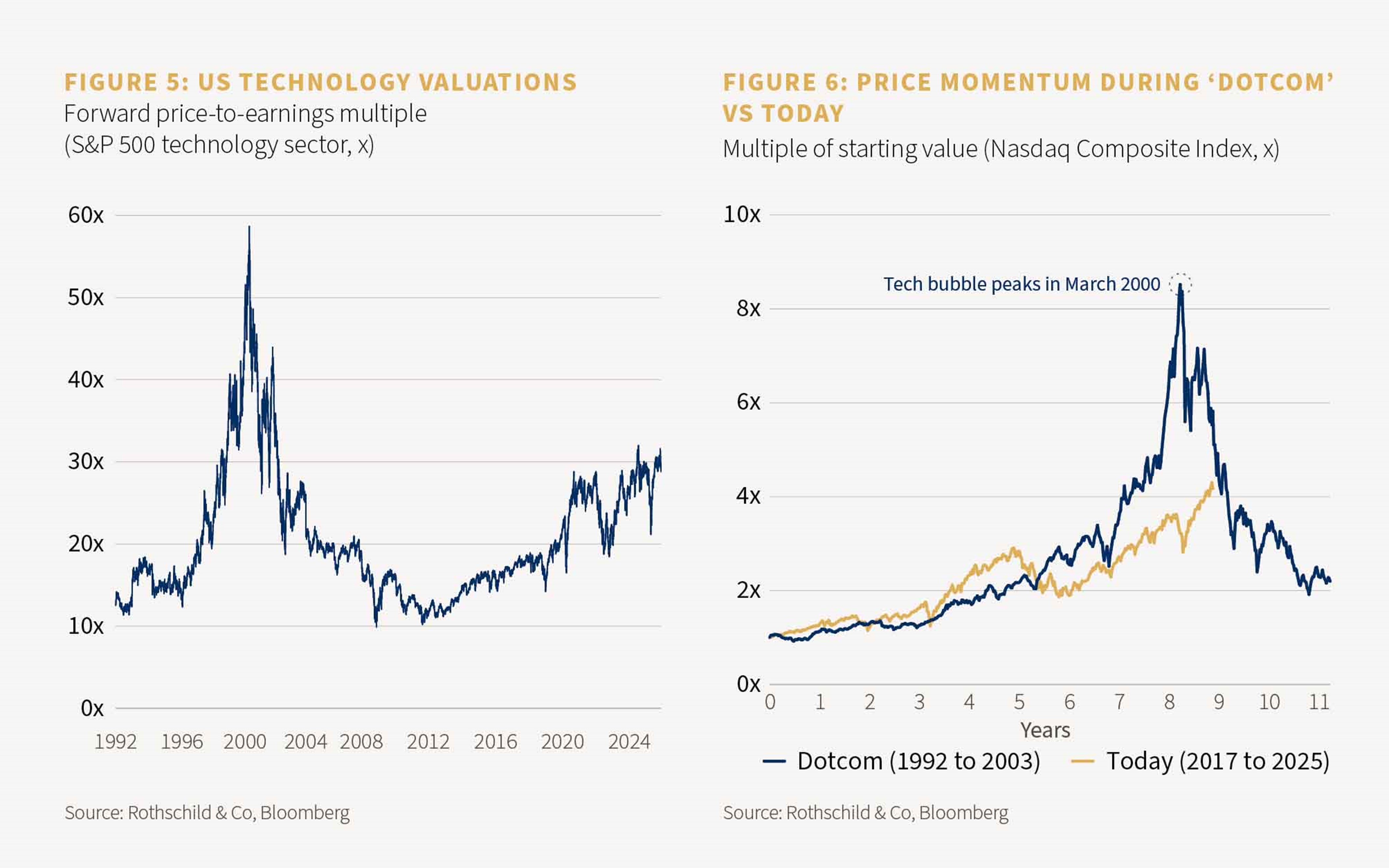
Price momentum today also falls well short of the nineties herding and there is no sign of the frenetic deal-making activity or stock issuance (figure 6). Much of today’s corporate activity is confined to smaller – and probably less systemically-important – private markets. Crucially, leverage seems absent from today’s excesses – aggregate corporate borrowing appears more subdued now (according to macro data which includes both public and private markets).
There are certainly parallels with the dotcom episode, then, but there are also important distinctions. But while today’s froth may not (yet) warrant the ‘bubble’ label, that doesn’t mean that richly-priced stocks can’t deflate from here: at some stage, the AI flywheel is likely to slow. Our inclination in 2025 has been not to chase this market higher. Stocks usually look forwards, and have a way of “looking across the valley”, but prices today may be looking a bit too far too soon. That said, we know that elevated valuations on their own are often not a useful short-term timing tool.
Q5: CAN AI DELIVER?
A: Amara’s Law states that “we invariably overestimate the short-term impact of a truly
transformational discovery, while underestimating its longer-term effects”. AI may be a case
in point.
AI proponents suggest demand is insatiable, that wider adoption is only constrained by a lack of supply. This is true insofar as the scaling of AI’s computational intensity is outpacing the supply (efficiency) of chips, and crucially the electricity supplies to support them. But unless today’s Large Language Models quickly drive a widespread step change in productivity trends – which is looking questionable as we write – there is a risk that much of today’s investment will prove unprofitable for both the purveyors and users of today’s AI, despite its impressive achievements.
In recent years, the US stock market has experienced a secular trend of improving profitability, reflecting not just improved average corporate performance but also a shift towards less capital-intensive output as the technology sector and digitisation has led the product cycle.
But as the AI ecosystem – encompassing hardware, infrastructure and software – has started to deploy immense amounts of capital in order to secure its access to processing capacity and energy, this ‘dematerialisation’ trend may be going into reverse.
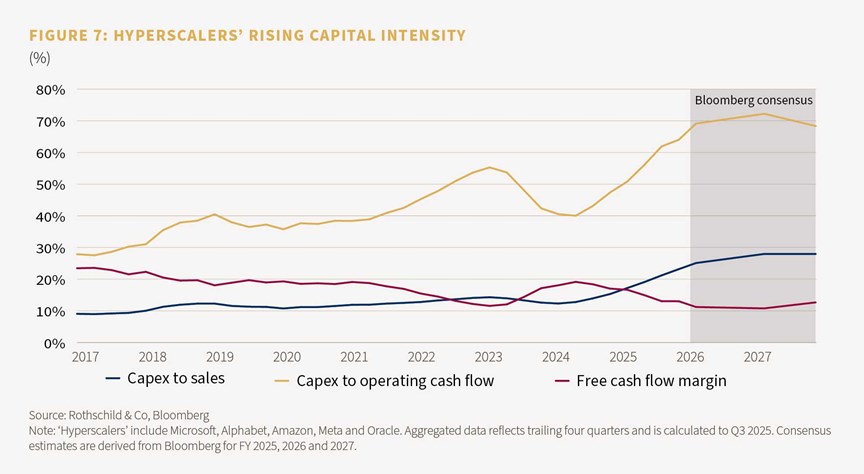
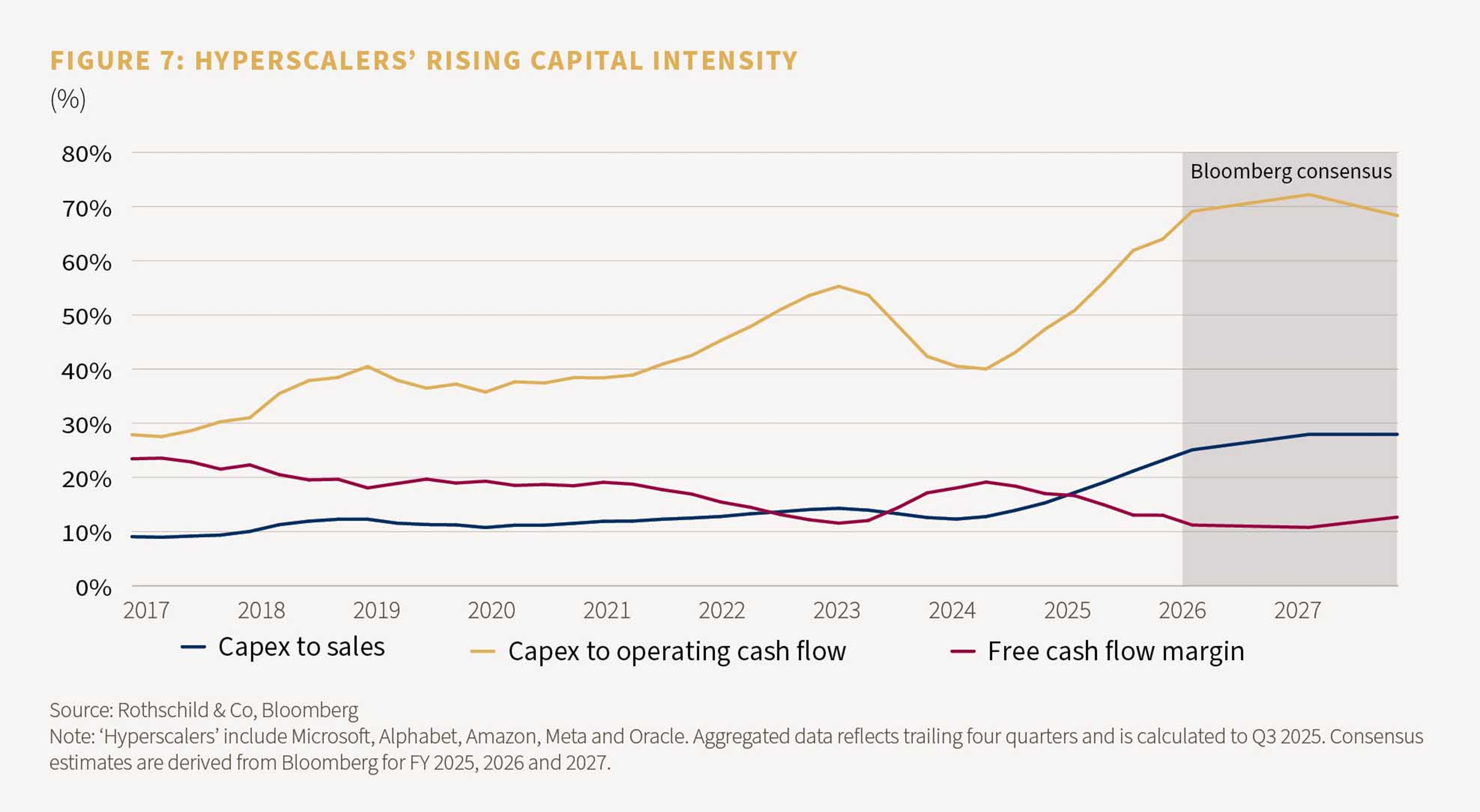
Today’s big ‘hyperscalers’ (the agglomerators of the ‘big data’ from which AI ‘learns’) seem to be locked into an AI-arms race to secure their computational dominance. Their superior free-cash-flow margins – one of their most attractive investment qualities – have fallen sharply in the past five years (figure 7), and some of the capital outlays that are consuming it risk becoming quickly obsolete (unlike, for example, the late nineties fibre rollout that is still being utilised today).
The numbers are immense: over the next five years, AI-related capital expenditure is poised to reach ~$5tn, which conservatively assumes a fivefold increase in datacentre grid power demand. But even setting aside the immense capital requirements for such ambitions, this tells us little about the ultimate destination. Will the activities facilitated by those chips themselves prove profitable in due course? How many business problems are ‘computable’ to begin with? Is Big Data necessarily going to solve those which are?
Meanwhile, increasingly visible circular transactions are raising the spectre of ‘vendor-financing’ – businesses funding their customers’ purchases. This may well reflect a practical business strategy given the huge capital requirements – helping customers maintain cashflows in the course of their operations – but it could also suggest that demand is not appearing as quickly as the hyperscalers hope or need. Business adoption rates for AI seem to have cooled, and a tidal wave of insipid textual content may be fuelling user scepticism.
Even if AI delivers some more profound breakthrough, such as Artificial General Intelligence or even the revered – and feared – Artificial Super Intelligence, it could take considerable time for a wider AI revolution to become a reality. The advent of earlier general-purpose technologies was followed by a considerable lag before they delivered a transformative economic impact. We should remember that the evolution of the internet was full of corporate casualties (as noted) – many of the early pioneers did not reap the commercial benefits.
Widespread adoption, and the subsequent productivity benefit, is dependent on a whole host of factors alongside the technology itself, including social attitudes, government policy, and consumer behaviour.
Bond vigilantes ride again?
“I used to think that if there was reincarnation, I wanted to come back as the president or the pope… But now I would like to come back as the bond market. You can intimidate everybody.”
– James Carville, Clinton adviser
If you believe what you read in the papers (spoiler alert…), rising public debt has put bond vigilantes back in the saddle, to intimidate governments and investors alike.
To be sure, American, French and British governments look somewhat fiscally challenged this autumn (we write as a UK budget looms later in the month). Economists talk of “doom loops” and the like. Other countries are under budgetary pressure too, though German and Swiss readers may wonder what the fuss is all about.
But those vigilantes are hard to track down. Bond yields have not been surging, and are not unusually high.
So: just how big a predicament do governments face – and how much does it matter to portfolios?
Q6: ARE WE IN A FISCAL DOOM LOOP?
A: No. Government debt could indeed balloon; but equally, with only small changes in
prospective spending and revenue growth, it could disappear. There is everything to play for.
In a fiscal doom loop, a big deficit adds to debt, which adds to borrowing costs, which cuts growth, which adds to the deficit – and so on. In some scenarios, rising interest charges alone push the deficit higher. The debt burden eventually explodes. (A recent real-world example perhaps being that of Greece, which had to restructure its debt in 2012.)
However, the arithmetic is not as one-sided or as urgent as it can sound. Even today’s budget deficits are still small relative to total revenues and spending. Modest changes to those two variables’ growth rates can thus have a big impact – in either direction.
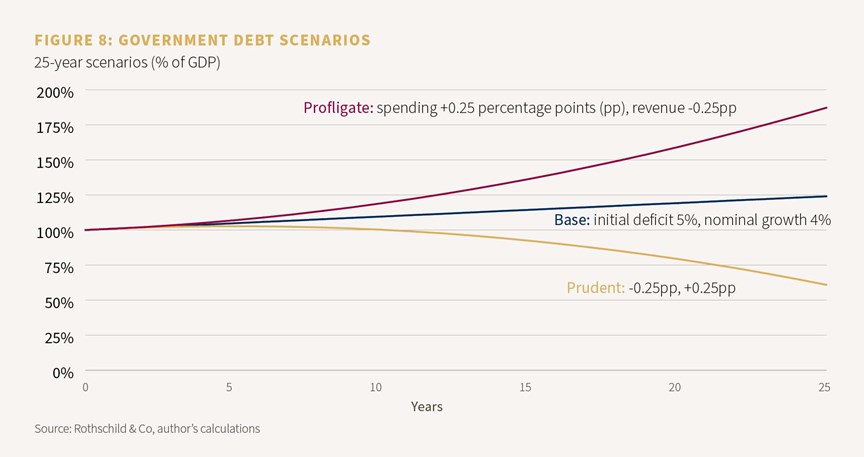
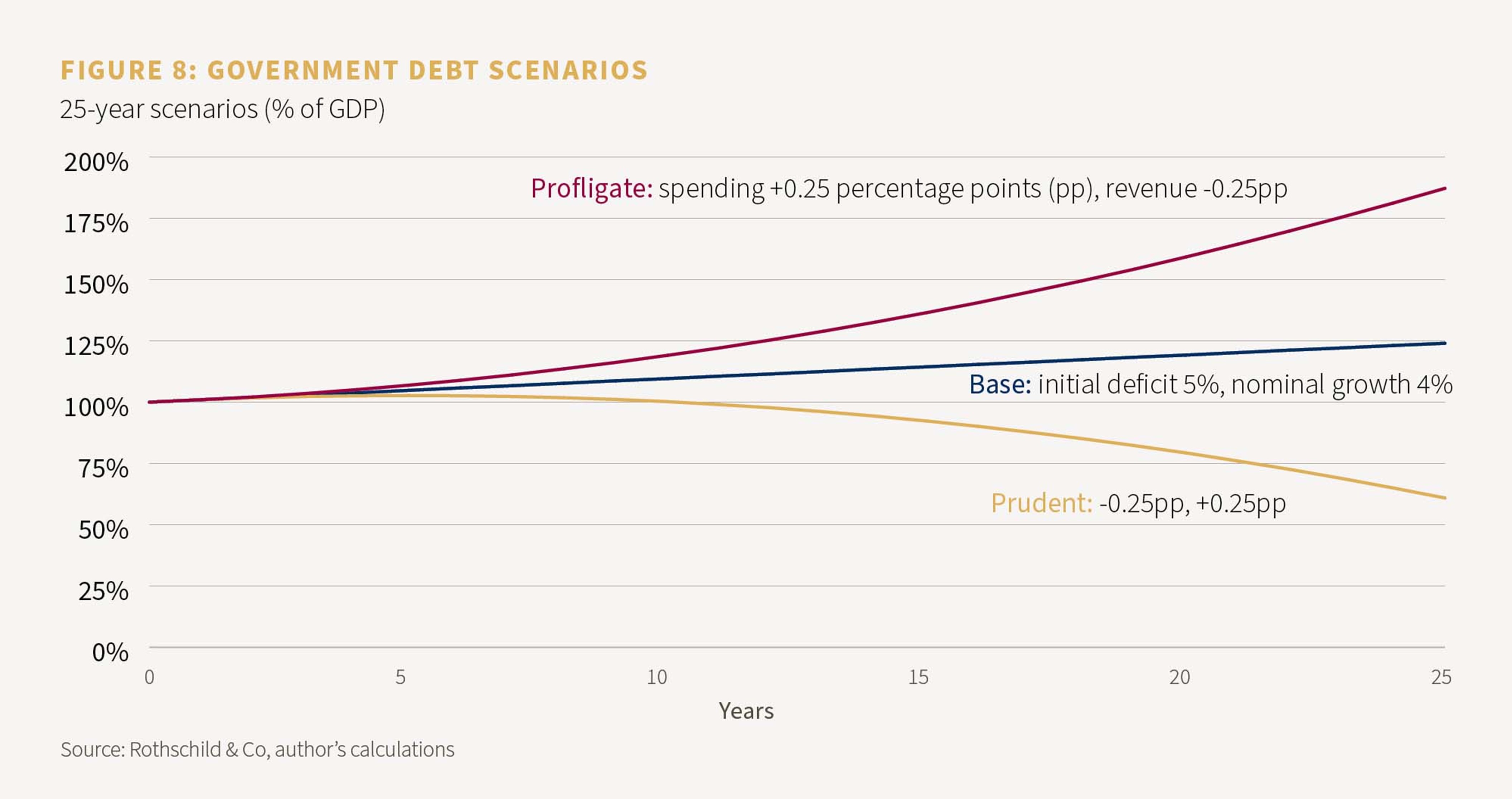
Figure 8 shows stylised scenarios for a starting deficit of 5% of GDP, debt at 100%, and prospective trend growth in nominal GDP, and in public revenues and spending, of 4% per annum (magnitudes faced by the US, France and UK).
In the base case, debt rises only gradually. However, in a scenario in which spending grows just one quarter of a percentage point per annum faster, and revenues one quarter point more slowly, it rises exponentially. And in a scenario in which growth in spending and revenues diverge similarly in the opposite direction, it implodes.
For sure, the collective will to deliver even such a small positive growth gap is conspicuously missing today. The recent US federal shutdown was the longest yet; France’s budgetary impasse has toppled its government (several times); the UK Chancellor seems unable to deliver even a small reduction in planned spending.
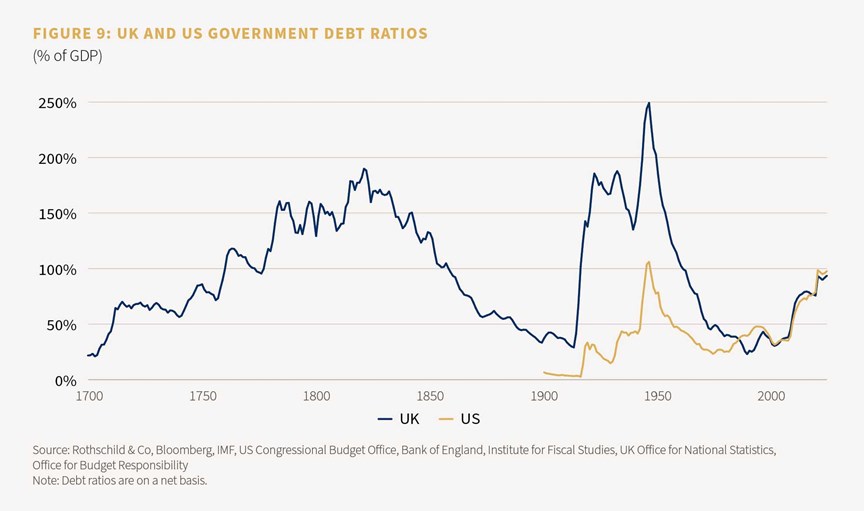
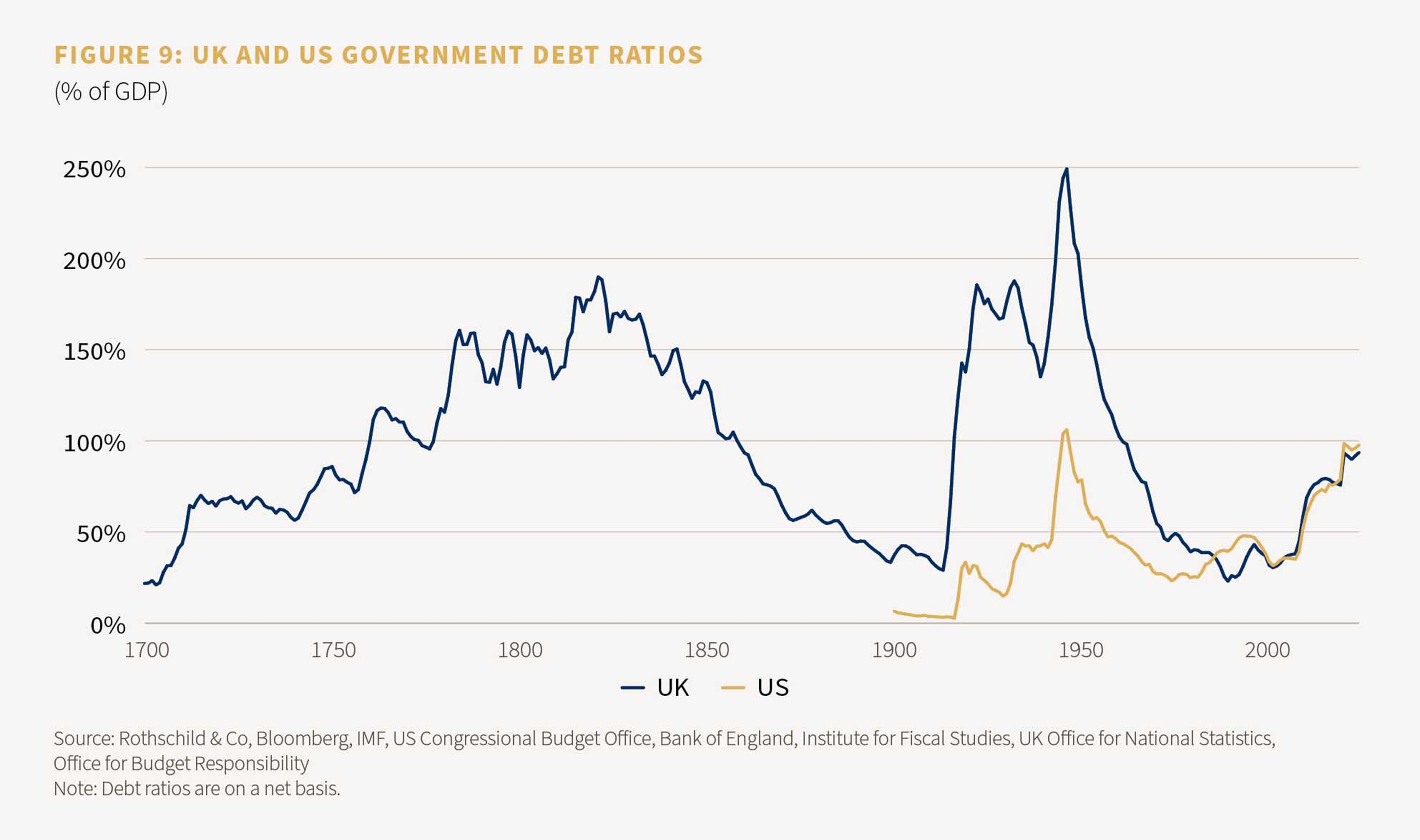
But politics and politicians change, and do so in real time, not spreadsheet time. Today’s deficits are not unprecedented; and while the US debt ratio is, it tested the previous (WWII) high several years ago (figure 9). The UK’s debt ratio was significantly higher between WWI and the 1960s, and for much of the early nineteenth century. Despite high-profile claims to the contrary, there are no clear thresholds at which public debt becomes unsustainable.
As for those interest costs: governments borrow mostly at fixed rates, and it takes years (roughly six for the US, nine for France, fourteen for the UK) for current market yields to materially affect the interest bill. Nonetheless, there are easy headlines to be written comparing interest outlays with more socially important items (such as defence) or with the deficit itself (“we’re borrowing just to pay interest” – well, no, we’re not).
The biggest exception to fixed coupons is inflation-linked debt (roughly a tenth of the US total, an eighth in France and a quarter in the UK). Even here, however, costs are manageable (the UK’s total interest bill was bigger in absolute terms in 2023, and higher as a proportion of public spending before 2010).
For the record: none of this makes us fans of big government, and borrowing, per se.
Q7: DO DEFICITS AFFECT BORROWING COSTS ANYWAY?
A: Not much.
Trigger warning: this section contains views which may upset many economists.
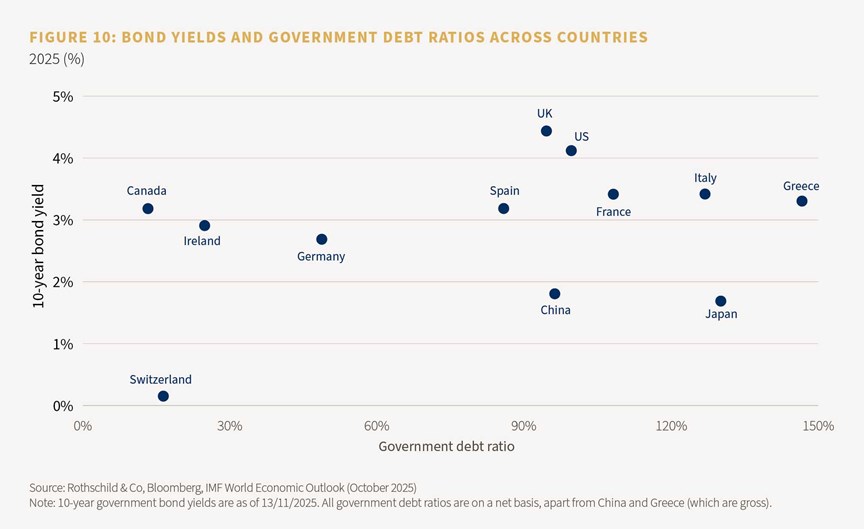
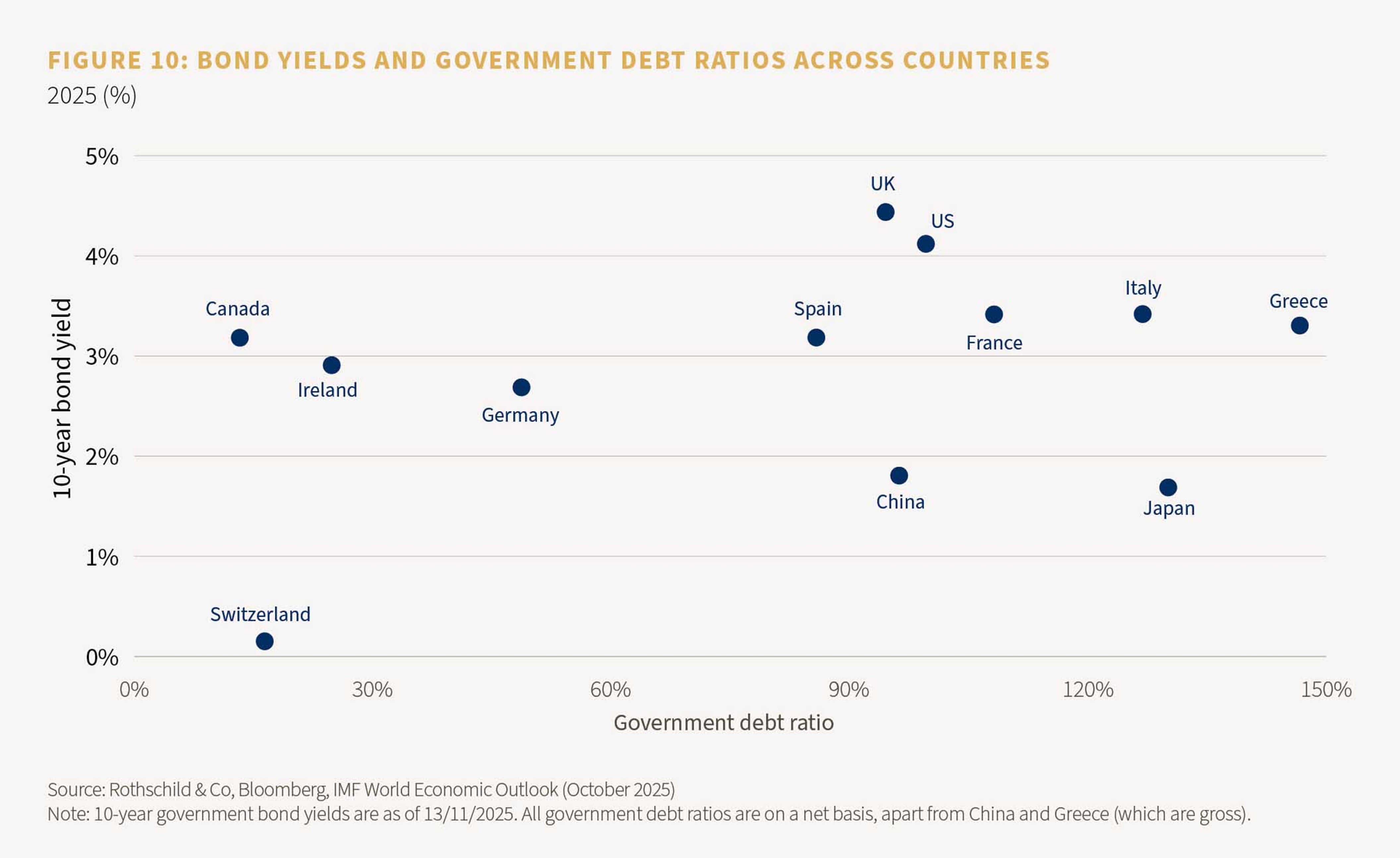
Most of the time, there is no clear link between how much governments borrow and the cost of that borrowing. Whether we look at history, or across different countries (low-debt, low-yielding Switzerland being perhaps the most obvious exception), the correlation between government debt or deficits on the one hand, and the level of bond yields on the other, is unconvincing (figure 10).
Some link would be intuitive. After all, the bigger the supply of bonds, the less valuable we might expect them to be (lower bond prices translate into higher yields). And in the short-term – when a new issue is unexpectedly announced, or a Truss budget is delivered, or (in the other direction) when a Quantitative Easing (QE) programme is announced – supply and demand imbalances do make themselves felt on prices and yields. But flow effects seem to get lost in the longer-term wash.
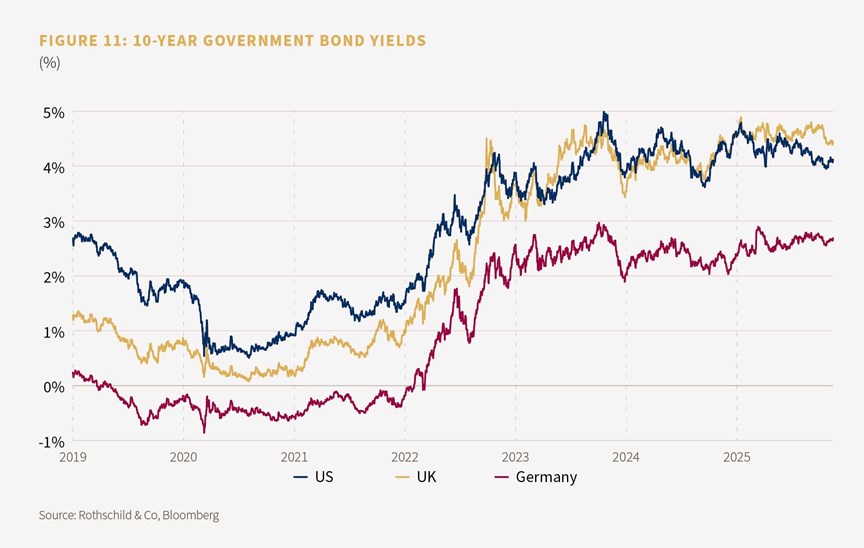
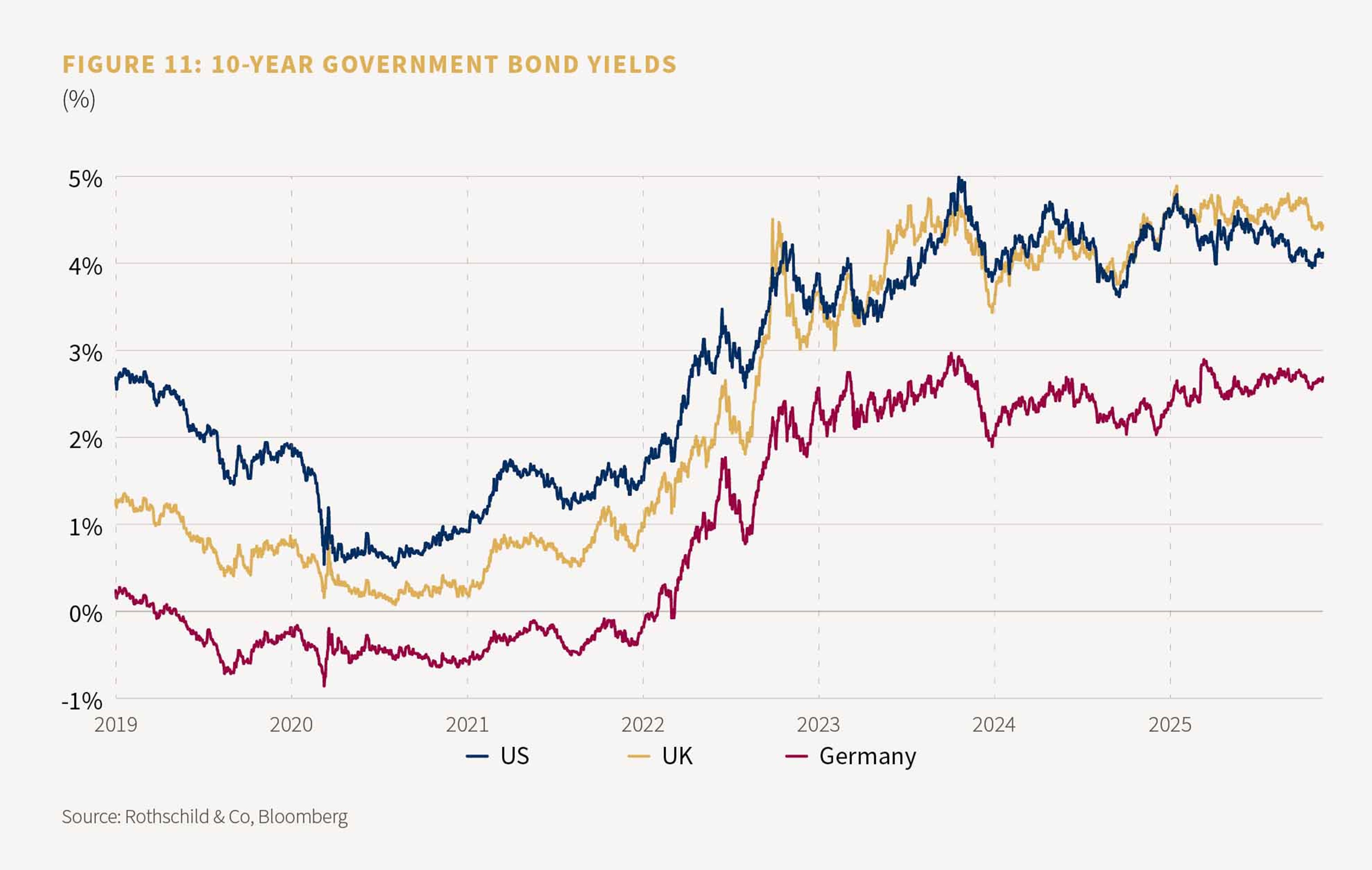
In 2025 to date, despite all the noise, nominal yields have not risen much. Indeed, the key 10-year US Treasury note yield, the world’s ‘riskless’ interest rate, has actually fallen, even with fiscal concerns more elevated there (figure 11).
True, yields in both nominal and inflation-adjusted terms are significantly higher than they were in the 2015-20 period. But the general level of interest rates was then being held at ‘emergency’ levels, and central banks had been buying-up big chunks of bond markets via QE.
The subsequent ‘normalization’ of rates and yields was driven primarily by things other than government borrowing (or QE unwinding).
Indeed, the biggest budget deficits and debt surges in recent times occurred during the pandemic in 2020 – when yields were low and falling.
Q8: SO WHAT DOES MATTER FOR YIELDS?
A: The business cycle: growth and inflation.
There are many interdependent moving parts. However, while flows of funds can be interesting and important, and can affect prices for a while, the business cycle – the evolution of growth and inflation rates – more routinely moves the dial.
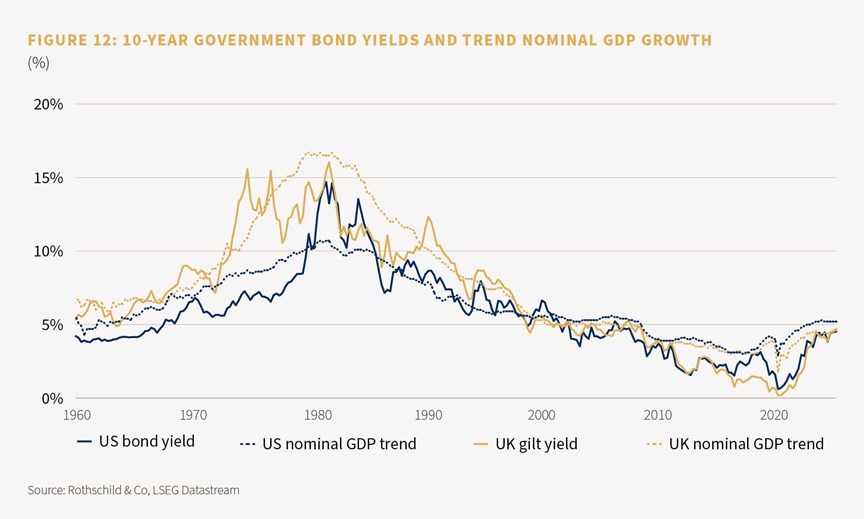
Figure 12 shows longer-dated US and UK bond yields alongside trend rates of growth in nominal GDP – the sum of real growth and inflation.
By the standards of financial modelling, these are good fits. For some sub-periods there are systematic divergences, and the UK market perhaps seems a bit more anticipatory than the US. During the recent period of ‘emergency’ monetary policy, both yields fell well below nominal growth. But the average gaps between yields and nominal GDP trends over the whole period are less than a percentage point for both the US and UK.
This may be why government deficits often don’t move yields as expected, even in the short term. In recessions, aggregate savings might rise, and investor risk appetite fall – just as government deficits widen on faltering tax receipts and surging benefit payments. In the pandemic, investors wanted more ‘safe haven’ assets just as governments wanted to borrow more. Enhanced demand, meet rising supply.
Moreover, growth and inflation can be more correlated internationally than debt and deficits.
Conclusion?
None of this means governments can borrow without limit (or that they should try to!). There could be lines in the sand beyond which borrowing costs do surge in response to deficits and debt – we may just not have reached them yet.
But the popular picture of “The Market” continuously telling governments exactly how much they can borrow is a caricature. And as long-term investment advisers, we may not need to wait for debt ratios to fall before turning more positive on bonds – though we probably do need softer-than-expected growth and inflation.
UK Budget preview
The UK budget is political pantomime – a noisy, unavoidable seasonal ‘entertainment’ in questionable taste. Lots of individuals are affected, sometimes quite profoundly, but when we leave the theatre we realise that our collective outlook hasn’t changed much, and we won’t get that time back.
We write with this year’s ‘fiscal event’ just a week away. The previews have been even more excitable than usual, though the plot sounds familiar. A wise wizard announces from behind a curtain that some money will perhaps go missing in several years’ time, breaking the ancient rules of good housekeeping, and the ‘fiscal black hole’ has to be filled somehow. Spending being excluded from the script, a hapless Chancellor, after the traditional blaming of their predecessors, Brexit and the Nasty Stepmother (“Oh yes they did!”), announces that the good citizens will have to pay. Taxes also being excluded from the script, a stealthy ‘smorgasbord’ of other revenue raisers is announced (“It’s behind you!”), to be levied on those citizens who are less good than the others. Nobody being able to decide exactly who those are, the event ends with everybody confused, but with a catchy kitschy singsong in which construction-led growth, the magic money tree and a new set of forecasts from the wizard (who has stayed firmly behind that curtain) make everything turn out for the best (“There’s a tiny house”).
Seriously (are you sure? Ed), the UK’s fiscal shortfall, as reportedly identified by the Office for Budget Responsibility, does not sound that large (less than 1% of GDP at the forecast horizon). The likely increases in planned revenues will probably not alter the UK’s economic outlook materially – though they will, of course, matter more to the individuals affected, who seem set to be better off and older than most. The event’s political significance of course may be bigger than its macroeconomic consequences.
Ready to begin your journey with us?
Speak to a Client Adviser in the UK or Switzerland
Past performance is not a guide to future performance and nothing in this blog constitutes advice. Although the information and data herein are obtained from sources believed to be reliable, no representation or warranty, expressed or implied, is or will be made and, save in the case of fraud, no responsibility or liability is or will be accepted by Rothschild & Co Wealth Management UK Limited as to or in relation to the fairness, accuracy or completeness of this document or the information forming the basis of this document or for any reliance placed on this document by any person whatsoever. In particular, no representation or warranty is given as to the achievement or reasonableness of any future projections, targets, estimates or forecasts contained in this document. Furthermore, all opinions and data used in this document are subject to change without prior notice.