Growth Equity Update

October 2024 – Edition 31
- Unpacking the $6.6bn OpenAI raise: "We are making progress on our mission to ensure that artificial general intelligence benefits all of humanity." With these words, OpenAI’s Sam Altman revealed the company’s latest $6.6bn raise, followed a day later by a further $4bn credit facility. We look at who invested and who didn’t, at the financials and at the state of OpenAI as its mission shifts away from capped profit status.
- VC fundraising picking up: That $6.6bn had to come from somewhere. AI is proving a boost to VC firm funding with Thrive Capital, Index Ventures and Radical Capital launching substantial AI focused funds. European tech has attracted recent funds at Atomico, Balderton, Creandum and Noteus. Overall global VC funding is picking up with Q1 2024 at $30.4bn, Q2 at US$50.1bn and Q3 at $62.6bn.
- September better for VC company raises: After a slow August for European venture capital raises at $833m, September bounced back with our Deal Monitor recording raises of $3.4bn including twelve of $100m or more, the highest of the year. In the US September saw eighteen $100m+ deals raising a total of $4.1bn. The October number, with OpenAI’s $6.6bn, has already beaten that.
- Win-win: The Federal Government of Germany has launched the €12bn WIN initiative to promote the venture capital industry in Germany.
- Soft landing: Jobs growing, inflation static, interest rates on a downtrend. The Fed charts a path to a soft landing.
- ‘ A touch of madness is, I think, almost always necessary for constructing a destiny.' Marguerite Yourcenar
Click here to download a PDF version of Growth Equity Update
OpenAI’s $6.6bn raise
Interesting features from the second biggest venture round in the US this year
It was a short statement from Open AI that came out on October 2.
‘We are making progress on our mission to ensure that artificial general intelligence benefits all of humanity. Every week, over 250 million people around the world use ChatGPT to enhance their work, creativity, and learning. Across industries, businesses are improving productivity and operations, and developers are leveraging our platform to create a new generation of applications. And we’re only getting started.
We’ve raised $6.6bn in new funding at a $157bn post-money valuation to accelerate progress on our mission. The new funding will allow us to double down on our leadership in frontier AI research, increase compute capacity, and continue building tools that help people solve hard problems.
We aim to make advanced intelligence a widely accessible resource. We’re grateful to our investors for their trust in us, and we look forward to working with our partners, developers, and the broader community to shape an AI-powered ecosystem and future that benefits everyone. By collaborating with key partners, including the U.S. and allied governments, we can unlock this technology's full potential.’
The essential details – a $6.6bn raise at a $157bn valuation- are there but not an awful lot more. Kremlinologists might glean a little extra. The increase in compute capacity might explain, for instance, why Nvidia came in for the first time as a backer of the business in this round. So, what else do we know, or can glean, from the coverage of this raise.
Led by Thrive Capital: The $6.6bn convertible raise was led by Thrive Capital. Thrive was founded by the now 39-year-old Josh Kushner in 2010 and has raised in the order of $7.3bn from investors. It was an early investor in Instagram and has been a partner of OpenAI and its founder Sam Altman for some time and led its previous round. Thrive Capital is investing around $1.3bn in this round which consists of c$750m from its own funds and $550m from partners in a special purpose vehicle.
Unlike other participants it has an option to invest another $1bn at the same valuation through 2025.
And co-leads: The raise was commonly reported as having Khosla Ventures, Microsoft and Nvidia as the co-leads.
Microsoft was an early investor in OpenAI in 2019 and followed that up with a $10bn investment in cash and kind in January 2023. It is reported to have contributed just under $1bn in this round.
Vinod Khosla founder of Khosla Ventures recently authored a 10,000 word social media post on the subject ‘AI: Dystopia or Utopia’ arguing that the potential impact of AI has been greatly underestimated. Khosla is reported to have invested more than $500m in this round. It was an early investor in OpenAI contributing $50m in 2019.
Nvidia is a first time investor in this round. It is reported to have put in $100m. Nvidia has its own family of large language models. On the same day as the OpenAI raise was announced, NVIDIA introduced the new NVLM 1.0 family led by the 72 billion-parameter NVLM-D 72B model which it hopes will compete with Open AI’s GPT-4 Omni.
Another new investor in this round is SoftBank which is reported to have invested $500m via the SoftBank Vision Fund II. In June, at the company’s AGM, CEO Masayoshi Son observed that Softbank’s past investments in the likes of Alibaba and Arm Holdings would look like ‘a warm up for my great dream to realize artificial superintelligence.’ He highlighted AI, semiconductors, autonomous driving, data centres and robotics as key areas for potential investment. Expressing his new mood of confidence and the now total shift from defense Masayoshi Son told its AGM that SoftBank will ‘look for our next big bet, without fear of whether it’ll be a hit or miss’, outlining that that ‘This is what I was born to do, to realise ASI -artificial superintelligence’ – technology smarter than humans.
A third new investor is MGX which was launched in March 2024 in Abu Dhabi. It is an AI-focused investment vehicle with Mubadala and technology business G42 as its founding partners. MGX aims to grow its assets under management to $100bn, focusing on large-scale technology investments.
Other investors known to have participated in this round are Altimeter Capital, Fidelity and Tiger Global. Brad Gerstner of Altimeter Capital spoke shortly after the Open AI deal was announced at the Madrona IA Summit in Seattle. He commented: ‘I hope and expect that the next step for OpenAI would be to go public. Having the opportunity for every retail investor in America to share in the upside that gets created by AI at a time we’re going to have massive social disruption, jobs lost, and other things, I think it’s critically important.’
Tiger Global was an early investor in Facebook and LinkedIn. It has been a regular investor in AI businesses having first bought into OpenAI in 2021 and having also participated in rounds for Scale AI and Cohere.
According to the Wall Street Journal, funding round investors can take their investments back if OpenAI does not complete its transition from a non-profit to a for-profit firm.
Who didn’t invest: A couple of interesting features here. During the funding round OpenAI reportedly asked prospective investors not to invest in direct rivals. These would include the likes of Elon Musk’s xAI venture, Anthropic, Cohere and Mistral.
This stipulation is unusual and rather goes against the clustering techniques frequently used by VCs to spread their bets in an industry which has found their favour. This has us reviewing who has recently been involved in funding Open AI’s rivals. At the very least Salesforce and Nvidia seem to have a pass.
Anthropic raised $4bn in a funding round announced in May this year. Salesforce Ventures was involved as were Qualcomm Ventures, Amazon, Hermitage Capital, 3 Comma Capital, Elevation Capital, Bessemer Venture Partners, Bossa Invest, IronArc Ventures, Helios Ventures, Wisdom Ventures, DT Unicorn Fund and Australian Gulf Capital. Press reports suggest that as of September 2024 Anthropic is seeking a new raise at a c$40bn valuation.
xAI’s $6bn round in May this year valued the company at $18bn. Elon Musk, one of the co-founders of OpenAI, started the business in July 2023. In November 2023 it launched Grok-1, an AI LLM 'modelled after the Hitchhiker’s Guide to the Galaxy. It is intended to answer almost anything and, far harder, even suggest what questions to ask.’ The Series B round was supported by Valor Equity Partners, Vy Capital, Andreessen Horowitz, Sequoia Capital, Fidelity Management & Research Company, Prince Alwaleed Bin Talal and Kingdom Holding, amongst others.
Cohere, the Canadian start-up which develops large language models for enterprise use, raised $500m from investors in July 2024 at a valuation of $5.5bn. Investors in the round included Cisco, AMD, Fujitsu, Nvidia and Salesforce as well as PSP Investments of Canada and Canada’s export credit agency. Cohere had $35m ARR in March 2024.
French LLM start up Mistral raised a $640m round in June this year led by General Catalyst. Nvidia and Salesforce Ventures were present as well as Lightspeed, Andreessen Horowitz, Samsung Ventures, Belfius, Bertelsmann Investment, BNP Paribas, Bpifrance, Cisco, Eurazeo, Headline, Hanwha Asset Management, IBM, Korelya Capital, Latitude, Millennium New Horizons, Sanabil Investments, ServiceNow and SV Angel.
The notable absentee from the list of investors is Apple. In June 2024 Apple and OpenAI announced a partnership to integrate ChatGPT into Apple ‘experiences’. ChatGPT integration, powered by GPT-4o, is due to come to iOS, iPadOS, and macOS allowing Siri to display ChatGPT responses directly with user permission.
Apple, which does not habitually invest in other tech companies, was reported to be involved in negotiations to join the OpenAI fund raise but appeared to drop out of the running at the end of September.
The valuation: The $6.6bn deal valued OpenAI at a pre- money valuation of $150bn. It was a big jump in the valuation. The previous $300m round in April 2023 gave OpenAI a value of c$29bn. A secondary round in January 2024, designed to allow employees to sell stock in the company, valued the business at $80bn.
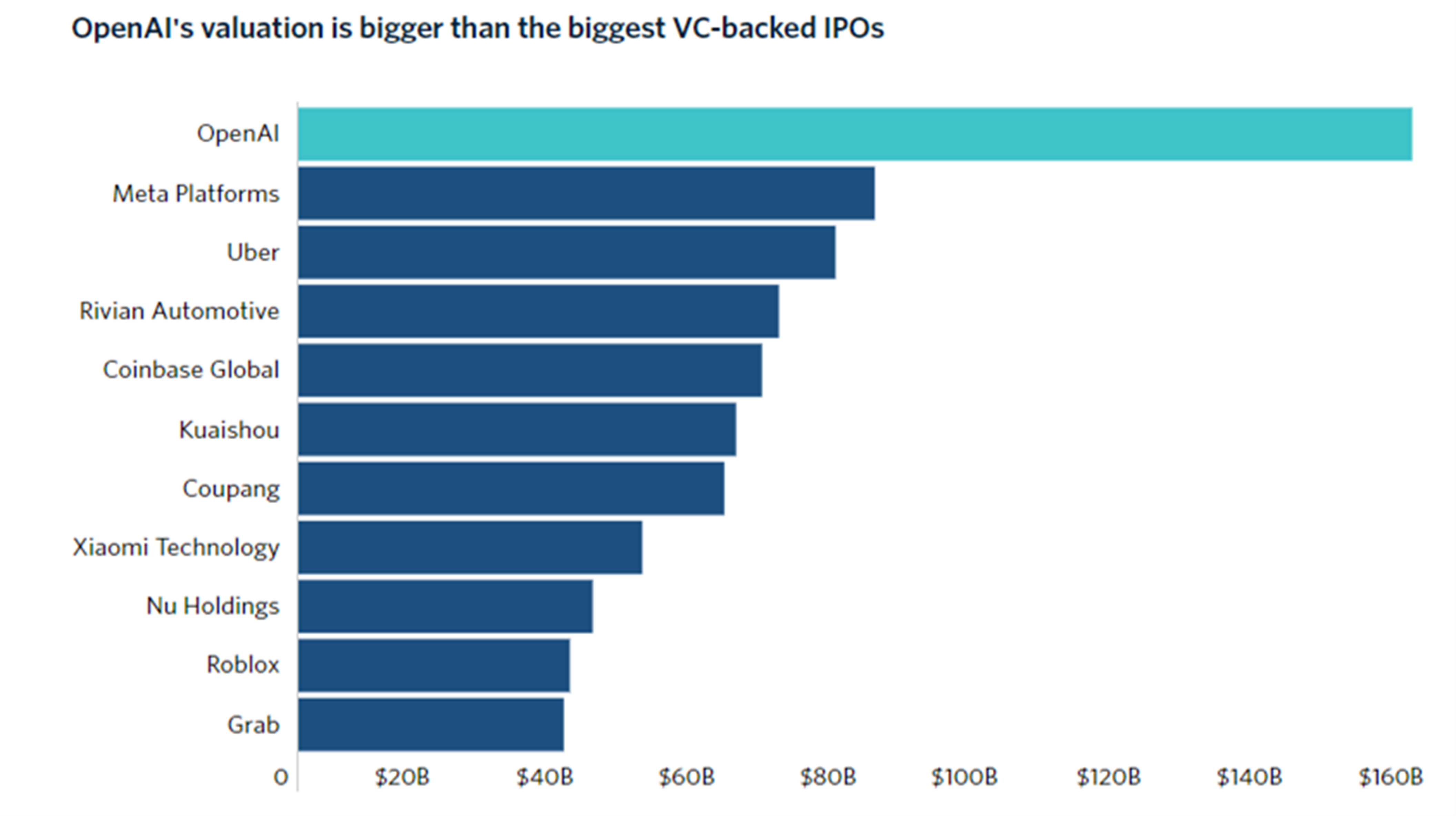
Pitchbook observes that at a post money valuation of $157bn OpenAI has been valued at more than any VC backed company at the time of their IPO – and this includes Meta, Uber and Rivian Automotive. At this valuation OpenAI is also valued higher than 87% of the companies in the S&P500.
open ai's valuation
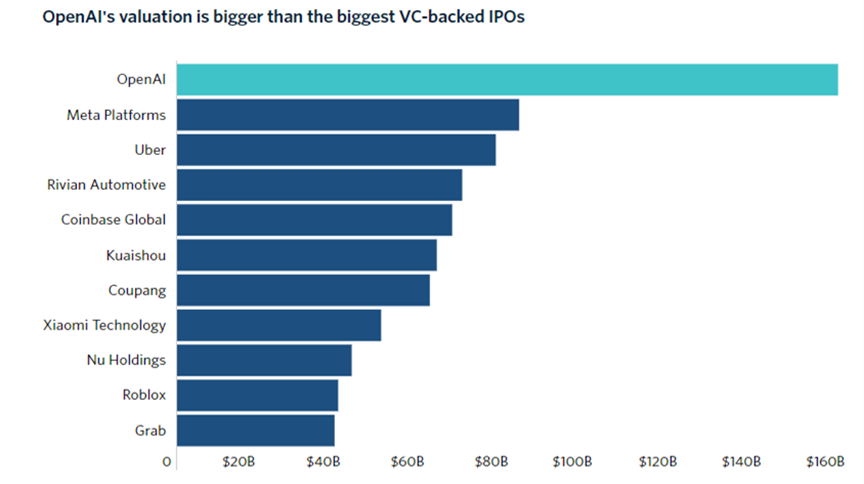
Source: PitchBook Data
IPO valuations are post-money and based on shares outstanding at the time of the IPO
Source: PitchBook Data
IPO valuations are post-money and based on shares outstanding at the time of the IPO
How are the financials looking? It is reported that OpenAI only shared its financial documents with investors willing to put in a minimum of $250m. We do not have direct access to the documentation….
Various press reports have though filled in on OpenAI’s financial progress. The New York Times shared Open AI’s revenue forecasts stating that revenues are expected to be $3.7bn in 2024. This consists of $2.7bn from ChatGPT (up from $700m in 2023) and $1bn from other sources.
Revenues are forecast by OpenAI to rise to $11.6bn in 2025 which would imply that the fund raise was struck at a c13x 2025 revenue multiple. OpenAI projects its revenue will reach $100bn in 2029 – reducing the sales multiple to 1.5x in that year.
We note that back in January 2023, when Microsoft made its $10bn investment, OpenAI management was forecasting $200m in revenue in 2023 and $1bn by 2024.
ChatGPT has more than 250 million users of which, however, only circa ten million are paying customers. The company plans to raise ChatGPT subscription fees from $20 per month presently to $22 pm and then to $44 pm over the next five years.
The company expects a c$5bn loss in 2024 before expensing the cost of equity compensation for its employees.
As an indicator some press reports state that OpenAI has thus far invested c$7bn on model training and $1.5bn on staff costs. At one point ChatGPT was said to be costing OpenAI $0.7m a day to run.
$4bn credit facility: The day after the convertible funding was revealed OpenAI announced a new revolving credit facility of $4bn with participating banks including JPMorgan Chase, Citi, Goldman Sachs, Morgan Stanley, Santander, Wells Fargo, SMBC, UBS, and HSBC. As yet it remains undrawn. There is an option to increase the credit facility by an additional $2bn. The facility is unsecured and can be deployed over the next three years. It is reported that OpenAI will pay the SOFR (Secured overnight financing rate) plus 100 basis points on the utilised portion of the facility – equivalent to c6%.
As OpenAI observes, combined with the equity raise this gives it access to over $10bn in liquidity. Sarah Friar, CFO of OpenAI commented ‘This credit facility further strengthens our balance sheet and provides flexibility to seize future growth opportunities. We are proud to have the strongest banks and investors in the world supporting us.’
Secondary – employee sales: Part of the reason for the fund raise is to provide liquidity for employees who want to sell stock. Press reports cite OpenAI’s CFO saying in a memo to employees that the company has ‘the ability to offer a tender event to give qualifying employees a liquidity option’. Details will be revealed later. Employees were last able to sell shares in a tender offer in February 2024 which valued the company at $86bn in a deal led by Thrive Capital. OpenAI employees earn around $300k a year in base salary and receive ‘Profit Participation Units’ which vest in equal amounts over four years.
The shift in OpenAI’s mission: OpenAI started out as a non-profit business. In 2015 it was established as a not-for-profit that would make its patents and research open to the public.
In 2019 it transferred to a ‘capped’ for-profit status. OpenAI LP, a for-profit business was formed, of which the non-profit OpenAI Inc was the sole controlling shareholder. Stating ‘the mission comes first’ (that safe artificial general intelligence is developed and benefits all of humanity) the founders of the company said:
“We want to increase our ability to raise capital while still serving our mission, and no pre-existing legal structure we know of strikes the right balance. Our solution is to create OpenAI LP as a hybrid of a for-profit and nonprofit—which we are calling a ‘capped-profit’ company. The fundamental idea of OpenAI LP is that investors and employees can get a capped return if we succeed at our mission, which allows us to raise investment capital and attract employees with startup-like equity. But any returns beyond that amount—and if we are successful, we expect to generate orders of magnitude more value than we’d owe to people who invest in or work at OpenAI LP—are owned by the original OpenAI nonprofit entity.”
As a capped profit business therefore the returns that OpenAI’s for-profit can give to investors and employees are limited - capped- with the remainder given to the nonprofit.
There appears to be a stipulation in the most recent round that its investors will be able to reclaim their investment if the current capped profit status is retained.
Change appears to be afoot. Reuters reports that OpenAI is working on a plan to restructure its core business into a for-profit benefit corporation that will no longer be controlled by its non-profit board. The proposed model is that of a public benefit corporation. This is the model employed by OpenAI’s counterparts Anthropic and xAI. There is no cap on profit returns for a public benefit corporation which is a ‘for profit’ business albeit defined as acting for the public benefit.
It seems the OpenAI non-profit will continue to exist although its main role now come through owning a stake in the for-profit company. OpenAI would no longer be ultimately controlled, as is the case now, by its non-profit board.
The structure of public benefit corporations also endows them with certain ‘poison pill’ attributes that might appeal to founder led companies not wanting to have their path deflected by the threat of takeover or shareholder activism. The requirement to balance the public benefit plus the best interests of shareholders and other stakeholders would potentially compromise any third-party action to change the nature of the company.
Management changes: This mission shift may be a moving force behind the flurry of management changes that took place at the time of the raise.
The November 2023 convulsion: OpenAI underwent a convulsion in November 2023 when its founder and CEO Sam Altman was summarily removed after the four strong non-profit board, which included OpenAI’s chief scientist Ilya Sutskever, declared that it had no confidence in his leadership. The CTO of OpenAI Mira Murati was appointed as interim CEO. The resignation of OpenAI’s Chairman Greg Brockman, an ally of Sam Altman, was followed by the Board’s decision to appoint the former CEO of Twitch, Emmett Shear, as Open AI’s CEO. A threat of mass employee resignations, including by Ilya Sutsekever, followed leading to the reinstatement of Sam Altman four days after his summary removal.
Recent departures: There are clearly tensions at OpenAI which appear to centre around the mission of the company, the changing roles of people as the company develops as well as the usual personal friction that can arise in these situations. In the run up to, and through the equity raise, a number of prominent departures have occurred.
In May 2024 chief scientist and co-founder Ilya Sutskever left OpenAI and started his own company, AI research lab Safe Superintelligence. In September this raised $1bn in a deal led by Andreessen Horowitz and Sequoia which valued the business at $5bn.
Another of the company’s co-founders John Schulman left in August 2023 due to a ‘desire to deepen my focus on AI alignment’ and reappeared at Anthropic where he was joined by Jan Leike, who had been Head of Alignment at Open AI.
Chairman Greg Brockman, another cofounder, announced in early August that he was going on sabbatical.
On September 25th, 2024, Mira Murati, OpenAI’s CTO who was a significant figure in the development of ChatGPT, and who was briefly CEO in the November 2023 interregnum, announced her resignation. Murati said she is leaving OpenAI to 'create time and space to do my own exploration.' She is believed to be being courted vigorously by venture capitalists anxious to fund her next venture.
On the same day the Chief Research Officer at OpenAI, Bob McGrew, resigned as did the vice president of research, Barret Zoph.
Sam Altman commented 'I saw some stuff that this was related to a restructure, that’s not true. This is just about people being ready for new chapters in their lives.'
Interestingly only two of the eleven cofounders remain at the company. Wojciech Zaremba leads some of the research and language teams. SamAltman is CEO.
Reports that Sam Altman will now receive a stake in OpenAI appear to be premature. Bloomberg has reported that Altman could receive a 7% stake – worth at the $150bn pre money valuation c$10.5bn.
Bret Taylor, the chairman of Open AI told Fortune that 'The board has had discussions about whether it would be beneficial to the company and our mission to have Sam be compensated with equity, but no specific figures have been discussed nor have any decisions been made.'
Venture Funds – a flurry of fundraising
The more positive tone prevails
We observed in our July Growth Equity Update that, while the statistics for global venture capital firm fundraising continued to look relatively downbeat, the tone of recent fundraising trends had begun to look more optimistic.
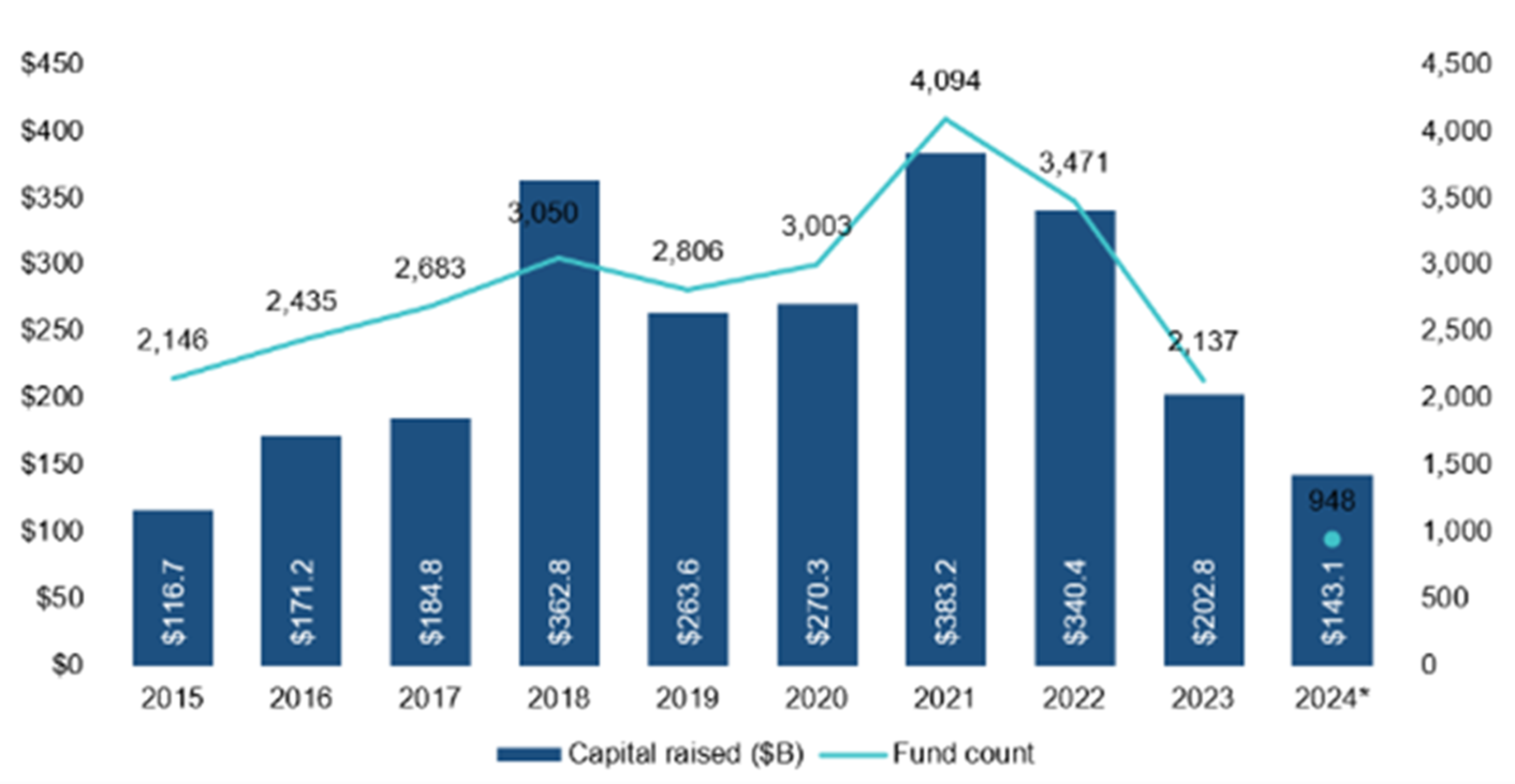
This assertion appears to be borne out by the flash figures produced by Pitchbook for global VC fundraising to the end of September.
Pitchbook data for H1 2024 suggested that globally the industry had raised $80.5bn putting it on track to raise $161bn for the full year, compared with $203bn in 2023 and the peak of $382bn in 2021. $161bn would have been the lowest amount raised since the $117bn of 2015.
After nine months the total raised now stands at $143.1bn meaning that the industry is on track for a full year total nearer $190bn, close to the 2023 outturn. Q1 VC funding was $30.4bn, Q2 was at US$50.1bn and Q3 at $62.6bn.
As before, average fund size has risen substantially, with the few new investment vehicles suggesting that funds are being concentrated with larger players.
Global VC fundraising activity- Capital Raised and fund count
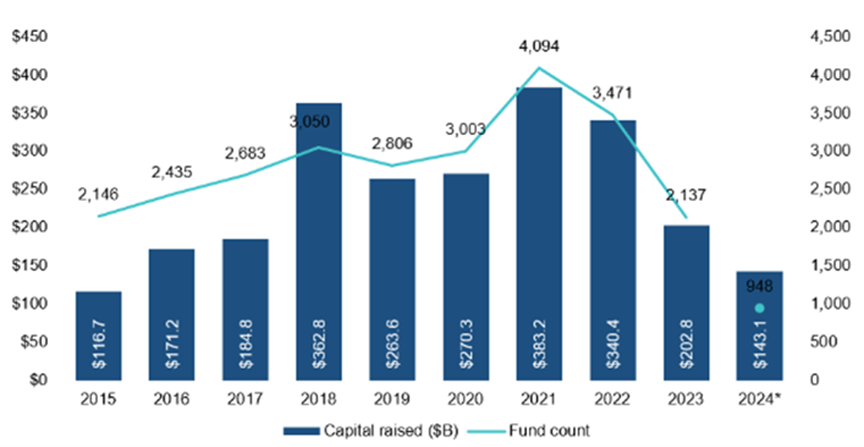
Source: Pitchbook Q3 2024 Global Venture First Look – As of 30th September 2024
Source: Pitchbook Q3 2024 Global Venture First Look – As of 30th September 2024
Recent announcements by big venture funds suggest conditions in the market are improving.
Insight Partners is reportedly close to closing its 13th fund with $10bn already committed. General Catalyst is close to raising $6bn in new funds. Like Insight its focus is on technology businesses. Lightspeed Ventures is raising money for three new funds which in total would amount to $7bn, a bigger raise than the $6.7bn amassed for its last series of funds in 2022.
In August, Balderton Capital raised $1.3bn to invest in European tech businesses. The money consists of a $615m early-stage fund and a $685m growth fund aimed at more mature start-ups. Headline announced its $865m fourth growth fund in September with the aim to deploy half the money in Europe.
Also in Europe, Creandum raised a €500m tech-focused fund in July. General partner Carl Fritjofsson commented it was raised ‘in record time’, observing 'There is a dramatic change in the sentiment, appetite and activity across the industry.'
In early September tech investor Atomico announced €1.12bn of raises across two funds, the €681m Atomico Growth VI aimed at Series B to pre-IPO and the €438m early-stage fund, Atomico Venture VI.
September saw a new European VC firm, Noteus, formed by former members of Eurazeo, target a new €600m fund to invest in European tech.
The development of Artificial Intelligence and its breakthrough opportunities is attracting much focused venture capital money. In July Index Ventures raised $2.3bn with its focus on artificial intelligence opportunities. Thrive Capital, a significant player in the recent OpenAI round, raised $5bn for a pair of funds in August.
Radical Ventures announced an $800m raise in August focused on AI investments. It was an early investor in Cohere and Radical’s co-founder Jordan Jacobs comments on the AI opportunity 'There are some truly giant future companies that are now transitioning from early stage to growth and feel we have the expertise and relationships to invest.’
Reflecting the pickup in biotech investment we have been tracking in recent months Arch Venture Partners closed a $3bn fund in September. Arch’s 13th fund is aimed at early-stage biotech companies. Bain Capital Life Sciences also recently closed with $3bn for its fourth fund ‘to invest scale capital globally in transformative medicines, medical devices, diagnostics and life sciences tools.’
Biotech investor DCVC Bio raised a new $400m fund at the end of September.
Developments in the secondary market as well as firms target undervalued venture stakes. GSquared announced a new $1.1bn fund in August focused on secondaries. Lightspeed is moving more heavily into secondaries citing that ‘Given market dislocation we [have been] able to purchase a lot of very compelling new opportunities at significant discounts of 45 to 50 per cent compared to the last fundraising round.’
Back in June Stepstone’s VC Secondaries Fund VI raised $3.3bn, identified as the largest ever fund dedicated to venture secondaries.
China stimulus and jumbo cuts
The markets have ground further up, with China stimulus an unexpected boost and a 50bps US rate cut.
In public markets September started poorly with a revival of US slowdown fears occasioned by the JOLTS figures (Jobs Openings and Labor Turnover Statistics) whose low number of jobs vacancies were interpreted as an indicator of potential recession. After the July job numbers Fed Chairman Jay Powell acknowledged 'the labour market has cooled considerably' that 'downside risks to employment have increased” and that the Fed does “not seek or welcome further cooling in labour market conditions.'
The Fed was accused of cutting rates too late by holding rates steady at the end of July. The Fed itself indicated that its focus was shifting from the fight against inflation to the state of the jobs market. The result was a ‘jumbo’ cut of 50bps at the Fed rate meeting on 17th September, taking the Fed rate down to 4.75%-5%. This had been anticipated and the positive effect was then somewhat tempered by strong jobs numbers announced on October 4. The 254,000 ‘surge’ in payrolls was 100,000 better than expected, the employment rate fell to 4.1%, the July and August numbers which had caused such angst were revised up and the apocalyptic Sahm rule recession indicator was reversed.
The strong jobs number in particular appears to have convinced the market that the Fed is in the process of pulling off the seemingly unachievable – controlling inflation while encouraging growth and guiding the US towards a soft landing.
All of this in turn had the market revising down its expectation of another jumbo cut by the year end. The expectation is now of a 25bps cut at each of the remaining two meetings in 2024. There is a minority view that the Fed may not cut rates at all at its meeting on 6-7 November. The final meeting of the year is on December 17-18. Minutes from the September Fed meeting show that support for a 50bps rate cut was not unanimous with the statement that ‘Several participants noted that a 25 basis point reduction would be in line with a gradual path of policy normalisation that would allow policymakers time to assess the degree of policy restrictiveness as the economy evolved.’
The Fed’s official dot plot showing its projected course of interest rates indicates another 50bps of rate cuts by the end of 2024 (so two cuts of 25bps each) taking the Fed rate to 4.25%-4.5% and a further fall of 100bps to 3.25%-3.5% by the end of 2025.
Market momentum thus stalled post the Fed rate cut in mid-September but was revived by the unexpected stimulus measures announced by China on September 24. The PBOC central bank announced it would cut interest rates by 20-30bps and the reserve requirement ratio (RRR) for banks - the amount banks must hold as reserves- by 50bps. In theory this will free up to c$140bn in new lending capability. To stimulate the property market mortgage rates were reduced by 50bps and the minimum deposit required to buy a home was cut to 15%. Other measures such as easier funding for insurers and brokers were also introduced.
The enthusiastic response to these monetary easing measures intensified when the Chinese Politburo in its September 26 meeting pledged the ‘necessary fiscal spending’ to ensure China meets its 5% economic growth target.
The CSI 300 Index (the top 300 stocks on the Shanghai and Shenzhen exchanges) jumped 25% in the last week of September as a result and were 32% up by October 8th before disappointment at the failure of officials to announce specific plans at a meeting on that day tempered the gains.
Elsewhere the Bank of Canada cut its interest rate at the start of September by 25bps to 4.25% and indicated that more cuts are likely with the BoC governor indicating in mid-September that it might move to 50bps rate cuts if growth disappoints.
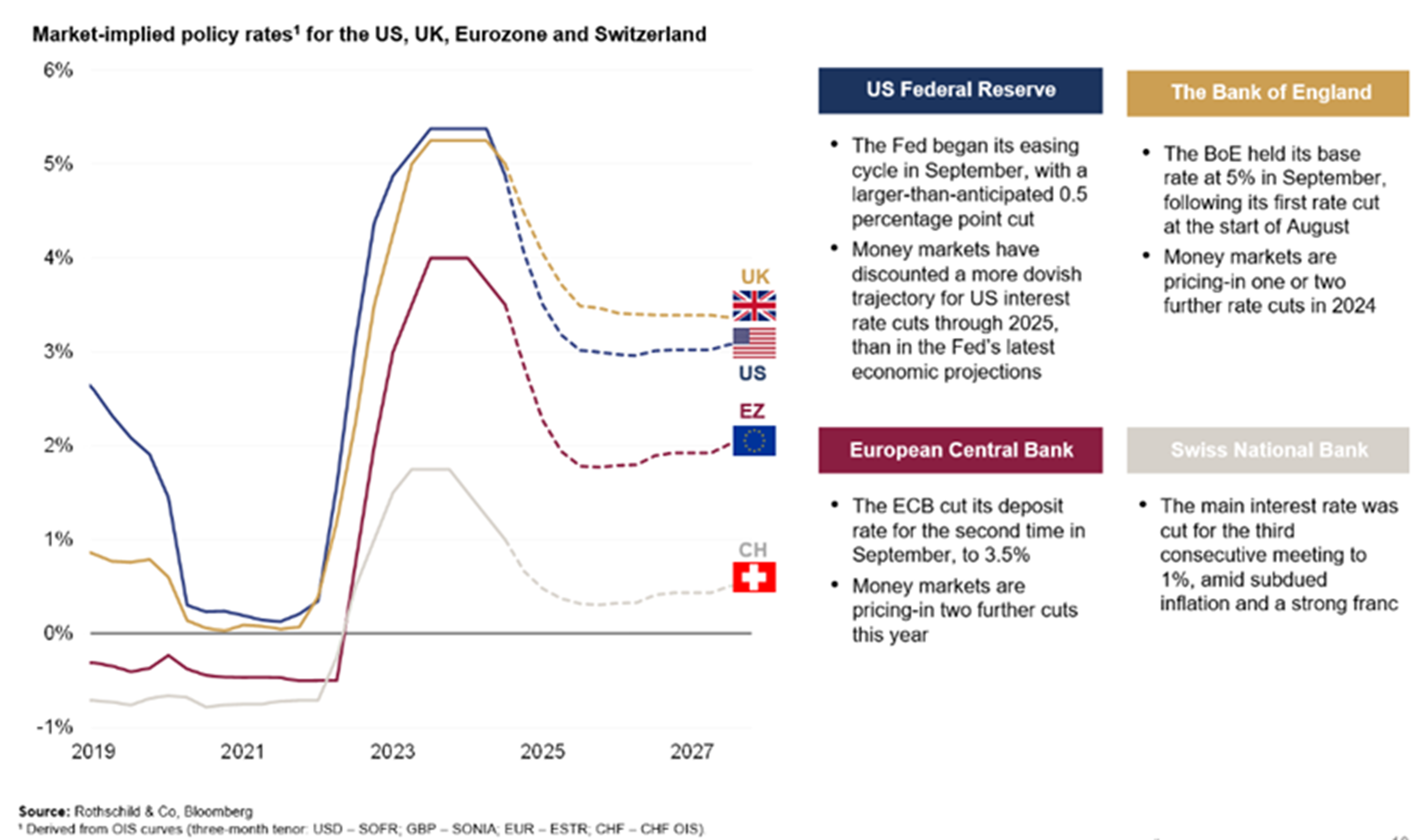
In the UK in August the Bank of England made a 25bps rate cut to 5%, the first rate cut since 2020. The decision was close, with a 5-4 majority on the BOE rate setting committee. It held the rate at 5% in the September meeting. The governor of the Bank of England then indicated in early October that interest rate cuts could be ‘a bit more aggressive’ citing less persistent inflation pressures. This has led forecasters to expect as much as two 25bps rate cuts by the end of the year starting with the meeting on 7 November (the other is on the 19th of December).
On June 6, the ECB lowered interest rates for the first time in five years, cutting the core interest rate by 25bps to 3.75%. At its mid-September meeting it reduced by another 25bps to 3.5% although the minutes of that meeting released in early October said that a 'gradual' and 'cautious' approach to rate cuts is still appropriate because it is 'not fully certain that the inflation problem was solved.'
It previously indicated that it was ‘not pre-committing to a particular rate path’. Nevertheless over 90% of economists in an early October Reuters poll expect a further 25bps rate cut to 3.25% at the next meeting in mid-October and the same percentage expect another cut to 3% at December’s meeting.
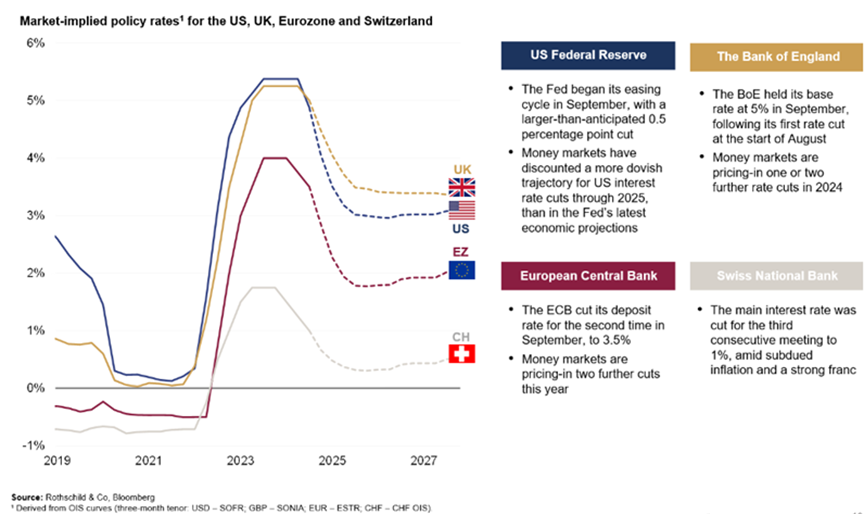
Interest rates are starting to fall
Source: Rothschild & Co, Bloomberg
Source: Rothschild & Co, Bloomberg
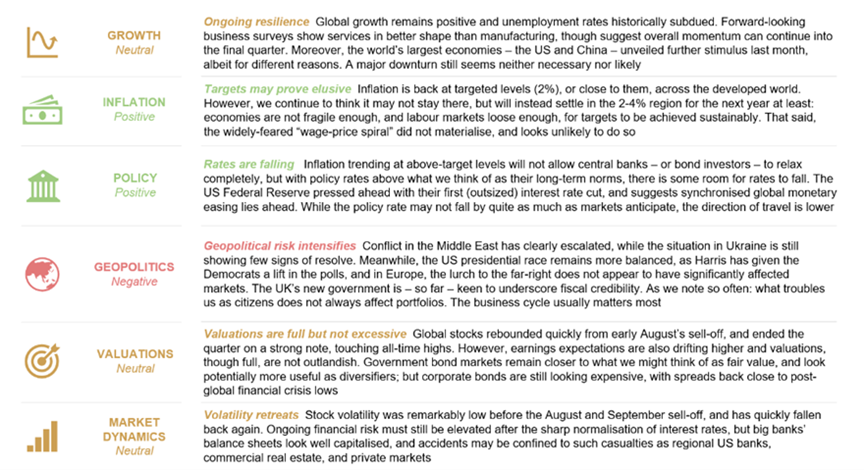
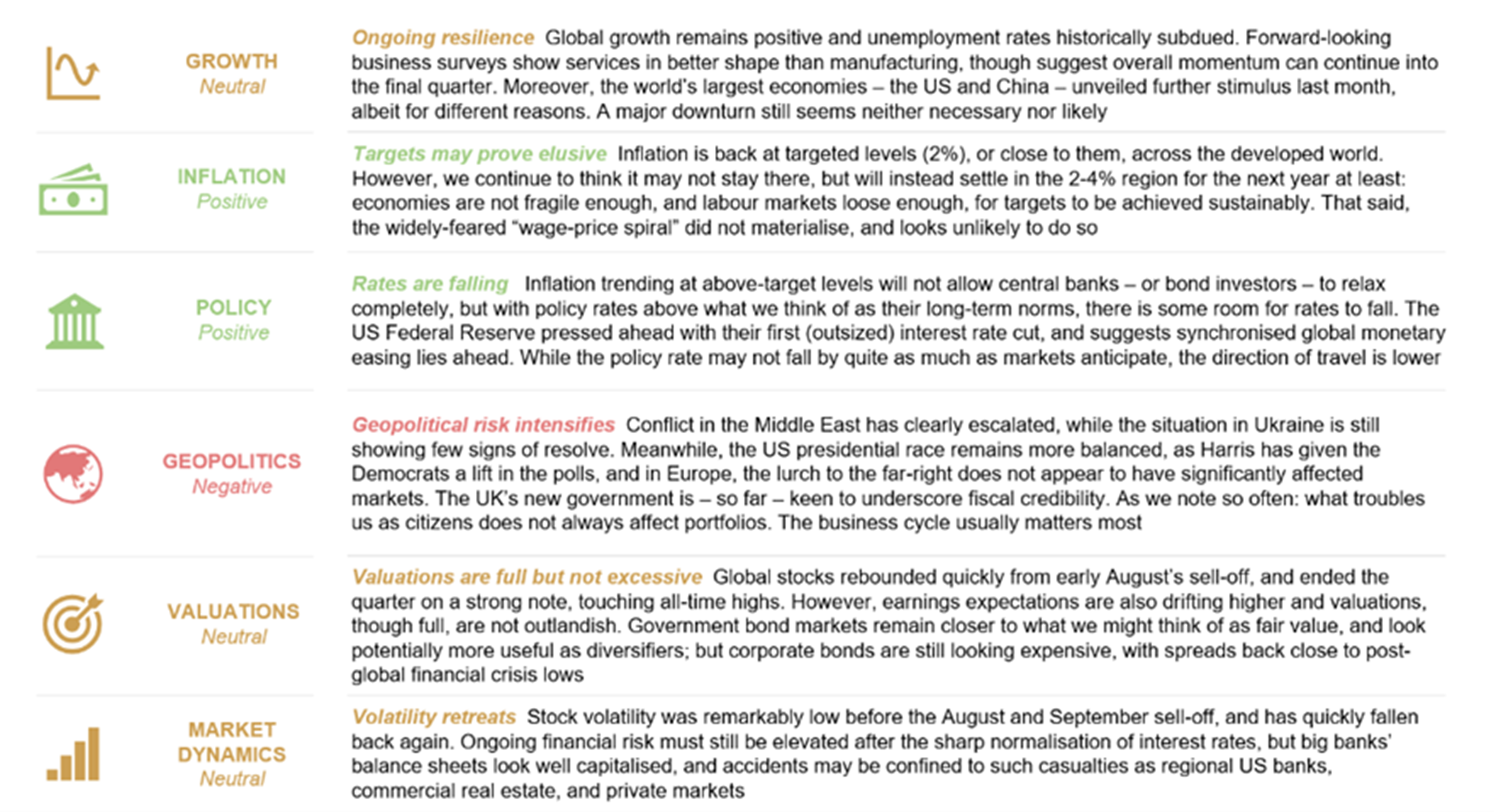
Rothschild & Co strategist Kevin Gardiner summarises the current key drivers of the market in this graphic:
Germany – promoting the venture market
Win-win?
In mid-September, the WIN initiative was announced in Germany with its slogan ‘growth and innovation capital for Germany’. As part of the programme the Federal Government, in cooperation with KfW and a broad alliance of companies and associations has agreed to target €12bn of investments in domestic startups and innovative companies by 2030. Other signatories include Allianz, Blackrock, Deutsche Bank, Commerzbank, Deutsche Telekom, AXA Deutschland, and insurance companies such as HUK Coburg.
The plan was initiated by Christian Lindner, German Minister for Finance, and backed by Robert Habeck, German Minister for Economics and Climate Protection. The announcement was made at the Startup Germany Summit.
There is a ten point plan. The key focus is on:
Promoting cooperation between universities and companies: WIN will use the EXIST “Startup Factories” to promote the establishment of science-based startups. By 2025, it is hoped up to ten new start-up factories will be built to facilitate the transfer of scientific innovations into marketable companies.
New fund vehicles: Wealthy individuals and institutional investors will be encouraged to invest more in venture capital through new fund vehicles such as the “European Long-Term Investment Fund” being developed for the purpose.
Tax incentives: Tax breaks to encourage investments in growth and innovation capital are planned to include includes increasing the ratio for venture capital investments and adapting investment regulations.
Secondary market for venture capital funds: As in the UK there is a plan to create a secondary market for venture capital shares to increase liquidity and strengthen the venture capital ecosystem.
Improving the legal and regulatory framework: Amendments will be made not just to provide new sources of capital but also to change the legal and regulatory framework to help venture companies as they scale up with a focus on regulations in key market sectors such as CleanTech.
Verena Pausder, chairperson of the German Startup Association notes that German VC backed companies suffer a funding gap, especially in the later stages. She observes: 'The WIN initiative specifically addresses the [growth financing] problem and is an important step in the right direction. It has the potential to be a real game changer — similar to what France managed with the Tibi initiative.'
Interestingly, the WIN initiative also targets cultural change in Germany. It regards the traditional investment culture in Germany as conservative and risk averse when looking at potential VC investments. The aim is to change this attitude towards VC investing amongst both institutional and private investors.
The German Ministry of Finance launched the first measures this summer with the draft of the second Future Financing Act.
The German Chancellor, Olaf Scholz, commented:
"With it, private investments in venture capital, startups, and innovation technologies are to be mobilized. This strengthens the German venture capital market and economic location as a whole."
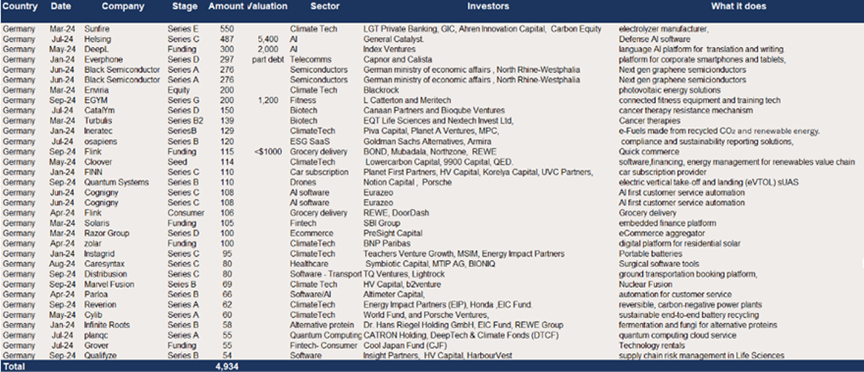
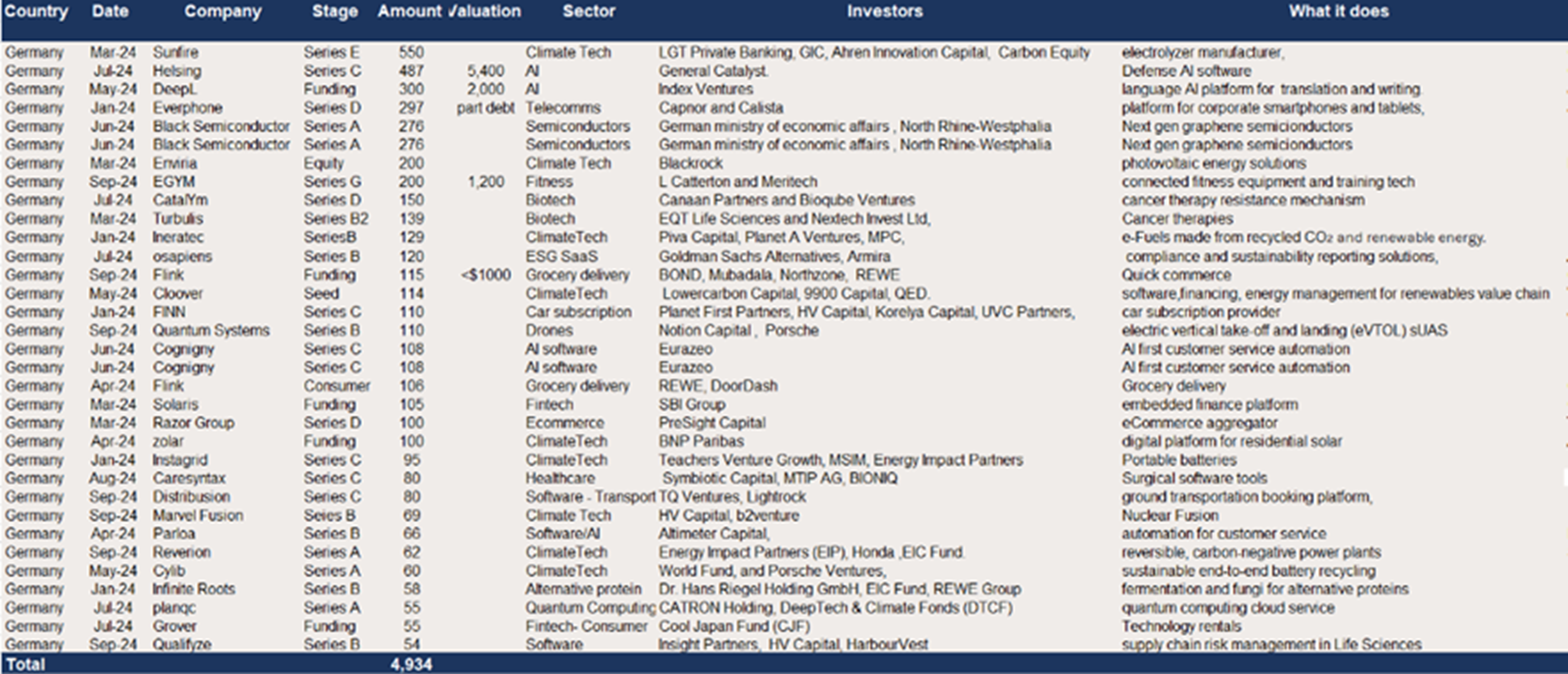
Our Deal Monitor indicates that raises of $20m or more for German VC backed companies totalled c$5.6bn in the first nine months of 2024. The 33 deals of $50m or more raised $4.9bn. The biggest raise has been $550m for ClimateTech business Sunfire, an electrolyser manufacturer. The next two have both been AI related, with General Catalyst leading a $487m raise for defence AI business Helsing and Index Ventures a $300m raise for DeepL an AI driven language platform for translation and writing.
The largest German VC raises - 2024 ytd
Source: Rothschild & Co
Source: Rothschild & Co
Venture capital raises – momentum slowed in Q3
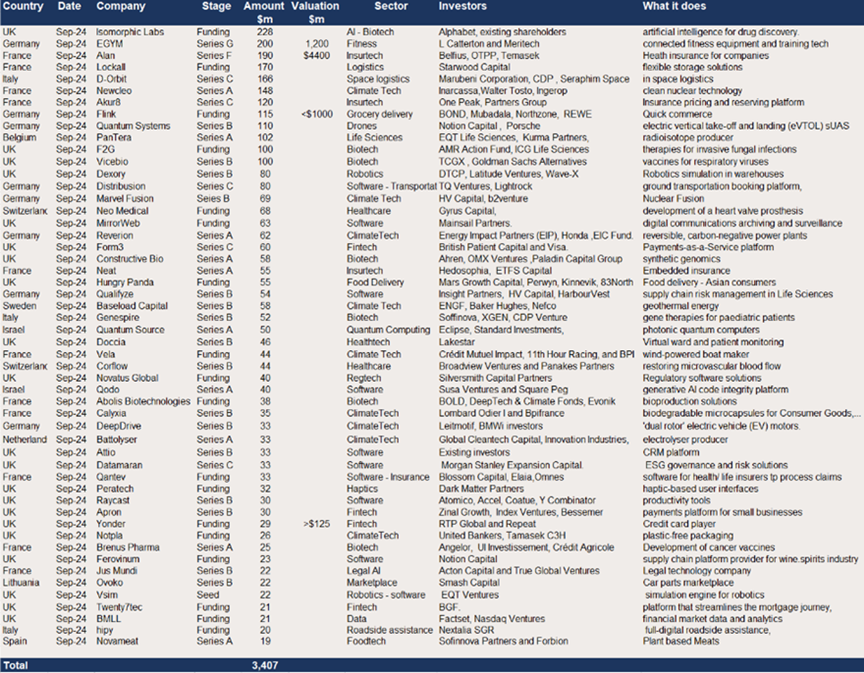
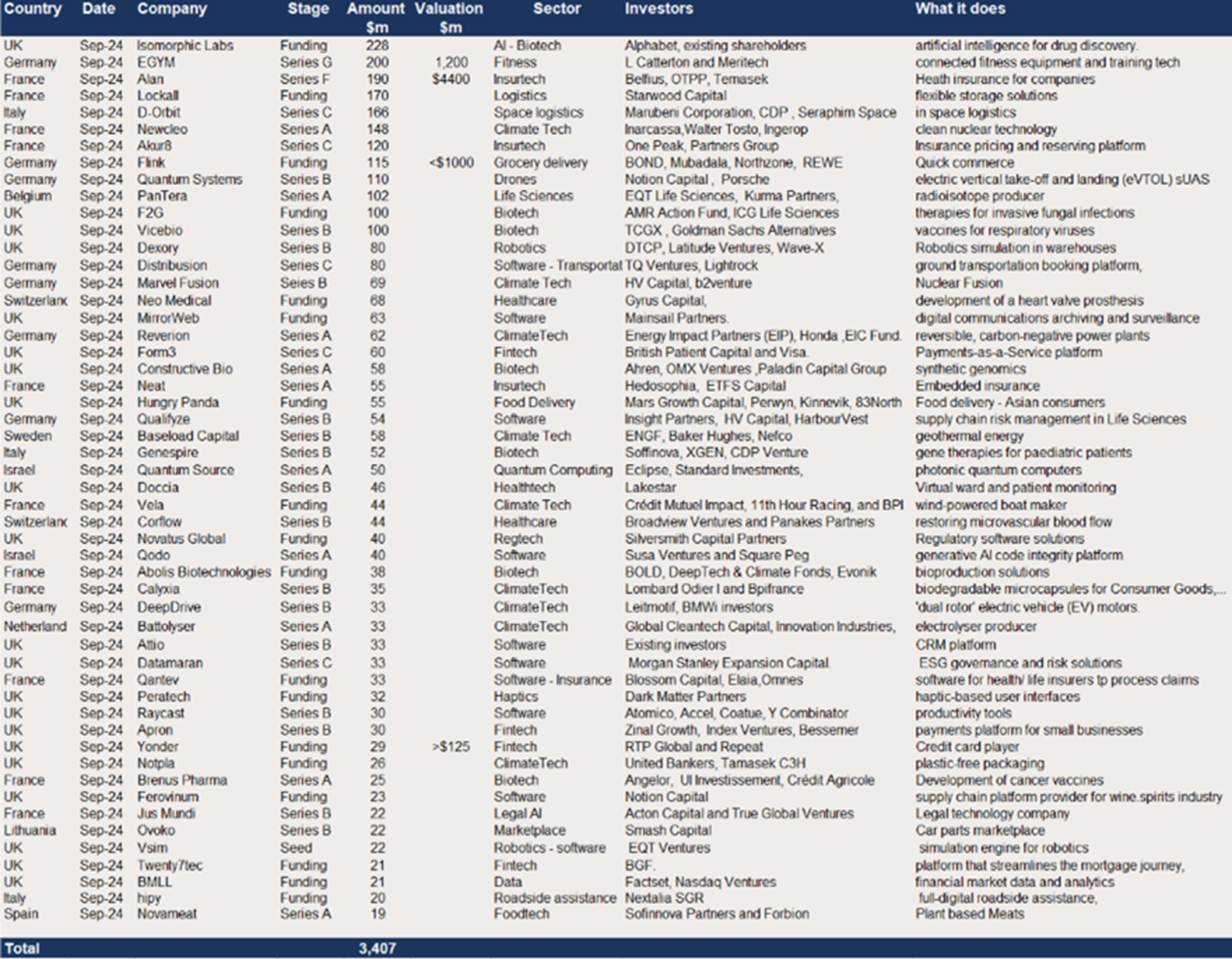
After a slow month in August for European venture capital raises (just $833m) September bounced back with our Deal Monitor recording total raises of $3.4bn. This included twelve raises of $100m or more, the highest total of the year so far.
September is typically a strong month. In 2023 it was that year’s best month by far with $6.9bn raised, twice the September 2024 total. In turn September 2024 was 5% ahead of the $3.25bn of September 2022.
YTD 2024 European raises are at $25.6bn, 6% ahead of the 2023 level. The relative momentum though was stronger at the start of the year. Q3 2024 saw just short of $8bn of European VC raises, down 27% on Q3 2023 and 10% down on Q3 2022.
The largest deals in September were marked by their diversity with three biotechs, two insurtechs and seven other categories in the twelve $100m plus deals.
The largest deal was for Isomorphic Labs which has developed an AI led platform which greatly reduces the time involved in the pre-clinical trials drug discovery process. It raised $228m. Two other biotechs were prominent. Vicebio of the UK raised $100m for its vaccines for respiratory diseases from TCGX and Goldman Sachs Alternatives. F2G, a UK company that specialises in therapies for invasive fungal infections raised $100m from AMR Action Fund and ICG Life Sciences. Belgian Life Sciences business PanTera, a radioisotope producer, raised $102m in a deal led by EQT Life Sciences.
Two French insurtechs appeared amongst September’s biggest raises. Alan is a digital health insurance company aiming to revolutionise health insurance by improving user experience while providing an excellent price-quality ratio health plan. It raised $190m in a Series F at a valuation of $4.4bn in a deal led by Belfius. It was last valued at €2.7bn when it raised a €183m Series E in 2022. Akur8 uses AI to model insurance pricing in P&C and Health. Its $120m Series C was led by One Peak and Partners Group.
German connected fitness business EGYM raised $200m in its Series G led by L Catterton and Meritech, in a deal valuing the company post money at $1.2bn. It last raised $225m in July 2023 in a deal led by Affinity Partners. Back then, its corporate health network operation, Wellpass had more than 2.5 million users. Now it has 17,000 sports partners (gyms), 14,000 corporate customers, and 3 million 'eligible' users.
French flexible storage business Lockall raised $170m in funding from Starwood Capital to develop itself storage site network across the Ile-de-France.
D-Orbit, an Italian in-space logistics company which specialises in the orbital transfer vehicle (space tug) market raised $166m from Marubeni Corporation, CDP, and Seraphim Space.
Clean nuclear technology company Newcleo raised $148m in a Series A led by Inarcassa, Walter Tosto and Ingerop. The company develops small modular reactors (SMRs) that are powered by reprocessed nuclear waste. It is constructing a manufacturing plant for reprocessed nuclear waste and a prototype reactor in France with completion expected in 2030/31. The company recently announced a shift in its headquarters from London to Paris.
Quick commerce business, Flink which earlier this year was in merger talks with Getir, raised $115m at a valuation of just under $1bn in a deal led by BOND and Getir’s major shareholder, Mubadala. Getir itself has withdrawn from its European operations and has focused its activity on Turkey.
Quantum Systems describes itself as a global leader in EVTOL (electric vertical take-off and landing) drones specialising in the collection of aerial data for use by military, government, and commercial users. The German business raised $110m in a Series B with Norton Capital and Porsche.
Europe - $3.4bn of raises in September
Source: Rothschild & Co
Source: Rothschild & Co
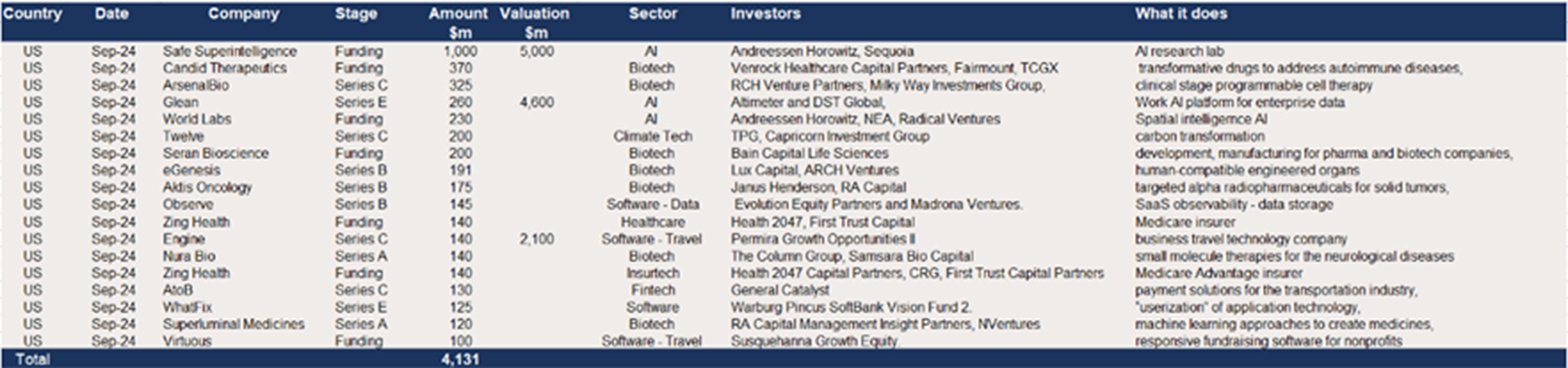
In the US September saw eighteen $100m plus deals raising a total of $4.1bn. This was down on the July and August totals, both of which came in at $6bn. Maybe venture capitalists were distracted by the $6.6bn OpenAI raise where the negotiations took place in September but where the actual close came at the start of October. The OpenAI deal is only the second largest year to date in the US, ahead of the $6bn raised for xAI in May but well short of the $9.2bn raised by Vantage Data Centers in June.
As in August the biggest deals in September were in AI and biotech, capturing eight of the top nine deals – the interloper was a ClimateTech deal.
There were three AI deals amongst the largest. September’s biggest US raise was $1bn for the AI research lab Safe Superintelligence. The deal was led by Andreessen Horowitz and Sequoia and valued the business at $5bn. There were two other prominent AI raises in the month. Glean, a Work AI platform connected to companies’ enterprise data raised $260m in a Series E led by Altimeter and DST Global. The round valued the business at $4.6bn. World Labs raised $230m in funding from Andreessen Horowitz, NEA, and Radical Ventures. It is a spatial intelligence AI company building Large World Models (LWMs) to perceive, generate, and interact with the 3D world.
There were five prominent biotech raises in September. Candid Therapeutics, which focuses on drugs to address autoimmune diseases raised $370m from Venrock Healthcare Partners, Fairmont and TCGX. ArsenalBio, a clinical stage, programmable cell therapy company focused on solid tumour cell cancer therapies to defeat cancer raised $325m in a Series C led by RCH Venture Partners and Milky Way Investments Group. Seran Bioscience which performs development and manufacturing for pharma and biotech companies raised $200m from Bain Capital Life Sciences. eGenesis’ Series B raised $191m led by Lux Capital and ARCH Ventures. The company specialises in xenotransplantation, the use of non-human organs in organ transplants. The company has already carried out a pig kidney transplant to a human patient with FDA authorisation under its Expanded Access pathway. Aktis Oncology raised $175m from Janus Henderson and RA Capital for its targeted alpha radio pharmaceuticals for solid tumours.
The Climate Tech business breaking into the leading group was Twelve which raised a $200m Series C led by TPG and Capricorn Investment Group.
Twelve is commercializing a process that breaks down and reforms carbon dioxide into nearly any chemical that is currently produced by fossil fuels. The company is already using it to make a sustainable aviation fuel (SAF) called E-Jet fuel.
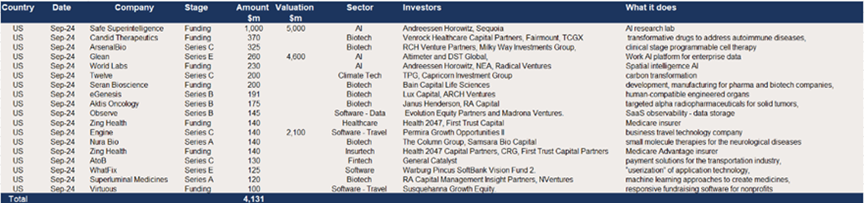
The US – $4.1bn of US venture backed raises of $100m+ in September
Source: Rothschild & Co
Source: Rothschild & Co
Our views on the state of the venture capital markets
The combination of global inflation, rising interest rates, and increased geopolitical risk substantially impacted the venture capital market in 2022 and 2023. As we move through 2024 adaptation to the ‘new normal’, the refocusing of venture backed companies to achieve a better balance of growth, profitability and cash flow and the prospect of H2 interest rate cuts have led to increased optimism and enthusiasm for growth equity. Our summary of the outlook is:
- The deterioration in the interest rate, inflation and macro-economic environment has had a sharp impact on valuations in private markets. The scale of the fall in the Refinitiv VC index in 2022 was much more substantial than the 33% fall on NASDAQ. This was reflected in some big valuation reductions in some high-profile VC rounds in 2023.
- There is substantial interest in venture capital to fund artificial intelligence, both the foundation LLM models, the applications of AI and industries (data centres, semiconductors) supporting the development of AI.
- Best-in-class companies, addressing critical requirements, continue to attract support. There are still hotspots for investment most notably in Artificial Intelligence and Climate Tech. Certain investors remain very active in the space with substantial funds to deploy.
- The speed of the investment process has slowed. The level of diligence on new deals has stepped up.
- 2023 saw more downrounds, albeit the substantial fund raising of 2021 and the ability of companies to eke out existing resources has limited the number of these. These continue into 2024.
- There is substantial dry powder in the VC industry. This though appears to be prioritised to support existing rather than new investments.
- It seems likely that the more difficult conditions for fundraising, and the lack of a clear path in some cases to early cash positive status, will mean a flurry of venture capital backed businesses looking to sell or merge their businesses.
- Valuation priorities have shifted, with investors having moved away from an emphasis on revenue growth and revenue multiple emphasis. There is a sharp focus instead on profitability (or a rapid path to it), on positive free cash flow and an emphasis on DCF and comparative based multiples.
Read the previous editions:
May 2022, June 2022, June 2022 (2), July 2022, August 2022, Sep 2022, October 2022, November 2022, December 2022, January 2023, February 2023, March 2023, April 2023, May 2023, June 2023, July 2023, August 2023, September 2023, October 2023, November 2023, December 2023, January 2024, February 2024, March 2024, April 2024, May 2024, June 2024, July 2024, August 2024, September 2024
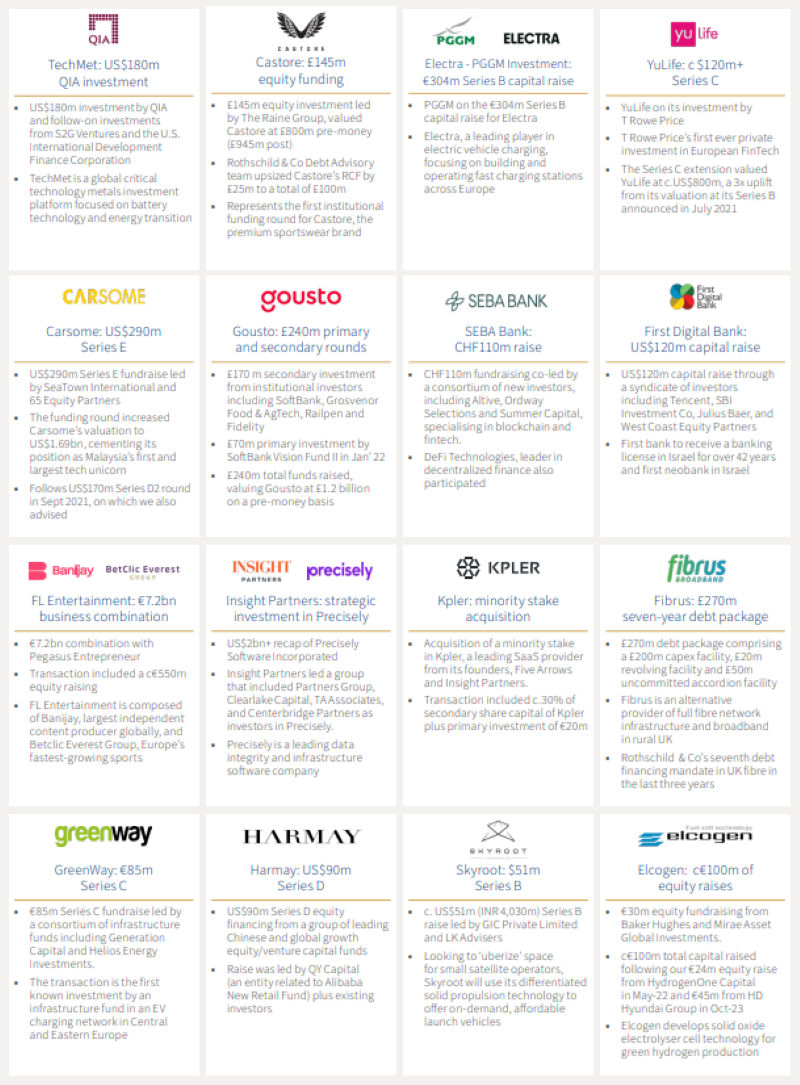
Rothschild & Co: Selected recent deals in Growth Equity and Private Capital
A selection of recent deals on which we have advised
For more information, or advice, contact our Growth Equity team:
Chris Hawley
Global Head of Private Capital
chris.hawley@rothschildandco.com
+44 20 7280 5826
+44 7753 426 961
Patrick Wellington
Vice Chairman of Equity Advisory
patrick.wellington@rothschildandco.com
+44 20 7280 5088
+44 7542 477 291
Mark Connelly
Head of North American Equity Market Solutions
mark.connelly@rothschildandco.com
+1 212 403 5500
+1 917 297 5131
Stéphanie Arnaud
Managing Director – France
stephanie.arnaud@rothschildandco.com
+33 1 40 74 72 93
+33 6 45 01 72 96
This document does not constitute an offer, inducement or invitation for the sale or purchase of securities, investments or any of the business or assets described in it.
This document has been prepared from publicly available information. This information, which does not purport to be comprehensive, has not been independently verified by us or any other party. The document does not constitute an audit or a due diligence review and should not be construed as such. The information provided should not be relied on for any purpose and should not in any way serve as a substitute for other enquiries and procedures that would (or should) otherwise be undertaken.
No representation or warranty, expressed or implied, is or will be made and, save in the case of fraud, no responsibility or liability is or will be accepted by us, as to or in relation to the accuracy, sufficiency or completeness of this document or the information forming the basis of the document or for any reliance placed on the document by any person whatsoever. No representation or warranty, expressed or implied, is or will be made as to the achievement or reasonableness of, and no reliance should be placed on, any projection, targets, estimates or forecasts and nothing in this document should be relied on as a promise or representation as to the future.
Law or other regulation may restrict the distribution of this document in certain jurisdictions. Accordingly, recipients of this document should inform themselves about and observe all applicable legal and regulatory requirements. This document does not constitute an offer inducement, or invitation to sell or purchase securities or other investments in any jurisdiction. Accordingly, this document does not constitute a Financial Promotion under the Financial Services and Markets Act 2000 (Financial Promotion) Order 2005 or equivalent legislation in other jurisdictions. This document is being distributed on the basis that each person in the United Kingdom to whom it is issued is reasonably believed to be such a person as is described in Article 19 (Investment professionals) or Article 49 (High net worth companies, unincorporated associations etc.) of the Financial Services and Markets Act 2000 (Financial Promotion) Order 2005 or is a person to whom this document may otherwise lawfully be distributed. In other jurisdictions, this document is being distributed on the basis that each person to whom it is issued is reasonably believed to be a Professional Investor as defined under the local regulatory framework. Persons who do not fall within such descriptions may not act upon the information contained in this document.