
Five stock market talking points

Stocks have continued their ascent during the first half of this year. The MSCI All Country World Index (ACWI) – the global benchmark – has returned 11% so far in US dollar terms, hitting another all-time high in June (however, the index is still 7% below its late-2021 inflation-adjusted high).
Just as we did last year, below we flag five striking observations from stock markets at the halfway point of 2024.
1. Ongoing US exceptionalism…
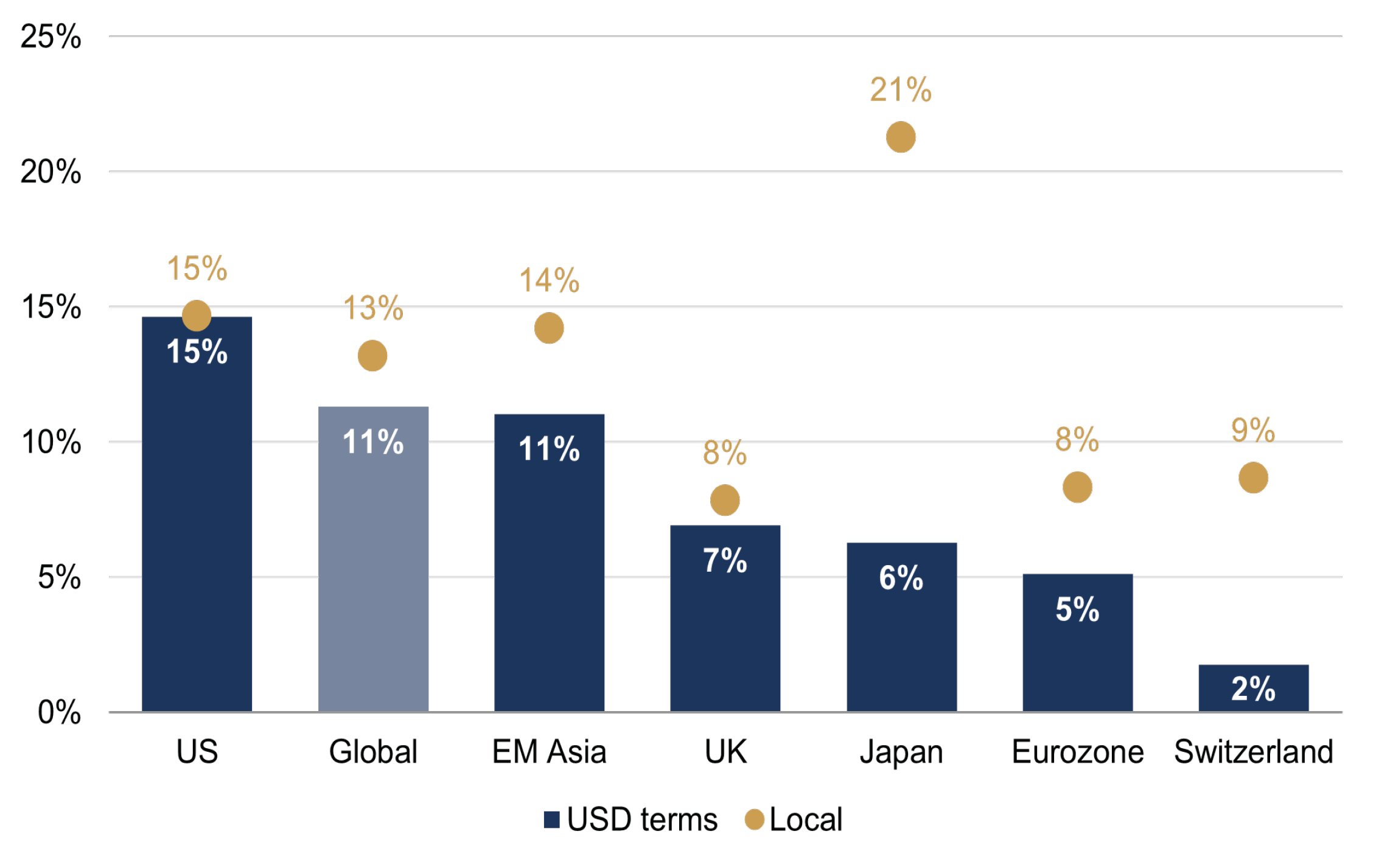
The US has outperformed the global benchmark this year in common currency terms, and it now accounts for almost two-thirds of that index. ‘Growth’ and ‘cyclical’ style stocks have outperformed ‘value’ and ‘defensives’ this year (respectively), and the US of course has a higher weighting in technology (and other ‘growth’ style sectors). There have been healthy local currency gains in some other regions, but the stronger dollar has reduced their value to unhedged global investors. In the case of Japan, the yen’s collapse has translated a striking local currency gain of 21% into a USD return of just 6%.
Figure 1: Year-to-date ranked returns by region (%)
Source: Rothschild & Co, Bloomberg, MSCI
2. …driven by a handful of (AI-related) stocks
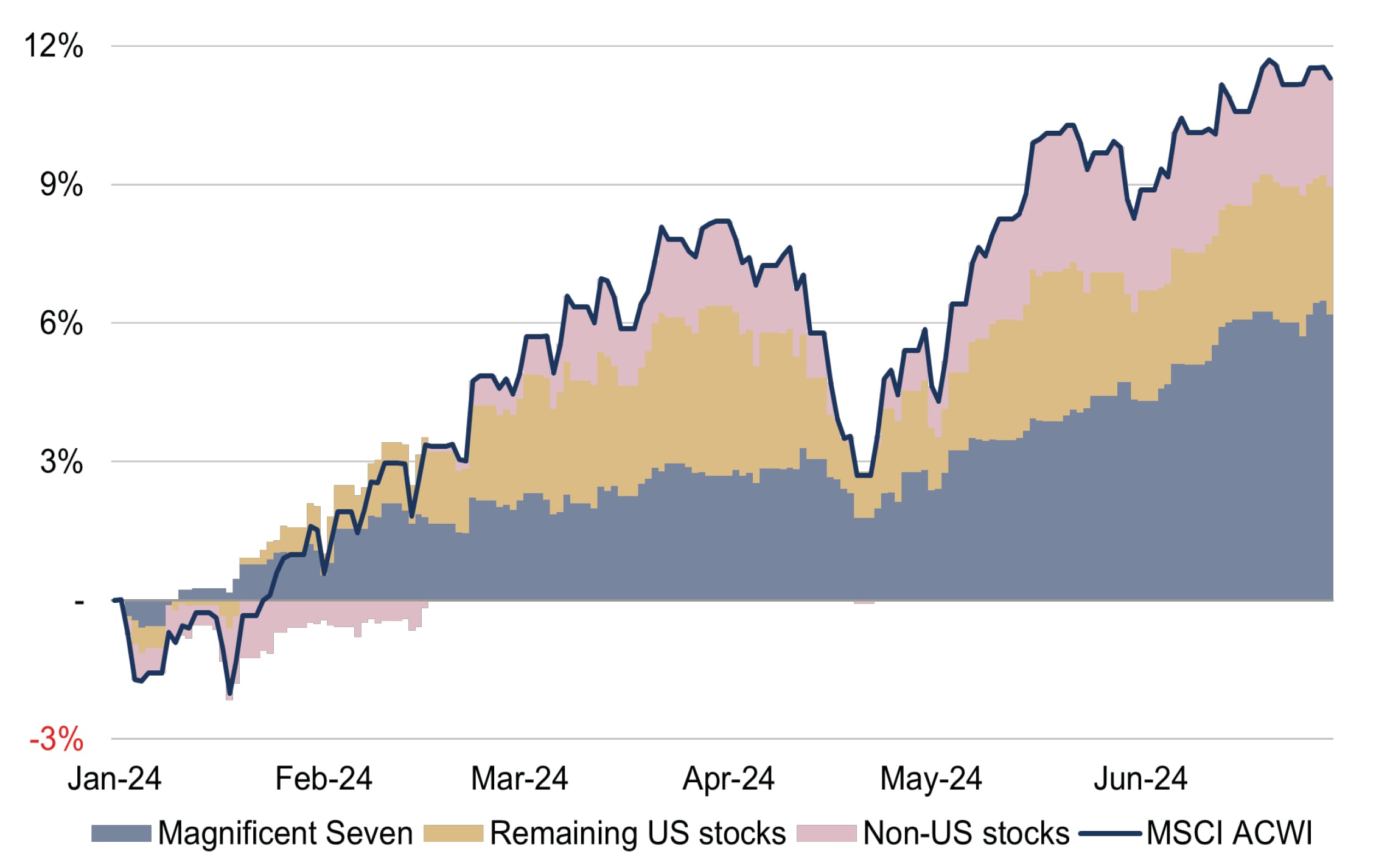
Global stock market leadership has remained narrow this year, with the US mega-cap ‘Magnificent Seven’ cohort – Alphabet, Amazon, Apple, Meta, Microsoft, Nvidia and Tesla – reaping the rewards from ongoing AI-related momentum, albeit in a more fragmented manner (Tesla has bucked the trend and is down by a fifth this year). The Magnificent Seven have accounted for more than half of the MSCI ACWI’s 11% year-to-date return – roughly a quarter of global returns have been driven by Nvidia alone – and almost all of its second-quarter returns. Conversely, the equal-weighted US index was only up 5%, and US small caps’ returns were just 2% in 2024.
Figure 2: Year-to-date global stock market contributions (%pts, USD)
Source: Rothschild & Co, Bloomberg, MSCI
Note: Magnificent Seven consists of Alphabet, Amazon, Apple, Meta, Microsoft, Nvidia and Tesla.
3. Not a frothy market (for now)
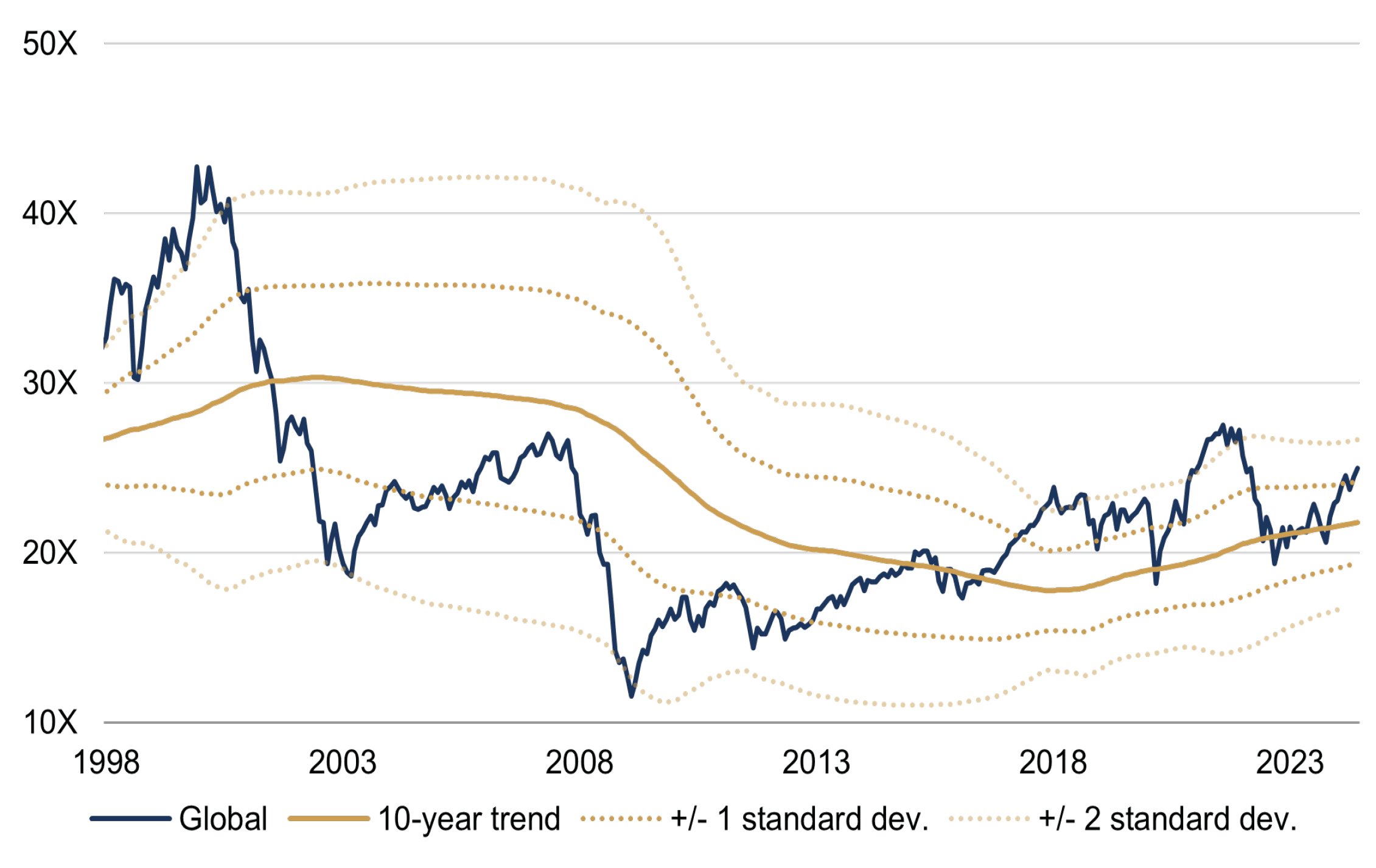
Global stocks have also become dearer this year. Our preferred long-term valuation metric, the cyclically-adjusted price-earnings (CAPE) ratio – the inflation-adjusted price relative to the inflation-adjusted 10-year moving average in trailing earnings – has risen to more than one standard deviation above its long-term trend. However, this is not alarmingly expensive. During the dot-com bubble, the global CAPE was more than two standard deviations above that trend and trading at over 40X, versus 25X today. While we don’t use valuations as a short-term timing tool, they can matter more when near extreme highs and lows – but that is not the case today.
Figure 3: Global stock market valuations (cyclically-adjusted price-earnings ratio, X)
Source: Rothschild & Co, Bloomberg, Datastream, MSCI
4. Corporate earnings (and expectations) have turned a corner
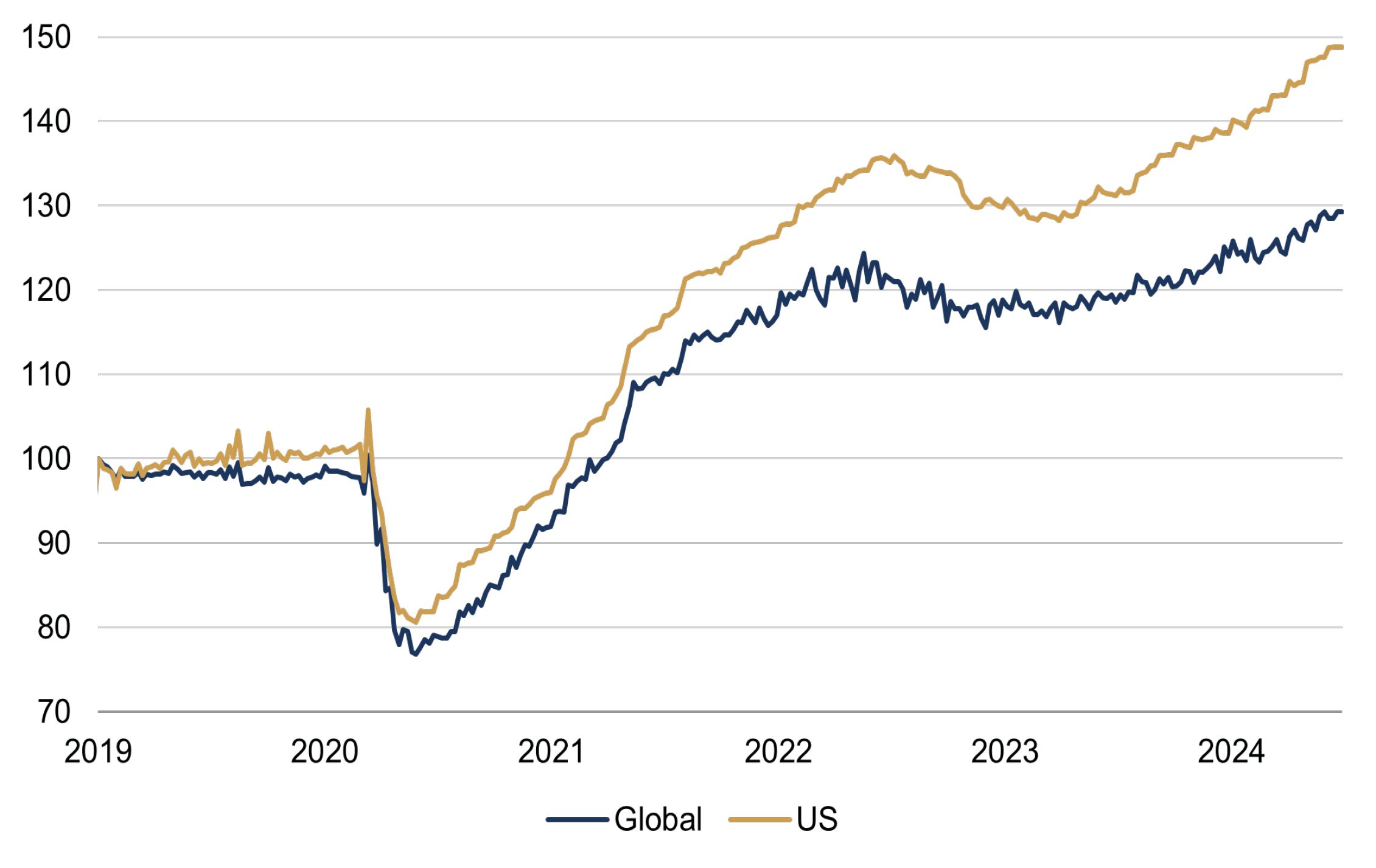
Global earnings stagnated in 2023, meaning the last year’s stock market rebound was driven primarily by those rising valuations. Promisingly, trailing – or actual – earnings appeared to tentatively pick up towards the end of last year, most notably in the US, where there have been a few quarters of positive earnings growth. Admittedly, this has mostly been due to strong profits at some of the mega-cap names in the Magnificent Seven, but analysts are expecting earnings to broaden across other sectors this year, which is plausible given ongoing economic resilience.
Figure 4: Forward earnings expectations (12-month forward earnings per share, rebased to January 2019)
Source: Rothschild & Co, Datastream, MSCI, I/B/E/S
5. Volatility remains unusually subdued
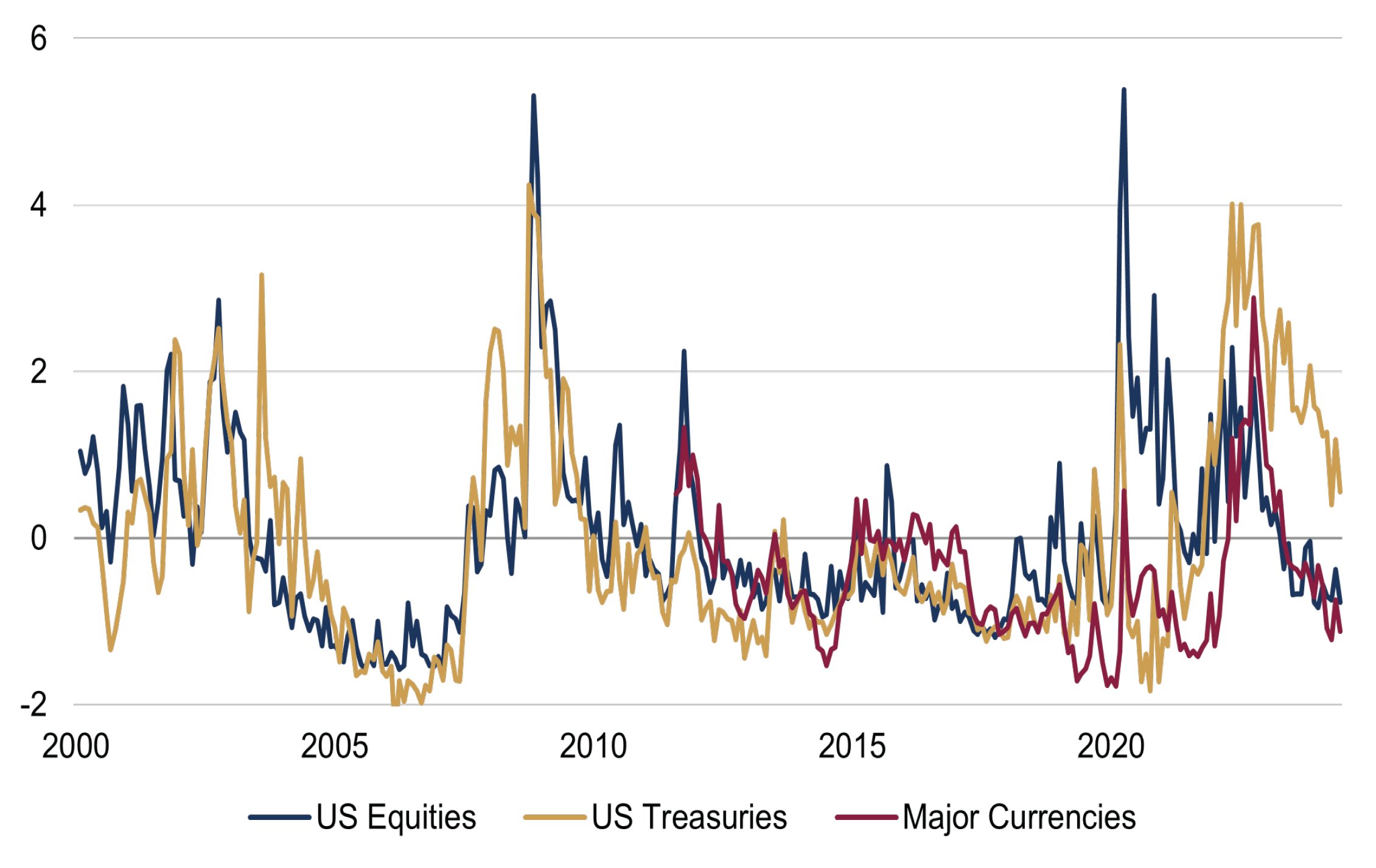
Stock market volatility has remained remarkably low this year. There has only been one trading day in 2024 where the S&P 500's daily price change has been greater than 2% (in absolute terms), following just two days in 2023 (compared to 46 trading days in 2022). In fact, global stocks have moved higher in a linear fashion since the end of October, aside from a brief sell-off in April. Moreover, from a cross-asset perspective, it is very unusual for implied volatility – derived from the prices of derivatives, or portfolio insurance – to be lower than normal for stocks, yet higher on average for bonds. It would not be surprising if stock volatility picks up from here, particularly given the busy political calendar, but for long-term investors it is the wider business cycle that matters more – and there are few signs of a downturn looming.
Figure 5: Cross-asset implied volatility (z-scores, normalised)
Source: Rothschild & Co, Bloomberg
All charts and data as of 30 June 2024.
Ready to begin your journey with us?
Speak to a Client Adviser in the UK or Switzerland
Past performance is not a guide to future performance and nothing in this article constitutes advice. Although the information and data herein are obtained from sources believed to be reliable, no representation or warranty, expressed or implied, is or will be made and, save in the case of fraud, no responsibility or liability is or will be accepted by Rothschild & Co Wealth Management UK Limited as to or in relation to the fairness, accuracy or completeness of this document or the information forming the basis of this document or for any reliance placed on this document by any person whatsoever. In particular, no representation or warranty is given as to the achievement or reasonableness of any future projections, targets, estimates or forecasts contained in this document. Furthermore, all opinions and data used in this document are subject to change without prior notice.
Read more articles
-

Chips: Moore spending
Strategy Blog
Despite renewed Middle East tensions and oil price spikes, a bigger market question is whether AI investment momentum can justify soaring capital expenditure. Demand remains strong, but investors are increasingly focused on adoption, monetisation and funding sustainability, raising concerns over future earnings, valuations and capital discipline.
-

Rothschild & Co receives five major awards at Euromoney's Awards for Excellence 2026
Awards
Global Advisory has been recognised with five prestigious awards at this year’s Euromoney's Awards for Excellence.
-

Politics on the beach
Strategy Blog
Populism is reshaping politics across the US and Europe, drawing parties away from the traditional centre. Rather than left versus right, voters increasingly divide along establishment versus anti-establishment lines, creating opportunities for populist movements and challenging conventional political assumptions.
-

Rothschild & Co’s UK Wealth Management business continues to strengthen its regional presence with appointment of Samantha Beach in Manchester
Press releases
Rothschild & Co’s UK Wealth Management business continues to strengthen its regional presence with appointment of Samantha Beach in Manchester.
-
Growth Equity Update
Insights
The 52nd Growth Equity Update from Patrick Wellington, Vice-Chairman of Equity Advisory.
-

Monetary policy - behind the curtain
Strategy Blog
Interest rate expectations have shifted markedly in 2026, with markets now anticipating higher rates amid persistent inflation, economic resilience and more hawkish central banks. Despite this, strong AI-driven earnings have supported equities.
