Japan: partying like it's 1989
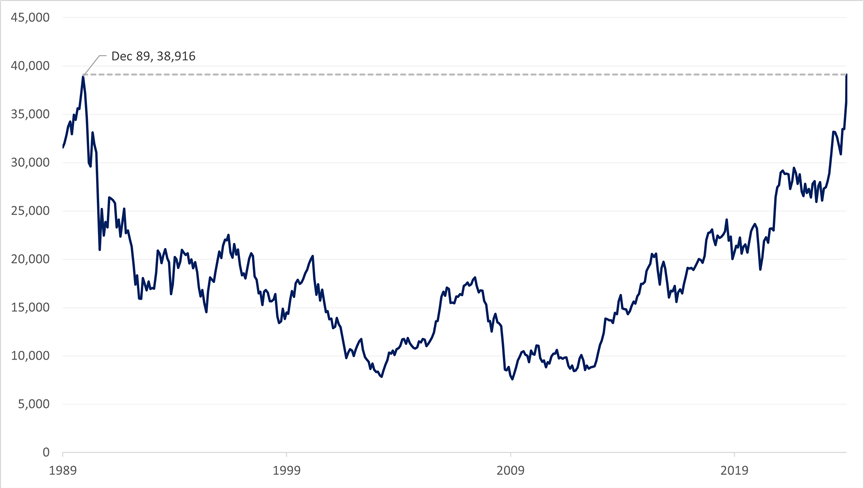
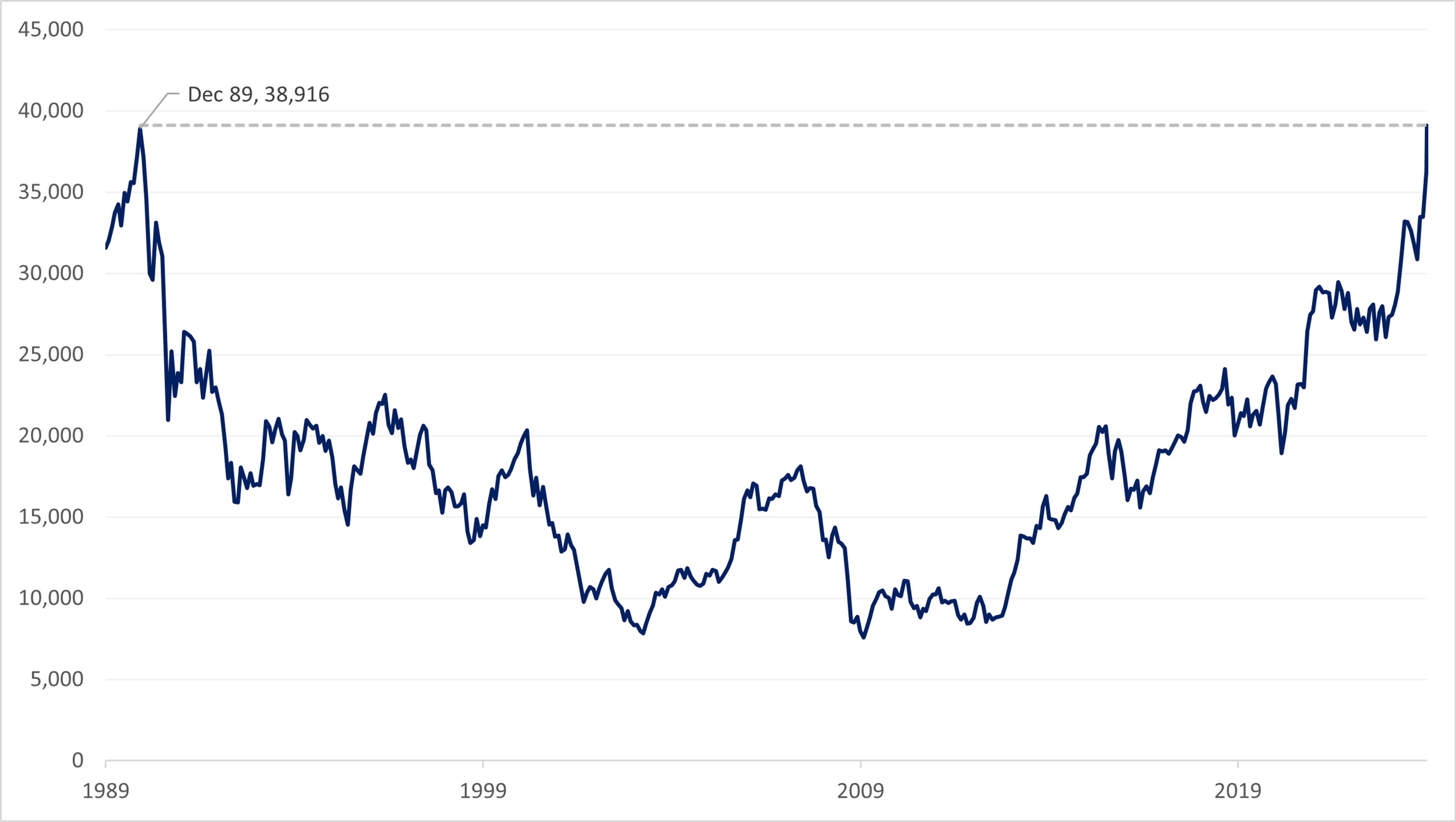
Japan’s stock market has been on a tear in recent months. The Nikkei 225, one of the major Japanese equity benchmarks, recently closed at 39,098.68 – a fresh all-time high, marking an end to nearly three and a half decades underwater. For some investors, breaching this level marks an important psychological milestone in Japan’s long road to redemption (admittedly, the more conventional market capitalisation-weighted index, the TOPIX, is yet to reclaim its highs- ~8% below its high watermark).
Nikkei 225 index (level): January 1989 to February 2024
Source: Rothschild & Co, Bloomberg
Past performance is not a reliable indicator of future performance.
Correct to 22nd February 2024.
The investment narrative that has emerged in recent years is that after decades of sluggish growth and mild deflation, Japan’s economic revival is gathering steam. Japanese output grew by nearly 2% in 2023 – the second fastest in the G7 (behind the US), and its quickest pace in a decade (setting aside the pandemic rebound in 2021). Alongside this Japan is also benefitting from portfolio shifts – not only domestically, but reportedly internationally too, as investors rebalance away from other, less favoured regions (it’s perhaps no coincidence that Japan’s ascent has coincided with China’s descent).
While the headlines have been unabashed in their proclamation of Japan’s big revival, we are unconvinced. Soundbites and neat narratives rarely make for good analysis.
Our lack of enthusiasm is threefold:
1. Japanese growth is still lacklustre - The popular view of Japan’s economic malaise is that it’s all about a lack of inflation – and even now, Japan’s ultra-loose monetary policy has failed to deliver more on this score: the modest post-pandemic revival has largely been imported (via exogenous shocks and a weak currency). But arguably, Japan’s problem hasn’t been a lack of inflation, but stagnant growth. Economic confidence has been building recently, but this has yet to translate to a rebound in household spending, despite continuing low unemployment. Absent more structural reforms, and in the context of the biggest demographic challenge facing any big developed economy, this cyclical upturn may be short-lived.
2. Shares are relatively expensive - Japanese stock market valuations are no longer cheap – the CAPE ratio at 25x is a tenth higher than the global stock market and well above its long-term trend. Earnings have been improving, but mostly on account of the weak yen boosting exporter’s profits. The domestic picture – which accounts for more than half of the stock market’s sales – is less compelling.
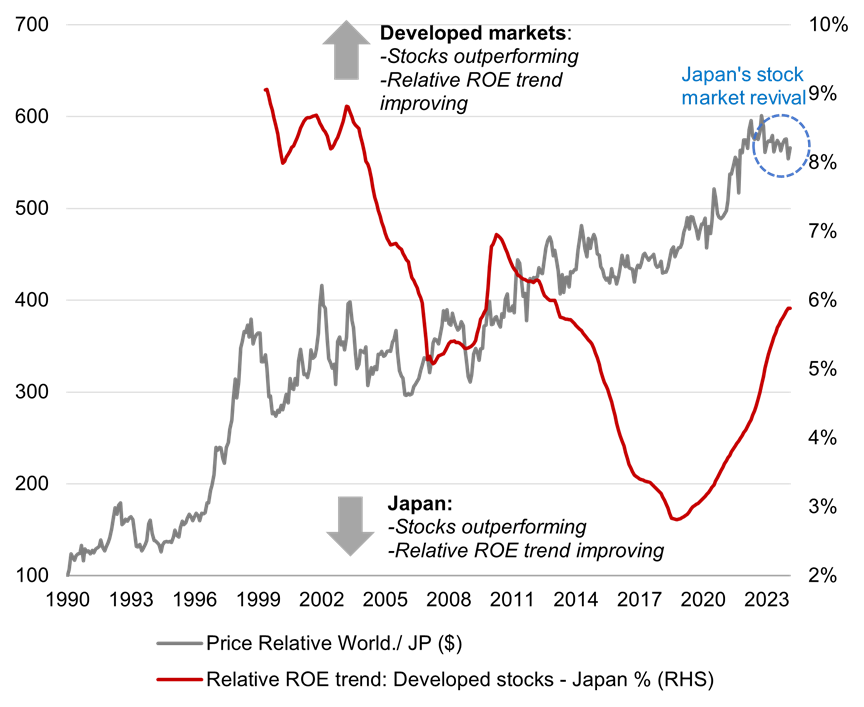
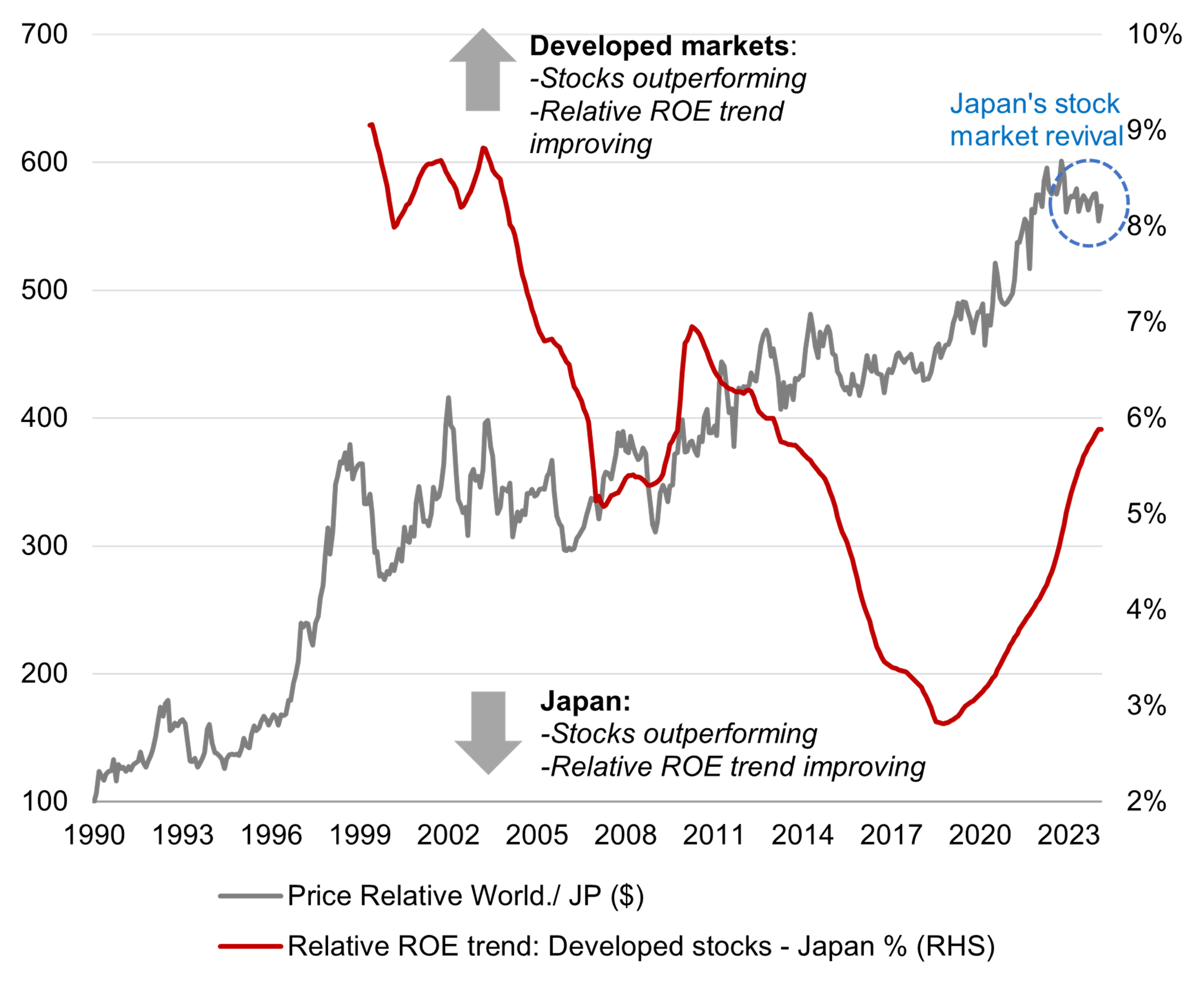
3. Japan is still not a capitalist economy - Profitability (as measured by Return on Equity) is the lowest across the major developed regions (and in line with China’s) – and this gap has failed to close in recent years. The 'third arrow' of Abenomics (the policy introduced by PM Abe after 2012), aimed at structural supply-side reform, failed to hit its target (as did the other two). The bottom line remains that Japan is still not a capitalist economy: return on capital, and shareholder values generally, remain less important than in the other major economies. The market for corporate control is underdeveloped, and market share and stability continue to matter more than the efficient use of resources. This is not a general criticism: Japan’s model has delivered enviable living standards for its population. But investor outcomes have not been seen as important.
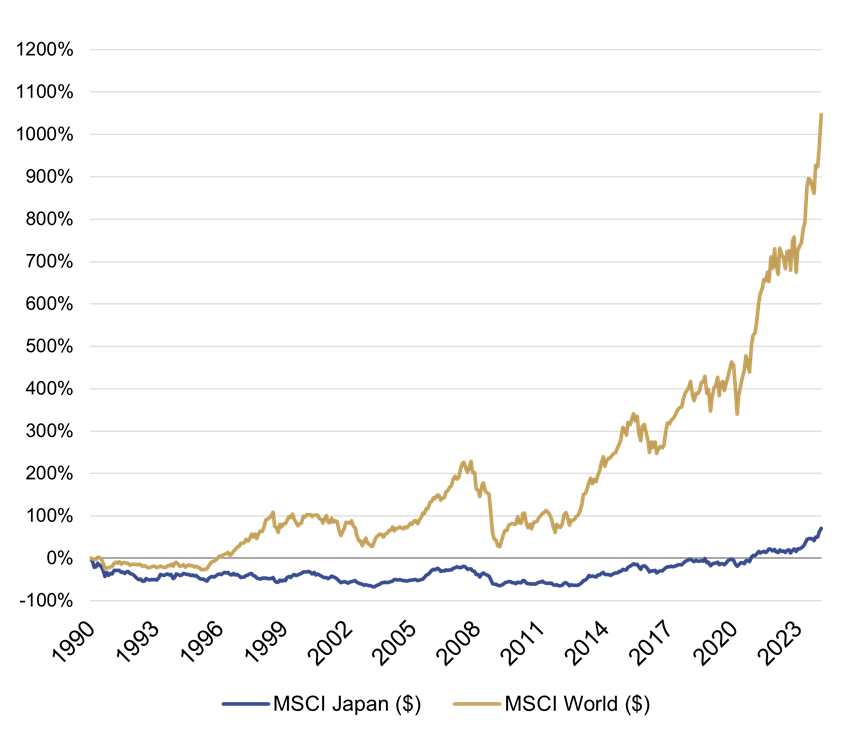
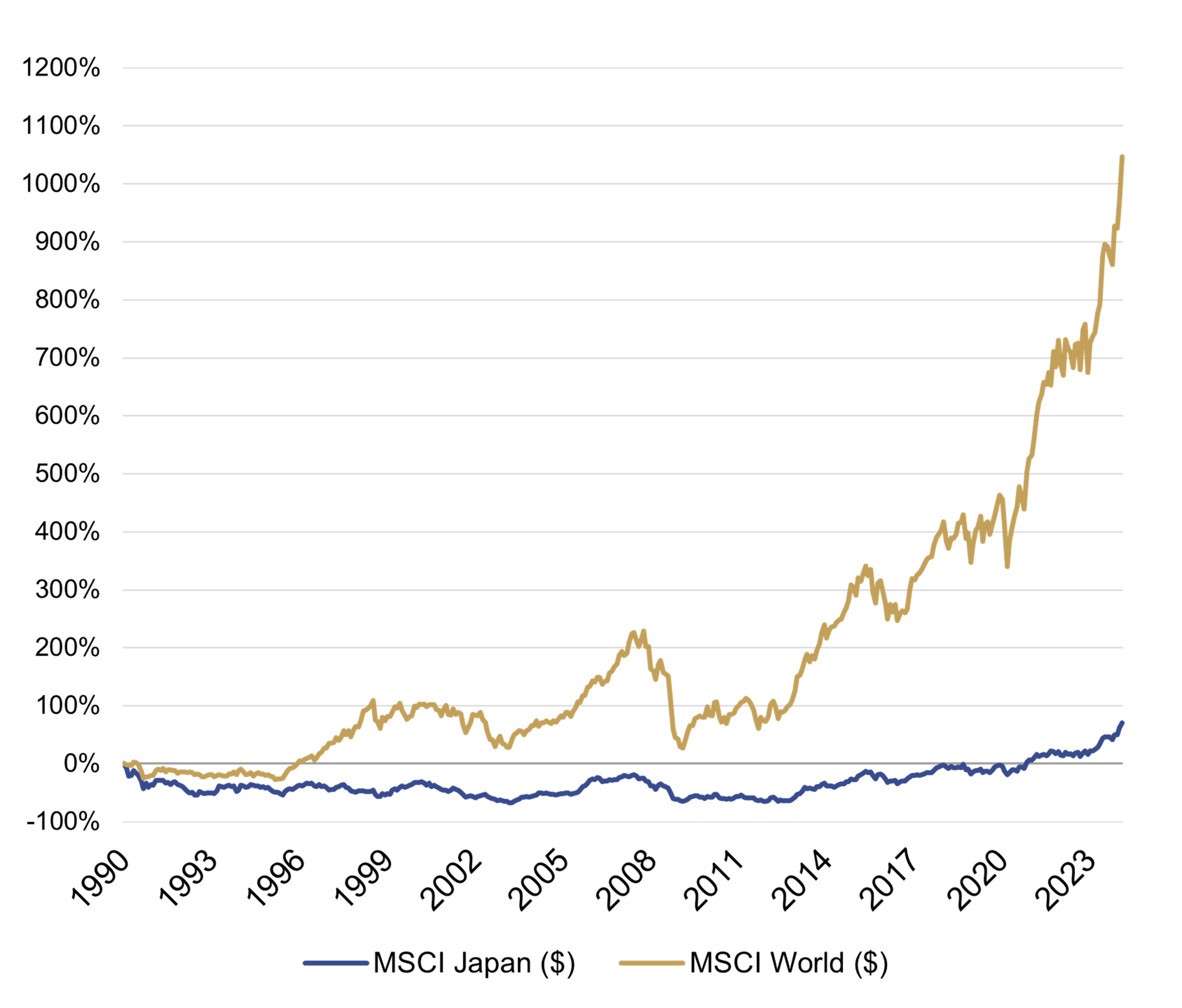
The momentum in Japanese stocks is undeniable on a short-term view: MSCI Japan is up nearly 7% in 2024 (USD terms) and remains well ahead of the global stock market, +5% (even as the yen has fallen nearly 7% against the dollar since December). But on a long-term view, this burst of outperformance looks unremarkable.
We see this as largely a sentiment or momentum driven story, and not one that yet reflects better fundamentals. Investors have been wrongfooted more than a few times when it comes to Japan – ourselves included – and we’re happy to arrive fashionably late should this party last, perhaps once we see a meaningful improvement in growth and/or profitability trends.
Cumulative total returns (in USD): 1990 to 2024
Source: Rothschild & Co, Bloomberg
Past performance is not a reliable indicator of future performance.
Correct to 22nd February 2024.
Relative price returns and return on equity: 1990 to 2024
Source: Rothschild & Co, Bloomberg
Past performance is not a reliable indicator of future performance.
Correct to 22nd February 2024.
Relative price returns and return on equity: 1990 to 2024
Source: Rothschild & Co, Bloomberg
Past performance is not a reliable indicator of future performance.
Correct to 22nd February 2024.
Source: Rothschild & Co, Bloomberg
Past performance is not a reliable indicator of future performance.
Correct to 22nd February 2024.
Ready to begin your journey with us?
Speak to a Client Adviser in the UK or Switzerland
Past performance is not a guide to future performance and nothing in this article constitutes advice. Although the information and data herein are obtained from sources believed to be reliable, no representation or warranty, expressed or implied, is or will be made and, save in the case of fraud, no responsibility or liability is or will be accepted by Rothschild & Co Wealth Management UK Limited as to or in relation to the fairness, accuracy or completeness of this document or the information forming the basis of this document or for any reliance placed on this document by any person whatsoever. In particular, no representation or warranty is given as to the achievement or reasonableness of any future projections, targets, estimates or forecasts contained in this document. Furthermore, all opinions and data used in this document are subject to change without prior notice.