

Preparing for life after the firm
Background
Our client is a partner at a US law firm in London. He is married, in his early 50s with two children, one at school and one at university. He plans to continue working for 10-12 more years.
Key objectives
Our client wanted to know how and when he could afford to retire whilst continuing to invest in private investment opportunities though his firm. He also wanted to be able to give each of his children £250,000 to help them onto the property ladder.
How we helped
We started by helping our client categorise and consider the risk and return profiles of his assets using our ‘Wealth Framework‘, which mapped out as follows (see table below). Our client had already built a strong financial foundation by paying off the mortgages on his properties and having a good mix of assets across different ‘pots’.
| Lifestyle | Cash | Nest egg | Growth | Firm |
| £3.5m primary residence £1m second property (both mortgage free) |
£100k | ~£2m across pension, ISA and GIA | ~$2m in committed private assets ($500k already funded) | $1m partnership |
Solutions and options
As our client still had 10-12 years of earning potential of $2m annual compensation, we built a number of cashflow planning models to show the impact of different-sized regular contributions to his Nest Egg. We settled on £400,000 annual contributions. We allocated £250,000 in year 5 and year 11 to cover house deposits for his children.
We set aside a sum for capital calls for private equity arrangements and allocated this to a range of deposit accounts and gilts, which we proactively manage for him to balance returns and liquidity. For additional peace of mind, we arranged a lending facility secured against his investments with us, for any unexpected capital calls.
Our client appreciated our ‘bottom up’ investment approach as it aligned with his private equity investments. We therefore consolidated his non-private equity holdings into our balanced strategy. He invested within one of our tax-efficient investment structures that is domiciled offshore and provides flexibility should he choose to retire overseas in the future.
With a long-term plan in place to continue to build his family’s wealth, we were able to start a discussion on how to then consider passing those assets down to his children (e.g. trusts or family investment companies) and the timing of these.
Outcome
As a result, our client now feels like he has a much better understanding of his plans to retire and aims to diversify the risk of his private assets by investing further in his family’s Nest Egg.
Cashflow modelling for a US Partner
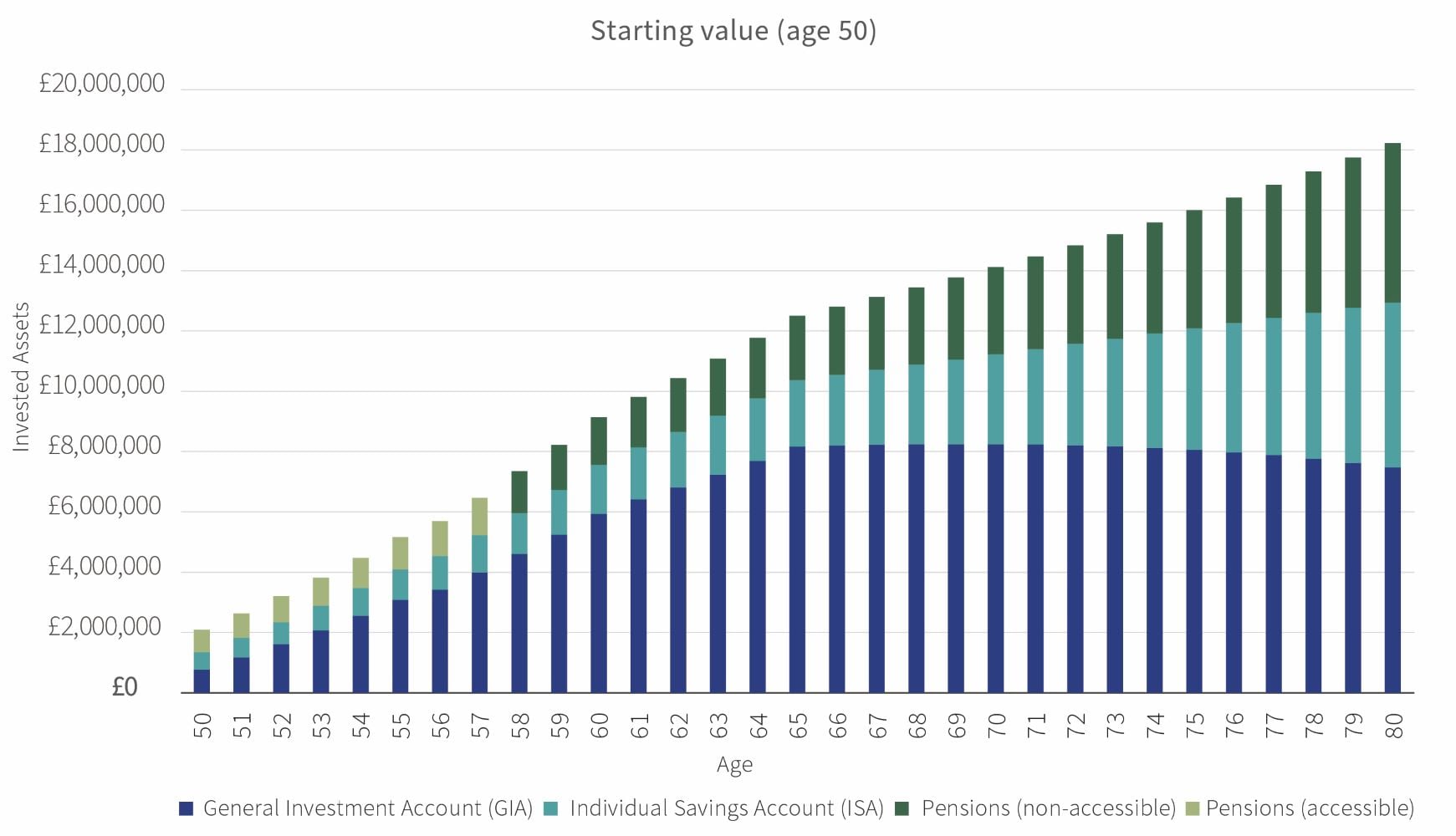
| Assumptions | GIA | ISAs | Pensions (Non accessible) | Pensions (Accessible) |
| Starting value (age 36) | £500,000 | £500,000 | £700,000 | £0 |
| Performance (balance for illustration) | 6.24% | 6.24% | 6.24% | 6.24% |
| Inflation | 2.00% | 2.00% | 2.00% | 2.00% |
Source: Rothschild & Co, Bloomberg Data from 31 December 2002 to 31 December 2024.
The New Court Fund GBP inception date was 14 July 2015. Performance for periods prior to inception date is the Rothschild & Co Wealth Management UK Ltd GBP Balanced composite, adjusted to reflect the fund's 1% annual management charge and 0.06% operational costs. Performance data is net of fees. Data post 30 September 2007 is net of actual client fees incurred. Data prior is actual gross performance less current average client fees.
Past performance is not a reliable indicator of future performance and the value of investments and the income from them can fall as well as rise.
The above graphs are for illustrative purposes only. The information above is not intended and should not be construed as tax advice. Each investor should seek their own independent tax advice