Inflation, stock valuations, AI FAQs
Foreword: Making sense of higher stock prices
Stock markets have been hitting new highs even with the ceasefire looking shaky, oil prices back above $100 per barrel (pb) and bonds struggling.
It’s not quite as remarkable as it looks.
We know that conflict, despite its human toll, is just one of many influences on markets. In the first essay below we find that so far at least, the disruption and inflation caused by those oil prices is material, but not yet that severe. The widely-reported claim that this is the biggest energy shock ever looks premature.
We also know that markets anyway often look “across the valley” at times of stress, at what they see as a more stable longer-term outlook. Investors can tolerate higher stock valuations if they expect a near-term shortfall in earnings (for example) to be brief.
In the second essay we note that valuations have been quite high, but not for this reason. Meanwhile, there has been no shortfall in earnings yet, rather the opposite – first quarter results have surged, and not just because disruption has been manageable (or because oil companies were more profitable in March).
We didn’t know the surge was coming, but it makes stocks’ performance still less remarkable. It has been led – again – by companies working in and around Artificial Intelligence, and in the final essay we offer our answers to some frequently-asked questions about AI.
We are in two minds about it. We are usually fans of technology, which has led the global market higher for most of the last forty years now. However, this latest surge in profitability is still being driven by the suppliers of AI – especially the makers of the increasingly expensive chips needed by Large Language Models (LLMs) – and not by happy end-users.
Overall, the balance of risks did seem to improve when the initial ceasefire indications emerged some six weeks or so back, and we are always ready to look across valleys. But those AI misgivings make us reluctant to chase stocks higher still, at least not yet.
Kevin Gardiner / Victor Balfour / Anthony Abrahamian
Global Investment Strategists
How much more inflation?
Headline Consumer Price Index (CPI) inflation rates have turned higher since conflict escalated in the Middle East.
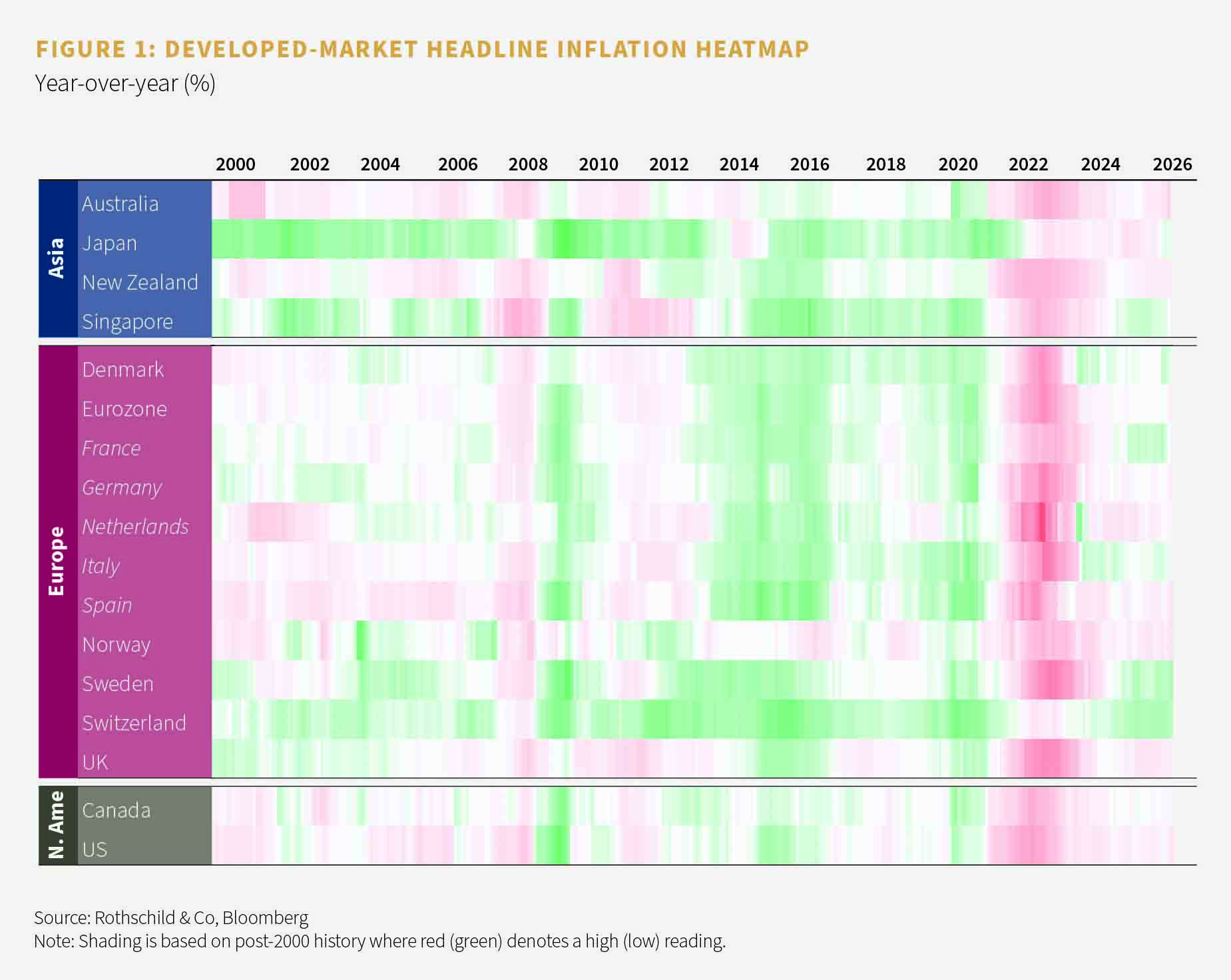
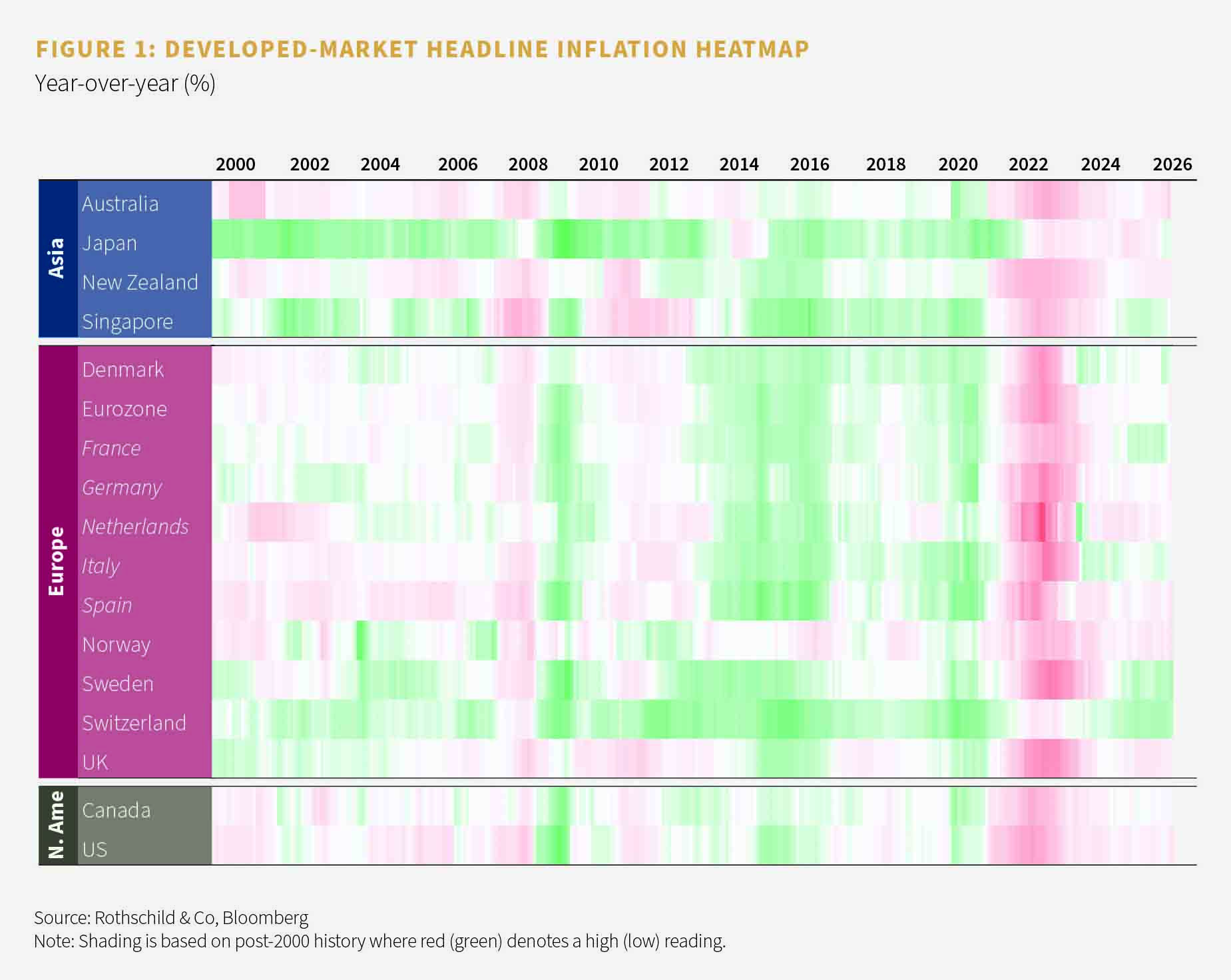
In developed markets, the US headline inflation rate is now testing the upper bound of the notional 2-4% range within which we have expected it to stick, and the UK and eurozone equivalents could soon follow (there are exceptions: see Switzerland in figure 1). The moves have been more pronounced in some emerging market economies, particularly those in Asia which are highly dependent on energy imports from the Middle East.
Is this rangebound view still valid, or should we be braced for inflation to surge back into mid or high single digit territory?
To address this question, we analyse the usual four categories of CPI inflation below: energy, food, goods and services.
ENERGY CPI
Both West Texas Intermediate (WTI) and Brent Crude oil – the respective US and European benchmarks – have risen by 50-60% in dollar terms since the Middle East hostilities erupted.
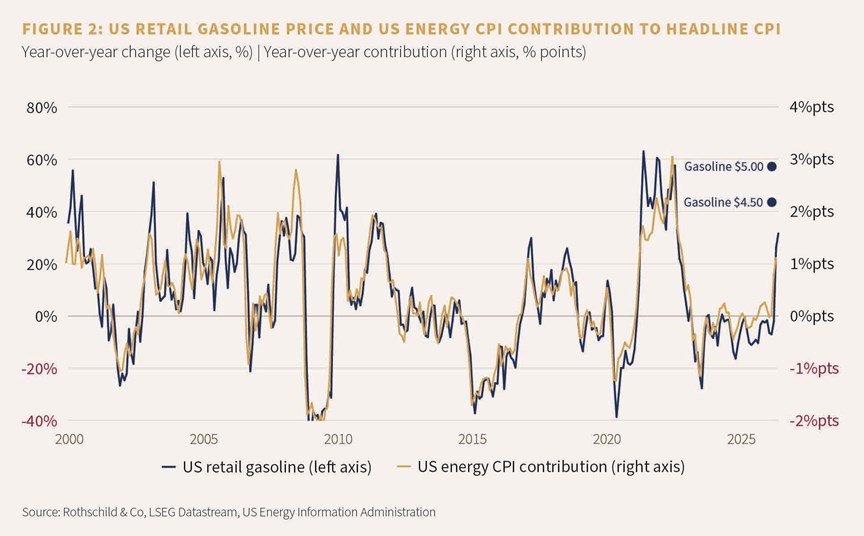
In the US, ‘prices at the pump’ are highly sensitive to changes to the WTI benchmark and have already risen by a similar amount. These retail gasoline prices effectively account for more than half of the domestic energy CPI basket, meaning it is this latter category – unsurprisingly – which has caused a lurch higher in the US headline inflation rate over the past couple of months.
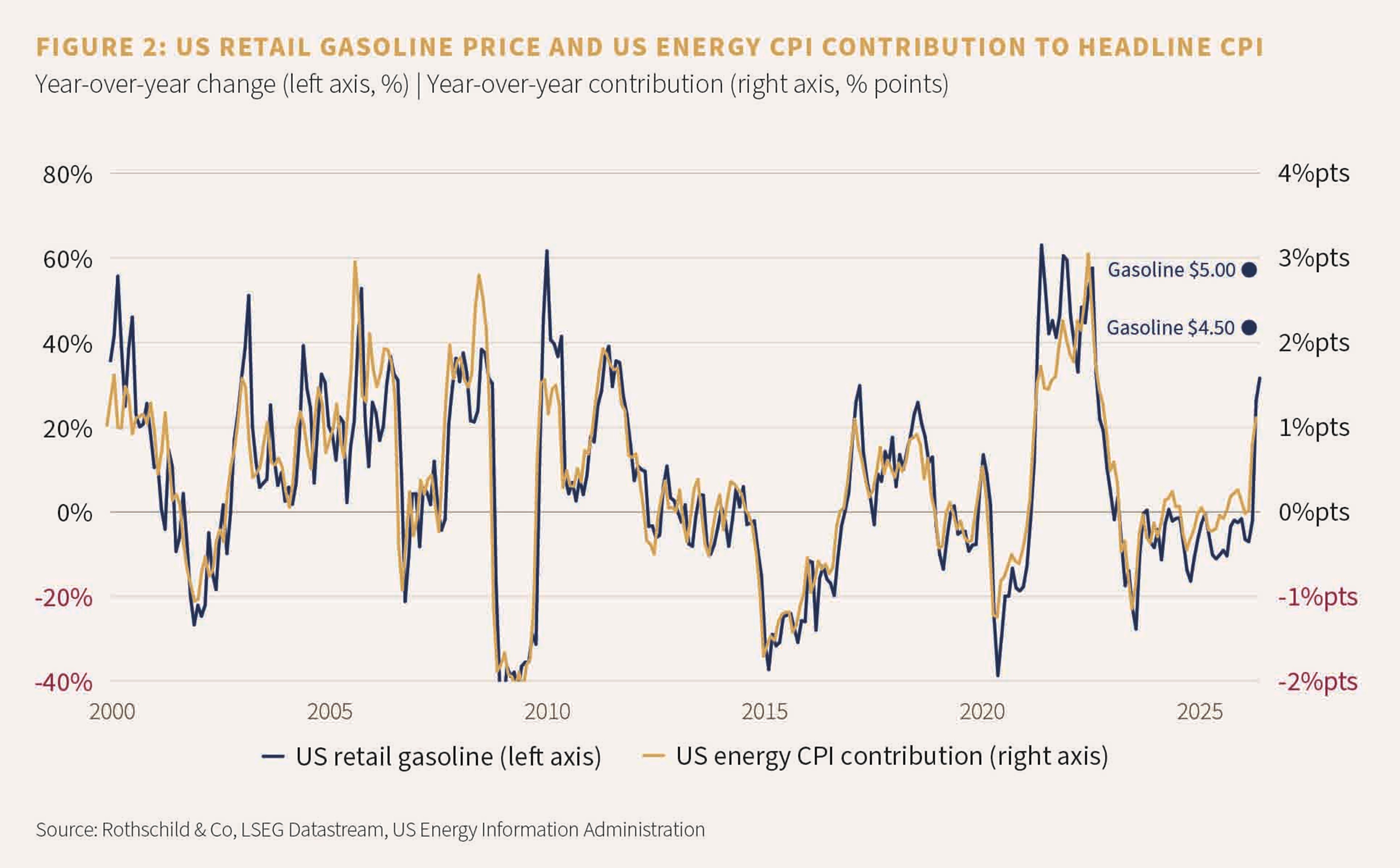
The contribution from energy CPI inflation to the year-over-year US headline rate has so far swelled from zero in February to more than a percentage point in April. If US pump prices remain at today’s level of roughly $4.50 per gallon, then energy CPI’s contribution to near-term US headline inflation could perhaps rise to roughly two percentage points (figure 2). If gasoline prices move towards their post-pandemic peak of $5 per gallon – which seems plausible given that oil prices were close to their 2022 highs in late March – then its contribution may be closer to three percentage points. In Europe, petrol prices have generally not risen by as much as in the US, possibly because oil accounts for a smaller proportion of the total cost (taxes are higher).
Meanwhile, US wholesale natural gas prices have been somewhat stable, likely because America is the world’s largest producer and export capacity was already full before the war. In Europe, local natural gas prices have conversely surged by a similar magnitude to Brent Crude oil, given the region’s energy import dependence.
However, the increase in European energy CPIs has not (yet) been significant, perhaps due to European gas markets being highly regulated, meaning the pass-through from wholesale to consumer prices is gradual (and usually smaller). For instance, the UK government sets a quarterly price cap on per-unit household energy costs roughly a month before the start of each quarter. As a result, UK headline inflation may not ‘jump’ until July, given that the April-to June price cap was announced in late February – just before the Iran conflict.
FOOD CPI
The war is also likely to disrupt the food supply chain, given that the blockaded Strait of Hormuz typically accounts for a third of global seaborne trade in nitrogen fertilizers.
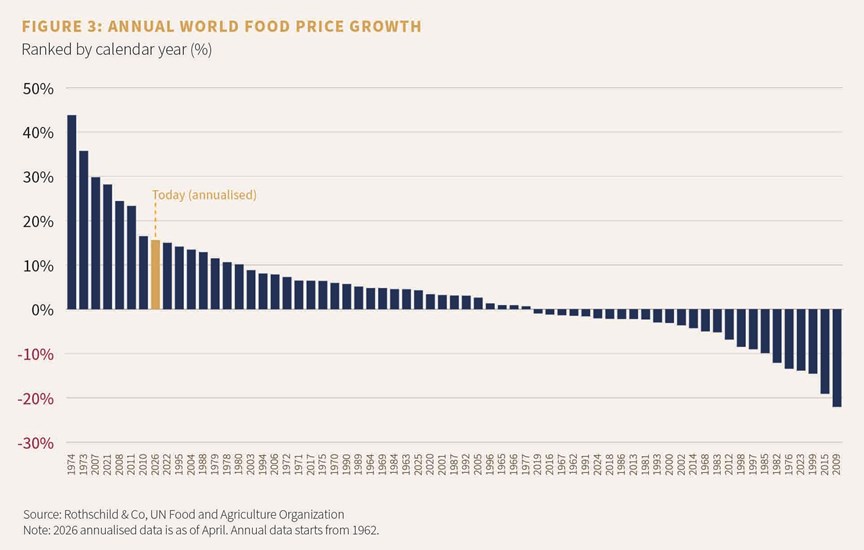
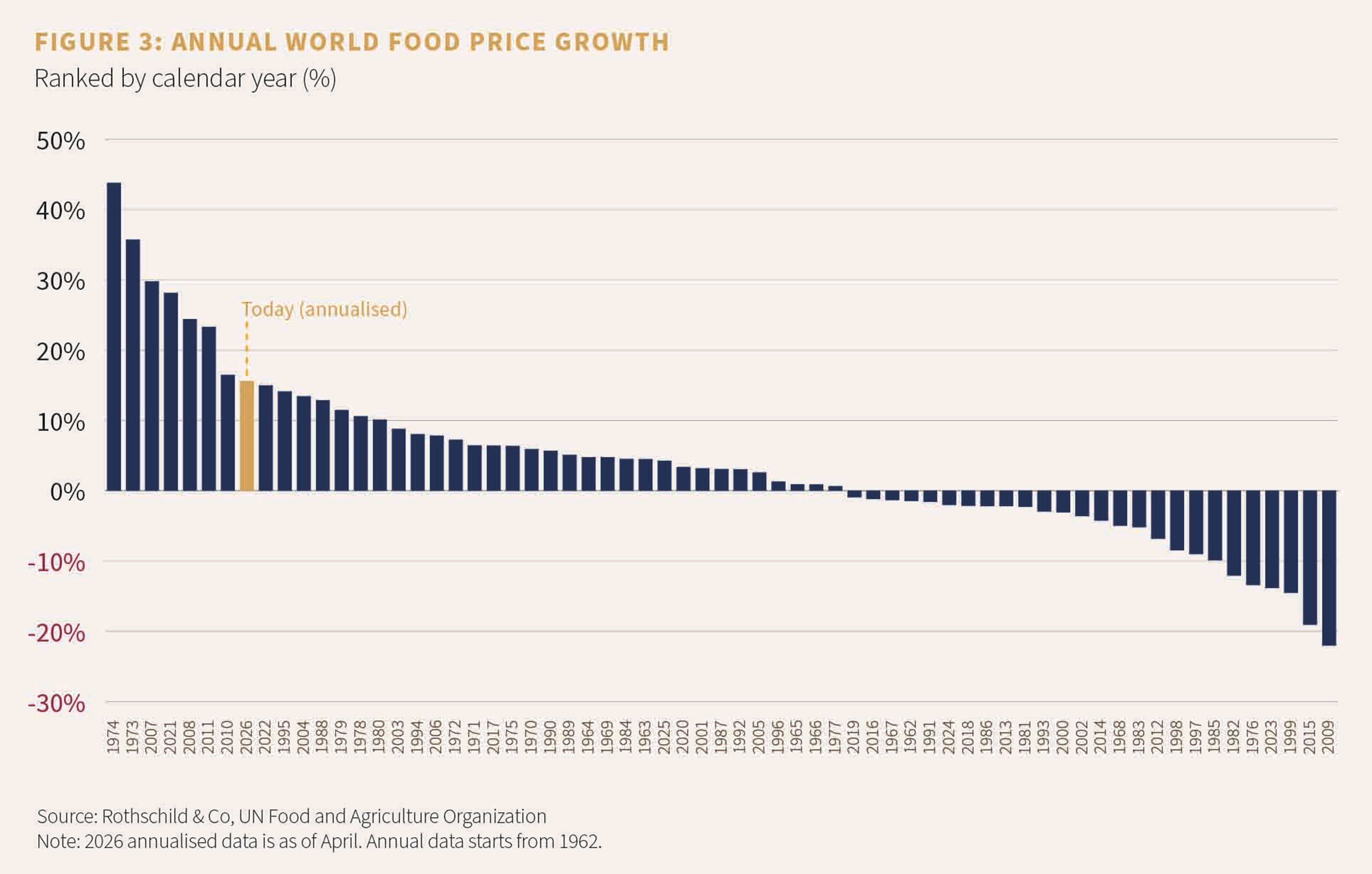
While Middle East urea spot prices have surged by more than 50% since March, global food prices have only risen by 5% this year (as of April), according to the UN Food and Agriculture Organization (FAO). The latter may indeed continue to drift higher if supply issues persist, but it is unlikely to increase by as much as fertilizer prices as other input costs are involved in the food ecosystem.
The annualised growth rate of the UN FAO food price index is nonetheless big, at 16%, but it still falls short of the post-pandemic rebound of 2021 (figure 3) – and it is well below the food price surges of 1973 and 1974, which coincided with the Arab oil embargo as well.
Moreover, higher wholesale food prices are unlikely to immediately filter through to western food CPI baskets, as supplier-retailer price negotiations can take time and they may already be locked into long-term contracts. In the UK, for instance, the prices we see on our supermarket shelves tend to lag the UN FAO’s index by roughly nine months, and so the food CPI contribution may only become more noticeable at the turn of the year.
GOODS AND SERVICES CPI
Higher energy prices and longer delivery times will also raise production costs for companies in the near term (although, today’s supply chain stress appears small when compared to the initial years following the pandemic, as noted here). The US producer price index, which measures changes over time in the selling prices received by domestic producers, has nevertheless already risen in April to its highest year-over-year reading since 2022. Goods and services CPI inflation may then be amplified by wider ‘cost-push’ inflation if companies choose to pass on these higher costs to consumers.
In contrast, a prolonged energy price shock may in fact be more deflationary in the medium term, in the sense that higher costs could eventually hit real incomes, employment and aggregate demand.
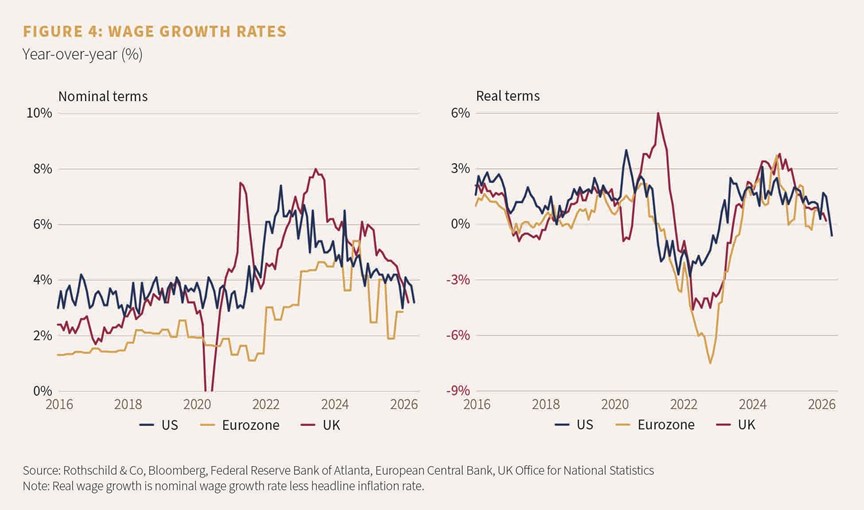
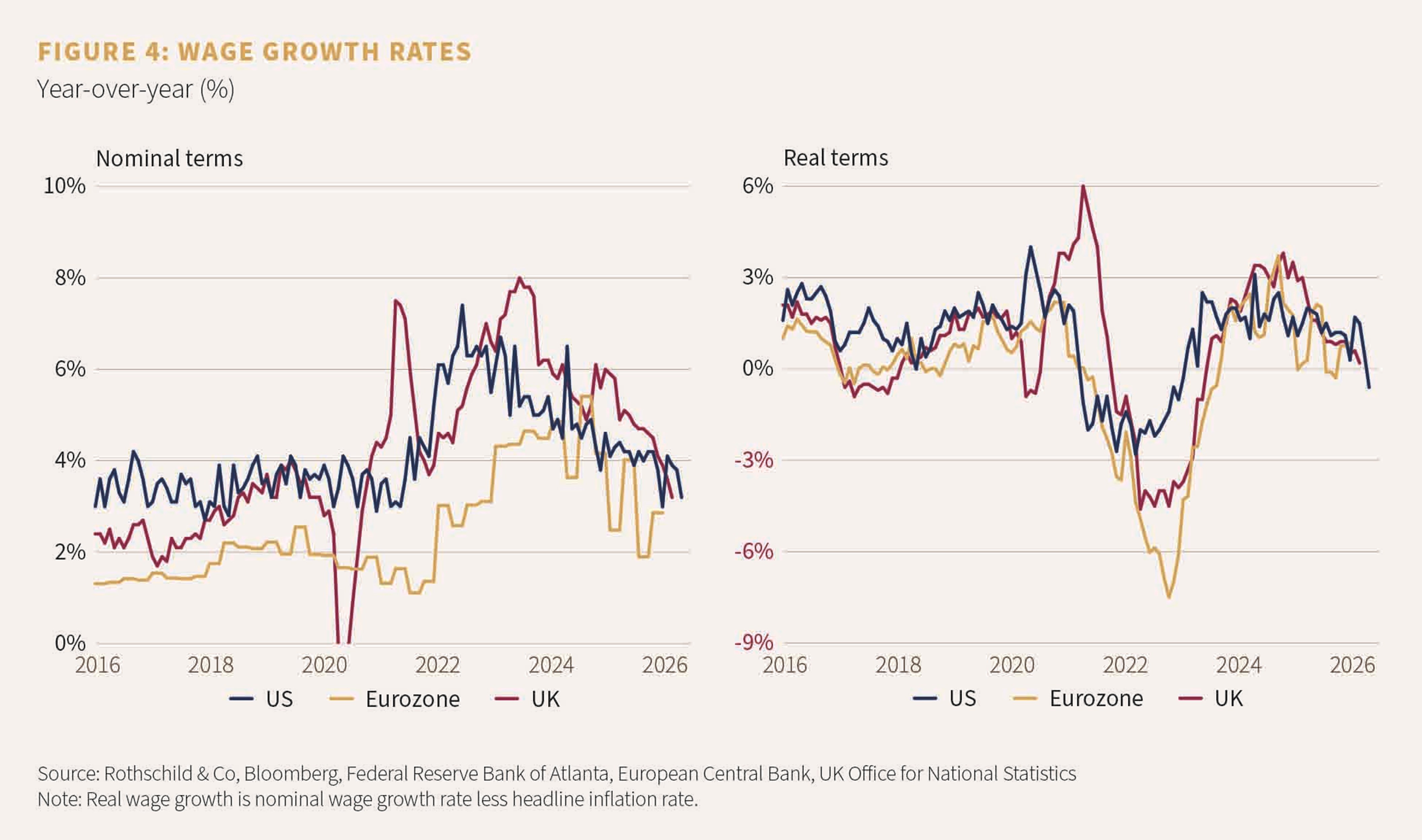
Critics of this hypothesis might flag that the last time we faced a big energy shock, following Russia’s invasion of Ukraine, developed-market CPI inflation spiked then remained above its 2% target. The jobs market was however extremely tight back then – remember the so-called “Great Resignation”. Real wages still fell markedly, but nominal rates of wage and price growth were much higher (figure 4), amplified by product shortages and spikier input costs than today.
Labour is by far the biggest cost for service sector companies, and so services CPI – which tends to be the largest category within developed-market inflation baskets as well – was very sticky in the post-pandemic years.
Today’s jobs market is arguably still tight but there are notable differences. For example, interest rates have normalised from unprecedented lows, muting aggregate demand; the fiscal impulse is lower (although governments may intervene further if the energy shock intensifies); the labour demand-supply mix is more balanced; there is no pent-up demand from pandemic related lockdowns. Overall, these so-called “second-round” wage effects seem less likely to materialise this time round.
CONCLUSION
The duration and severity of hostilities in the Middle East will materially influence developed market CPI inflation this year. The spectrum of possible outcomes remains wide, not least because Mr. Trump’s actions, and the evolution of events in the Middle East, are so difficult to predict; but inflation so far looks to be more contained than it was in the initial post-pandemic years. It is too soon to jettison the medium-term 2-4% range as our rule of thumb. This may sound optimistic, but only when set alongside some of the more alarmist predictions being made recently: we’ve always seen such an outcome as ultimately disappointing for central banks – and bonds – pledged/hoping to see a lasting return to 2% targets.
Two final observations. First, just as the inflation hit to date has not yet been dramatic, so too the disruption to business activity has (so far) been more modest than many feared. The global economy had more momentum going into the conflict than was realised at the time – world trade accelerated markedly in the first two months of 2026 – and subsequent business surveys and hard data suggest that growth has continued in recent months. This means, though, that our concerns about inflation’s underlying stickiness may remain valid.
Second, while politicians may not reach agreement soon, markets can sometimes take matters into their own hands. Longer term, the clock may be ticking for the global economy’s dependence on Middle Eastern trading routes – and on oil itself.
CAPEd Crusaders
As noted above, where stock markets are concerned, conflict, disrupted energy supplies, and stagflation fears appear to have counted for little when set alongside the AI zeitgeist. In particular, the promise of unprecedented capital expenditure continues to propel the big chip producers to new highs, lifting the wider stock market higher.
The promise is not without some near-term foundation: global corporate profits are currently expected to expand by a quarter this year, largely driven by the immense AI infrastructure rollout (figure 5).
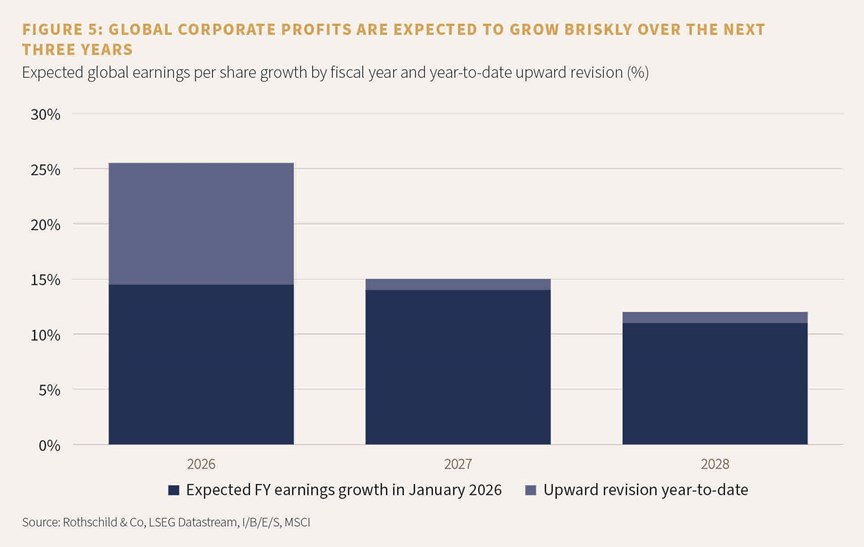
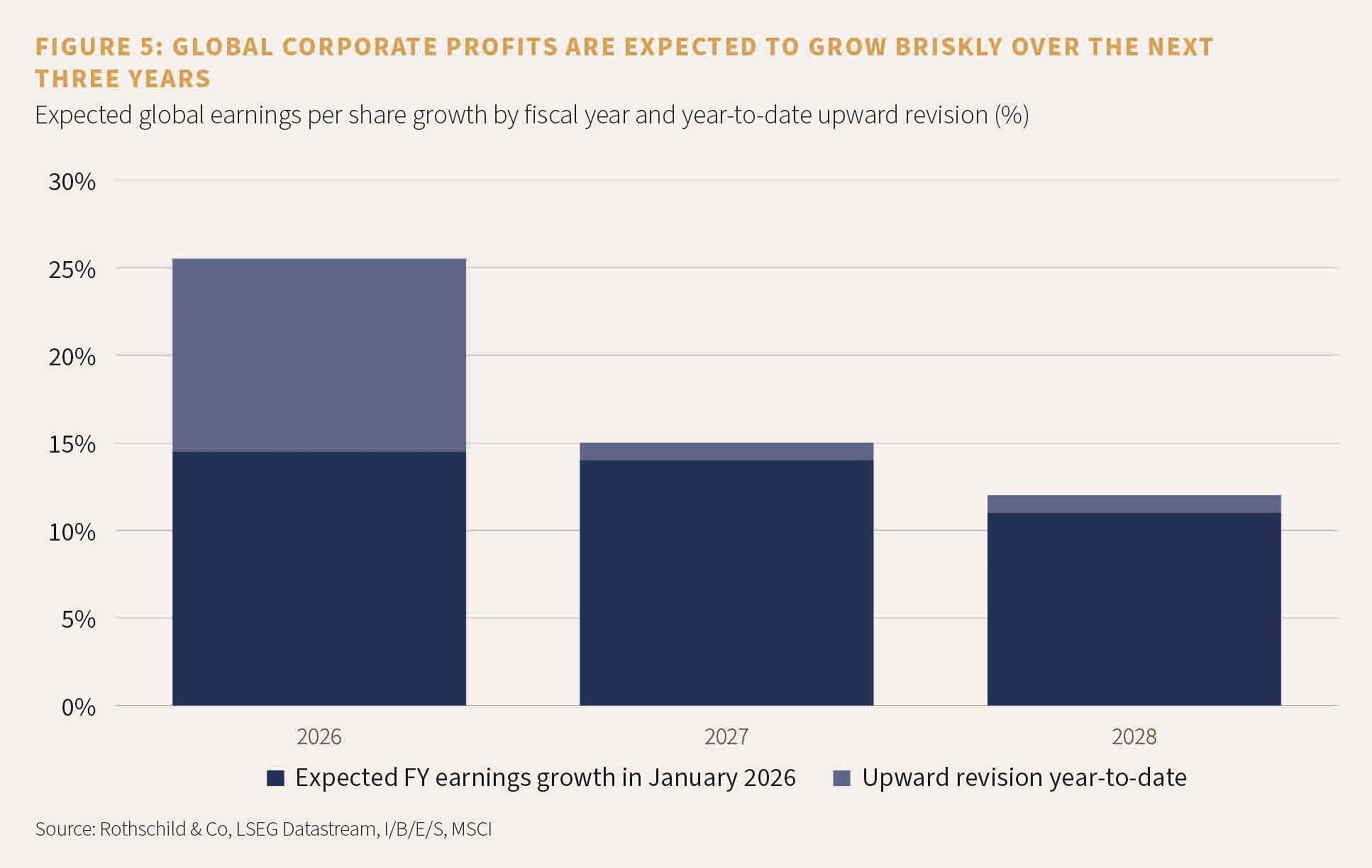
The corollary of such exuberant expectations is that despite the relatively strong – if uneven – share price returns, valuations based on forward earnings have fallen back a little in 2026. Before conflict in the Middle East reignited, we saw high stock valuations as an ‘amber light’ for top-down asset allocators: stretched, though not prohibitively so. Does the fast-evolving AI driven earnings story change things?
There are many ways to value stocks, none of them perfect. We can look at prices relative to earnings, cashflow or even relative to capital, though on its own this doesn’t tell us whether something is cheap or expensive. Does the absolute level matter, or does deviation from trend matter more? How should we incorporate profitability, and perhaps most importantly, what about interest rates? A stock’s value can be derived from the sum of its future cash flows discounted back to today’s value – a higher interest rate (or discount rate) reduces the present value of those future earnings.
Such discounted cash flow analysis is highly sensitive to assumptions about prospective growth and interest rates. The point is that there is a huge amount of nuance, subjectivity, and often inherent contradiction when comparing indicators – not least because, to further complicate matters, definitions of earnings (for example) can vary across data providers.
When we say that valuations are “stretched” what we mean is that prices are high relative to some underlying fundamental. It suggests that an investor is paying a high premium for future growth, perhaps unjustifiably.
One popular metric we use often is the Cyclically-Adjusted Price Earnings ratio (CAPE). This measure judges ‘fair value’ by comparing today’s price to a ten-year moving average of earnings (adjusted for inflation, though it doesn’t have to be: in its most venerable version, popularised by Graham and Dodds in 1934, it was constructed in nominal terms). By “cyclically-adjusting” earnings in this way – rather than using a single year (as with the typical PE ratio) – the smoothed denominator eliminates much of the short-term noise of the business cycle.
Currently, the US CAPE multiple (the US market is the one for which we have the best long-term data), is currently flashing ‘red’, eclipsed only by the heady dotcom bubble in absolute and relative terms (compared to say, for example, a 10-year trend). The gap between the CAPE and the conventional forward-looking PE multiple is close to the widest we’ve ever seen (figure 6) because of the latest – and potentially transient – surge in earnings.
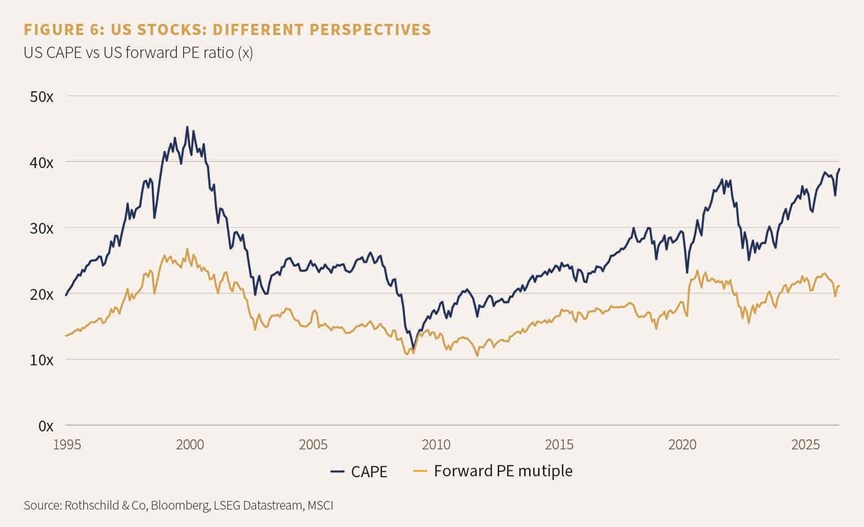
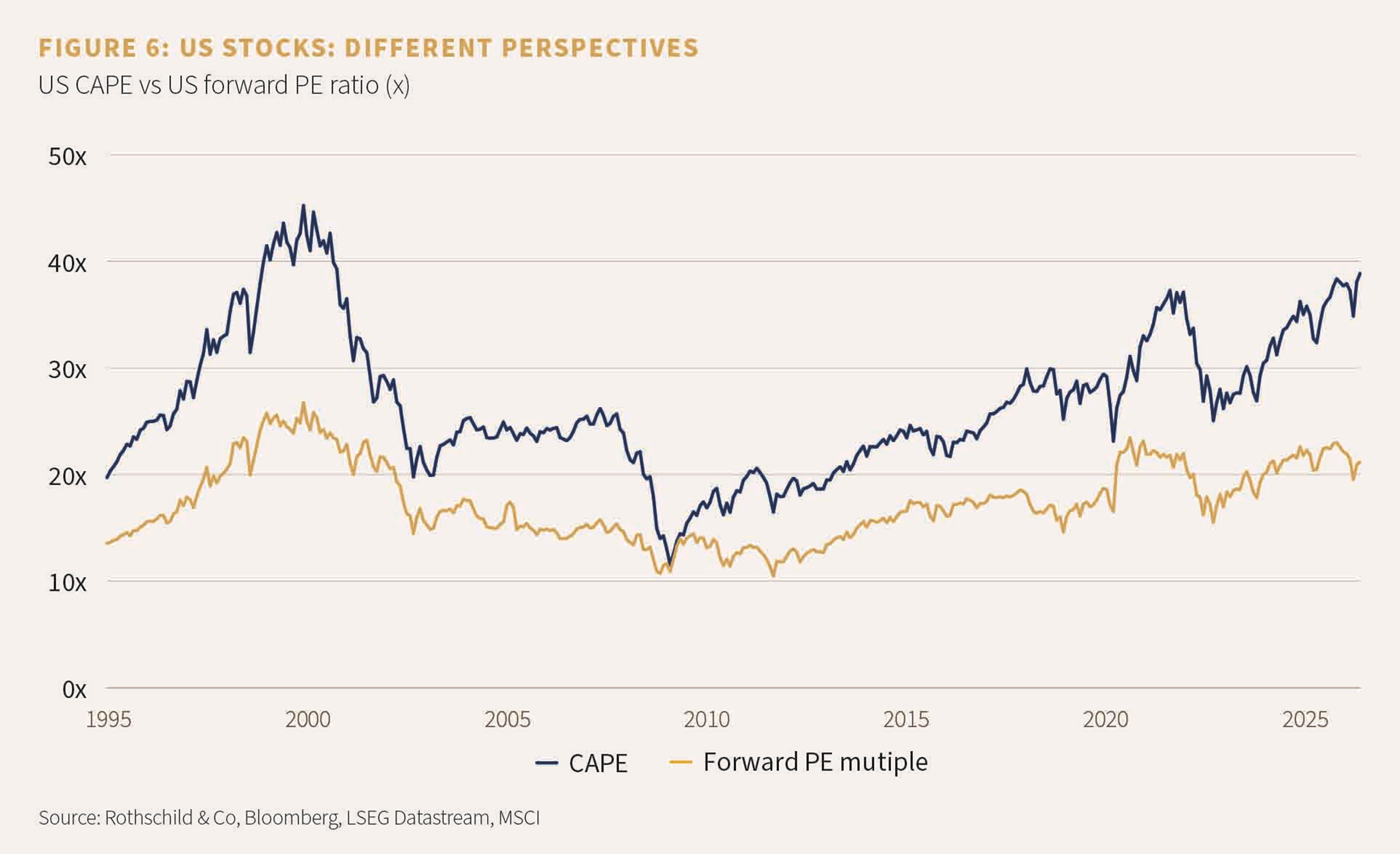
As noted, the slow moving 10-year average earnings reading is a feature, not a bug, of the CAPE. But it means that most predictive power in the metric likely comes from the numerator (i.e. the change in prices), not the denominator. What the CAPE may be capturing is simply the notion that after rising quickly, prices are sometimes more likely to reverse. And if recent earnings turn out not to be transient but instead prove to be sustainable then the CAPE will not be providing a useful valuation signal at all.
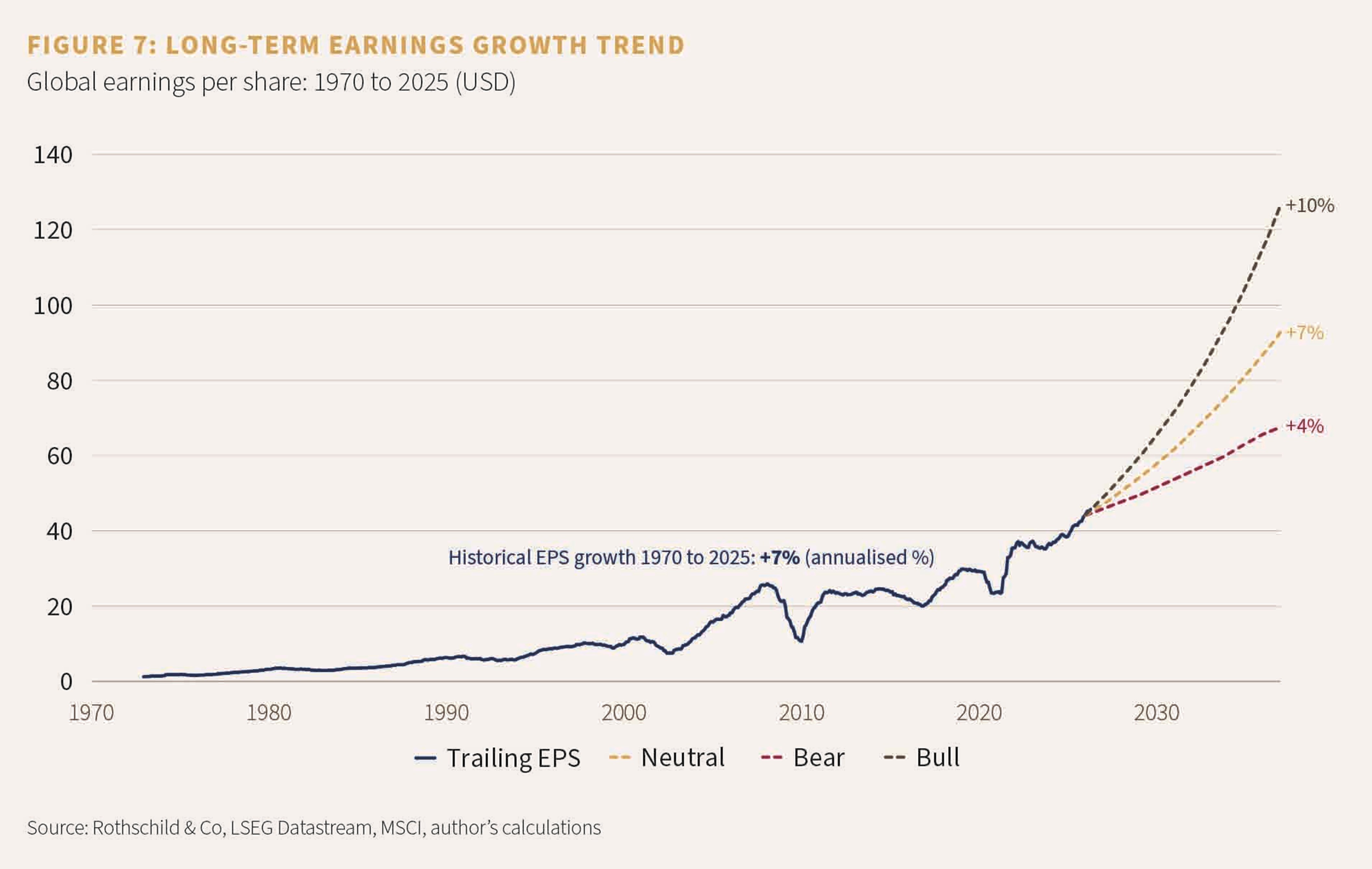
Indeed, depending on the rate at which future earnings compound, ultimately the 10-year average itself – and the valuations that depend on them – could end up in very different places (figure 7).
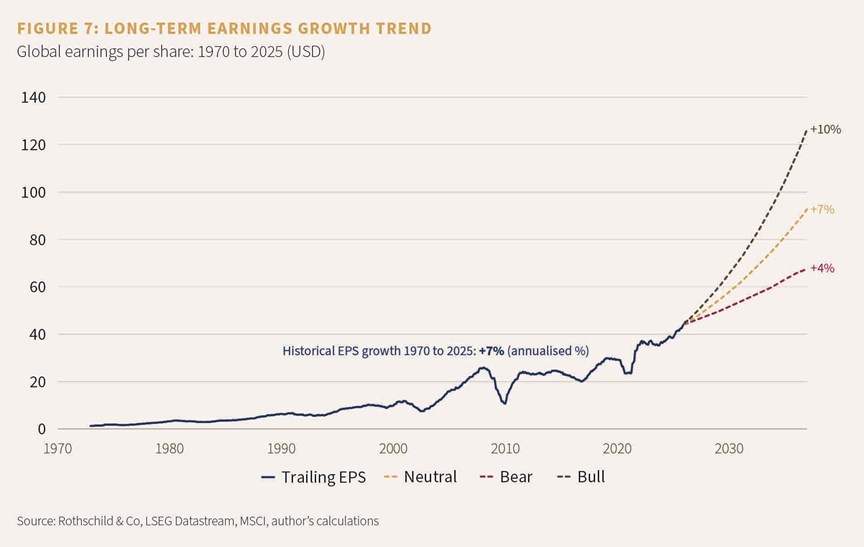
This helps explain why any two equity analysts seem to be able to reach at least three different conclusions about “fair value”. And as noted above, all this is before we even think about profitability (what the E means as a return on capital) and, especially, interest rates. Even if we take the CAPE at face value, it may be less useful in gauging future returns than we might think. It’s limited utility as a short-term market timing tool is well known, but even its long-term usefulness is somewhat questionable.
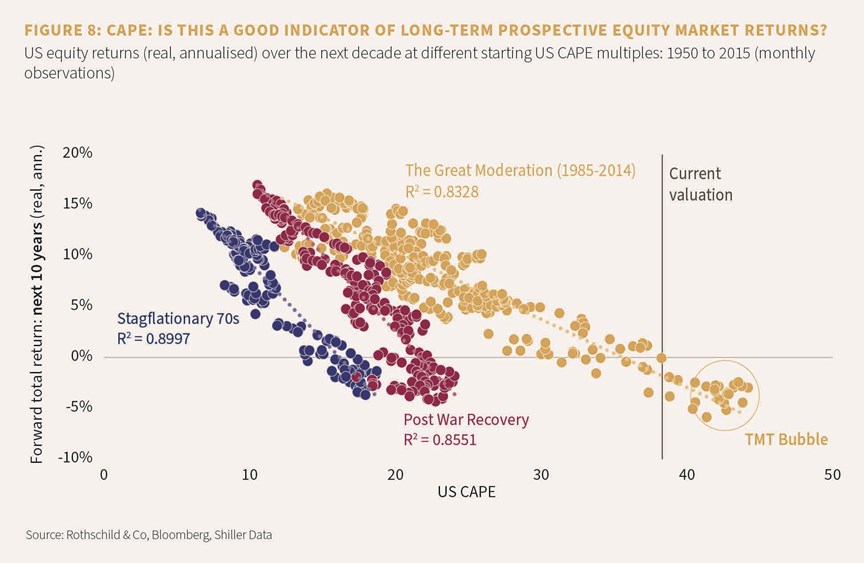
A simple historic regression, based on today’s starting level, suggests US stocks might deliver a return below expected inflation (see above). However, the US CAPE has in fact been in ‘expensive’ territory – more than one standard deviation above its trend – for more than a decade, and investors allocating purely on valuation grounds would have missed out on the past decade’s returns (an indisputably bad decision).
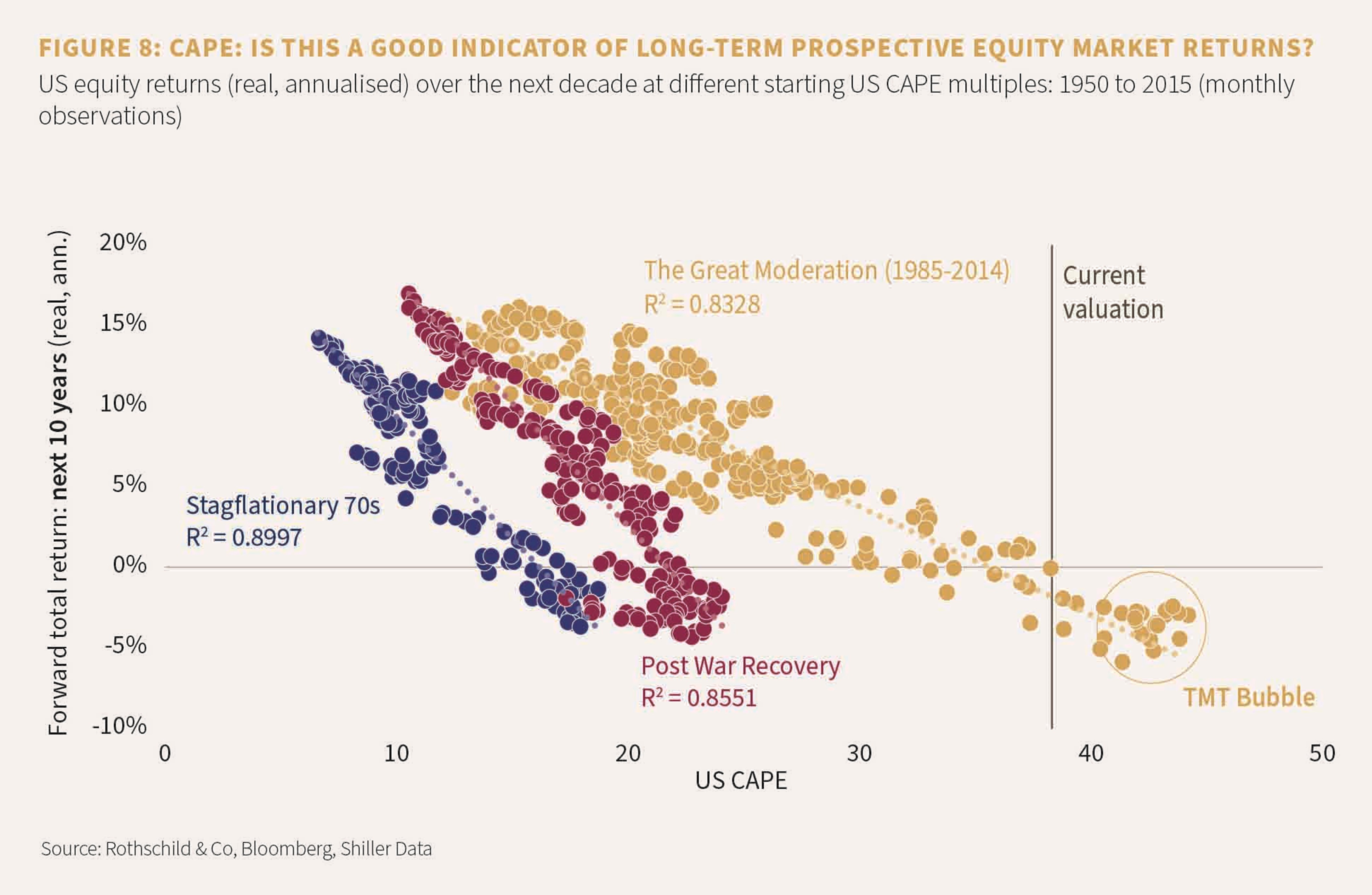
Indeed, when comparing the CAPE multiple with the subsequent returns delivered by the stock market over the next decade, there is a pretty meagre statistical relationship. When we segment these returns by different periods or regimes, a clearer relationship emerges (figure 8) – but one that still tells us little about what when valuations are too stretched.
There are many possible reasons for this variable relationship, including accounting regimes, compositional effects and (you guessed it) profitability and interest rates.
We’ve explored the notion of ‘EVA’ (Economic Value Added) in previous publications. This is the gap between profitability (return on equity) and the return that capital might make elsewhere (cost of equity), and it has widened materially in recent decades. Again, there are measurement nuances, and the positive trend has flattened more recently as interest rates have reverted to more normal levels. But the key point is that rising EVA has loosely echoed the rise in many valuation multiples (including the CAPE).
Some of this improving profitability can be explained by a more resilient and stable macro climate (particularly compared to the 1970s period, for example). But it also reflects a big compositional change in the index towards services and technology – which are characterised by intangible output and capital-lite balance sheets.
Recently, the communications and technology-led market advance has looked particularly concentrated, and is potentially worrying, especially if it speaks to anti-competitive and monopolistic practices. But there is an alternative perspective: where the shifting composition of the index reflects a change in the wider composition of the US economy. That shift, until very recently, has delivered increasing returns to scale, by virtue of the resultant operational leverage and low capital intensity. Even with some big tech balance sheets and business models being ‘re-materialised’ in search of energy and expensive semiconductors, profitability may not suddenly go into reverse.
This all may appear somewhat academic, but we are trying to stay open-minded: the last decade has not been kind to more dogmatic pundits. There is some fundamental merit in the idea that higher-than-usual valuations (at least on a CAPE basis) might be more sustainable than they were in the past. And this is not us just being wise after the event: that rising EVA has long been visible, albeit occasionally obscured by more pressing cyclical concerns…
Even setting aside the valuation debate, the narrow leadership itself might yet cast a shadow over the durability and strength of the market’s rally. We entered this year expecting a broadening of earnings growth to other sectors and regions. While this is playing out to some extent, cyclical risk may yet appear in more energy-exposed sectors, and AI is once again firmly in the van of the market’s advance.
Looking ahead, technology earnings are currently expected to lead global corporate profits - the latter is expected to expand by a half over the next three years. This would mark the fastest pace of earnings growth without a preceding contraction (that is, which isn’t a recovery situation). We’re not in the economic slump camp, but the jury is surely still out on whether that sort of growth really is at hand – as we discuss below.
There is some fundamental merit in the idea that higher-than-usual valuations (at least on a CAPE basis) might be more sustainable than they were in the past."
Frequently-asked questions about Artificial Intelligence
Q: WILL AI TAKE EVERYONE’S JOB?
A: No
If nobody has a job, who will be able to buy the things AI produces? A world without jobs might be a world without customers, or indeed without a conventional economy at all. Such a world is hard to imagine. It sounds dystopian.
How might we get there? We don’t know if today’s AI build-out will ultimately pay off. Who will invest even bigger sums into an economy shrinking under the weight of mass lay-offs?
Perhaps a utopian outcome is more feasible, a world of “Lotus Eaters”, as envisaged by Keynes when he considered future automation:
“Thus for the first time since his creation man will be faced with his real, his permanent problem – how to use his freedom from pressing economic cares, how to occupy the leisure, which science and compound interest will have won for him, to live wisely and agreeably and well.” (Keynes, 1930)
In such a world, entitlement to a “universal basic income” might sustain demand and make things add up, as it were. Robots – mechanical as well as digital – produce everything, but the state distributes the output across the population, amicably and luxuriously. Even then, deciding who gets what would not be easy.
The main obstacle to AI domination, however, is simple: the ‘bots will not be up to it any time soon.
Here are fifty job titles selected at random (by AI) from the 1,384 identified in the “Extended Standard Occupational Classification 2020” compiled by the UK’s Office for National Statistics:
Chief executive; Marketing director; Forestry manager; Golf course manager; Beauty salon manager; Agricultural scientist; Biomedical scientist; Archaeologist; Structural engineer; Aeronautical engineer; Cyber security specialist; DevOps engineer; User experience designer; General practitioner; Clinical psychologist; Registered community nurse; Paramedic; Primary education teacher; Teacher of English as a foreign language; Finance and investment analyst; Marketing manager; Youth work professional; Newspaper or periodical editor; IT operations technician; Complementary health associate…
… Higher level teaching assistant; Veterinary nurse; Interior designer; Project support officer; Data analyst; Merchandiser; IT trainer; Data entry administrator; Exam invigilator; Metal working machine operative; Plumber or heating engineer; Chef; Veterinary assistant; Sports and leisure assistant; Bed and breakfast owner; Sales and retail assistant; Call centre agent; Paper and wood machine operator; Large goods vehicle driver; Train and tram driver; Elementary construction occupation; School crossing patrol warden; Street cleaner; Kitchen and catering assistant; Waiter.
Jobs earlier in the list (the ordering’s is the SOC’s) likely use data to a greater extent, but are less important, statistically, than their position suggests. (Like all random selections, this one shows clustering – for example, public administration is under-represented.)
What’s our point? Only that it is easy to forget the varied things that people do for a living – many of which will not be done by machines soon, if ever. Some jobs and occupations will go, but lots won’t, and – see below – some new ones will be created too.
No doubt it is easier to assume that all jobs are equally at risk of automation if we ourselves work in a data-intensive sector:
“So white-collar work where you’re sitting down at a computer, either being a lawyer or an accountant or a project manager or a marketing person, most of those tasks will be fully automated by an AI within the next 12 to 18 months.” (Mustafa Suleyman, CEO Microsoft AI, interviewed by the FT, February 12th).
Either lawyers and accountants are now just a year from obsolescence, or this was mistaken. Or a marketing pitch.
A world without jobs might be a world without customers, or indeed without a conventional economy at all."
Q: WILL AI CREATE JOBS?
A: Yes
AI and workers is not an “either-or” decision. For most jobs, it will be a case of both together, as the new technology partners and extends human capabilities – a case of “augmentation rather than automation”.
It is already hard to perform any data or language-processing task without receiving some input from AI, solicited or not. “Copilot” is fast becoming as ubiquitous – and perhaps irritating – as “Clippy”. More seriously, lawyers and accountants with AI-enabled data management and comms are more productive than those without.
Of course, higher productivity does not have to result in the same output but less input: it can also give us more output from the same (or more) input.
This is not a new idea. In the nineteenth century, the “Jevons paradox” noted that more efficient steam engines led to more coal being used, not less: cheaper output led to higher demand. More recently, faster motorways have led to more traffic – there are countless other examples. Perhaps AI will be the next, as the cost of data and language management/analysis falls and boosts overall demand for some services – creating, not replacing, jobs.
AI’s impact may not be one-directional, then. And this is before considering the additional demand for labour from the as-yet-unknown new products and services which will doubtless be invented in the wake of the new technology.
We still don’t know just how disruptive or expansionary today’s AI will turn out to be. If it does prove to be the latest “transformational” technology, history suggests the effects on the product range, employment and living standards will be wide-reaching, gradual, unpredictable – but net positive.
In November 2015, the Bank of England’s Chief Economist gave a widely-publicised speech to the Trades Union Congress in which he suggested that “… up to 15 million jobs could be at risk of automation”. At the time, this would have been roughly two-thirds of total full-time employment.
Since then, total employment has risen by 2 million. To be fair, the Bank’s timeframe was “the next few decades” – but such a period of adjustment in itself should have argued against hyperbole.
Prosperity is usually driven by productivity, and proceeds in waves of innovation and invention."
Q: ARE LLMS ANSWERING OUR QUESTIONS?
A: No
The ability of Large Language Models to engage directly with words, images and sound as well as numbers is dauntingly impressive to those of us who remember communicating with a CPU via a piece of cardboard with holes punched in it. It could be a hugely valuable breakthrough too, if enough commercial applications arrive soon (see below).
However, it does not do this quite in the way we might think. When we make a request of an LLM, it does not “reason” its way to a response. It is not thinking, nor is it generally (genuinely) “intelligent” (again, see below).
Instead, having translated our request into a pattern of digitised “tokens”, it searches its vast training memory – all digitally available literature perhaps – for similar patterns, and produces an “answer” based on how such patterns might have evolved in the past.
It is as if AI engineers have solved an “Infinite Monkey” problem by familiarising the monkey with the notion of “words”, and getting it to type super quick: Hamlet gets written faster, but the text still doesn’t mean much to the monkey. (Just as, in another example found in the literature, a person unfamiliar with a foreign language can still create plausible sentences by following pattern-based rules.)
Because the process is largely one of pattern recognition, it requires massive amounts of data and energy – even with today’s super-fast and three-dimensional processing architecture, and emerging quantum capabilities. LLMs may unearth spurious patterns or “hallucinations”, lack common sense, or be contextually naïve: their responses need checking.
The process sounds (perhaps ironically) inefficient. As the energy used rises, LLM proprietors are increasingly having to pass on some of those costs (making customers pay for the quantity of tokens used), or to subsidise them with (you guessed) advertising revenues.
Q: IS AI GOOD FOR PORTFOLIOS?
A: Yes, but…
On the strategy team we are currently in two minds when it comes to the investment case for AI.
Prosperity is usually driven by productivity, and proceeds in waves of innovation and invention. Sometimes an invention disappoints, and the purveyors and users of the new technology fall out of favour. But genuinely transformational technologies – the printing press, steam driven processing of fabrics and metals, new modes of transport, disease eradication, telecommunications, ICT, the internet (eventually) – become widely adopted, making businesses bigger and more profitable.
With this in mind, a healthy weighting in innovation is a core component of any long-term portfolio – whether explicitly, in the form today of direct holdings in information and computing technology (ICT) and life sciences companies, or implicitly via the ownership of companies which benefit from using it.
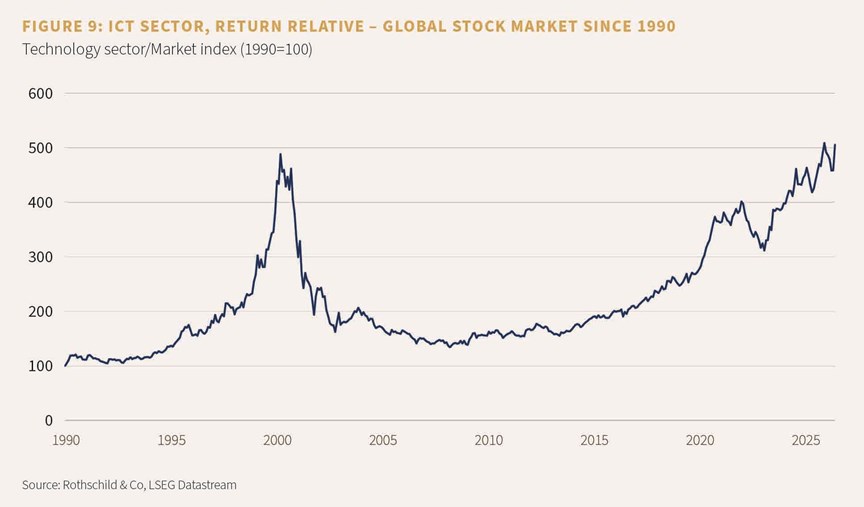
In fact, the ICT sectors in particular – software and hardware together – have contributed much of the dematerialisation and enhanced profitability which has led the global stock market higher since 1990 (figure 9). They do not always have to do so, of course, even if the technology they provide is widely adopted and continues to be useful. There are few ISPs (or publishers, or transport companies) left in today’s main stock indices, for example, though the internet (and printing, and mass transportation) has been hugely successful commercially.
The current AI build-out, with its massive data centres, huge energy usage and super-expensive processing units, has already run a long way. Total AI-related capital spending is variously estimated to be running in the $0.5-1.0 trillion region in 2026, with $1 trillion likely next year – an increase which looks likely to require external financing for the first time. Overall stock market valuations surged last year to post-2000 highs – they have since fallen back, but only when gauged in terms of today’s rapidly-growing earnings (as per the previous essay).
Despite the sensational achievement in computing terms, however, much AI capability can look like an answer in search of a convincing commercial question. Its potential looks huge, but profitable practical applications to date seem narrow and unscalable. As noted above, many tasks and issues are simply not computable.
In our small part of the world, AI offers to write routine market reports; to take minutes at meetings; to gather, analyse, tabulate and chart all sorts of accounting or economic data; to mine that data for any and all correlations or other regularities – and lots more besides, including processing applications for our jobs to begin with.
Impressive though these achievements are, however, they may not be game-changing for overall business performance. At the same time, the importance of the human touch is easily overlooked, and might even become more, not less valuable, in an increasingly impersonal world.
Meanwhile, in an echo of the 2000 dotcom embarrassment, the hype around AI is now considerable. We’re told not just that the machines are coming for all our jobs, but that “the singularity” is approaching, with machine intelligence and agency poised to overtake our own (this is highly unlikely: see below).
We are also seeing the return of some financial froth, though not yet on anything like a 2000 type scale (balance sheets are still relatively light; there is no merger and acquisition frenzy; vendor-financing is relatively limited in scale).
In stock market terms, our caution – luckily not outright bearishness – has been premature. As we write, the semiconductor sub-sector is on a tear, and hardware (and hyperscaler) earnings are flying.
The software sector has slumped, admittedly, but because it is one of the areas in which AI is thought likely (not by us) to replace existing suppliers. The software slump is itself a testament to elevated AI expectations.
Arguably, however, much of the current excitement and earnings growth is driven by corporate FOMO. The scaleable end-user applications which will boost profitability outside the AI industry have not arrived – at least, not yet. Meanwhile, the industry is increasingly recognising the efficiency problem.
Finally, in one very specific portfolio context we doubt that AI will make a significant difference, ever – namely, in the ability of individual investors to beat the wider stock market index.
If everybody has access to high-powered search and interrogation capabilities, it will be even more difficult to obtain an analytical “edge” from publicly-available data than it already is – and at the end of the day, for investors in aggregate nothing can change the unavoidable fact that the owners of the market collectively can’t beat it. The future will remain unfathomable, and genuine insight will be as scarce as it is today.
Investment analysis may not be the only instance in which, once a particular enquiry has shown itself to be capable of being “answered” by pattern recognition and extrapolation, its intrinsic worth to the user is less, and the AI-generated output is commoditised.
That said, some AI solutions will be valuable no matter how many people have access to them: speedy and accurate medical diagnoses, for example.
Arguably, however, much of the current excitement and earnings growth is driven by corporate FOMO."
Q: IS THIS ESSAY WRITTEN BY AN LLM?
A: No, but it could have been
It would be nice to think these ideas (and our prose) are uniquely ours. Sadly, most of them (and any style) will have been encountered by LLMs “trained” appropriately, and could easily have been returned as a plausible response to an enquiry.
AI is indeed capable of seeming like a human. Some would say, despite the misgivings noted above, that this is an indication that AI is generally (genuinely) intelligent.
Exactly such a test was proposed in 1950 by the mathematician Alan Turing as a way of answering the question “Can machines think?”. He suggested that if you could interrogate a computer, and from its answers believe it to be human, then it might be said to think. More recently, after interacting with it, Richard Dawkins proclaimed the LLM Claude to be “conscious”.
In practice, there is more to general intelligence than the ability to fool an observer – as Turing himself realised. Artificial Intelligence has logic and data-processing covered – but that’s not enough.
Intuition, imagination, initiative, contextual awareness, and that most elusive quantity of all, consciousness – these are all non-algorithmic, non-computable qualities which come easily to the human brain and are part of what we mean by general intelligence. Such intelligence is capable of many more tasks than are computers – just as the human body can still routinely do things which the most dextrous mechanical robot can’t.
Despite the excitement, we may be little closer to being able to replicate general intelligence in a machine than when Sir Roger Penrose published “The Emperor’s New Mind” in 1989. Today’s search for general intelligence through AI seems to involve little more than throwing lots of data at a wall, as it were, and hoping that some of it will stick – but with no reason to expect it to.
Meanwhile, most business questions – like Douglas Adams’ search for an answer to “Life, the Universe and Everything” – are not computable, and there is a limit to what today’s computers (conventional or quantum) can likely do for it.
So yes, an LLM could have written this. But why would it?
And if you thought that it had, would you have read it?
Ready to begin your journey with us?
Speak to a Client Adviser in the UK or Switzerland
Past performance is not a guide to future performance and nothing in this blog constitutes advice. Although the information and data herein are obtained from sources believed to be reliable, no representation or warranty, expressed or implied, is or will be made and, save in the case of fraud, no responsibility or liability is or will be accepted by Rothschild & Co Wealth Management UK Limited as to or in relation to the fairness, accuracy or completeness of this document or the information forming the basis of this document or for any reliance placed on this document by any person whatsoever. In particular, no representation or warranty is given as to the achievement or reasonableness of any future projections, targets, estimates or forecasts contained in this document. Furthermore, all opinions and data used in this document are subject to change without prior notice.