Private credit canaries
Even before war broke out in the Middle East, stress was beginning to show up in the private credit market.
The collapse of First Brands and Tricolour last year may have given us the phrase "credit cockroaches" – distressed, hidden borrowers – but US private credit defaults had been steadily rising for the past couple of years. More recently, some of the big banks have reportedly been writing down the value of the loans to private credit funds.
The issues are myriad: higher interest rates, seemingly miraculous liquidity transformation, loose underwriting standards, accounting chicanery, and of course, AI threatening to disrupt long-standing business models. Until recently, private markets’ defining features – opacity and illiquidity – had been features not bugs, but that is coming under increasing scrutiny.
Seeing the private investment management industry humbled (see chart) may be a case of schadenfreude to some – and there is little doubt that the media have taken special delight in their latest misfortune. But for some investors now effectively “gated” – unable to redeem their holdings – it is a potent reminder that low recorded volatility does not mean “low risk”.
Selected stock returns
Indexed (100 = January 2025)
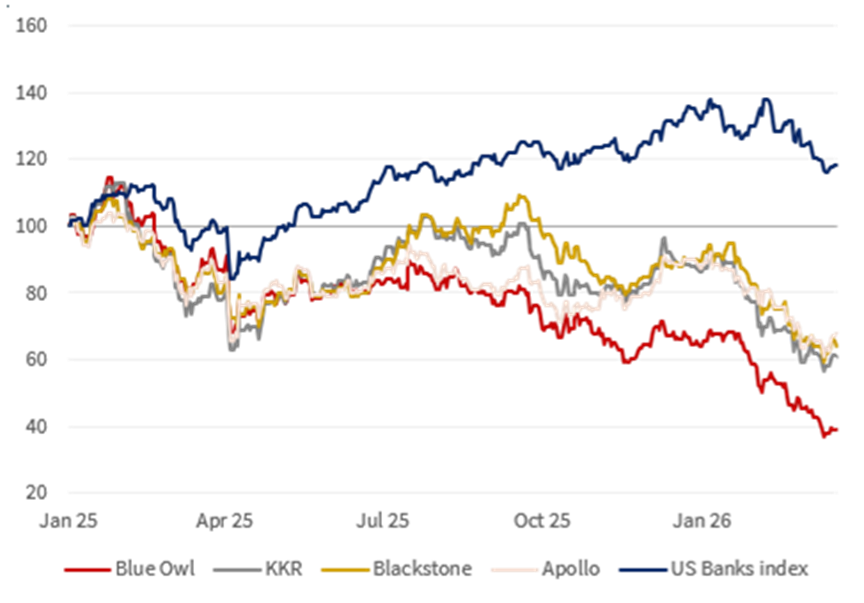
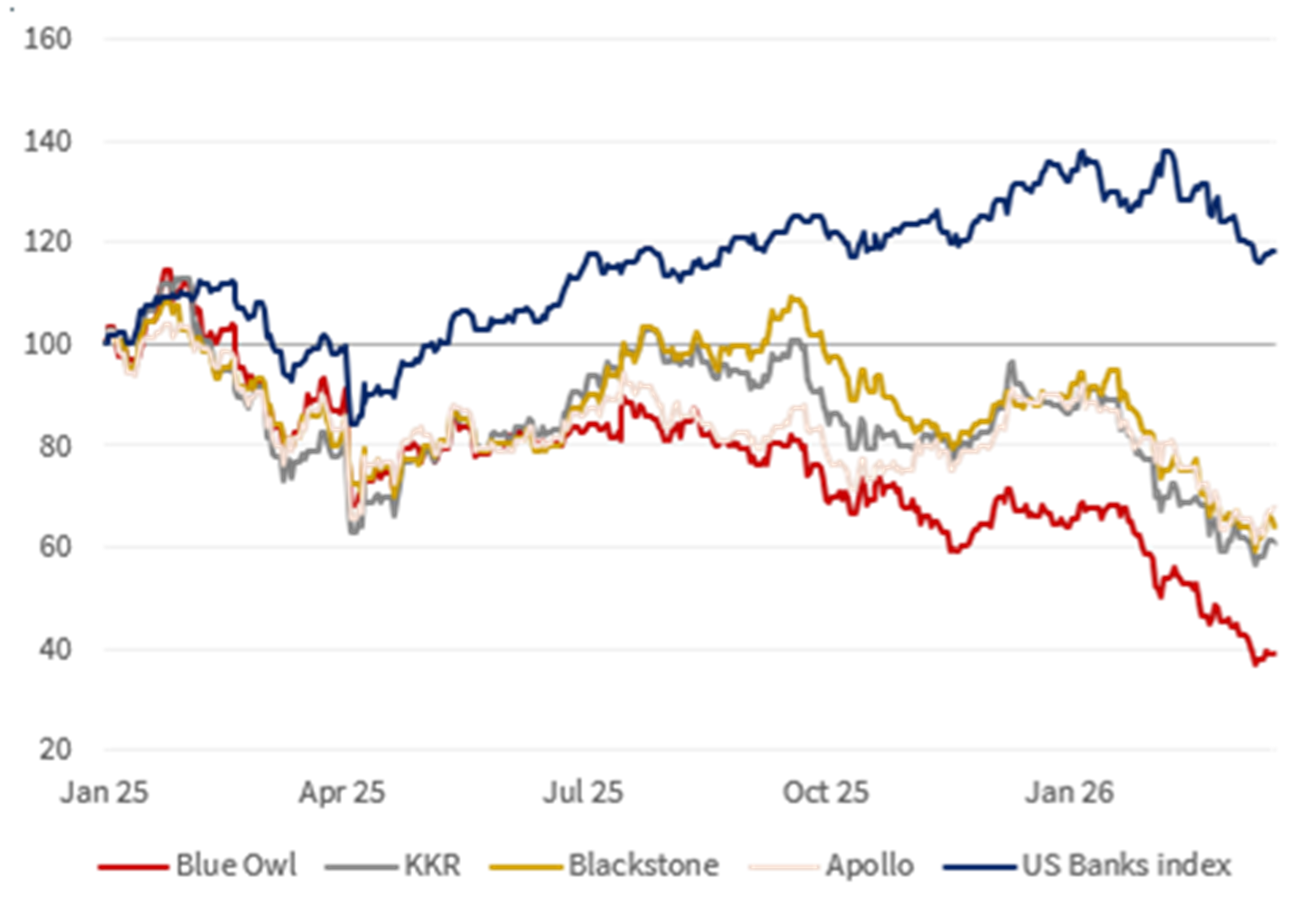
Source: Rothschild & Co, Bloomberg, MSCI
Meanwhile, beyond the potential investment losses, there are wider systemic concerns given the growing influence of ‘shadow banking’, which is getting bigger and becoming increasingly interconnected.
No longer a niche asset class
Private credit has grown into a global ~$3tn asset class that includes direct lending and asset-backed finance to mostly unlisted middle market firms (at least, as far as we can tell: as the name suggests, it is hard to gauge the exact market size). Its success has partly been opportunistic – years of tighter banking regulation restricted complex or risky lending. For would-be borrowers it offered credit on compelling (or at least available) terms, and for investors it offered the possibility of higher returns than the conventional fixed income market.
Today’s US private credit woes can largely be explained by high(er) interest rates, loose lending standards and declining credit quality in some sectors. Many floating rate loans extended during the pandemic period – when interest rates were low and cover was high – has left some borrowers (and their lenders) in a more vulnerable position today.
Rising concerns over profitability recently have also been amplified by fears that AI will permanently impair the software companies that by some estimates account for a quarter of private credit portfolios. There is also some scepticism around the valuations of the underlying assets and attempts to optically inflate earnings – “marketing EBITDA?” – and to deflate leverage ratios.
The use of Payment-in-Kind (PIK) notes and covenant holidays has allowed some credit funds ease terms for distressed borrowers – and to avoid recognising a default. But such ‘extend and pretend’ tactics may be merely a reckoning delayed.
A liquidity mismatch
There are a wide variety of strategies and vehicles in the private credit space. The long-established Business Development Corporations (BDCs), for example, bundle up private loans in a transparent, and liquid closed-ended vehicle which is actually traded in public markets. At the other end of the spectrum are more conventional drawdown funds, which are opaque and offer no liquidity over their typical 5-7 year lifespan.
Somewhere in between these two camps lie ‘semi-liquid’ open-ended perpetual funds, which might allow monthly or quarterly redemptions up to a certain limit. These vehicles aim to hold some liquidity to meet redemptions, while incoming subscriptions allow for some natural turnover. Many of these structures also have laddered maturities with various term loans – as those underlying loans mature this also creates some liquidity to meet redemption needs.
But what works in theory does not always work so neatly in practice: the underlying assets remain unavoidably illiquid. Offering investors (increasingly retail investors too) better liquidity terms than can be delivered has always been sticky territory. When confidence is dented and investors rush for the exit at once, a sort of ‘bank run’ ensues. The manager is inevitably forced to pause redemptions to avoid impairing the portfolio or disadvantaging other investors. This is unsettling at the very least. Investors in open-ended property funds in the late noughties and during the pandemic were chastened by a similar experience.
The aggregate level of debt is still not the problem
For most of its life, private credit has likely been too small and detached from mainstream banking to become a systemic problem. In aggregate, there doesn’t appear to be a macro concern around total corporate debt or the ability of companies to service that debt.
US corporate debt issuance has outstripped economic growth for much of the past couple of decades, but that trend has gone into reverse over the past five years. Faster nominal growth and ongoing deleveraging – aided by low interest rates and surging profits - has seen a big decline in the size of US corporate (non-financial) debt relative to GDP. Crucially, most companies are able to better service those debts.
US corporate debt
US non-financial debt relative to GDP (%) and debt service ratio (%)
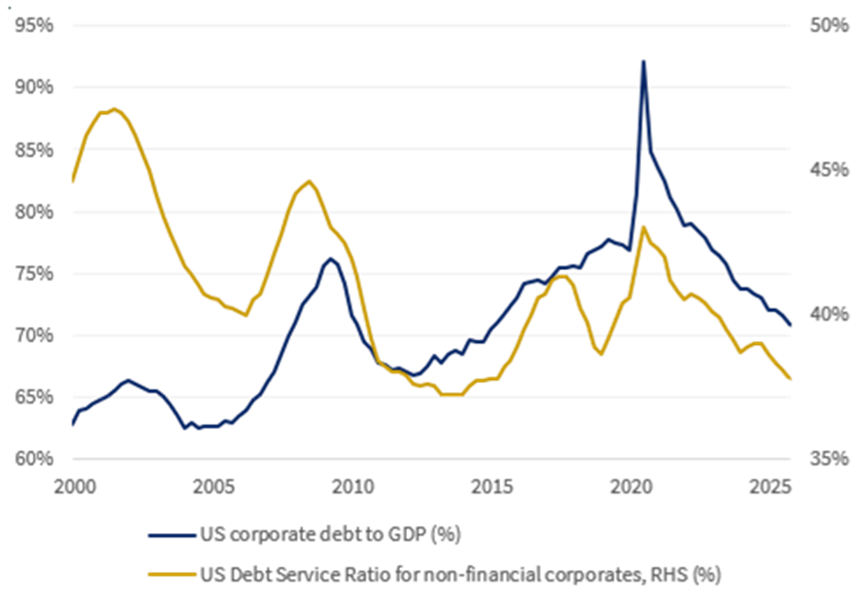
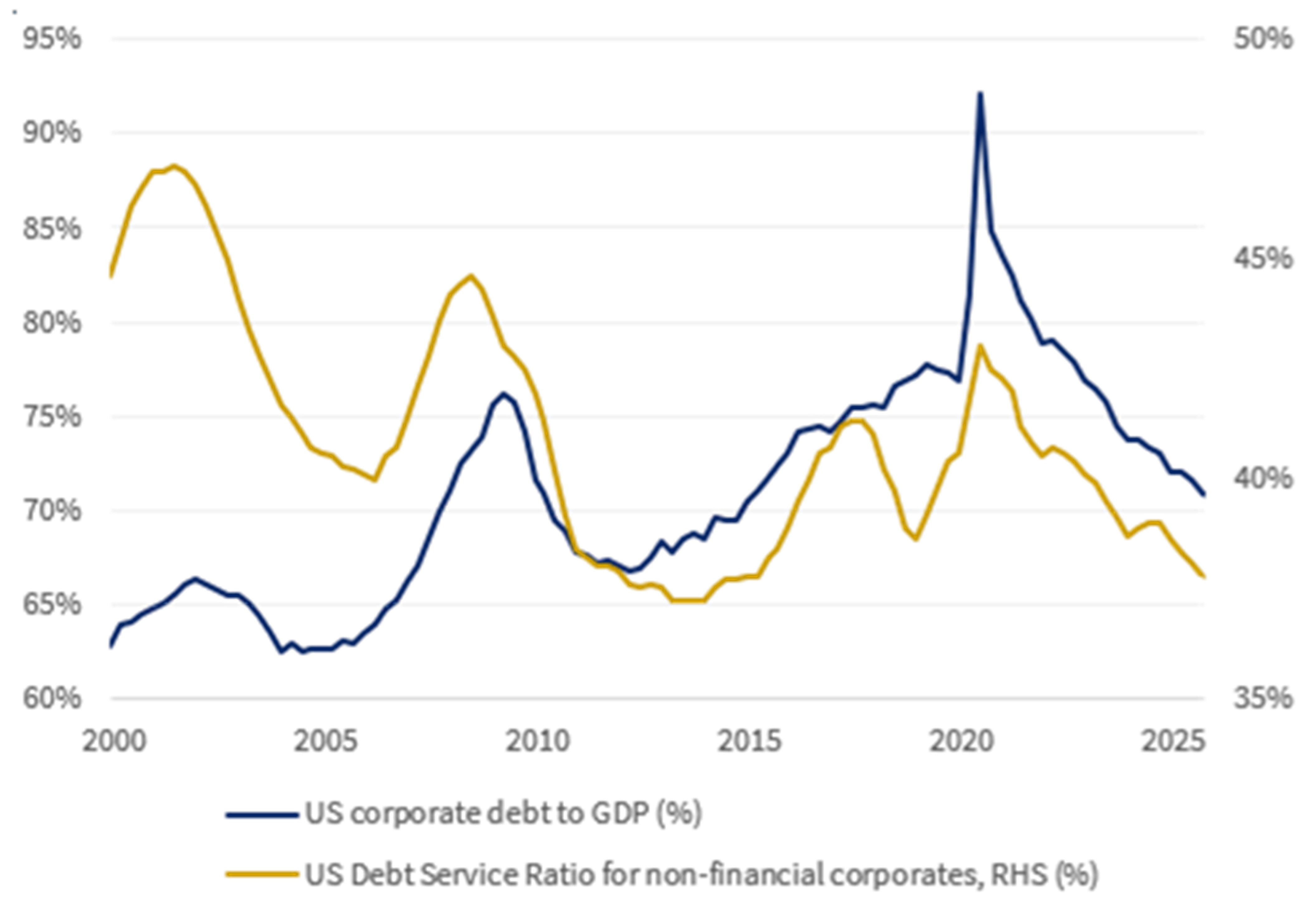
Source: Rothschild & Co, Bloomberg, BIS, US Federal Reserve. Footnote: The nonfinancial corporate business sector consists of all private for-profit domestic nonfinancial corporations. The nonfinancial noncorporate business sector consists of partnerships and limited liability companies, sole proprietorships, and individuals who receive rental income. The debt service ratio represents the share of income used for interest and principal payments for US non-financial corporates..
But broad aggregates can hide a multitude of sins – particularly at the more speculative end of the market, where much of the private lending takes place. ‘Bottom up’ data reveal that leverage ratios for US speculative grade credit still appear relatively conservative, in the 3.5-4.0x range (net debt-to-EBITDA), which is perhaps twice that of the investment grade cohort. However, according to Moody’s, for direct lending that figure is perhaps closer to 5-5.5x and perhaps even higher in more exposed segments – where the underlying earnings are being called into question.
However, the sector remains small in the macro context. Private credit likely still only accounts for less than a tenth of total corporate borrowing, and within the asset class, those troubled ‘semi-liquid’ strategies perhaps account for a sixth of that total. The size of the aggregate speculative grade credit universe (private and public together) has actually been relatively stable when compared to output over the past decade: there has been a shift in the public vs private market mix, but not an overall rise in the level of risky borrowing.
Hidden risks and spillover effects
Perhaps the greatest concern is whether there are hidden exposures on bank balance sheets: risks taken by non-bank lenders pose little systemic threat. Such hidden exposure might be through increased use of bank credit lines or through co-investments. In the US, for example, undrawn commitments to shadow banks (non-depository financial institutions) total $1.9 trillion – a sixfold increase relative to a decade ago – which could be a source of liquidity stress in extremis. This is perhaps why some of the big banks are signalling caution today.
Global Financial Crisis (GFC) comparisons are seldom reassuring, but at least on this count, private credit – and prudent estimates of the size of the wider shadow banking system – still seem small by the standards of the US mortgage market ($15 trillion) or aggregate US fixed income market ($60 trillion).
There are also other spillover risks to consider. The old adage goes "when panic strikes, you don't sell what you should, you sell what you can". Ironically, the recent fallout has led to the sale of more liquid US leveraged loans and Collateralised Loan Obligations (CLOs) – repackaged leveraged loans - which is also an important lending channel for many private equity owned companies.
That said, these other leveraged and illiquid funds may also be coming under similar pressure independently of private market indigestion: many of those CLOs are also exposed to the enfeebled software sector and higher yields will have caught many offside.
Not such a bad cycle
Perhaps the most remarkable development in recent years is how little interest rate stress we’ve witnessed after one of the sharpest tightening cycles on record. For some time, many were predicting the collapse of corporate credit, a big wave of defaults, and housing market stress. Today, aggregate corporate default rates remain low, credit spreads on both sides of the Atlantic remain tight (and well below their long-term median), and the housing market remains relatively resilient.
In any year, some businesses will fail and some loans will default, the credit cycle will fluctuate, and sector-specific risks will emerge. If the profit and/or interest rate cycle were to turn dramatically, the picture could change. But we don’t yet think those credit cracks are set to turn into economy-wide fissures.
Ready to begin your journey with us?
Speak to a Client Adviser in the UK or Switzerland
Past performance is not a guide to future performance and nothing in this article constitutes advice. Although the information and data herein are obtained from sources believed to be reliable, no representation or warranty, expressed or implied, is or will be made and, save in the case of fraud, no responsibility or liability is or will be accepted by Rothschild & Co Wealth Management UK Limited as to or in relation to the fairness, accuracy or completeness of this document or the information forming the basis of this document or for any reliance placed on this document by any person whatsoever. In particular, no representation or warranty is given as to the achievement or reasonableness of any future projections, targets, estimates or forecasts contained in this document. Furthermore, all opinions and data used in this document are subject to change without prior notice.