Growth Equity Update

October 2025 – Edition 43
- Back to the future: October 12, 2025, marked the third anniversary of the start of the bull market that has seen the S&P500 rise by c90%, NASDAQ by c120% and the FTSE Venture Capital Index by almost 170%.
- Since June 2025 the FTSE Venture Capital Index has been back above its previous 2021 peaks, buoyed by intense appetite for AI businesses.
- At $7.1bn September was the biggest month by value in European growth equity raises since 2021 and twice the amount raised in September 2024. The ytd European fundraising total stands at $34.9bn, already surpassing full year 2024.
- September saw $25.9bn of raises in US growth equity, bigger than any month in 2024 but only the third biggest month of 2025.
- YTD US raises are at $160.8bn, dwarfing the proceeds of the US IPO market in the same period ($29.3bn) and already 2.6x the amount raised in US growth equity in the first 9 months of 2024 and 1.5x the amount raised in the whole of 2024.
- AI and software lead the raises on both sides of the Atlantic. Fintech, biotech and Climate Tech fill out the top five sectors. Defence related deals have surged in recent months, and it appears as the sixth largest US sector ytd.
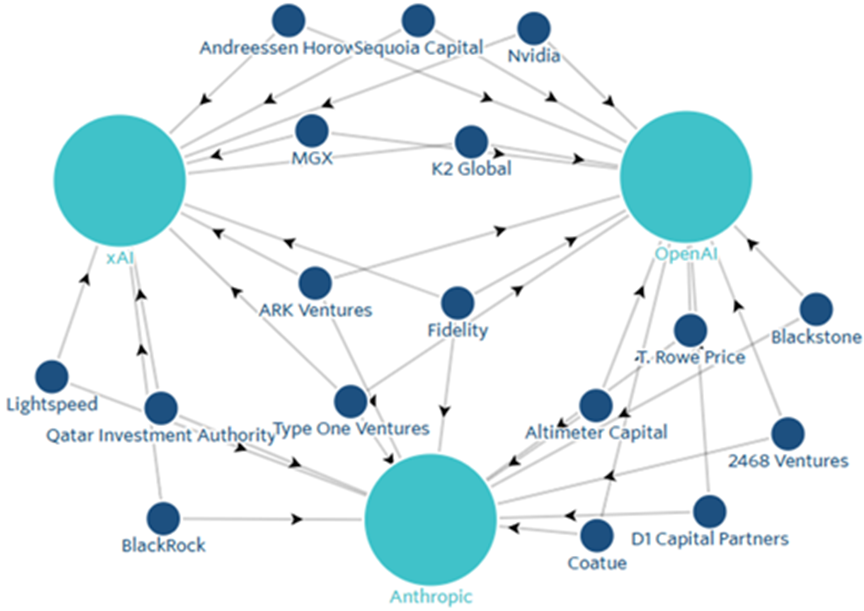
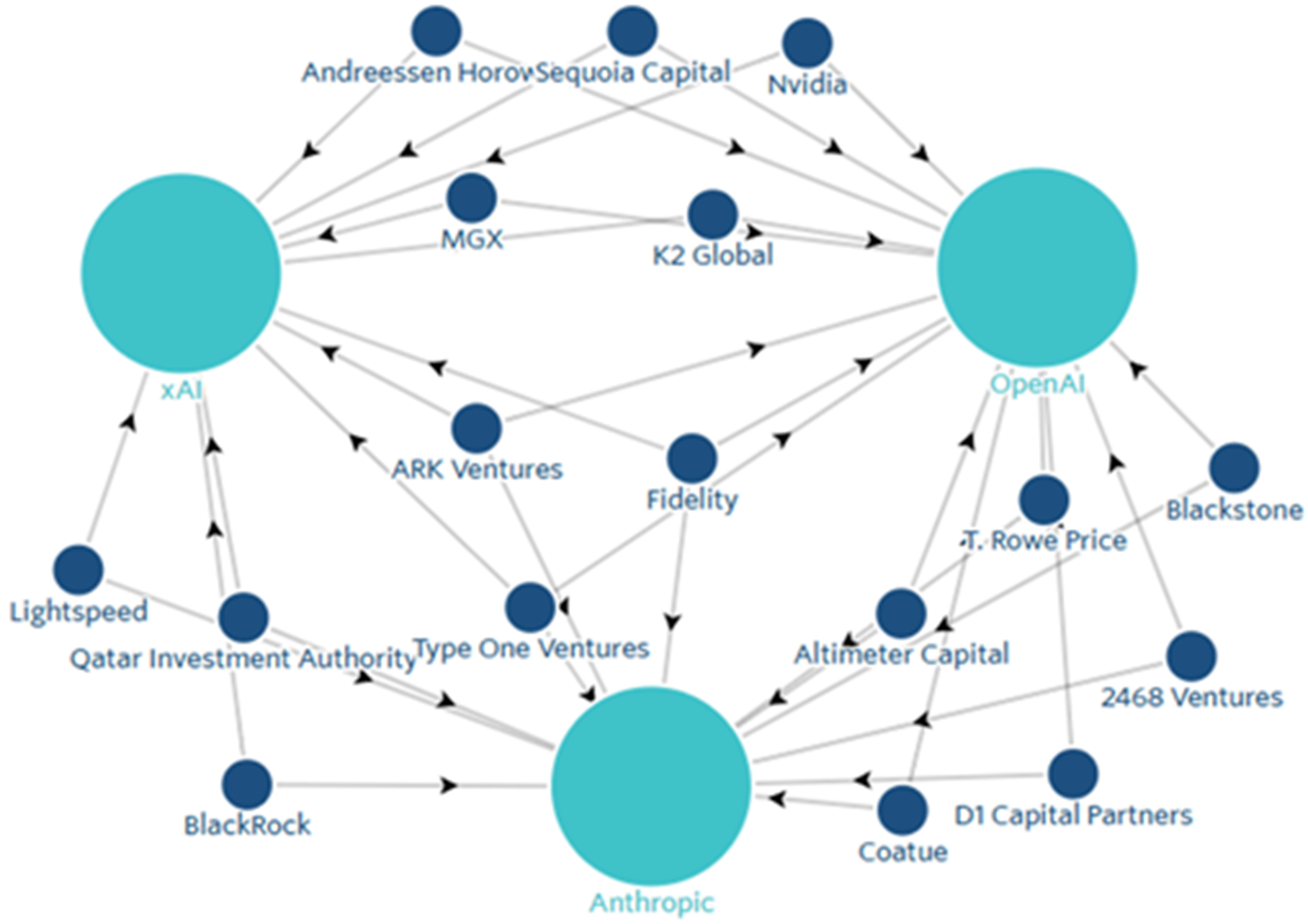
- AI investors: We include a useful chart from Pitchbook which tracks the cross holdings by investors of the three largest LLMs. Separately we note the scale of involvement of Nvidia across raises for AI associated businesses.
Click here to download a PDF version of Growth Equity Update
Big September
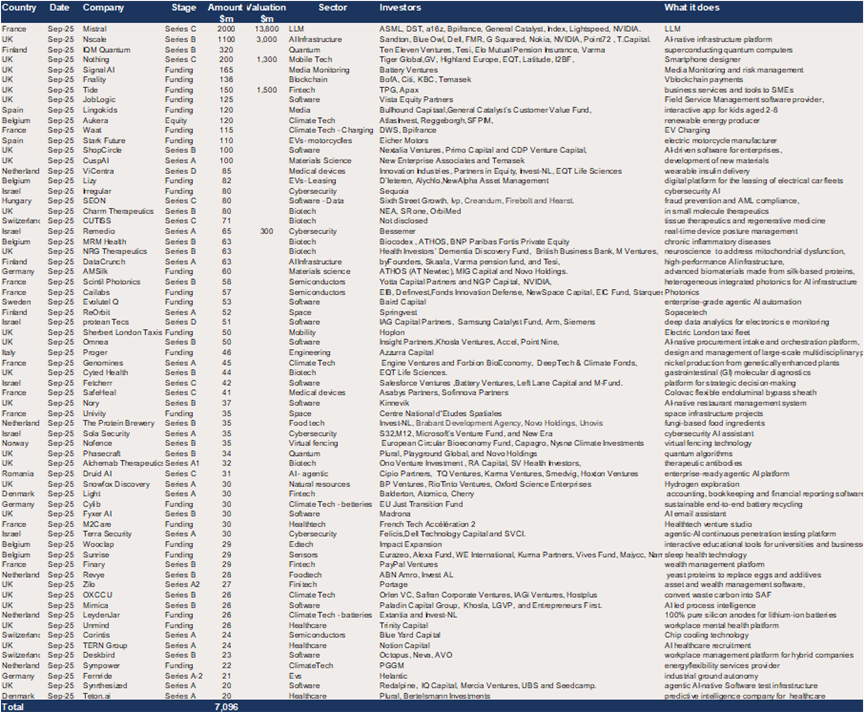
September was the biggest month by value in European Growth Equity raises since 2021.
September was a substantial month in growth equity raises in Europe. The Rothschild & Co Deal Monitor recorded $7.1bn of growth equity and VC deals of $20m and above. That figure was just over twice the amount raised in September 2024 ($3.4bn) and is the biggest month by value since the peak of the market in late 2021. The next biggest month in the last four years was the $6.9bn of September 2023.
In turn the strong September meant that each month of 2025 has seen the value of raises exceed that of the equivalent month in 2024. The year-to-date European fundraising total stands at $34.9bn to the end of September, already surpassing the $34.2bn full year outturn for 2024.
What characterised this flurry of deals in September?
AI related deals dominated. This has been a regular feature of the US Growth Equity market for the last 15 months but has not been such a marked trend in Europe, where AI has typically ranked as fourth or fifth in terms of sector weights by the value of fundraising. In September there were four deals in AI raising $3.2bn with the vast majority of that coming from just two deals, the $2bn raise for Mistral and the $1.1bn for Nscale in the UK.
Mistral’s Series C had been long awaited and valued the business at $13.8bn post money. The amount raised and the valuation are still modest in the context of its US LLM counterparts (Open AI’s last raise was $40bn at a $300bn valuation, Anthropic’s was $13bn at a $170bn valuation).
Mistral says that the raise ‘fuels our scientific research to keep pushing the frontier of AI to tackle the most critical and sophisticated technological challenges faced by strategic industries.’ It was led by Dutch semiconductor equipment company ASML which invested $1.5bn of the total. Existing Mistral investors DST Global, Andreessen Horowitz, Bpifrance, General Catalyst, Index Ventures, Lightspeed, and Nvidia also supported the round.
ASML CEO Christophe Fouquet commented that “The collaboration between Mistral AI and ASML aims to generate clear benefits for ASML customers through innovative products and solutions enabled by AI and will offer potential for joint research to address future opportunities.”
While the overlap between Mistral and ASML is not obvious at a practical level much of the commentary around the raise focused on European technology sovereignty.
UK datacentre business, Nscale described its $1.1bn raise as the largest Series B in European history. The hyperscaler will use the proceeds to accelerate its global AI infrastructure and GPU deployment roll out.
The new funding will be used to further Nscale’s deployment of large-scale AI infrastructure across Europe, North America and the Middle East, enabling the rapid rollout of the company’s “AI factory” data centres for projects like Stargate UK and Stargate Norway, and the expansion of its vertically integrated AI cloud platform.
The financing was led by Aker ASA supported by existing shareholders, including Sandton Capital, Blue Owl Managed Funds, Dell, FMR, G Squared, Nokia, Nvidia, Point72 and T. Capital. The Norwegian energy and industrial group Aker led the round with $285m of funding and payment in kind. The latter consisted of a portion of its Narvik land portfolio in northern Norway. In exchange Aker will receive a 9.3% stake in Nscale whose implied valuation was c$3bn.
Nscale is a relatively new entity having been spun out of the Australian bitcoin mining group Aekon Energy in 2024. During President Trump’s visit to the UK in September Nscale announced, alongside Aker, a five year $6.2bn contract with Microsoft.
Software, Climate Tech, biotech, fintech prominent as usual: Software (twelve deals raising $637m) was the second largest category in September, followed by Climate Tech (seven deals, $384m).
Quantum deals are typically relatively few but sizeable when they arrive. Quantum interpolated the usual order with two deals at a value of $354m in September, led by the $320m raise for IQ Quantum. IQM has sold 15 quantum computers to date. It has a flagship machine, Radiance, and an affordable machine Spark, which it sells to universities. The fundraise means that IQM has achieved unicorn status.
Thereafter usual service was resumed with Biotech (six deals, $353m) and Fintech (four deals, $236m) the other major categories.
A lot of deals: The R&Co Monitor recorded 67 deals of $20m or more spread across 22 sectors. Seasonally September tends to be a strong month. Nevertheless 67 deals are the highest volume number in 2025 and well ahead of the 52 deals in September 2024.
What does this indicate?
Investor sentiment appears more confident.
In H2 2024 the AI revolution kickstarted the venture capital/growth equity market out of its relative doldrums. The sense is that the VC market has gained more confidence in 2025 as public markets enjoy their third successive year of strong gains, as private markets move increasingly into focus and as the confidence in growth and potential industrial transformation engendered by the spread of AI suffuses through other industries. It is rare to see a raise that fails to mention AI as a driver of its operations and of its business opportunity. VC backed companies, as disruptors of the old order, are natural candidates for the broadening wave of AI impact.
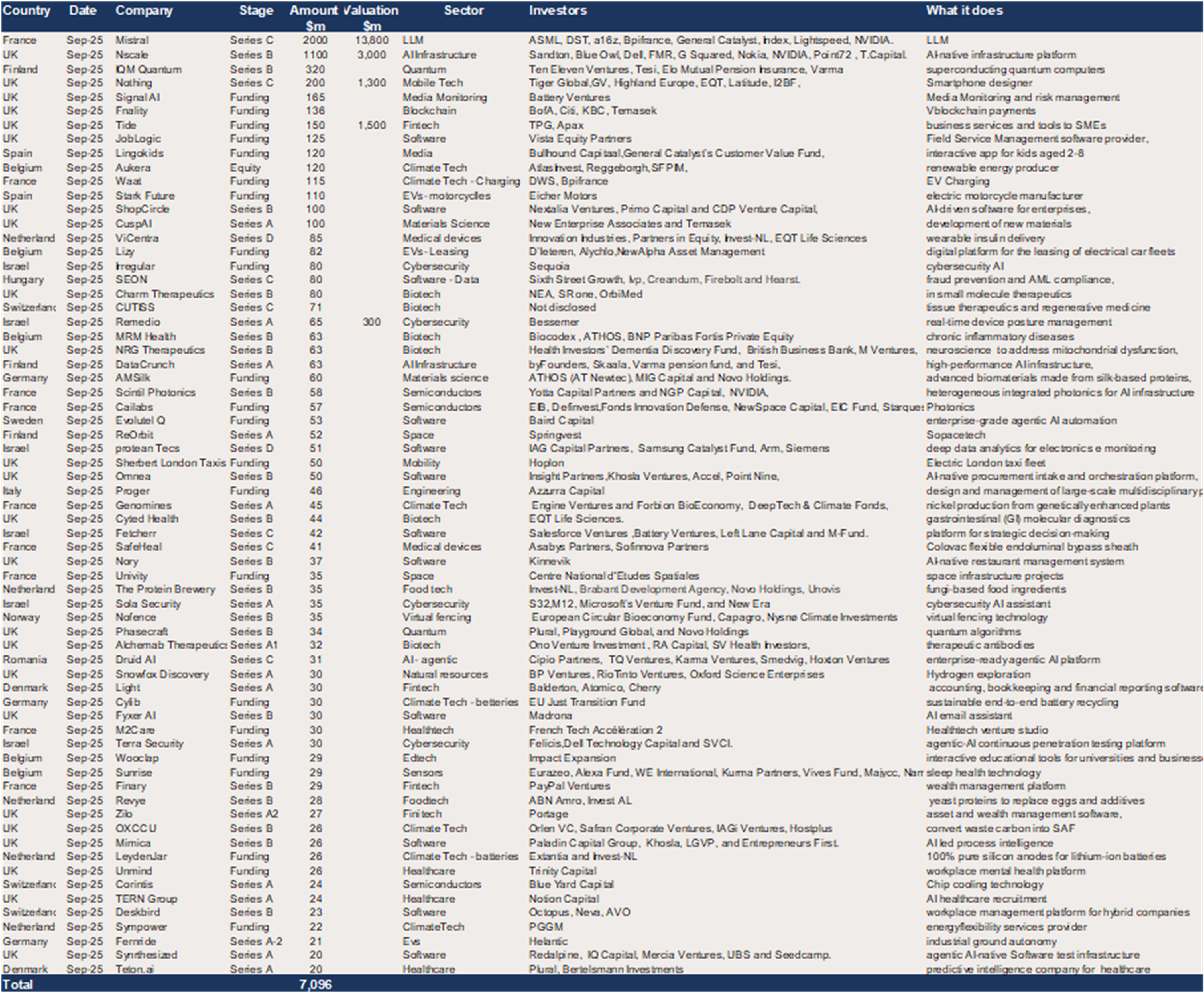
Europe – 67 deals raising a bumper $7.1bn in September
Source: Rothschild & Co
Source: Rothschild & Co
Europe - $34.9bn of Growth Equity raises ytd
In a buoyant year the value of European growth Equity/VC raises is at $34.9bn at end September 2025, up 36% yoy and now ahead of the full year total for 2024.
A strong Q3 (+66% yoy) which culminated in the record September means that ytd to end September $34.9bn has been raised in the European growth equity market, up 36% yoy and ahead of the full year total of $34.2bn in 2024.
Europe – The top 10 VC raises ytd


Source: Rothschild & Co
Source: Rothschild & Co
The top 10 deals raised $7.3bn and reflect some of the big trends that have become apparent since the start of the year.
AI is prominent with five of the top ten deals, including the largest. Here though we see the diversity of investment in European AI. Only one of these companies is a ‘pure’ AI deal, the LLM provider Mistral. Nscale and EcoData Centre are data centre providers - effectively infrastructure suppliers to, and facilitators of, AI. Helsing is an AI defence application – it uses AI to conduct modern remote warfare, while Isomorphic Labs has developed new AI dependent techniques for drug discovery.
Datacentres are key to AI development: Datacentres are the real estate of AI in terms of energy, availability of GPUs and land and energy access to drive them.
Deals to provide funding to AI data centres and energy players who will provide the power for them are becoming a big feature of the growth equity business both sides of the Atlantic. The equivalents in the US are the likes of Crusoe Energy, 5C Group, Massed Compute, Atlas Data Storage and Armada, also big raisers of capital in the first 9 months of 2025.
AI dependent industries: As we push down the sector list we see several other categories of AI dependent raises.
In Climate Tech the raises in fusion technology and nuclear are typically made with a view to providing cheap, green energy for AI datacentre demand.
The flurry of semiconductor deals is frequently, like that of the largest European one of the year, SiPearl to support supercomputing and AI.
The raises in Robotics are for businesses using one of the key early applications of AI. There were eight such raises in the first 9m of 2025 led by the $125m raised for Neura Robotics: ‘Cognitive robots that think and learn, collaborative platforms that work alongside humans, and AI-powered assistants that understand your world.’
Quantum Computing – the next leg of AI: There has been a flurry of raises on both sides of the Atlantic for quantum computing businesses. This rush of enthusiasm reflects the view that quantum computing is the next key stage in the development of AI.
For all its strengths AI has significant challenges around data and power intensive training, optimisation bottlenecks, lack of transparency and interpretability and sheer computational limits. The application of quantum computing to AI, unimaginatively called Quantum AI, means the ability to perform complex matrix operations faster, overcoming classical hardware limitations and improving natural language processing.
Europe, traditionally the poor relation to the US in quantum computing funding, has seen nine deals so far this year with four at over $100m (IQM Quantum - $320m, Quantum Machines $170m, Classiq $110m and Alice & Bob $105m).
Defence scaling up: We could have reclassified Helsing to the Defence sector, which would have raised Defence into the top 10 of European VC fundraising sectors in the first 9m. The Stockholm International Peace Research Institute reports 2024 saw the steepest y-o-y rise in world military expenditure since 1988, up 9.4% to $2,718bn, with its share of world GDP up to 2.5%.
The experience of the Ukraine war has shifted the focus of incremental defence spending from traditional military platforms (tanks, warships, planes) to new technologies like AI, robotics, autonomous solutions, quantum computing and cybersecurity.
Our Deal Monitor records six more defence deals, all in drones, led by the $176m May raise by Munich based Quantum Systems which produces AI-powered aerial intelligence systems for defence, emergency services, and industry, and the $77m raise by Lisbon based defence drone business Tekever led by Ventura Capital, the NATO Innovation Fund and Baillie Gifford.
Fintech and the return of crypto: Fintech has been staging a solid recovery since H2 2024. It is represented in the top 10 raises by the $500m raise by the Israeli global payments’ platform Rapyd in March to fund its acquisition of Dutch fintech PayU from Prosus.
In total the first 9 months of 2025 has seen 49 raises by Fintechs for a total of $3.3bn. In addition, there has been a marked revival in blockchain/crypto deals, subdued since the FTX bankruptcy of late 2022. There were 10 European deals raising $592m led by the $136m Series C by Fnality which is building a global settlement network employing distributed ledger technology to connect wholesale markets with tokenised and decentralized markets.
Space: Ten raises for Space businesses gathered $778m with three raises at over $100m. Loft Orbital , which raised a $170m Series C led by Tikehau Capital with Axial Partners describes the commercial space sector as ‘red hot’ driven by three factors (i) the need to understand the Earth’s changing climate (ii) the national need for security and sovereignty across all governments and (iii) the world’s ‘insatiable’ demand for connectivity and data.
Loft has designed standardised components notably Hub, a modular and universal payload adapter, and its Cockpit flexible mission operations software for hybrid satellite fleet and constellations at scale to speed up commercial space launches.
Meanwhile German rocket builder Isar Aerospace raised a $172m convertible and the Belgian satellite manufacturer Aerospace Lab $110m.
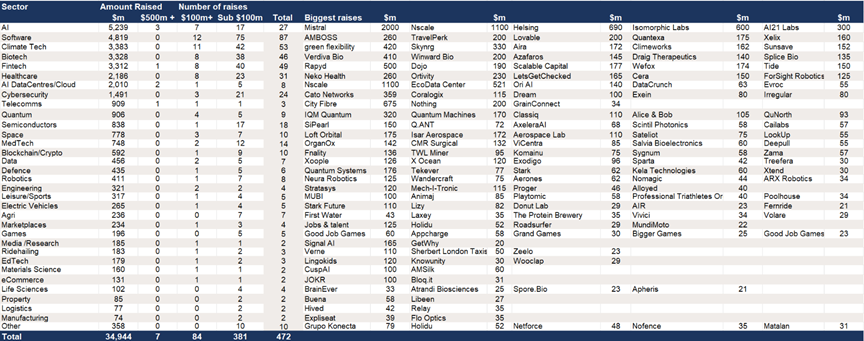
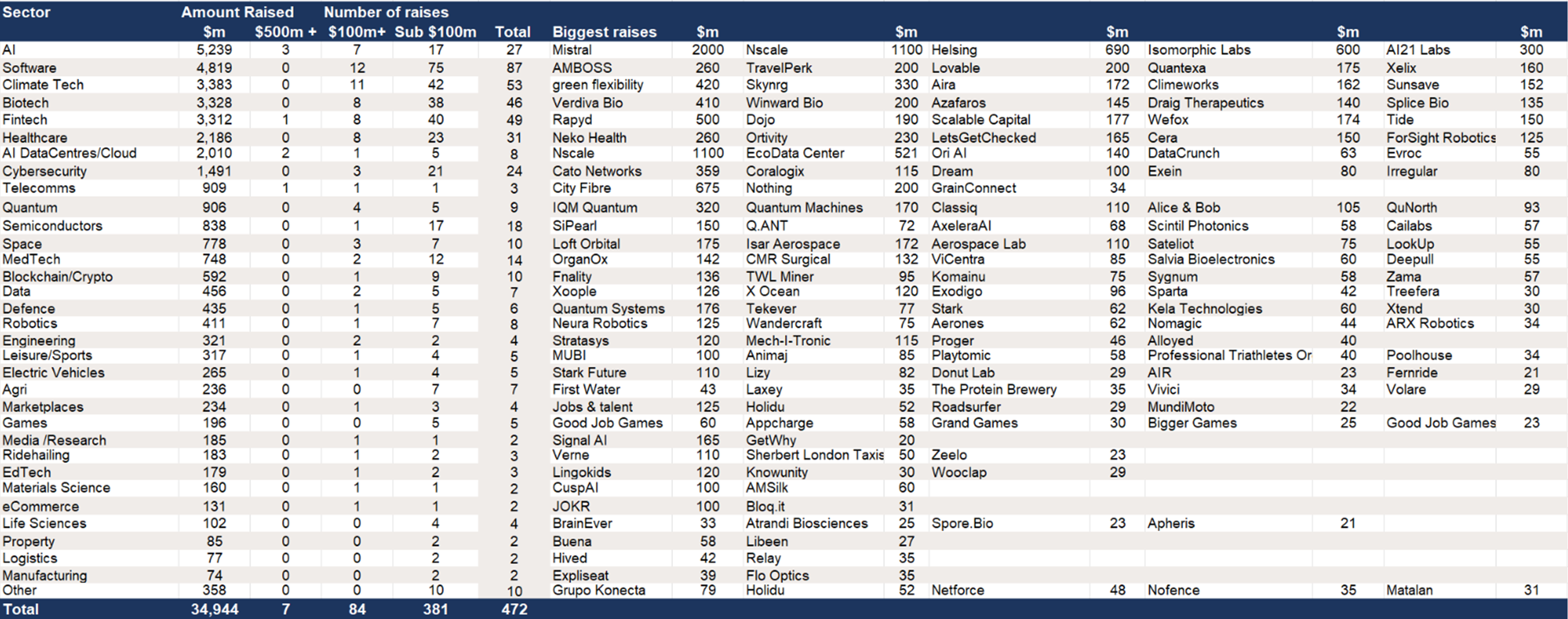
The next exhibit shows the breakdown of the c$35bn of European VC fundraises in the forest nine months of the year split by sector. Seven sectors AI, Software, Climate Tech, Biotech, Fintech, Healthcare and AI datacentres raised in excess of $2bn each in that period. We highlight the biggest individual raises in each of the 33 sectors highlighted.
Europe - $34.9bn of VC fundraises after 9 months – ranked by sector and largest raises.
Source: Rothschild & Co
Source: Rothschild & Co
…And another big month in US raises
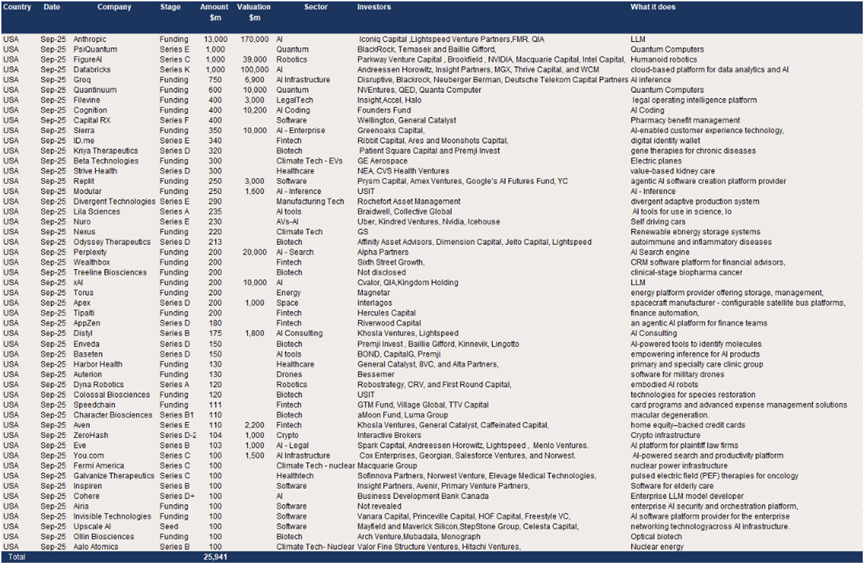
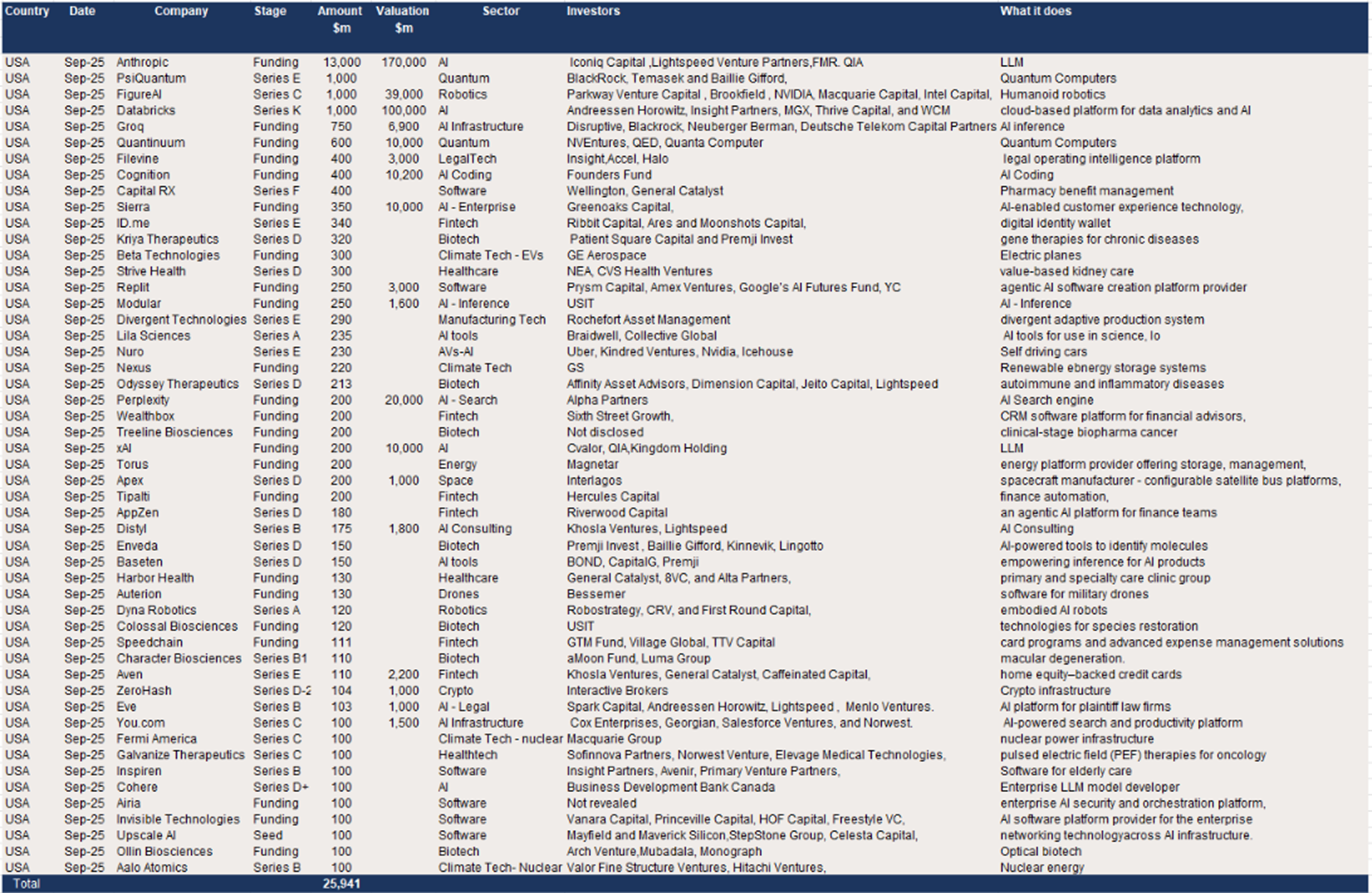
September saw $25.9bn of raises in US growth equity, bigger than any month in 2024 but only the third biggest month of 2025.
This is a remarkable time in US growth equity with huge appetite for AI related investments driving the market. Our R&Co Deal Monitor records US raises of $100m or above. There were 52 such deals in September, raising $25.9bn implying an average deal size of $498m (median $200m).
Of the total of $25.9bn raised in September there were 15 AI deals raising $17.2bn, 66% of the total. This meant the remaining deals raised $8.7bn, still 2.1x the entire amount raised in the US growth equity market in September 2024. The $25.9bn total was 1.6x the $16bn raised in each of the AI fuelled months of October-December 2024 which seemed remarkable at the time.
September’s leading deal was the $13bn raise for Anthropic led by Iconiq Capital, Lightspeed, FMR and the QIA. It brought the total raised for Anthropic to $28.7bn since May 2023. The raise was more than 3x the size of its previous largest raise, the $4bn funding by Amazon in November 2024. It valued Anthropic at $170bn, up from $61.5bn in March 2025. That is a 2.7x value uplift in six months and $108.5bn of ‘value creation’ in that period.
The next largest raise in AI was $1bn for Databricks. Databricks demonstrates the ability of private companies to remain private in this new AI age. The $1bn was its Series K – its eleventh raise therefore- and valued the business at $100bn. Databricks intends to use the proceeds to expand Agent Bricks which builds AI agents optimized on companies’ enterprise data and to invest in its new database offering Lakebase, an operational database (OLTP), built on open source Postgres, and optimized for AI agents.
Robotics is a closely related field to AI and saw another substantial raise with Figure AI raising $1bn at a valuation of $39bn led by Parkway Venture Capital and Brookfield plus a number of industrial backers including Nvidia, Intel Capital, LG Technology Ventures, Salesforce, T-Mobile Ventures, and Qualcomm Ventures. Figure said the funding will be used to expand production at its BotQ high-volume manufacturing facility for humanoid robots as well as to expand real-world deployments, enabling robots to assist with household and commercial workforce tasks. It will also scale its AI platform Helix with its core models for perception, reasoning, and control, and launch advanced data collection.
Quantum Computing: As in Europe, September was a strong month for raises by quantum computing businesses. As ever the volume of such raises is low, but the average value is high with three raises totalling $1.83bn. The largest of these was the $1bn Series E for PsiQuantum led by BlackRock, Temasek and Baillie Gifford which valued the company at $7bn. Other new investors included Macquarie Capital, Ribbit Capital, NVentures (Nvidia’s venture capital arm), Adage Capital Management, the QIA, Type One Ventures, Counterpoint Global (Morgan Stanley), 1789 Capital, and S Ventures (SentinelOne).
As well as the investment by NVentures, PsiQuantum announced a collaboration with Nvidia to accelerate quantum computing development with areas of cooperation including quantum algorithms and software, GPU-QPU integration and PsiQuantum’s silicon photonics platform. This reflects the keen interest AI ventures have in harnessing the enormous computing power of quantum.
PsiQuantum’s breakthrough is that it has integrated barium titanate (BTO), one of the world’s highest-performing electro-optic materials, into its manufacturing flow, which enables ultra-high-performance optical switches – a key ingredient in scaling optical quantum computing. The funding will enable PsiQuantum to scale up BTO production towards the volumes needed for utility-scale quantum computing. The BTO-enabled optical switch has potential in next-generation AI supercomputers, an area of increased interest given rapidly growing AI workloads.
USA – 52 raises of $100m + in September for a total of $25.9bn
Source: Rothschild & Co
Source: Rothschild & Co
US - $160.8bn of Growth Equity raises ytd
YTD US raises are at $160.8bn, dwarfing the proceeds of the US IPO market in the same period ($29.3bn) and already 2.6x the amount raised in growth equity in the first 9 months of 2024 and 1.5x the amount raised in the whole of 2024
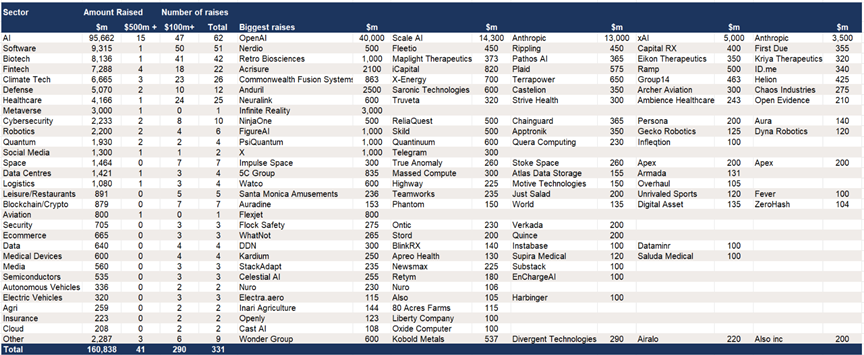
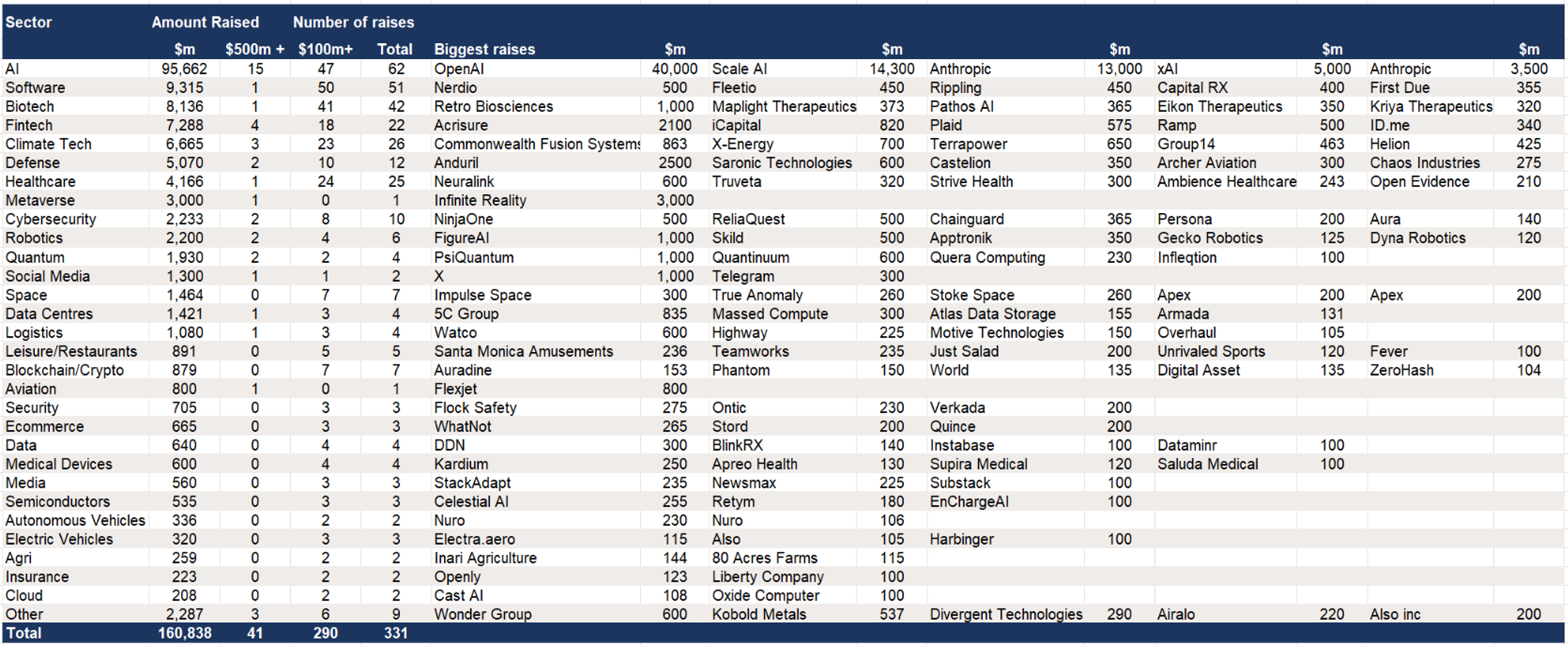
Our R&Co Deal Monitor records 331 US growth equity raises of $100m or more in the first nine months of 2025 raising $160.8bn. This remarkable total has been fuelled by intense investor interest in the AI opportunity. The perceived growth and disruptive potential of AI plus the spiralling valuations for its private players, of which many of the biggest operate in the private sphere, has fuelled the growth in funding.
The apparent success of early investors in the AI phenomenon has attracted follow on investment and new funders and has led to a widening of the spectrum of AI businesses that are attracting both high levels of investment and valuation.
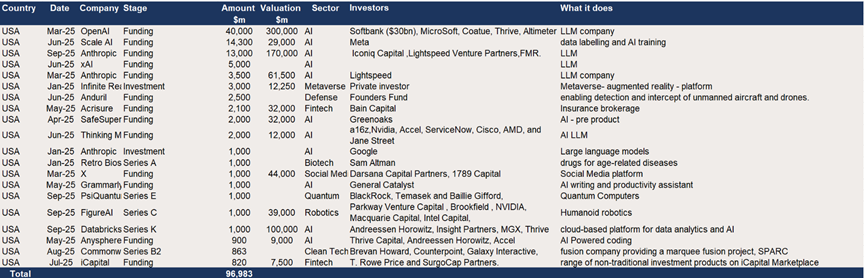
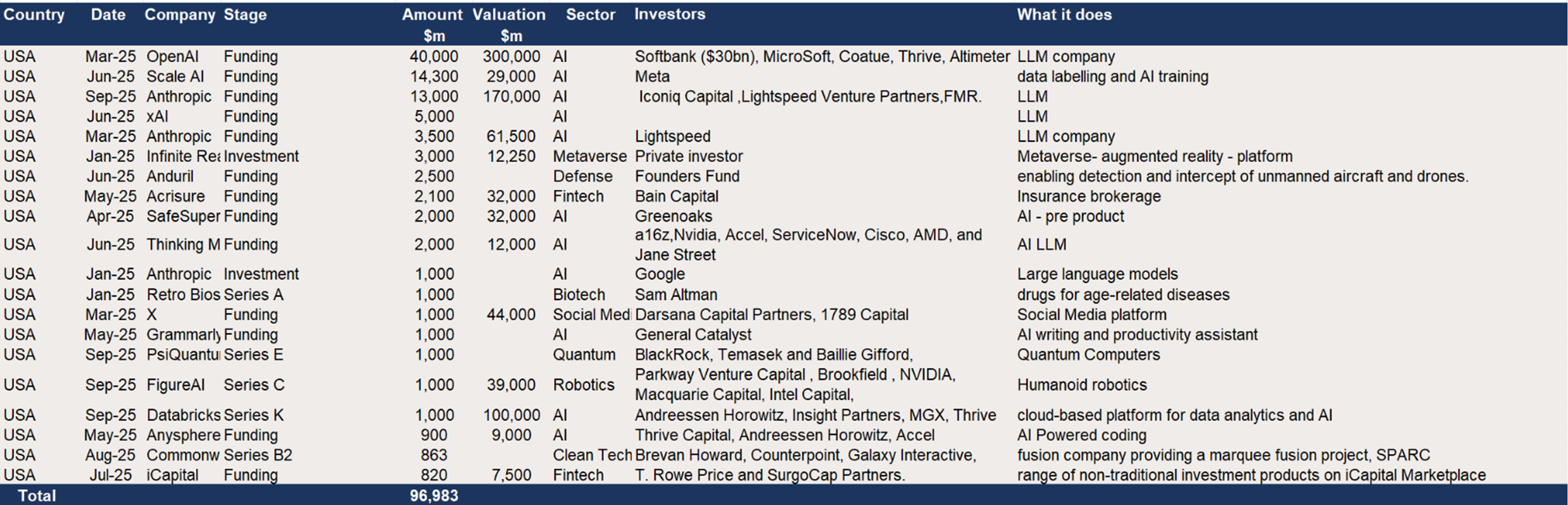
The next two Exhibits show the 20 biggest deals in the first nine months of 2025 and the breakdown of the $160.8bn by sector.
US – Top 20 deals in first 9m of 2025 – Dominated by AI
Source: Rothschild & Co
Source: Rothschild & Co
AI dominates: The top 20 deals at a value of $97bn account for 60% of the total raised in the first nine months of the year. There are 17 deals with a value of $1bn or more. Of the top 20, 11 deals are for AI businesses with a value of $83.7bn.
Looking at all deals there were 62 raises in AI with a combined value of $95.7bn, c60% of the total raised. The upper end of the list is a familiar set of names.
The $40bn March 2025 funding for OpenAI, led by $30bn from SoftBank with Microsoft, Coatue, Thrive and Altimeter also participating, heads the list. Its valuation doubled from $150bn to $300bn between the October 2024 and March 2025 rounds. OpenAI has raised $56.6bn since the start of 2023.
Scale AI’s data annotation techniques enable models to build AI applications. It raised $14.3bn in June 2025 with Meta buying a 49% stake at a $29bn valuation. Scale provides data labelling and model evaluation services delivering training data for AI applications such as self-driving cars, mapping, AR/VR, and robotics. Meta is keen to access these specialised datasets for LLM training to improve the performance of its Llama 4 models. As well as Meta taking a 49% stake in Scale AI, the founder of Scale, Alexander Wang, will head Meta’s new superintelligence research lab.
Anthropic raised $13bn at a valuation of $170bn in September which followed on from a $3.5bn raise at a valuation of $61.5bn in March. It also raised $1bn from Google in January, making a total of $17.5bn raised ytd.
A flurry of funding in the last 15 months has raised $17bn in equity for xAI. It raised a $5bn ‘strategic equity investment’ in June 2025. Of this $2bn was supplied by fellow Elon Musk company, SpaceX. This in turn was SpaceX’s first major external investment. xAI’s Grok is being used in Starlink’s customer service and Elon Musk has emphasised that partnerships between his companies are likely to expand.
The $5bn equity raise was accompanied by a further $5bn debt package of secured notes and term loans to ‘support xAI’s continued development of cutting-edge AI solutions, including one of the world's largest data centers and its flagship Grok platform.’
There is a fall away in the scale of funding after that to the $2bn each raised by the two ‘talent ‘AI raises, Safe Superintelligence and Thinking Machines Labs. Both companies were founded by former Open AI executives, both were pre-product at the time of the raise, and both are examples of the AI minted concept of a ‘talent unicorn.’
The $2bn raise for Safe Superintelligence (SSI) was at a valuation of $32bn and was led by Greenoaks. The business was founded in 2024 by the former chief scientist at OpenAI, Ilya Sutskever with its first funding round being a $1bn round at a $5bn valuation in September 2024. The concept behind SSI is that it creates superintelligent AI that is safe for humanity. The company as yet is focused on foundational research, although it is believed to be considering applications in healthcare and education.
The $2bn raise in June by Thinking Machines Lab was the largest seed round in Silicon Valley history The company, founded by the former CTO of OpenAI, Mira Murati raised at a valuation of $10bn in a deal led by a16z. The nine-month-old company is pre-revenue at the time was pre-product. It has subsequently launched a tool called Tinker that automates the creation of custom frontier AI models. Earlier this year it indicated that it was working on making “AI systems more widely understood, customisable and generally capable.’ It has several other former OpenAI employees working for it including co-founder John Schulman, former head of special projects Jonathan Lachman, and former vice-presidents Barret Zoph and Lilian Weng.
Usual names – Software, Biotech, Climate Tech and Fintech: AI is much more dominant in growth equity fundraising in the US than it is in Europe. Beyond AI though the prominent sectors are much as they are in Europe.
Software saw the second highest total for value and volume of deals in the first 9 months, chalking up 51 deals with a value of $9.3bn. Unusually for the upper end of the sector list, its largest deal was a relatively modest $500m for Nerdio in March 2025 led by General Atlantic, Lead Edge Capital and Stepstone. Nerdio has a desktop-as-a-service automated end-user computing platform to help organizations deploy and manage Microsoft cloud technologies. The platform has more than five million users across 15,000 customers in over 50 countries.
Biotech saw 42 deals raise $8.1bn. The largest deal was by Retro Biosciences which raised a $1bn Series A in January for its work on anti-ageing, age related diseases and conditions. A notable investor in the round was OpenAI’s Sam Altman.
Fintech raised $7.3bn across 22 deals of $100m or more. The largest deal was a $2.1bn raise by Acrisure led by Bain Capital. It valued the business, whose services have included insurance, reinsurance, cybersecurity, real estate, payroll, benefits, and wealth management solutions, at $32bn.
In July iCapital raised $820m at a valuation of $7.5bn in a deal led by TRowe Price and SurgoCap Partners. Fittingly, iCapital a platform which provides technology, data infrastructure and enterprise to enable financial advisors, wealth managers and asset managers to access alternative investments, structured products and annuities alongside traditional investments.
ClimateTech saw $6.7bn raised across 26 deals. The most prominent raise was the $863m Series B2 by Commonwealth Fusion Systems in August. The company is collaborating with MIT’s Plasma Science and Fusion Centre to build SPARC, the world’s first fusion device to produces plasmas which generate more energy than they consume. SPARC is a compact high-field tokamak being built with HTS magnets. It's an AI related deal. Fusion power is seen as critical in powering the new generation of data centres required for AI. CFS intends to build the world’s first large-scale fusion power plant in Virginia, home to the greatest concentration of data centres in the world. The company signed a deal to supply 200MW of electricity to Google in June 2025.
Defence related deals have surged in relative significance in recent months and appear as the sixth largest sector with $5.1bn raised across 12 deals. The largest deal in this industry was the $2.5bn Series G by Anduril in June at a valuation of $30.5bn, twice the valuation of its previous round. It was led by a $1bn contribution from Peter Thiel’s Founders Fund, the largest single investment ever made by the fund.
Anduril offers a range of autonomous defence systems, and the AI based software that controls them. Its systems are powered by Lattice, an AI-based operating system that connects autonomous sensemaking and command & control capabilities with modular and scalable hardware components. Products include the Barracuda family of military drones, the Roadrunner reusable vertical take-off and landing (VTOL) Autonomous Air Vehicle (AAV) and the Dive-LD autonomous underwater vehicle.
Saronic Technologies raised $600m in February in a round which valued the business at $4bn. Saronic describes its mission as ‘redefining maritime superiority for the United States and its allies.’ It develops autonomous surface vessels and will use the funds to build a new shipyard, Port Alpha, allowing it to expand its medium and large-class autonomous vessels - effectively water-borne drones.
In July Castelion raised $350m. The business ‘designs, tests, and manufactures next-generation military systems rapidly and at massive scale to deter future wars’ and offers ‘affordable hypersonic weapons, built fast.’ It previously raised a $100m Series A in January.
Blackrock was the lead investor in the $300m round raised by dual use business Archer Aviation in February 2025. Archer was originally a developer of VTOL aircraft for commercial use. In December 2024 it launched a defence division with plans for a hybrid-propulsion VTOL aircraft aimed at military applications.
AI related sectors: The influence of the broadening reach of AI can be seen with the spurring of investment in raises from AI related industries ranging from cybersecurity to quantum through robotics, data centres and autonomous vehicles.
Cybersecurity: There has been a flurry of raises in cybersecurity in the first nine months of 2025 both in the US and Europe. Ten deals in cybersecurity raised $2.2bn including two $500m deals. NinjaOne provides endpoint management, security and monitoring, which deals with the issues raised by remote working. It raised $500 million in a Series C at a $5bn valuation in February. Reliaquest describes itself as ‘a leader in AI powered security solutions.’ The company’s technology platform, GreyMatter, integrates 200 different cybersecurity tools, allowing security teams greater visibility and agentic AI-driven cybersecurity automation.
Quantum- NVentures to the fore. Four deals in quantum have raised $1.9bn ytd. Nvidia’s Nventures has been an investor in each of the three largest raises.
It participated in the September $1bn Series E from PsiQuantum led by BlackRock, Temasek and Baillie Gifford which valued the company at $7bn. Alongside the raise PsiQuantum announced a collaboration with Nvidia.
September also saw a $600m raise at Quantinuum at a valuation of $10bn led by Honeywell but with support from Quanta Computer, NVentures and QED Investors. Like at PsiQuantum there is an operational agreement with Nvidia. The company ‘will work with NVIDIA as a founding collaborator on breakthroughs at the NVIDIA Accelerated Quantum Research Center. Additionally, Quantinuum has entered strategic partnerships aimed at innovative quantum computing solutions that will expand the capabilities of classical artificial intelligence and realize next-generation technologies.
QuEra Computing raised a $230m Series B in February plus an undisclosed investment from NVentures in September. The company says that ‘QuEra will continue to collaborate with NVIDIA on go-to-market initiatives aimed at high-performance-computing centers worldwide, integrating QuEra’s neutral-atom systems with NVIDIA accelerated computing infrastructure and software stack.’
Robotics: Six deals raised $2.2bn. We have already touched on Figure AI’s $1bn raise at a valuation of $39bn for humanoid robotics. In June Skild AI raised $500m for its industrially oriented general automation robots. ‘We are building AI that will interact with and affect change in the real world’ is its message. SoftBank led the round with a $100m investment. Nvidia was again present with a $25m investment as it pushes into the ‘physical AI’ revolution.
Datacentres: These are key to supplying the logistics of the AI revolution and there have been major project announcements in 2025 such as the Stargate initiative which envisions $500bn of investment over the next four years building new AI infrastructure for OpenAI in the United States with the initial equity funders being SoftBank, OpenAI, Oracle, and MGX. This means that growth equity is only one portion of the activity in this area, and we identify four deals that raised $1.4bn.
In July 5C, a Canadian infrastructure and data centre solutions provider to neo-clouds, foundation model companies, AI-native enterprises and others, announced a $835m raise with the equity financing led by Brookfield Asset Management.
In August Massed Compute announced a $350m raise led by Digital Alpha. Massed Compute offers GPU-as-a-Service (GPUaaS) for artificial intelligence and high-performance computing workloads. The investment will enable it to expand its AI cloud infrastructure footprint, support customer demand for Nvidia computing (ie buy Nvidia GPUs), and further its cooperation with Cisco on Cisco’s Unified Computing Systems solutions to offer enterprise customers managed cloud AI solutions and to accelerate the development of sovereign AI Clouds.
Autonomous Vehicles: There were two raises for a total of $336m for Nuro, the self-driving start up founded by former employees of Waymo. The largest of these was August’s $203m Series E at a $6bn valuation led by Uber and Baillie Gifford. Nvidia was again present in the investor line up. Nuro’s compute module is built on the NVIDIA DRIVE AGX Thor platform, and it uses Nvidia GPUs for large-scale data processing and model training.
Semiconductors: As in Europe we are seeing US raises focused on AI applications and particularly on photonics. Celestial AI raised $255m in August observing that ‘The largest global infrastructure investment in history is currently underway as companies race to build AI computing capacity. The AI industry is hitting a fundamental wall with data movement between AI processors over copper wires…. Our Photonic FabricTM represents a generational leap in bandwidth, low latency and power efficiency designed to deliver the kind of breakthrough that redefines what's possible in AI.’
Counterpart Retym which announced $180m in equity funding in April similarly observes “As AI infrastructure demands intensify, Retym is well-positioned to lead in delivering cost-effective and power-efficient DSP innovation for the rapidly evolving landscape.’ A DSP is an integrated circuit used in optical networks that converts analogue signals to digital and encodes digital data into light signals
US - $161bn of growth equity raises to the end of September
Source: Rothschild & Co
Source: Rothschild & Co
Tracking AI investors
Before we leave the subject of AI dominated growth equity markets, we should briefly revisit the theme we wrote about in our September edition (here) where we spent some time looking at the identity of the major AI investors and where they have invested since the surge of funding from the start of 2023.
As a supplement to this - and because it has a very good graphic – we show here the leading investors in the big three LLM AI companies. The combination of OpenAI, Anthropic and xAI have raised c$102bn since the start of 2023. The original article can be found here: Pitchbook map- VCs and LLMs
Overlapping investments in US LLM companies
Source: Pitchbook
Source: Pitchbook
Fundraising outlook: $34bn of impending raises
A continuing strong pipeline of impending raises.
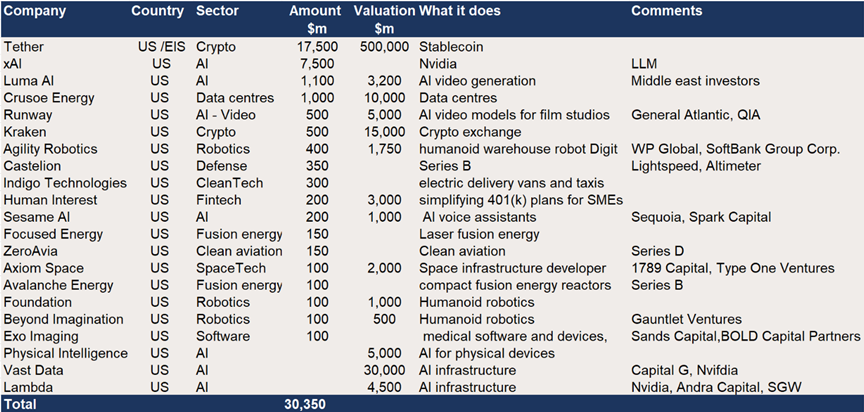
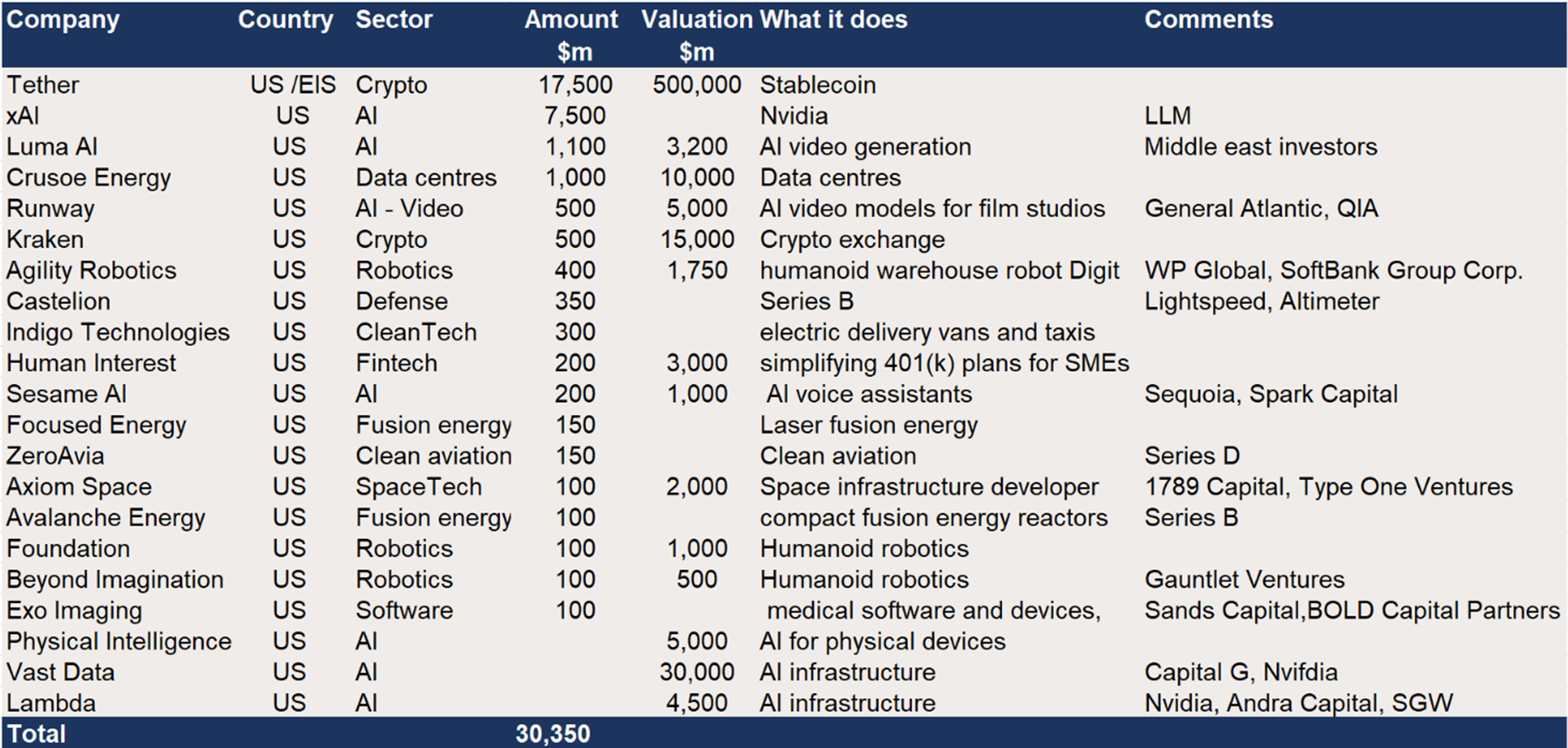
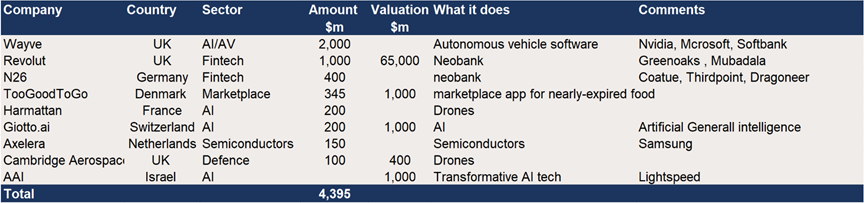
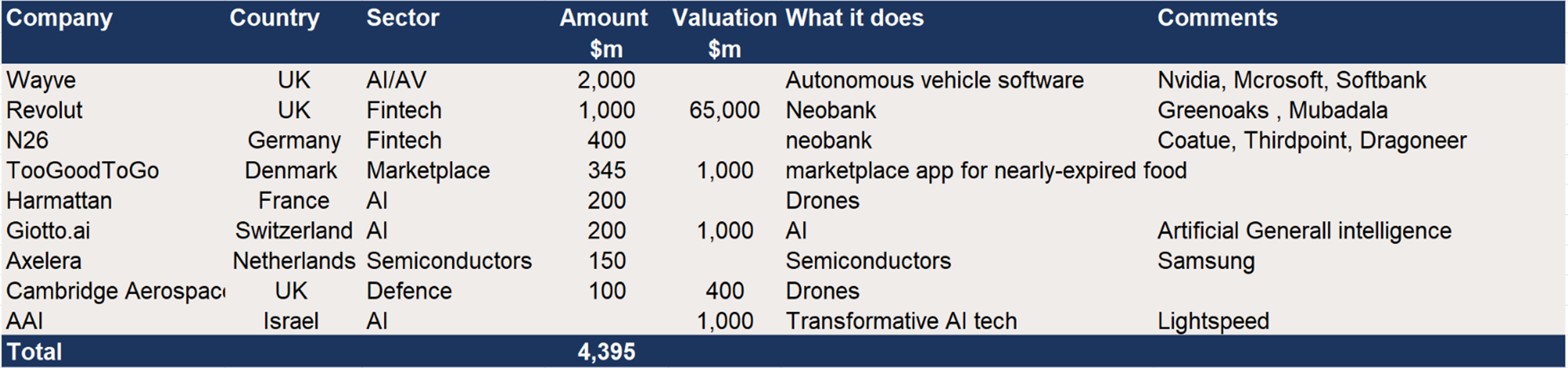
Despite the substantial September raises and a strong start to October our Deal Monitor of impending raises continues to look healthy. We identify c$30bn of impending US deals and $4.4bn in Europe.
At the top of the US list and emphasising the return of crypto, Tether, the stablecoin issuer, is widely reported to be looking to raise between $15-$20bn for a c3% stake. The deal could ultimately value Tether at around $500bn. Meanwhile the crypto exchange Kraken is reportedly looking to raise c$500m in a deal that would value it at $15-20bn.
Another potential raise appears in the offing for xAI, this one for $7.5bn of equity plus c$12.5bn of debt for a total package of close to $20bn. Nvidia is reported to be providing $2bn of the equity funding which is said to be tied to procuring Nvidia chips for xAi’s planned Colossus 2 data centre.
AI video generation business Luma has a planned $1.1bn raise at a valuation of $3.2bn. Data centres business Crusoe Energy, a prolific raiser of funds, is said to be raising $1bn at a $10bn putative valuation.
In Europe the list has thinned out after a couple of recent big raises in the last few days. Oura the Finnish smart rings business has just raised $900m at an $11bn valuation led by FMR and ICONIQ. German AI workflow automation platform n8n has just raised $180m at a $2.5bn valuation from Nvidia, DT and Sequoia.
Autonomous vehicles business Wayve appears to be on the verge of a $2bn raise at a valuation of $8bn with Nvidia, Microsoft and Softbank in the frame.
The previously rumoured raise of $1bn for Revolut has turned into a rumoured $2bn raise at a valuation of $75bn. A secondary round forms part of the total. Revolut’s revenues are believed to be on track for $5.9bn in 2025
Elsewhere impending raises include $400m for N26, $345m for Danish food marketplace TooGoodToGo, $200m for French drones business Harmattan, $150m for Dutch semiconductor business Axelera and $100m for UK drones business Cambridge Aerospace.
US Growth Equity – c$30bn in reported upcoming raises
Source: Rothschild & Co; press reports
Source: Rothschild & Co; press reports
European Growth Equity – c$4.4bn in reported upcoming raises
Source: Rothschild & Co; press reports
Source: Rothschild & Co; press reports
Markets – Investors still upbeat
Despite a mid-October resuscitation of tariff concerns, global stocks continue to challenge the highs with (to end October 14) in local currency terms, NASDAQ up 18%, the FTSE100 up 14%, the S&P 500 13% and the STOXX600 up 10%.
The three-month suspension for the imposition of 145% tariffs by the US on China expires on November 10. Ahead of that, new restrictions by China on the export of rare earths has elicited a threat by the US to put 100% tariffs on China trade starting November 1. An initial sell off has partially reversed as the US makes more conciliatory noises.
This ability to look through obstacles to a relatively benign outturn is a Feature of the latest Bank of America global fund manager survey. Published on 14 October – although the survey was carried out before the latest threat to China tariffs on October 10 – it found investors in a positive mood. The key findings are that
- Investor sentiment in October is at its most positive levels since February 2025.
- The market expects either a soft economic landing (54%) or no landing at all (33%). Fears of a hard landing (8%) and global recession are at their lowest level since February 2022 and the six-month swing round to a positive view is the most marked since October 2020.
- The number one upside risk factor for global growth is the prospect of monetary easing. Investors appear to be going for a higher-for-longer view of economic conditions as opposed to stagflation (slow growth and high inflation).
- The greatest risks to this optimistic picture are seen as an ‘AI equity bubble’ (33%) and a second wave of inflation (27%). Risk of a trade war is a concern for just 5% of respondents, down from 80% in April. This risk has likely elevated in recent days.
- Interestingly, when asked about AI, 54% of investors in the global survey said they think AI stocks are in a bubble (38% said no bubble). The 54% number is up from 41% in September.
- The percentage of investors who think global stocks are overvalued remains high (60% in October versus 58% in September)
- On asset allocation, investors are the most Underweight cash since December 2024. Respondents are a net 45% overweight stocks minus cash, the highest since January 2025. The preferred global region for stocks is Emerging Markets, followed by Europe. The gap to the US is narrowing, as investors have closed their reported underweight of US equities.
Source: Bank of America Global Fund manager survey – 14 October 2025
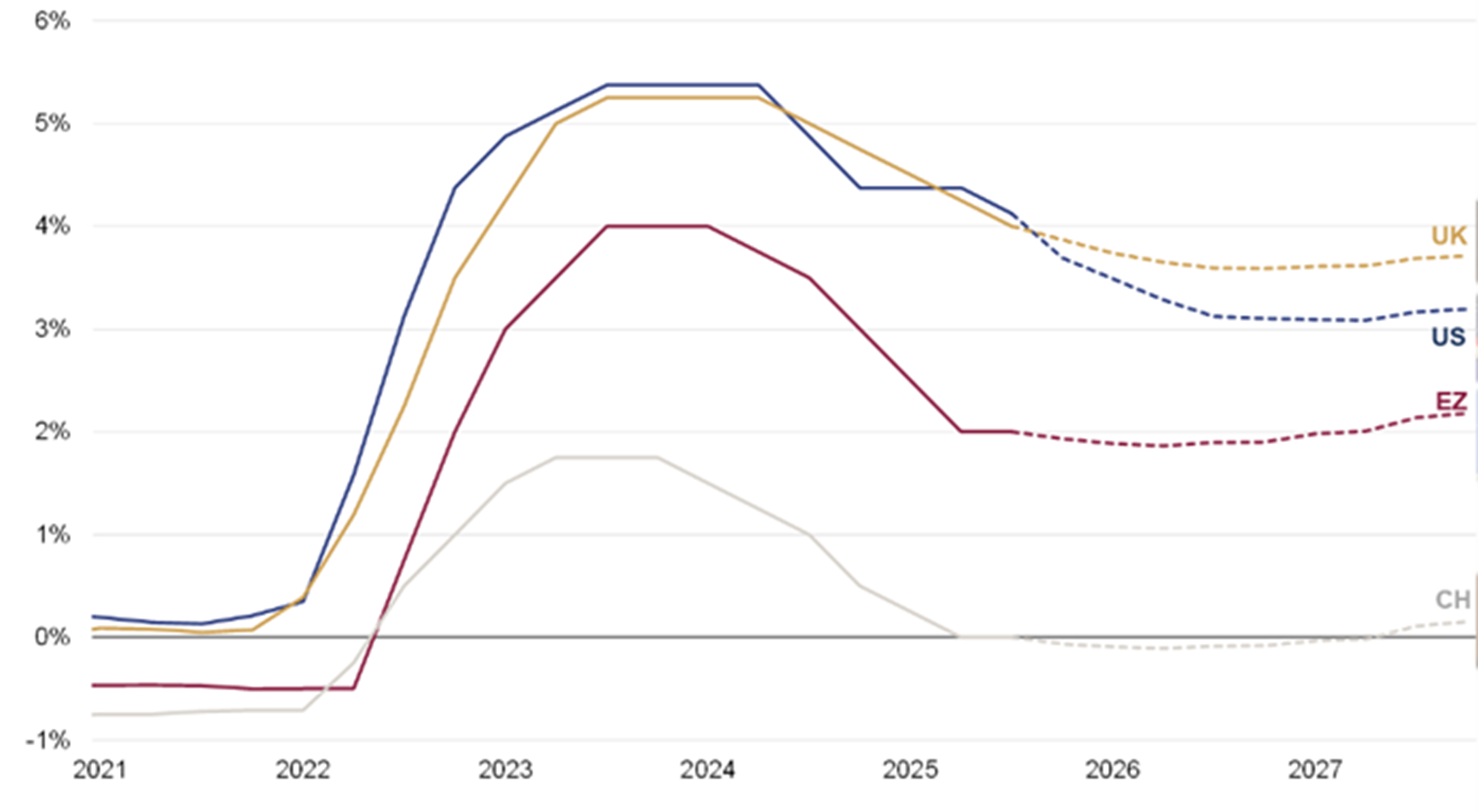
The expectation of a soft landing with good economic growth, falling interest rates and inflation under control has been encouraged by recent US events. Rates are not as low as President Trump would prefer (‘I think we should be paying one percent right now’) but the most recent move was in his direction with the Fed announcing a 25bps cut to 4- 4.25% at its September meeting.
The next meeting is on October 29. Signs of a weak jobs market in the August figures (just 22,000 jobs added) and the fact that the October 3 scheduled jobs report was pulled because of the Us government shut down means the Fed will be flying somewhat blind into its next meeting. The ADP report of private sector jobs released at the start of October showed though a net loss of 32,00 jobs in September versus a forecast gain of 45,000. Fed Chair Jay Powell said in response that “the downside risks to employment have risen” interpreted as a signal the Fed will cut at its next meeting.
Inflation rose to 2.9% in August up from 2.7% in July. The September number is due out on October 24 and will be published – the data having been collected before the shutdown. Market expectations are for a modest increase on the August figure. Nevertheless, the assumed primacy of the employment weakness over the inflation numbers means that market participants are confident of further rate cuts.
The Fed’s dot plot chart which shows the projected yearend target range for the fed funds rate from the FOMC meeting participants encourages this view. The latest chart shows six members anticipate an unchanged rate of 4-4.25% by 2025-year end. Nine members look for a range of 3.5% -3.75% - effectively a 50bps cut by year end. One participant, assumed to be President Trump’s recent appointee Stephen Miran, projects a year end rate of 2.75%-3%, an outlier of a 125bps cut.
The Fed’s latest published forecasts show inflation at 3.0% by end 2025 and that it does not expect to achieve its targeted 2% until end 2027. However, it raised its GDP growth consensus expectations by 20bps for each of 2025 and 2026 to 1.6% and 1.8%. The most recent quarterly number, the 3.8% in Q2 after a 0.6% decline in Q1, was encouraging. The next release is due on October 30th
Market expectations are thus for a 25bps cut in the Fed interest rate to 3.75%-4% on October 29 (98.9% certainty according to CME Fedwatch) with a 98% certainty of another 25bps cut to 3.5-3.75% at the December 10 meeting. Fed watchers are evenly split on whether there will be a third cut – to 3.25%-3.5% on the 28th of January 2026 meeting.
Fed Chair Jay Powell’s term runs out in March 2026.
In the UK inflation hit 3.8% in each of July and August with the Bank of England warning that inflation is likely to peak at 4% in September, twice its target rate.
The IMF reported in mid-October that it expects UK inflation to be the highest of the G7 countries in 2025 and 2026. It raised its July forecast of average UK inflation by 20bps in each of 2025 and 2026, to 3.4% and 2.5% respectively.
On GDP growth the IMF raised its forecast for the UK by 10bps to 1.3% for 2025 and lowered it, also by 10bps, to 1.3% in 2026. The impending August GDP figure is expected to show marginal yoy growth.
These weak economic signals meant that the Bank of England cut interest rates by 25bps to 4% at its meeting on August 7th on a split vote. Further immediate rate cut hopes are muted. In early September the Bank of England governor Andrew Bailey observed at the Treasury Select Committee meeting on further interest rate cuts:
“Although we’ve taken a further step, and although I think that the path will continue to be downwards, gradually over time, because policy is still restrictive…. there is now considerably more doubt about exactly when and how quickly we can make those further steps.’
In mid-October MPC member Catherine Mann commented that ‘It is perhaps counter-intuitive that in order to create an environment conducive to growth, monetary policy must remain restrictive for longer… but this is necessary to bring inflation sustainably back to our 2% target in the medium term.’
The consensus view is that interest rates will remain on hold at 4% through the end of the year. There are two meetings left this year, on 6 November and 18 December. The next rate cut is anticipated to be 25bps and perhaps not until the second BoE meeting of 2026, the March 19 session.
In Europe the ECB held interest rates at 2% at its September meeting for the second meeting in a row. Inflation was above target at 2.1% in August. The ECB raised its 2026 annual inflation forecast by 10bps to 1.7%. It expects 2025 GDP growth of 1.2% (was 0.9%) and 2026 growth of 1% (was 1.1%).
The messages coming out of the ECB in the last few months have pointed towards interest rates having reached an equilibrium after a period of sharp rate cutting. ECB president Christine Lagarde again hit this theme after the September ECB meeting:
‘The domestic economy is showing resilience, the labour market is solid, and risks are more balanced [and that inflation is] where we want it to be’.
The market consensus now looks for interest rates to remain unchanged to the end of the year although a minority thinks a 25bps cut possible in December.
Market-implied policy rates for the US, UK, Eurozone and Switzerland
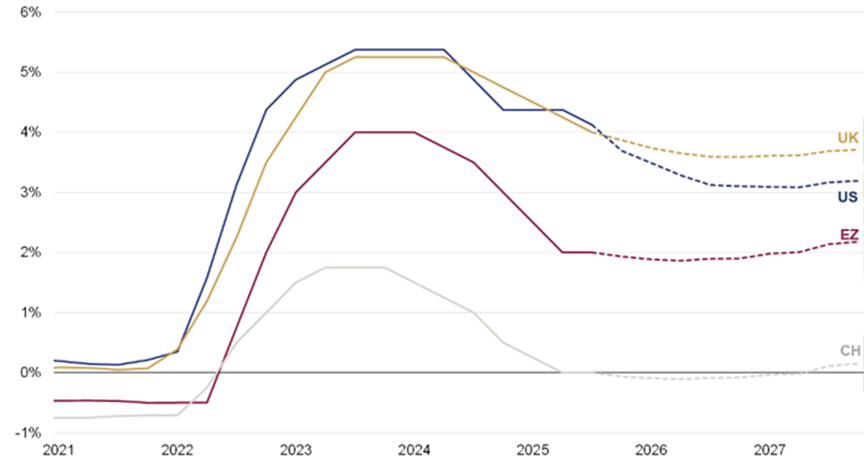
Source: Rothschild & Co, Bloomberg, Wikimedia Commons
Source: Rothschild & Co, Bloomberg, Wikimedia Commons
Rothschild & Co strategist Kevin Gardiner summarises the current key drivers of the market in this graphic:
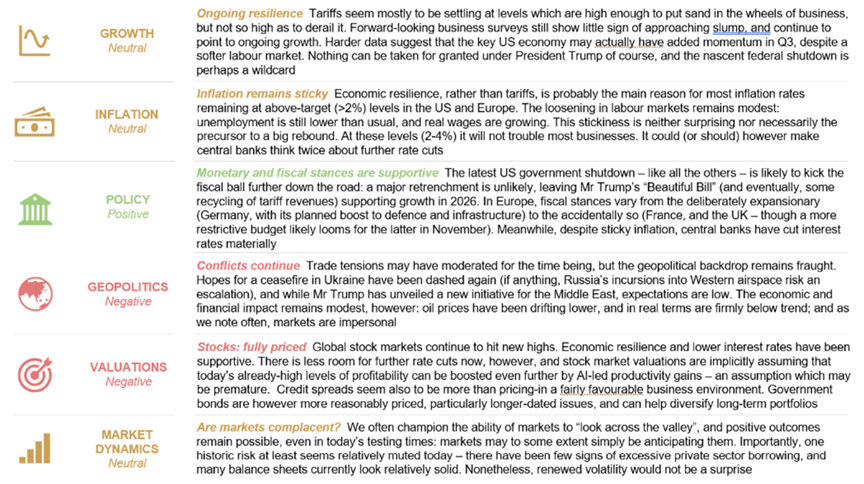
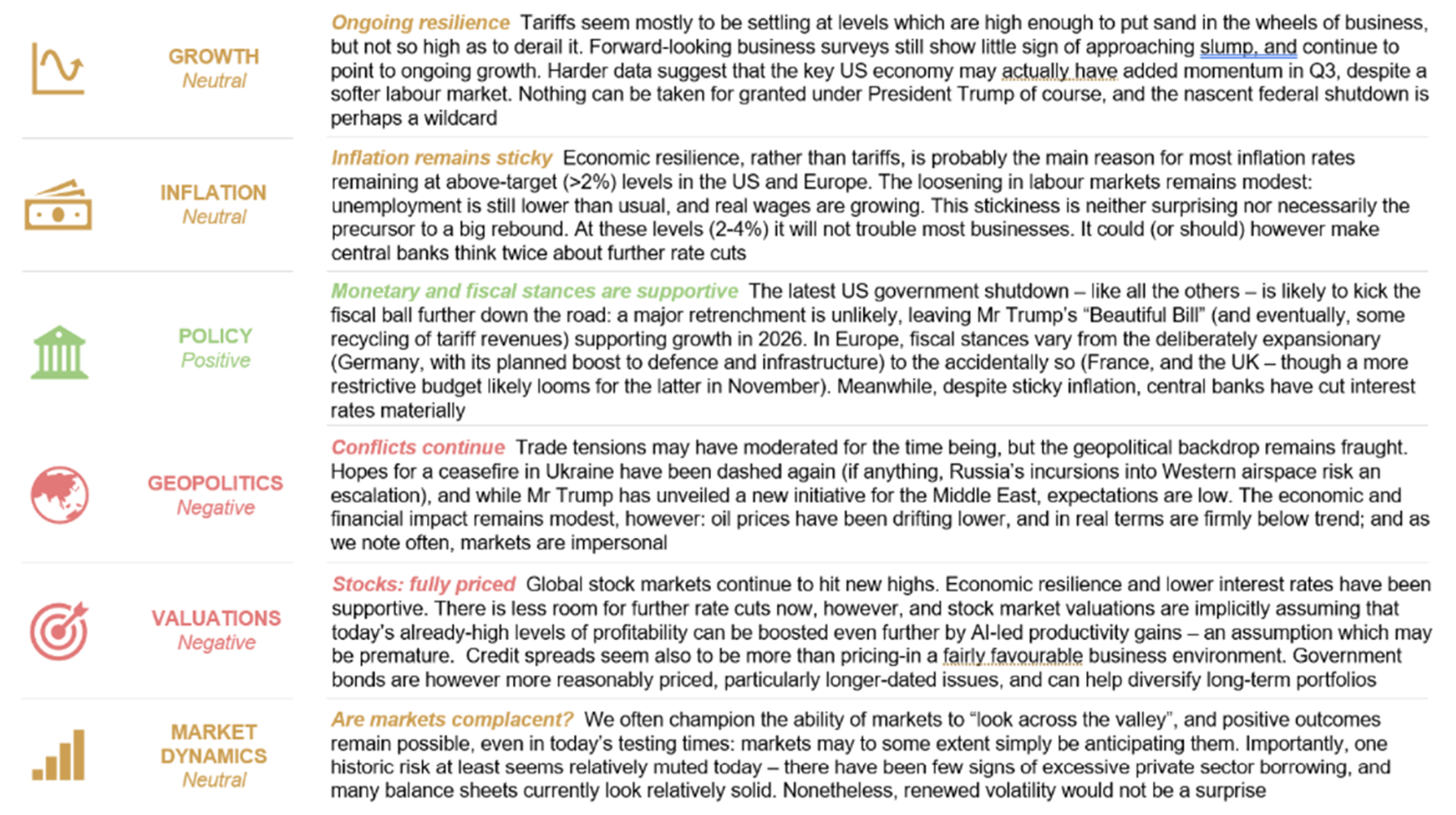
Source: Rothschild & Co
Source: Rothschild & Co
Our views on the state of the venture capital markets
October 12, 2022, marked the low point for the S&P500 on the back of global inflation, rising interest rates and increased geopolitical risk. The venture capital market saw its activity and valuations peak in late 2021.
October 12, 2025, marked the third anniversary of the bull market that has seen the S&P500 rise by almost 90% and NASDAQ by 120%.
In that period the FTSE Venture Capital Index is up by almost 170% and since June 2025 has been back above its previous 2021 peaks.
This revival of the growth equity market has been led by the US and by a surge of interest in artificial intelligence model providers and for companies using AI to transform a range of underlying industries.
At the same time the venture industry has re-adopted strong underlying approaches to investment with companies in most sectors striving to achieve a better balance of growth, profitability and cash flow. The underlying quality of the cohort of VC backed companies has improved.
Our summary of the outlook
- There is substantial interest in venture capital to fund artificial intelligence, both the foundation LLM models and industries (data centres, semiconductors) supporting the development of AI. Increasingly investment is moving into companies using AI applications to disrupt and grow across a range of industries.
- Outside the AI space the VC market is regaining confidence with the strength of interest in Software being notable and fintech and biotech reviving strongly.
- There is a burgeoning interest in defence industries from investors with the tense geopolitical environment, the advances in AI applications and the experience of the combat in Ukraine contributing to investor focus. By contrast, ClimateTech, while still a substantial sector has become less prominent both as a result of some high-profile failures and by being less favoured politically in the US under the current administration.
- Fund raising for venture capital firms remains subdued. Fund raising is concentrating into larger, established firms. Overall US VC fundraising was on a rate at H1 2025 to be at near decade lows.
- The speed of the investment process has slowed down since 2021-22. The level of diligence on deals has stepped up. This is true even in the ‘hot’ parts of the market like AI. Outside these areas it is marked – processes take time, downside protection is sought.
- Valuation priorities have shifted with investors having moved away from a pure emphasis on revenue growth and revenue multiples. There is a sharp focus instead on the combination of growth and profitability (or a rapid path to it) and on free cash flow.
Read the previous editions: May 2022, June 2022, June 2022 (2), July 2022, August 2022, Sep 2022, October 2022, November 2022, December 2022, January 2023, February 2023, March 2023, April 2023, May 2023, June 2023, July 2023, August 2023, September 2023, October 2023, November 2023, December 2023, January 2024, February 2024, March 2024, April 2024, May 2024, June 2024, July 2024, August 2024, September 2024, October 2024, November 2024, December 2024, January 2025, February 2025, March 2025, April 2025, May 2025, June 2025, July 2025, August 2025, September 2025
For more information, or advice, contact our Growth Equity team:
Co-Head of Global Market Solutions
+1 212 403 5500
+1 917 297 5131
Global Head of Strategic and Private Investors.
+44 20 7280 5826
+44 7753 426 961
Vice Chairman of Equity Capital Markets Europe
+44 20 7280 5088
+44 7542 477 291
Co-Head of Equity Capital Markets Europe
+44 20 7280 5377
+44 7907 712 978
Co-Head of Equity Capital Markets Europe
+44 20 7280 1668
+44 7912 395 294
Head of Private Distribution
+44 7926 905 488
Head of Private Capital, North America
+1 212 403 5559
+1 917 594 7208
Director of Private Distribution
+44 20 7280 1351
+44 7788 395 556