The rhythm of markets
Foreword
Markets have always moved in cycles. Periods of rising optimism give way to moments of discomfort, followed in time by recovery and renewed confidence. While this broad pattern is familiar, the precise timing and intensity of each shift remains difficult to predict with certainty.
Our more than 200-year history has exposed us to many such cycles, each with its own character. Experience does not grant clairvoyance, but it does provide perspective. It reminds us that trying to anticipate every turn in the road is rarely productive. Instead, it strengthens our conviction in focusing on what we believe we can control: preserving and growing our clients’ wealth steadily over time.
This is why our approach centres on investing in high‑quality companies with durable competitive advantages and sound financial foundations. We believe this offers a more reliable path to long‑term returns than attempting to time markets, particularly when conditions become unsettled.
Understanding the drivers of market cycles remains important, however – especially when emotions run high. In this Quarterly Letter, we discuss these themes in more detail, including our views on technology and artificial intelligence, and how current market momentum sits within the broader cycle. We also outline the work we are doing as a business to analyse AI with discipline: drawing on leading external experts, scrutinising the economics behind its rapid evolution, and assessing both the risks and opportunities for the companies in our portfolios.
Cycles are not confined to markets alone. Industries, too, experience phases of expansion and consolidation. In wealth management, the pace of change in recent years has been rapid, and it is understandable that this can feel disorienting. Against this backdrop, we hope the stability of our approach and the continuity of our stewardship offer reassurance.
Above all, our commitment to you is unchanged: to provide clear, calm, long‑term advice. In my new role as Chief Executive Officer of our UK Wealth Management business, I am both honoured and energised to continue working with you. Thank you for your ongoing confidence in us.
James Morrell
CEO, Rothschild & Co Wealth Management UK
The rhythm of markets
In October 1999, at the height of the dot-com bubble, a new book hit the shelves titled Dow 36,000: The New Strategy for Profiting From the Coming Rise in the Stock Market.
Written by economist Kevin Hassett and journalist James K Glassman, it argued that stocks were no longer meaningfully riskier than bonds over the long term. On that basis, they said equities were significantly undervalued and predicted the Dow Jones Industrial Average would rise four-fold to 36,000 between 2002 and 2004.
Unfortunately for them, the dot-com bubble burst less than six months later, ushering in the biggest slump in corporate profits since the post-World War One recession of 1920–1921.1 By the end of 2004, the Dow was little changed from when the book was published, and it took 22 years to reach 36,000.
The Washington Post, where Glassman had worked as a columnist, would later describe Dow 36,000 as "the most spectacularly wrong investing book ever". Fortune magazine said it has since taken on "legendary status" of out-of-control investor optimism.2
It is perhaps unfair to single out Dow 36,000 as an emblem of late-cycle excess. The authors were not the only experts banking on stocks continuing to climb higher, despite then-Fed Chair Alan Greenspan warning of "irrational exuberance" in markets in 1996.
We chose this particular example not for its uniqueness, but for its symmetry. Dow 36,000 was published 20 years after a BusinessWeek cover story in August 1979 titled The Death of Equities.3
According to the now infamous article, the case for equities had been permanently damaged by years of poor real returns due to persistent high inflation. It claimed much safer and more profitable options were available in alternative investments, including mortgage-backed securities.
"We have entered a new financial age. The old rules no longer apply," Alan B Coleman, Dean of the Southern Methodist University's business school, said at the time.
BusinessWeek's timing wasn't quite as unfortunate as Hassett and Glassman's, but a five-year bull market began in 1982 that quickly put paid to the idea that equities were finished. Nearly 45 years later, stocks are still here, and investments like mortgage-backed securities did not turn out to be quite as safe as suggested.
Bubbles and busts
Two incidents, two decades apart. Dow 36,000 and The Death of Equities may represent opposite ends of the stock market cycle — its heady peak and sombre trough — but they share striking similarities.
Both are times of heightened emotions, where investors forget fundamentals as they get whipped up in the madness of the crowd. And they each followed a prolonged rise or slump in market performance that encouraged unusual levels of risk tolerance or risk aversion.
At moments like these, there is often an unshakeable certainty that 'this time, it's different'.4
From the South Sea Bubble and Railway Mania to the Dot Com Boom and Global Financial Crisis, this cyclical trend has repeated itself over the centuries amidst geopolitical turmoil, financial innovation and technological revolutions.
A timeline of boom and bust cycles
- Tulip Mania (1634—1637)
- South Sea Bubble (1720)
- Railway Mania (1844–1847)
- US Stock Market Crash (1929)
- Dot Com Bubble (1995–2000)
- Global Financial Crisis (2007–2009)
Inevitably, however, it becomes clear the old rules do still apply and any extreme highs and lows, both in markets and investor confidence, usually revert back to the mean. The regular rhythm of the market continues unabated.
Sadly, these lessons are not always remembered when similar situations arise again in the future. It's a phenomenon economist John Kenneth Galbraith described as the "extreme brevity of the financial memory".5
"There can be few fields of human endeavour in which human history counts for so little as in the world of finance," he said.
At Rothschild & Co, we receive many questions about market cycles. Where are we in the current cycle? Are stocks overvalued or undervalued at this point in the cycle? Is there a bubble, and when will it burst?
With that in mind, we would like to set out our philosophy on cycles: what they are, the influence they have on investors, and how our investment approach seeks to preserve and grow wealth across a multitude of market rhythms.
Understanding cycles
Investor Howard Marks, in his 2018 book Mastering the Market Cycle, provides a useful definition of the word 'cycle' when thinking about how markets behave.
"A cycle is a 'group of events that happen in a particular order, one following the other, and are often repeated'," he explains.6
But what stages, and in what order, does a market cycle go through? There is often talk of the 'beginning' or 'end' of a cycle, although this is somewhat of a misnomer. By definition, cycles are rolling processes with no set start or finish.
However, a cycle can still be separated into several distinct phases:
1. The lowest extreme, or bottom, of the cycle
2. An upward swing toward a midpoint
3. The eventual peak of the upward swing
4. A downward correction back towards the midpoint
5. The cycle hits a new low
It is, of course, only when looking back that investors know for certain when the peaks, troughs and midpoints of a market cycle were. Indeed, each stage of the cycle often appears obvious after the fact.
In reality, this clarity is usually a product of hindsight bias — a tendency to overestimate our ability to have predicted events once they have already unfolded.
What we can be relatively sure of is that a market bubble will eventually be followed by a bust.
Furthermore, the bubble causes the bust; as euphoria peaks, even the most optimistic investors tend to question whether stocks are overvalued. Investors start to lose confidence, sparking sell-offs and triggering a market downturn.
Armed with this knowledge, one might argue that it should be possible to predict which way markets will turn and when. The signs are often there.
However, the speed and severity at which this occurs varies, and it is not uncommon for the market to bottom out far quicker than it took to reach its apex. In July 2007, just weeks before the US housing bubble burst, Citigroup's then-CEO Chuck Prince was quoted as saying:
"When the music stops, in terms of liquidity, things will be complicated. But as long as the music is playing, you've got to get up and dance. We're still dancing."7
As it turned out, Citigroup was still dancing when the music stopped and all the chairs were taken away.
Timing the markets
The irregular rhythm of markets outlined above illustrates the perils of making predictions. Capturing the upside of a boom while completely avoiding the bust requires near-perfect timing.
For example, earlier in this letter, we mentioned Alan Greenspan's warning of 'irrational exuberance' in 1996. His remarks foreshadowed the dot-com bust, but anyone who took his words to heart and immediately sold out of equities might have regretted it.
The Dow tripled in value between 1995 and 20008, and the S&P 500 achieved annualised returns of nearly 26% from the time of Greenspan's speech through to 19999. Exiting the market in 1996 likely meant forgoing substantial gains.
It's also worth noting how little time is spent at the 'midway' point of the market.
Since 1957, the S&P 500 has compounded at roughly 10% a year in nominal terms, but annual returns have landed within two percentage points of that figure (8–12%) only five times during that time and just twice this century.10
On the other hand, returns have been more than 20 points either side of the average (beyond +30% or –10%) 18 times over the same period, or nearly once every four years. Put simply, cycles spend much more time at the extremes.
"One thing that can be said with conviction about stock market performance is that the average certainly isn't the norm," Howard Marks once remarked.11
This is why you will often hear us say that we believe time in the markets is better than timing the markets.
Our view is that a genuinely diversified portfolio can achieve strong real returns on the upside, while also seeking to avoid large losses during a downturn. Mistiming the market, meanwhile, can have a significant, irreversibly negative impact on wealth.
Another confounding factor when investing is that stock markets are not the only cycle that affects investment decision-making.
There are business cycles, interest rate cycles, credit cycles and real estate cycles, to name just a few. Many of these overlap and feed into one another, yet their relationships are complex, unreliable and influenced by random factors.
And perhaps the biggest influence, and most random factor, is the ebb and flow of another cycle: human behaviour.
One thing that can be said with conviction about stock market performance is that the average certainly isn't the norm."
Howard Marks
The sentiment cycle
It's often said that greed and fear are the emotions that lead to market manias and crashes. However, economic historian Charles Kindleberger argues that fear triggers both — in a bubble, it's not greed, it's a fear of missing out.
"There is nothing so disturbing to one's wellbeing and judgement as to see a friend get rich," he said.12
Either way, psychology plays a powerful role in the rhythm of markets. When times are good, optimism abounds and people feel confident about the future. Consumers spend freely, corporate profits rise, businesses expand and valuations increase.
If the mood sours, pessimism creeps in and people grow cautious. Households save rather than spend, company expansion plans stall and workforces shrink. Everyone's waiting for the other shoe to drop.
Both of these trends are self-fulfilling. Confidence breeds confidence, while doubt breeds doubt — and neither are necessarily an accurate reflection of reality. Even so, the impact they have on markets is very real.
It may be a well-worn metaphor, but the image of an emotional rollercoaster is particularly apt when describing the cyclical motion of investor sentiment. As the graphic below illustrates, investors swing from euphoria to despair and back again, passing through a range of emotions along the way.
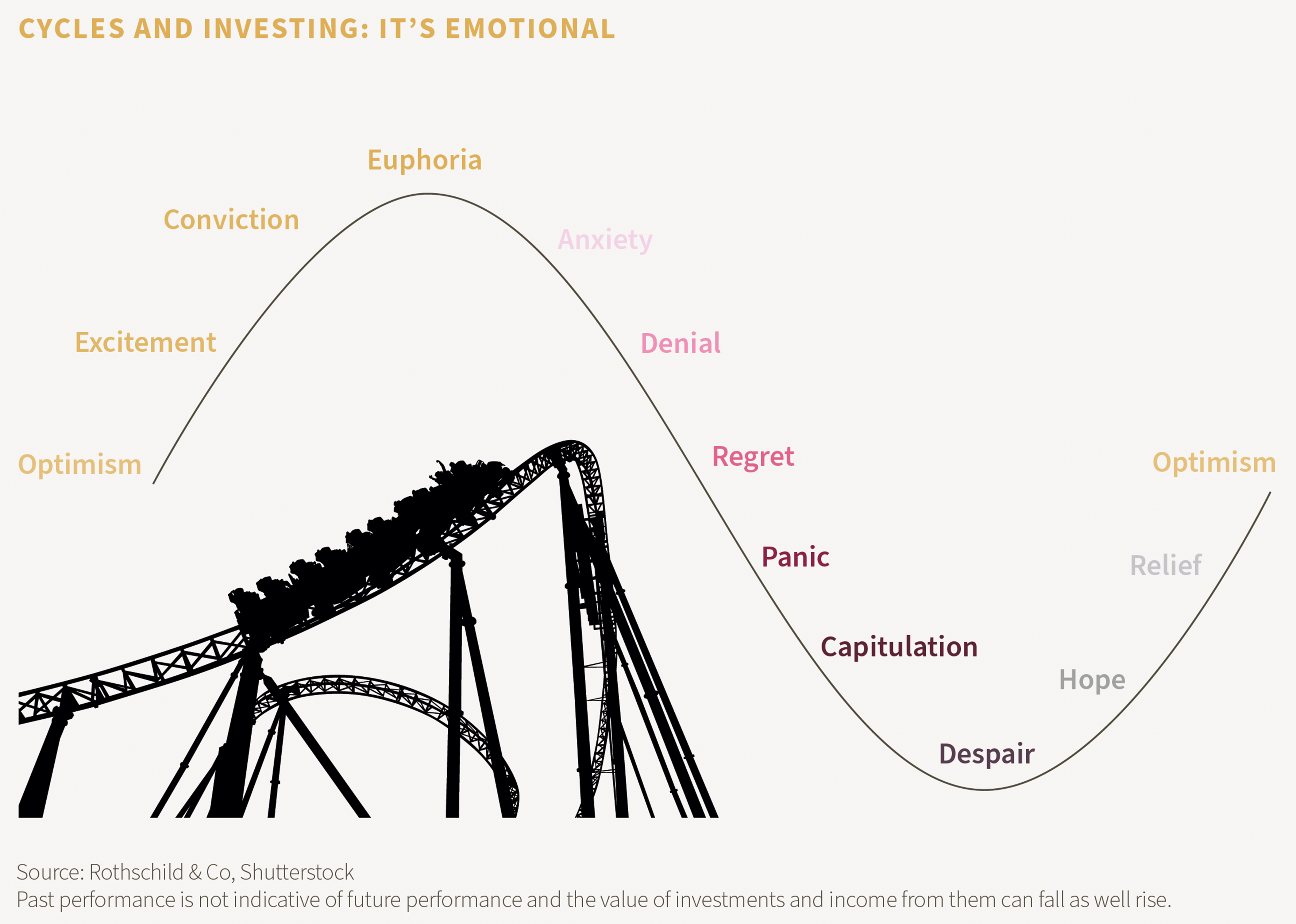
In previous Quarterly Letters, we have discussed in detail how emotions and biases can cloud people's judgements. We encourage readers to revisit those topics for further insight into our views on why it's important to fight against our instincts in order to make better investment decisions.13
For now, it's enough to remind ourselves that these emotions and biases are not only difficult to resist, but also contagious. Optimism and pessimism spread quickly, along with a natural impulse to follow the herd.
And at the extremes of the cycle, people's urge to buy before they miss out will often quickly be replaced by a panic to sell before things go to zero.
These psychological swings can create a disconnect between the price of a stock and its underlying value. For prudent investors, however, these mispricings are where the most compelling opportunities can lie.
Price versus value
Hetty Green was one of the most successful financiers of the late 19th Century. She amassed a fortune of $100 million (the equivalent of $2.3 billion today) and was a shrewd investor in railroad and mining stocks.
When asked what the secret to making money was, she said: "All you have to do is buy cheap and sell dear."
Ironically, Hetty was selling herself short here. She was well known for conducting exhaustive research on potential investments before buying, and has been described as America's first value investor.14 Hetty wasn't the first person to recognise the crucial distinction between a company's share price and its real value though.
Daniel Defoe, the author of Robinson Crusoe, expressed surprise in the 1690s that the East India Company was trading at a price over 300% more than its "Intrinsick [sic] value" without any material difference to its fundamentals.15
Whether we call it underlying value, real value or intrinsic value, it all amounts to the same thing — what is an asset really worth?
Like Hetty Green, we believe an asset's value can only be uncovered through extensive research and analysis. When we're considering investing in a company, a key part of this process is calculating its earnings power.
We think about what sort of earnings the business could generate over the next five to 10 years and the value of those earnings. From there, an estimate of a company's real value is possible, along with an estimate of what forward returns we could expect if we owned it.
Understanding cycles helps us to 'buy cheap and sell dear'. At the bottom of the market, when the mood is grim, great companies can be bought at an attractive price. Similarly, if a company's share price far exceeds its earnings power and value, it may be a sensible time to sell down our position and reallocate capital to opportunities we believe have greater potential.
That said, while we have confidence in the breadth and depth of our research and analysis, our investments won't always perform as expected. When this happens, we strive to be clear about why decisions were made and what we can learn to evolve our thinking.
At the same time, chasing yesterday's winners is rarely the best recipe for attractive long-term returns. Strong recent performance is not, in itself, a good reason to buy. We want to guard against being drawn into prevailing enthusiasms and paying an overinflated price that bears little relation to real value.
Our view on tech
Bubbles and busts, greed meets fear, price versus value — we hope that we have adequately captured the febrile movement of markets and how our investment philosophy guides us through them.
However, no discussion about cycles is complete without talking about the current cycle and what factors are driving it. In doing so, we must introduce one more type of cycle: the tech hype cycle.
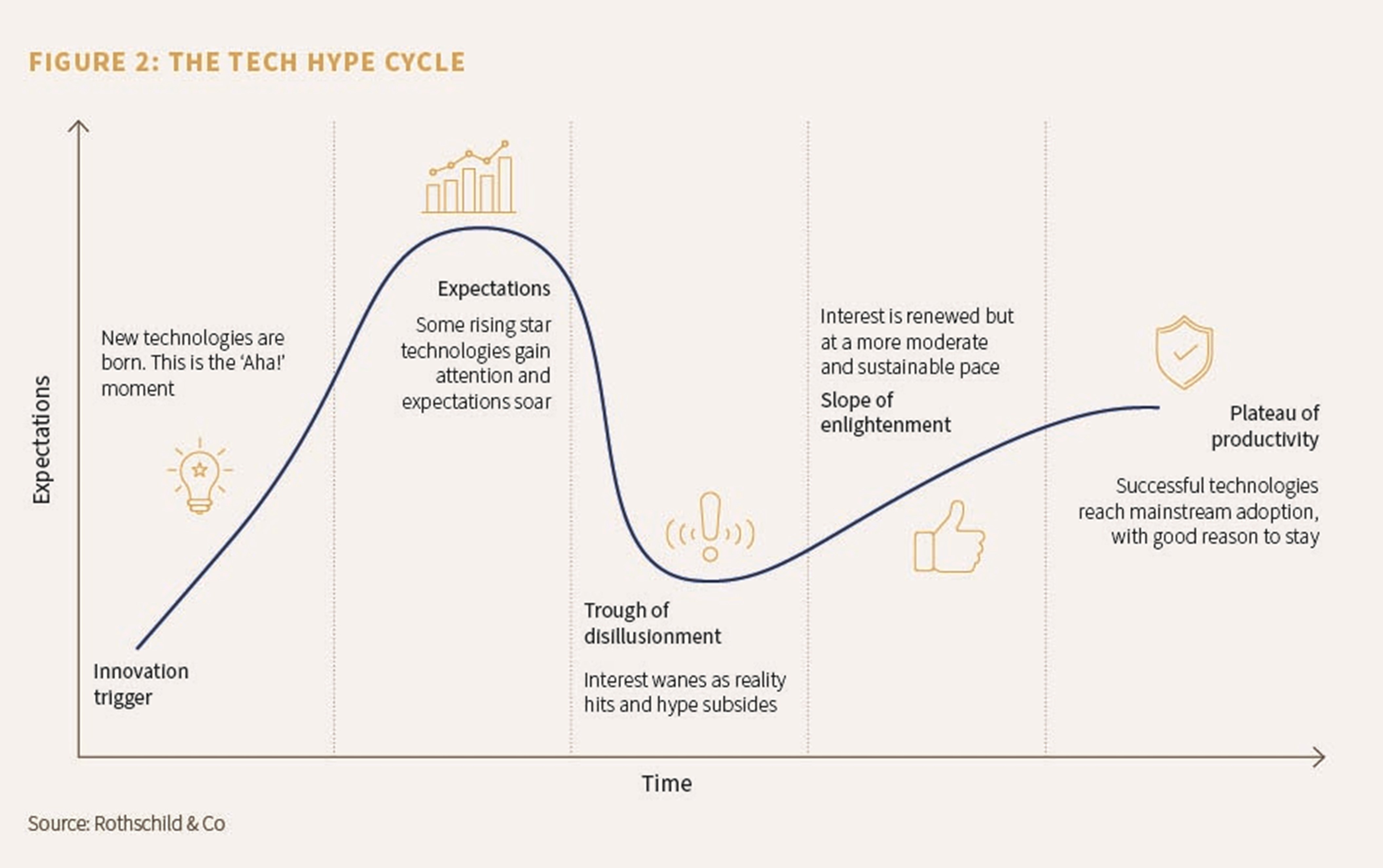
It's no secret that certain tech stocks have been responsible for a disproportionate share of stock market gains in recent years. The market capitalisation of the 'Magnificent Seven' tech companies16 represented approximately 33% of the S&P 500's total capitalisation as of March this year.17
To put that in perspective, this figure was just 12.5% in 2016, and the highest share of the top seven stocks during the dot-com bubble was 22%.
This consolidation is underpinned by strong ongoing investment in AI, and the widely held belief that the technology will prove transformative, reshaping industries and richly rewarding the innovators at its forefront.
Technological progress has always been a powerful engine for change. Railways, automobiles and the internet each revolutionised commerce and daily life in ways few could fully grasp at the outset.
Yet the path from innovation to enduring investment returns has rarely been straightforward.
Take automobiles, for example. Hundreds of new car manufacturers launched in the US in the early 20th Century, but only three (Ford, Chrysler and General Motors) survived a wave of bankruptcies that hit the industry between 1910 and 1930.
And of the 900+ tech companies that went public during the 1990s boom, Amazon was the big winner (Google did not go public until 2004) among a litany of failures.
Notably, even Amazon's share price dropped 90% from peak to trough during the crash.18 The investors who made the best returns on the company did so between 2002 and 2014, well after the peak of the dot-com boom.
As investors with a long-term focus, we want to be confident the companies we own will still be market leaders for at least the next decade, but preferably longer. With that in mind, where we find companies whose fundamentals, competitive position and valuation offer a clear path to durable long term earnings, whether in AI or elsewhere, we are always poised to consider them.
The path from innovation to enduring investment returns has rarely been straightforward."
Is there an AI bubble?
The sums now being committed to AI are substantial. Vast computing capacity is being built, specialist hardware deployed, and capital allocated at a pace that invites comparison with previous episodes of technological exuberance.
On the topic of AI, Google’s co‑founder Larry Page has allegedly told staff internally: “I’m willing to go bankrupt rather than lose this race.”
Comments like these reflect the extreme levels of risk tolerance that often accompany market manias. This is not a judgement on the technology itself – AI may very well justify much of today’s excitement.
The real question is whether that enthusiasm is pushing prices well beyond what underlying business economics can justify. And given the concentration of the Magnificent Seven in global indices, the risk is that if large‑cap tech stumbles, the rest of the market could feel the shock.
To navigate this environment, we continually and actively monitor developments across the sector, engaging with management teams, leading AI practitioners, venture investors and independent specialists. These conversations – coupled with our own research – give us a deep, multi‑lens understanding of how the economics of AI are evolving and where real value is likely to accrue.
One clear conclusion is that the earnings quality of many large tech firms has deteriorated. AI has pushed them from asset‑light software models to highly capital‑intensive infrastructure builders, where profits increasingly fail to translate into cash. At the same time, we see growing and often hidden leverage across the ecosystem, including circular financing structures and off‑balance‑sheet commitments that add fragility beneath the surface. With so much of the market tied to a handful of firms, this creates a systemic vulnerability: if tech sneezes, everyone else may well catch a cold.
But when exactly does a boom become a bubble? And if we are in one, when might it burst – tomorrow, next year, or five years from now?
No one can credibly claim to know. Even the most informed industry leaders admit the range of outcomes is extraordinarily wide.
What we can say is that we are deeply engaged in AI – not by chasing hype – but by applying rigorous research, expert insight, historical pattern recognition and disciplined valuation. Our aim is to capture the long‑term benefits of this technology while avoiding the traps that often accompany breakthrough innovations.
As bottom‑up investors, we remain focused on businesses rather than themes. We are examining how AI is reshaping competitive dynamics among the Big Tech firms, and how that feeds through into capital allocation, long‑term profitability, earnings quality and prospective returns. For the companies we already own, we ask whether AI strengthens their competitive position, threatens it, or simply forces them to invest more to stand still.
We also apply AI selectively within our own research processes where it genuinely enhances analysis and insight, rather than adopting it for its own sake.
Ultimately, periods of technological enthusiasm often bring heightened investment, volatility and uncertainty. That is why we invest only where valuations, business quality and fundamentals justify it, rather than where the narrative is loudest.
History rhymes
We have quoted many famous figures in this letter, from investors and innovators to authors and academics. However, we would like to finish with a quote that our readers may already be familiar with:
"History does not repeat itself, but it does rhyme."
The quote is often attributed to Mark Twain, though there is no evidence he ever said it. The closest – and much more elegant – wording appears in a novel he co-wrote called The Gilded Age:
"History never repeats itself, but the kaleidoscopic combinations of the pictured present often seem to be constructed out of the broken fragments of antique legends."
Whichever version you prefer, each quote encapsulates the idea that the present often echoes the past, even if it doesn't mirror it exactly.
The same can be said for markets. The ups and downs of every cycle may differ in the finer details, but there is an underlying pattern to the rhythm of markets.
For long-term investors, the lesson is not to predict this pattern with precision, but to recognise its cadence, and to remain disciplined when the music grows either too loud or too quiet.
The journey can sometimes be uncomfortable. However, being patient and maintaining perspective will, we believe, deliver superior results for our clients over time.
Ready to begin your journey with us?
Speak to a Client Adviser in the UK or Switzerland
Citations
[1] Irrational Exuberance: Revised and Expanded Third Edition, p6 [Kindle Version], Robert J Shiller, 2015
[2] Remember 'Dow 36,000'?, Fortune, 1 November 2021
[3] The Death of Equities, BusinessWeek, 13 August 1979
[4] Mastering the Market Cycle, p40 [Kindle version], Howard Marks, 2018
[5] A Short History of Financial Euphoria, p12, John Kenneth Galbraith, 1993
[6] Mastering the Market Cycle, p45 [Kindle version], Howard Marks, 2018
[7] Citigroup chief stays bullish on buy-outs, Financial Times, 9 July 2007
[8] Irrational Exuberance, p2 [Kindle Version], Robert J Shiller, 2015
[9] Is this 1996 or 1999?, A Wealth of Common Sense, Ben Carlson, 26 August 2025
[10] The five years were 1959, 1968, 1993, 2004 and 2016, according to S&P 500 Total Returns
[11] The Happy Medium, Oaktree Capital Management, Howard Marks memo, 20 July 2004
[12] Manias, Panics and Crashes: A History of Financial Crises (8th Edition), p47 [Kindle edition], Charles P Kindleberger, Robert Z Aliber and Robert N McCauley, 2023
[13] Fighting against our instincts, Straying from the herd, Making better investment decisions
[14] The Story of Hetty Green: America's First Value Investor and Financial Grandmaster, Financial History, Mark Higgins, Fall 2022
[15] Devil Take the Hindmost: A History of Financial Speculation, p45, Edwin Chancellor, 1999
[16] The Magnificent Seven are Apple, Amazon, Alphabet (Google's parent company), Nvidia, Tesla, Microsoft and Meta (Facebook's parent company)
[17] The Magnificent Seven's Market Cap vs. the S&P 500, The Motley Fool, Lyle Daly, Accessed 19 March 2026
[18] At one point, Amazon lost more than 90% of its value. But long-term investors still got rich, CNBC, Andrew Davis, 2018
Past performance is not a guide to future performance and nothing in this article constitutes advice. Although the information and data herein are obtained from sources believed to be reliable, no representation or warranty, expressed or implied, is or will be made and, save in the case of fraud, no responsibility or liability is or will be accepted by Rothschild & Co Wealth Management UK Limited as to or in relation to the fairness, accuracy or completeness of this document or the information forming the basis of this document or for any reliance placed on this document by any person whatsoever. In particular, no representation or warranty is given as to the achievement or reasonableness of any future projections, targets, estimates or forecasts contained in this document. Furthermore, all opinions and data used in this document are subject to change without prior notice.