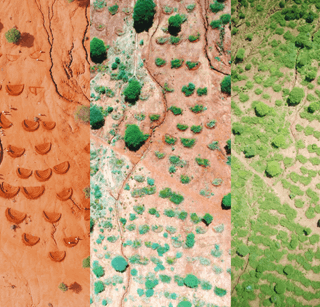
Our partnership aims to contribute to more climate-resilient landscapes while supporting the communities whose futures depend on them, creating lasting environmental and social impact for future generations.
Our project
We are supporting a three-year landscape restoration project in Westgate Conservancy in Samburu County, Northern Kenya. This initiative aims to restore degraded rangeland while strengthening the resilience of pastoralist communities and protecting important wildlife habitats. Our project combines two complementary approaches - together, they contribute to the recovery of ecosystems and the long-term productivity of the land.
Active restoration
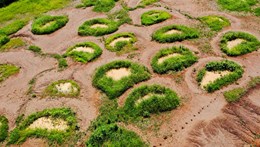
Active restoration focuses on direct interventions to rehabilitate degraded land and restore soil and water dynamics. Semi-circular soil bunds, known as “Earth Smiles”, are constructed to capture rainfall, slow runoff, and reduce erosion.
These structures improve water infiltration and create favourable conditions for vegetation to establish.
Combined with other water-harvesting techniques, they help restore soil fertility and stabilise landscapes, enabling natural regeneration in areas where degradation is too severe for recovery to occur unaided.
Passive restoration
Passive restoration works by reducing pressures on the land and enabling natural recovery processes. A key approach is the introduction of planned grazing systems, developed with local communities to manage livestock movement and intensity.
By allowing vegetation time to recover, these systems improve soil health, increase plant cover, and reduce erosion.
Community-led, they ensure long-term sustainability by aligning environmental restoration with local livelihoods and promoting responsible, balanced land use over time.
Supporting communities
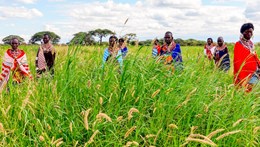
The initiative works closely with local stakeholders, including pastoralist households, grazing committees and conservancy rangers.
Local communities are central to the project, with training and support helping them to manage and protect their land. This builds the skills and knowledge needed for them to take ownership of the project and sustain the benefits over the long term.
Impact
Over the course of our partnership, we aim to achieve measurable environmental and community outcomes, including:
- Restoration of 460 hectares of rangeland
- Construction of more than 37,000 Earth Smiles
- Increased grass cover and biomass
- Improved grazing management and land stewardship practices
This partnership forms part of our broader commitment to addressing environmental challenges through scalable, community-led solutions. By supporting ecosystem restoration, we seek to contribute to long-term environmental sustainability and resilience.
