The unseen economy: Powering civilisation sustainably
Exploring the building blocks of civilisation
Each year, we extract more than 100 billion tonnes of raw materials from the Earth - metals, minerals, fuels and more, to power our modern lives.1
Every minute, the world produces enough concrete to fill an Olympic swimming pool.
Yet we rarely stop to ask: where do these raw materials come from?
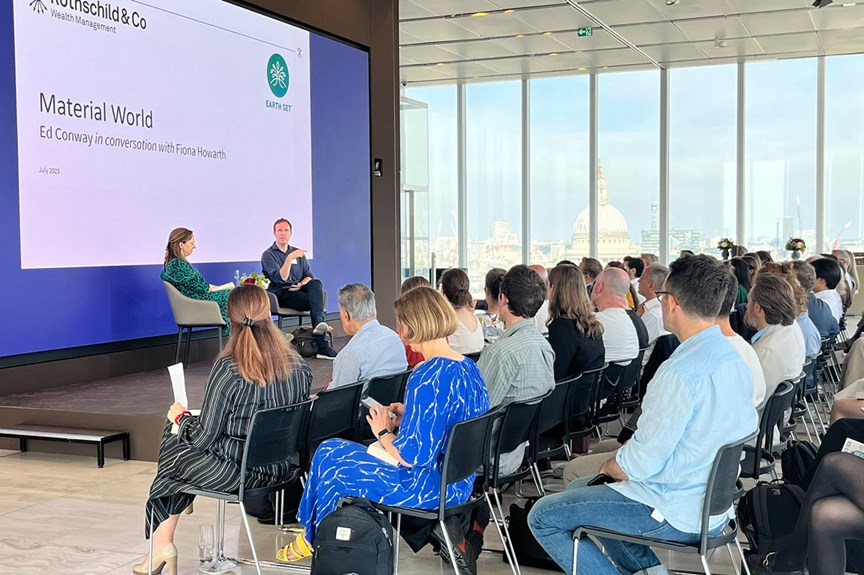
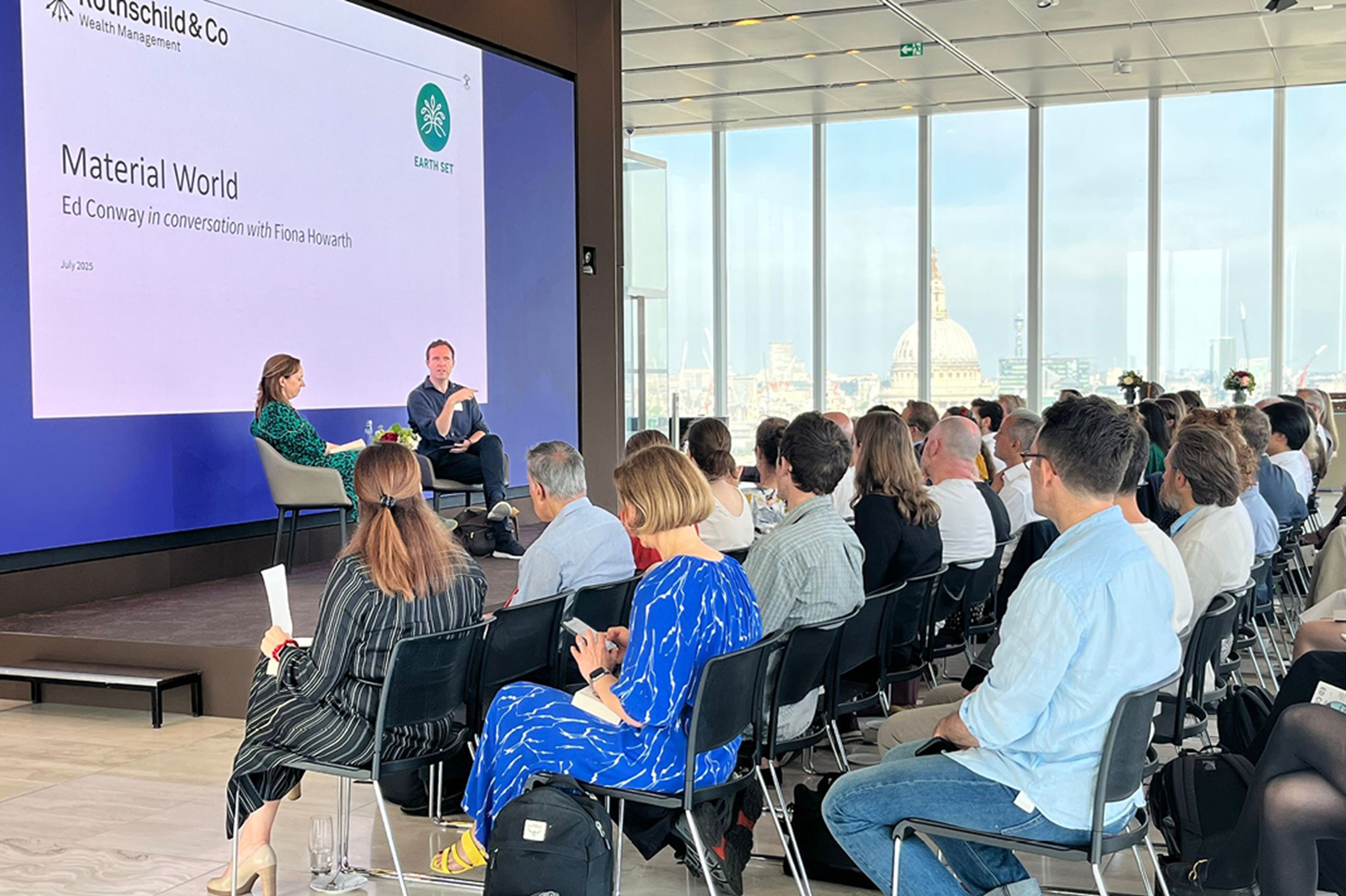
To explore this question, Rothschild & Co’s Wealth Management UK recently hosted a captivating conversation with journalist, economist and author Ed Conway, in discussion with Fiona Howarth, founder and director of Octopus Electric Vehicles, for a deep dive into the physical building blocks of civilisation.
Drawing from Conway’s acclaimed book Material World, the discussion delved into six essential substances: sand, salt, iron, copper, oil and lithium. These form the backbone of the global economy and quietly power every aspect of our daily lives. From the buildings we live in to the smartphones we rely on, these materials are the unsung heroes of modern life.
Rethinking the basics
The conversation opened with a deceptively simple question: 'What does civilisation need to function?' It’s a question that goes beyond the world of finance and into the bedrock reality of how things are made. Conway guided attendees on a captivating journey through the physical elements that enable contemporary life; from the sand that becomes concrete and silicon, to the lithium that fuels electric vehicles.
One particularly striking example explored the overlooked significance of sand. Commonly perceived as abundant and unremarkable, sand is the foundation for both the physical infrastructure we inhabit and the digital infrastructure we rely on. Conway traced the origin of silica, derived from sand, which is used in manufacturing fibre-optic cables. Many of these cables begin their life in a single quartz mine in North Carolina, before being deployed across the globe to form the invisible threads of modern communication.
This revelation underlined a key theme of the discussion: we are often unaware of the true origins of the materials we depend on daily. The story of silica serves as a reminder that even the most advanced technologies are grounded, quite literally, in the Earth.
From concrete to connectivity
This deeper awareness of raw materials resonates closely with our investment in Sika, a global leader in construction chemicals and sustainable building materials. One of the company’s flagship innovations is its reCO2ver technology, which allows old concrete to be recycled into high-quality aggregates and 65 million tons of CO2 emissions can be saved annually thanks to Sika’s admixtures which reduce cement consumption and clinker content.
Concrete is the second most used substance on Earth after water, and the construction sector accounts for nearly 40% of global CO2 emissions.2 Reimagining how we use and reuse materials like concrete is not just good practice, it’s essential for a sustainable future.
Sika’s innovations make it possible to recover both the sand and cement components from demolished concrete, and even to sequester carbon in the process. In the United States alone, this technology has already saved tens of thousands of tonnes of CO2 emissions, and the potential for global scale is enormous. For us, this investment is about more than performance, it’s about backing companies that see waste as opportunity, and materials as resources to be managed responsibly, not endlessly extracted.
Concrete is the second most used substance on Earth after water, and the construction sector accounts for nearly 40% of global CO₂ emissions."
Global complexity in everyday objects
Referencing Leonard Read’s seminal essay ‘I, Pencil’, Conway illustrated the intricate and interconnected global supply chains behind even the simplest items. From raw materials to finished products, the path is shaped by countless unseen hands and geographies, highlighting the complexity and fragility of the systems we depend on.
The pencil, he explained, is not merely a writing tool; it’s the product of an extraordinary collaboration spanning continents, industries, and centuries of innovation. From the lithium in the phone in your pocket, the copper in the electricity that powers it, the iron in the building you sit in, and the steel in the roads that have gotten you here – they are all essential. The same is true for the materials in a wind turbine or an electric vehicle.
Powering the transition
Fiona Howarth offered a valuable industry perspective from her work at Octopus Electric Vehicles, where the demand for lithium and other battery metals is accelerating as the world transitions to the electricity that powers it….electric mobility. But this transition is not without its challenges, especially when it comes to sourcing the raw materials ethically and sustainably.
This issue also intersects with our investment in Greencoat Renewables, a company that owns and operates wind and solar infrastructure across Europe. A single modern onshore wind turbine requires around 600-1000 tonnes of concrete, 165 tonnes of steel3, and nearly five tonnes of copper, not to mention a variety of rare earth elements. These materials have to come from somewhere. By investing in companies like Greencoat, we are aligning with efforts not just to generate cleaner energy but to do so responsibly. This means improving end-of-life recyclability, minimising environmental disruption, and driving greater transparency in material sourcing. More than 85 percent of a wind turbine can already be recycled4, and the sector is working hard to close the gap on difficult-to-recycle components like composite blades.
A single modern onshore wind turbine requires around 600-1000 tonnes of concrete, 165 tonnes of steel, and nearly five tonnes of copper."
A call for greater transparency
Throughout the discussion, one idea became clear. The transition to an energy-efficient future is not just about switching energy sources or reducing emissions. It is about rethinking our entire relationship with materials; where they come from, how they are used, and what happens to them after their initial life cycle.
Conway emphasised that while the digital economy may feel weightless, it is anything but. Behind every email, streamed video, or data centre lies an enormous infrastructure built from copper, sand, steel, and rare earths. Understanding these invisible dependencies is crucial to creating systems that are both resilient and sustainable.
Connecting capital with real-world impact
This conversation forms part of Rothschild & Co’s broader programme of sustainability-focused events and initiatives. By bringing together thought leaders across industry and academia, we aim to deepen our understanding of the forces shaping tomorrow’s economy and to support our clients in aligning their capital with long-term value creation.
Looking ahead
Events like this are not just opportunities for dialogue. They are moments for recalibration. As investors, individuals, and global citizens, we must take stock of the materials that quietly make our lives possible, and ensure they are sourced, used, and reused in ways that respect both people and the planet.
To explore more of our sustainability insights and upcoming events, please visit our Sustainability Hub or contact Richard Brass and Michel van der Spek, Co-Head's of Sustainable Capital at Rothschild & Co.
Ready to begin your journey with us?
Citations
[1] Yale School of Environment, World Consumes 100 Billion Tons of Materials Every Year, Report Finds
[2] Carbon Trust, Building decarbonisation in the construction sector
[3] Union of Concerned Scientists, How Are Wind Turbines Made?
[4] Orsted, Can Wind Turbines Be Recycled?
Please note this article does not constitute a solicitation or promotion of the above mentioned external companies or institutions. The content is also not intended as formal investment advice nor a recommendation and the suitability for your personal circumstances has not been checked.
Past performance is not a guide to future performance and nothing in this article constitutes advice. Although the information and data herein are obtained from sources believed to be reliable, no representation or warranty, expressed or implied, is or will be made and, save in the case of fraud, no responsibility or liability is or will be accepted by Rothschild & Co Wealth Management UK Limited as to or in relation to the fairness, accuracy or completeness of this document or the information forming the basis of this document or for any reliance placed on this document by any person whatsoever. In particular, no representation or warranty is given as to the achievement or reasonableness of any future projections, targets, estimates or forecasts contained in this document. Furthermore, all opinions and data used in this document are subject to change without prior notice.