Investing in a greener future

Sustainability has emerged as a key factor in driving long-term profitability as well as corporate responsibility and companies are increasingly recognising the need to integrate sustainable practices into their core business strategies.
In the following article we explore the sustainable practices and financial health of four leading Swiss firms: Novartis AG, Sika AG, Geberit AG, and Belimo Holding AG and highlight how their commitment to sustainability positively influences their performance and impact.
Each company excels in its respective industry while demonstrating a strong commitment to sustainability by aligning their business strategies with broader environmental and social goals. Through innovative solutions, ethical practices, and robust sustainability initiatives, Novartis AG, Sika AG, Geberit AG, and Belimo Holding AG exemplify how integrating sustainability can lead to substantial and enduring revenue growth.
Novartis AG
Headquartered in Basel, Novartis AG is present in more than 140 countries and one of the world's largest pharmaceutical companies. It focuses on developing, manufacturing, and marketing a diverse range of healthcare products, including innovative medicines, generics, and biosimilars while prioritising ethical business practices. Novartis' sustainable revenue can be attributed to its dedication to creating value through its core business of providing access to innovative medicines.
Key factors include:
|
Novartis' sustainable revenue reflects its substantial contribution to global health through innovative and essential medicines, affordable generics, and biosimilars. The company’s commitment to research and development for neglected diseases, access programs for underserved populations, and environmental sustainability initiatives all play a significant role in generating sustainable revenue.
By aligning its business practices with broader environmental and social goals in alignment with SDG 3 (good health and well-being), Novartis continues to lead in sustainability within the pharmaceutical industry, providing significant benefits to both patients and the global community.
Sika AG
Founded in 1910, Sika AG is a global leader in specialty chemicals, specialising in the development and production of systems and products for bonding, sealing, damping, reinforcing, and protecting in the construction and automotive industries. Headquartered in Baar, Sika focuses on creating sustainable solutions for the construction and automotive industries and its sustainability as well as financial viability is supported by the below key factors:
|
Sika’s commitment to sustainability is deeply embedded in its business strategy and operations. By developing innovative and sustainable products, managing resources efficiently, and engaging with communities and stakeholders, Sika not only contributes to environmental and social well-being but also ensures its financial viability. The company's focus on sustainability provides a competitive advantage, cost savings, risk management benefits, and growth opportunities, all of which contribute to its long-term financial success.
Geberit AG
Geberit AG, headquartered in Rapperswil-Jona, specialises in manufacturing and supplying sanitary products, piping systems, and related solutions for the residential as well as commercial construction industry. Renowned for its innovative bathroom solutions and water-saving technologies, Geberit has pursued a sustainability strategy since 1990, centered on "people, planet, and profit". This dedication earned Geberit a Gold Medal from EcoVadis for its sustainability management, placing it in the top 5% of over 100,000 evaluated companies. Its sustainable revenue can be attributed to its strong focus on environmental and social impact, particularly in the areas of water conservation, energy efficiency, and sustainable building solutions.
Geberit's green building solutions help reduce emissions in the construction industry, which account for more than a third of global carbon emissions. These solutions are instrumental in achieving green building certifications such as LEED, BREEAM, and DGNB, making them a key contributor to sustainable construction practices.
Key factors include:
|
Chart : Geberit product life cycle
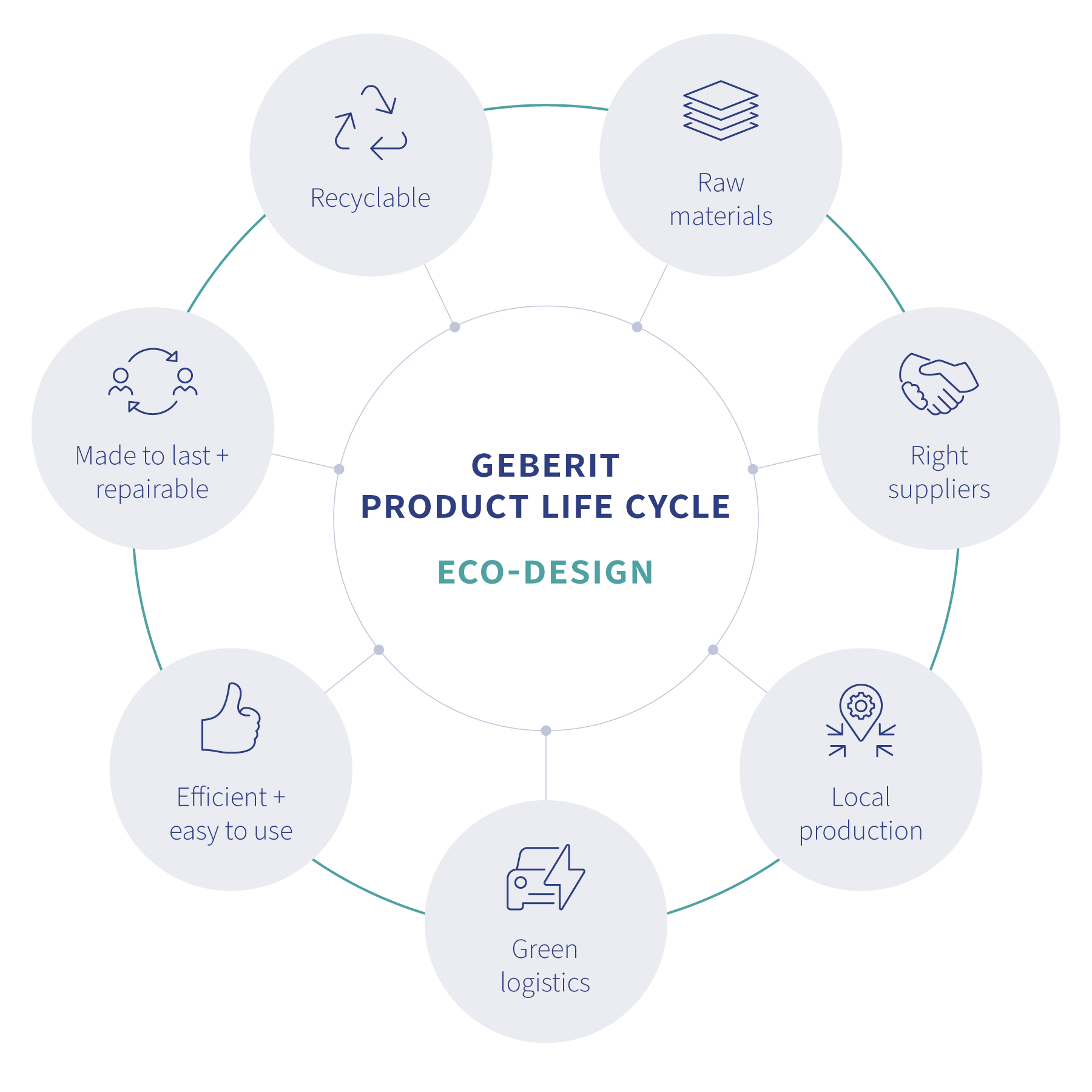
Source: https://reports.geberit.com/annual-report/2023/business-report/business-and-financial-review/financial-year-2023/sustainability.html#eco, 14.08.24.
By aligning its business practices with broader environmental and social goals, Geberit continues to lead in sustainability within the sanitary industry, providing substantial benefits to both the environment and society.
Belimo Holding AG
Belimo is global leader on actuators, valves and sensors needed to control heating, ventilation, air conditioning (HVAC) systems and water applications in buildings. Founded in 1975 and headquartered in Hinwil, Belimo focuses on improving comfort, energy efficiency, and safety in buildings through innovative products.
Belimo’s commitment to sustainability, embedded in its mission to create energy-efficient and eco-friendly building solutions, has earned it numerous industry awards and certifications.
Key factors include:
|
Belimo's efforts to reduce building emissions not only drive cost savings through lower energy consumption but also promote healthier indoor climates.
What does this mean for investors?
The analysis of the above companies underscores the significant role that sustainability plays in driving long-term success and financial stability. Novartis AG, Sika AG, Geberit AG, and Belimo Holding AG illustrate that prioritising environmental and social responsibility can lead to innovative products, operational efficiency, and strong financial performance. Novartis' dedication to global health, Sika's advancements in eco-friendly construction materials, Geberit's leadership in water conservation, and Belimo's mission to create energy-efficient and eco-friendly solutions, collectively highlight the potential for sustainable business practices to generate substantial revenue while positively impacting society and the environment. As sustainability continues to shape the future of global markets, these companies stand out as leaders, setting a benchmark for integrating ethical practices with business excellence.
[1] https://www.sika.com/en/fundamentals/environmental-dimension/environment-safety-and-sustainability.html
[2] https://www.sika.com/dms/getdocument.get/af0221c1-f3b0-4496-966b-4e14cced6c80/glo-sika-esg-presentation-april-2023.pdf
[3] By 2032, Sika is committed to reducing its greenhouse gas (GHG) emissions by 50.4% compared to the 2022 baseline, for scope 1 and scope 2 emissions, whilst advancing its growth strategy. These include direct emissions from owned or controlled sources, as well as indirect emissions from purchased electricity, steam, heating, and cooling. Over the same period, the company is also committed to reducing its scope 3 emissions by 30%, which includes all other indirect emissions in the value chain, such as those from purchased goods and services, upstream and downstream transportation, and waste disposal. The combined emissions reduction target for scopes 1, 2, and 3 is 30.4% by 2032 and 90% by 2050. Sika will report annually on its progress towards meeting these targets.
[4] The combination of water-efficient flushing systems with the type 212 flush valve and the latest generation of WC ceramics with TurboFlush technology enables the required flush volume to be reduced to 2.6 litres for a partial flush and 4 litres for a full flush.

At Rothschild & Co we follow the guidelines of the SFDR regulation definition, which requires investments to contribute to environmental or social objectives without harming them, and mandates good governance by investee companies. According to SFDR, a sustainable investment is an investment in an economic activity that contributes to an environmental or social objective, provided that the investment does not significantly harm any environmental or social objective and that the investee companies follow good governance practices. Rothschild & Co Group has defined specific metrics that an investment or the investee company must meet to be considered as sustainable.
Furthermore, the bank uses specific metrics to assess sustainability: A company is deemed sustainable if it either aligns with the Paris Agreement's warming pathway (below 2°C) using MSCI’s Implied Temperature Rise (ITR) metric or generates at least 20% of its revenue from sustainable impact solutions, measured by MSCI and the EU Taxonomy. Good governance is evaluated using MSCI's governance score emphasizing financial materiality such as remuneration, tax, and anti-corruption practices.
Additionally, companies must meet the "Do No Significant Harm" (DNSH) criteria by not negatively impacting environmental or social goals. This is assessed through Principal Adverse Impact (PAI) indicators from MSCI, and companies must report on specific PAIs while avoiding the lowest performance quintile. They must also adhere to UN Global Compact principles and avoid involvement in controversial weapons.