Growth Equity Update

December 2025 – Edition 45
- Who would’ve bet on that? Prediction marketplaces Kalshi and Polymarket have raised c$3.5bn since June. Polymarket’s $2bn November raise was at an $8bn valuation, up from $1.2bn in January. Kalshi’s June Series C valued it at $2bn. Its $1bn November raise was at $11bn. We predict what’s ahead for them in 2026.
- NVIDIA and the AI VC ecosystem: NVIDIA continues to be an active player in growth equity raises. We identify a further five raises where it has been involved since the start of November (Anthropic, Anysphere, Fal.AI, Physics X, Flexion)
- Funding growth companies in Germany: The €1bn ‘Growth Fund Germany’ managed by KfW has deployed €825m to 41 venture capital target funds with more than 360 technology businesses. A follow-on fund is planned.
- Fund raising for VC firms still weak: Lots out, less in. European VCs have raised €9.3bn to end November, down 58% on the 2024 full year total. According to Pitchbook, to the end of September capital invested into Europe’s VC market is 5.2x the amount raised by the region’s investors ytd.
- The US venture market in Q4 2025: Q4 (to 11 Dec) has seen $63.3bn of growth equity invested in US companies, up 31% from the whole of Q4 2024. 52% of Q4’s money raised has been for AI businesses. Datacentres, defense and crypto have made strong showings.
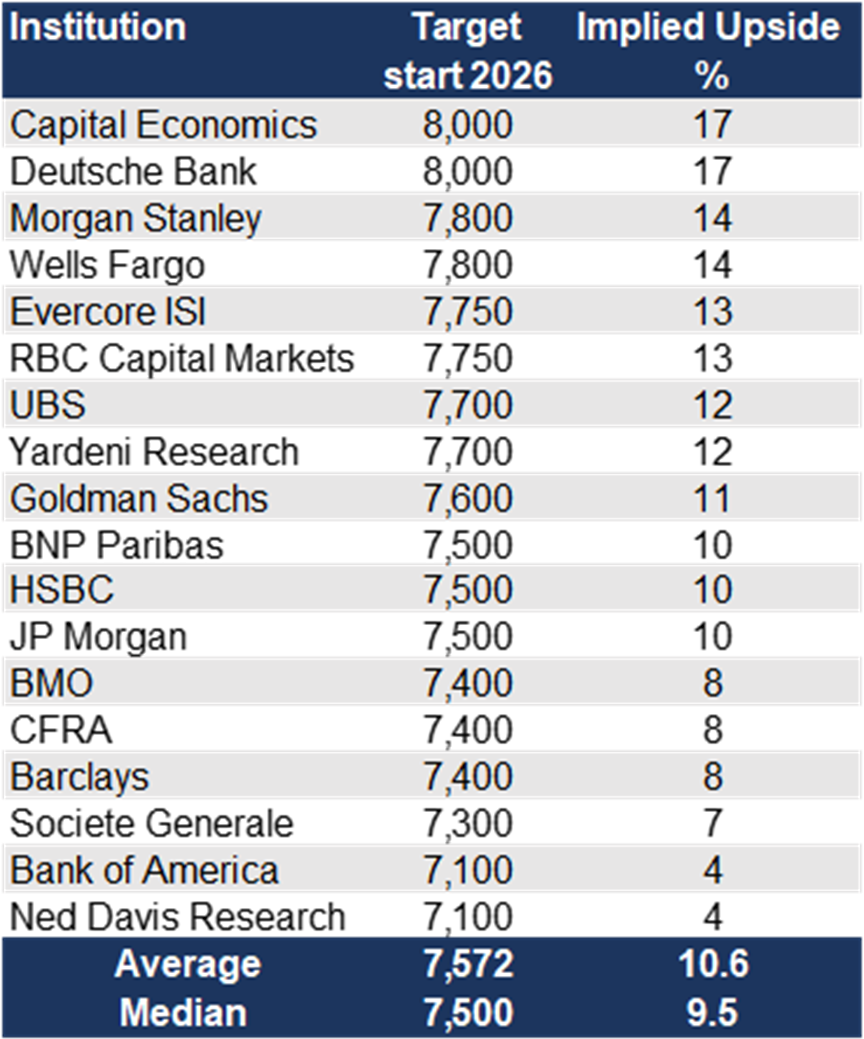
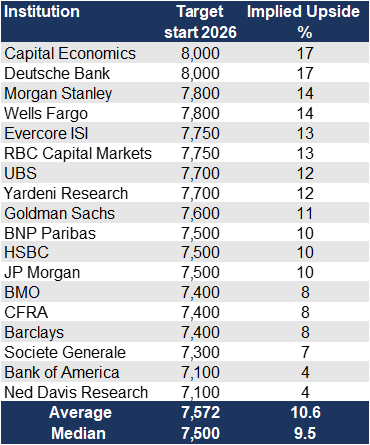
- Public markets in 2026: The average end 2026 level of the S&P 500 forecast by 18 Wall Street firms is 7,572 versus the current c6,850, a rise of just over 10.5%. The range is 7,100 to 8,000, a 4-17% rise. None forecasts the market going down. The debate is whether rapid earnings growth and falling Fed rates can offset high valuations and AI capex/returns fears.
- Growth equity market robust into 2026: The US had a spectacular November with 51 deals of $100m or more raising $37.5bn, up 12% yoy. It was 2025’s second biggest month. European deal value at $3.8bn was up 69% yoy. We identify c$29bn of impending US deals and $8bn in Europe.
Click here to download a PDF version of Growth Equity Update
Prediction Marketplaces - Who could have foreseen that?
Kalshi and Polymarket have raised c$3.5bn since June.
In Q4 the fourth largest category in growth equity fund raises by sector was a new phenomenon, prediction marketplaces. Two companies with three rounds raised $3.3bn in the quarter. Polymarket had a single raise of $2bn and there were two raises in the quarter for Kalshi, of $1bn and $300m respectively. So, what is this phenomenon?
Polymarket comes from a blockchain and crypto background and is described technically as a blockchain marketplace. Polymarket runs on Polygon blockchain technology using the USDC cryptocurrency. Every trade is matched peer-to-peer through smart contracts. At its front-end it is a gambling marketplace which allows punters to place bets across a wide range of events including sports, political outcomes, economic indicators, award ceremonies, the weather and any other event where there are disparate, certifiable potential outcomes.
At time of writing the top trending prediction subjects are for the ‘Time Person of the Year’, the likely Fed rate decision in January and the outcome of the Falcons vs Buccaneers game.
Interest in the platform has surged this year with the platform handling more than $6bn of trades in H1 2025. In total the platform now has 1.3m traders, daily users are running at c58,000 and in total it has processed over $180bn in trading volume.
Intercontinental Exchange, the owner of the NYSE, announced a $2bn cash investment in Polymarket in October, valuing the business at approximately $8bn pre money. ICE will become a global distributor of Polymarket’s data, providing customers with sentiment indicators on topics of market relevance. ICE and Polymarket have also agreed to partner on future tokenization initiatives. A potential POLY token is much rumoured.
Shayne Coplan, the founder and CEO of Polymarket commented,
‘Our partnership with ICE marks a major step in bringing prediction markets into the financial mainstream. Together, we’re expanding how individuals and institutions use probabilities to understand and price the future. By combining ICE’s institutional scale and credibility with Polymarket’s consumer savvy, we will be able to deliver world-class products for the modern investor. Realizing the potential of new technologies, such as tokenization, will require collaboration between established market leaders and next-generation innovators.’
Remarkably Polymarket has only been able to operate legally in the US since November 2025. The business was founded in 2020 and raised $4m in a seed round led by Polychain Capital in October that year followed by a $25m Series A at the end of 2021 led by General Catalyst. In January 2022 the US Commodity Futures Trading Commission (CTFC) blocked Polymarket from operating in the US, classing it as an unregistered digital exchange. Polymarket continued to develop its international customer base and bought QCX, a designated contract market. This latter act formed a pathway to the CTFC issuing an amended order in November 2025
‘…permitting Polymarket to operate an intermediated trading platform subject to the full set of requirements applicable to federally regulated U.S. exchanges.
The geo-blocking of potential US customers thus only came to an end in November 2025 but that now opens up new avenues of growth for the company. Donald Trump Jr a partner of one of Polymarket’s early backers, 1789 Capital, has just joined its advisory board.
Also, remarkably the platform doesn’t charge users fees for trading. It captures a sliver of the bid/ask spread in its markets by acting as a liquidity provider and with the ICE deal looks to be pinning its future plans on monetisation by selling feeds of its data and on value-added services. Already Polymarket’s odds data is used in the commentary by mainstream financial data services like Bloomberg. Polymarket’s data on the prospective outcome was widely used ahead of the US presidential election in 2024. The new relationship with ICE presents a further opportunity to package and distribute Polymarket’s market data for distribution to hedge funds, news organizations, and other global clients. It also looks to complement its retail platform with a professional trading platform in early 2026. This Pro tier will offer analytics, execution tools, and data feeds for institutional traders and financially sophisticated participants.
Press reports suggest that, post the ICE deal, Polymarket is looking to raise further funds at a valuation of $12-15bn while the joint ringing of the NYSE opening bell by founder Shayne Coplan and ICE CEO Jeffrey Sprecher in mid-November has raised press speculation that the company may be about to consider an IPO.
Kalshi: The pace of fundraising at Polymarket’s prediction marketplace counterpart, Kalshi has been remarkable. It raised $1bn in November at a valuation of $11bn in a round led by Paradigm, the research driven crypto investment firm, alongside Sequoia and Andreessen Horowitz. Its previous round was a $300m Series D led by Andreessen Horowitz a month earlier in October 2025 valuing the business at $5bn. Prior to that there was a $185m Series C in June 2025 at a $2bn valuation led by Paradigm at a valuation of $2bn. In total almost $1.5bn raised in six months with the valuation moving from $2bn to $11bn.
Kalshi operates in a similar style to Polymarket. At time of writing its platform is advertising odds on the next US Presidential election winner (JD Vance 29%, Gavin Newsom 21%), on the identity of the Pro Football Champion and on the Fed rate decision in January.
Kalshi was founded in 2018 and launched in 2021. Unlike Polymarket it has been a CTFC approved exchange since its launch and thus able to address customers in the United States. It gradually widened the range of events it was permitted to trade, starting with economic indicators and expanding through election markets and sports.
Kalshi’s volumes have expanded dramatically over the last year. The US Presidential election in 2024 appears to have been a major factor in sparking retail interest in both the Kalshi and Polymarket platforms. At the time of its December raise Kalshi was reporting trading volumes surpassing $1bn per week, up over 1,000% from 2024. It has had eightfold volume increases since July. Calling itself ‘the world’s largest prediction market’ Kalshi claims millions of users access the platform weekly ‘to trade the future in over 3,500 markets.’
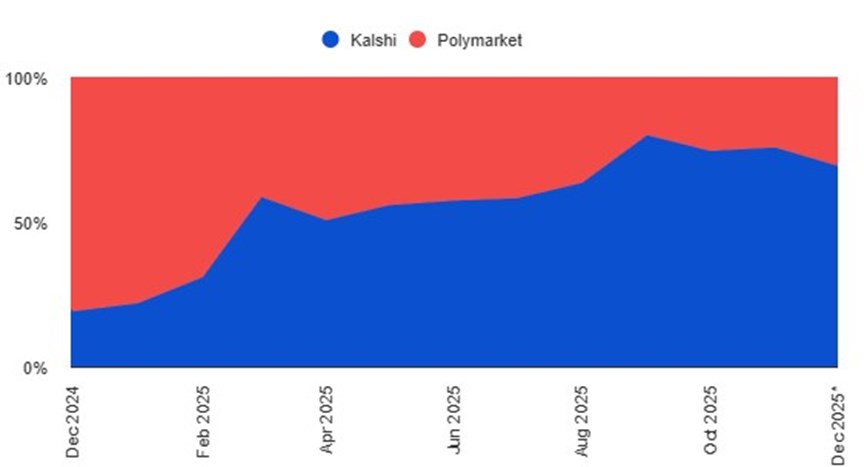
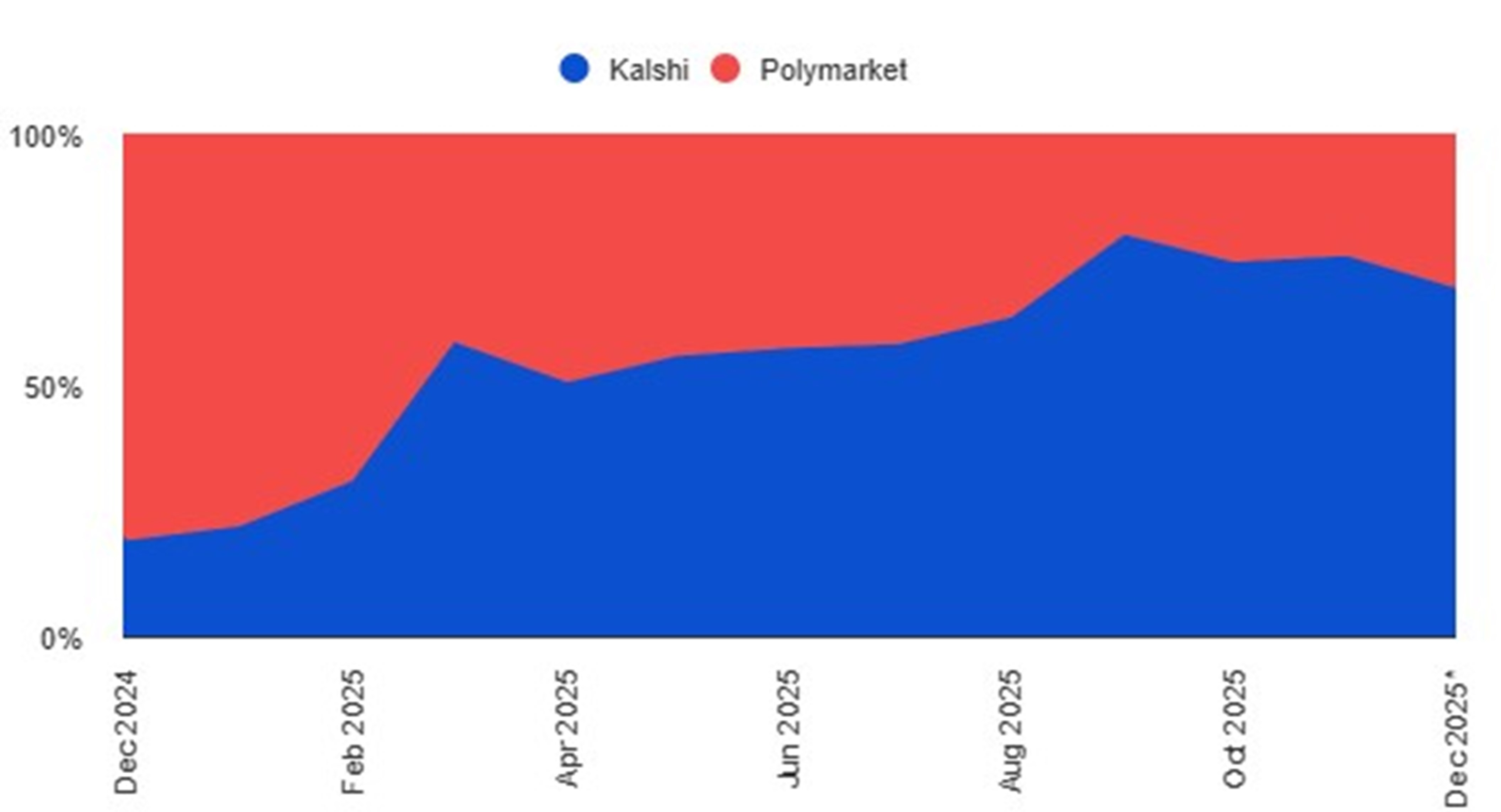
In terms of relative size in November, according to data sourced from The Block, Kalshi set an all-time high for its monthly volume at $5.8bn, a 32% increase over October. Polymarket was smaller, posting a record $3.74bn in November trading volume, up 24% over the previous month. In relative volume market share Kalshi was at 76% in October versus Polymarket’s 24%. This marks a substantial turnaround in the last year. In December 2024 Polymarket was at an 81% volume share to 19% at Kalshi.
Much of the difference appears to have been surging US-based interest in betting on sporting events in 2025. Interestingly the dynamic is about to change with the new CTFC permissions for Polymarket to operate in the United States. Polymarket will add US capability to its well-developed international market presence. Kalshi has been mainly focused on the US but expanded its international operations in mid-2025.
Unlike Polymarket Kalshi charges trading fees. Its user experience feels like a conventional brokerage using bank accounts. Polymarket has arguably a more crypto feel with its fast low-cost trades. The critical difference arguably has been legal access to the US market, and this is where the battle between the two is likely to be fought out in 2026.
Meanwhile with the strength of their liquidity and subscriber bases these two have largely driven out other conventional prediction players – the likes of PredictIt and Augur. They may yet face a challenge in 2026 from major crypto platforms and fintechs.
Polymarket and Kalshi – Relative volume market share in the last 12 months
Source: The Block – December 11, 2025
Source: The Block – December 11, 2025
Some updates
We update on some of the themes we have touched on in recent Growth Equity Updates.
NVIDIA and the AI VC ecosystem: In our November edition we noted that NVIDIA has upped the pace and scale of its direct investments into AI related startups in recent months. We identified 74 startups where NVIDIA has a stake, either directly or through its venture arm NVentures. With its immense resources (NVIDIA finished Q2 2025 with $48.3bn in net cash and quarterly cash flow from operations of c$15.4bn) it has become a substantial player in the ecosystem of investment around AI.
In the last month we have seen NVIDIA continue to be an active player in growth equity raises. We identify a further five raises where it has been involved since the start of November. It invested $10bn alongside Microsoft’s $5bn in a new strategic partnership with Anthropic. It joined the $2.3bn round for AI development platform Anysphere alongside Google and a group of venture investors. It invested $100m in Physics X, the UK AI software platform for manufacturing. Its venture arm NVentures was involved in the $140m Series D for generative media content platform, Fal.ai and the $57m Series A for Swiss robotics company, Flexion
NVIDIA – Growth Equity investments since the start of November 2025


Source: Rothschild & Co
Source: Rothschild & Co
Funding growth companies in Germany: In September we looked at German state initiatives to support the VC market in fundraising for growth companies.
German start-ups raised €7.6bn in 2024, making Germany the third-largest VC market in Europe, accounting for about 15% of the continent’s total funding. France was in the second place at €7.9bn with the UK leading at €17bn.
One of the key initiatives we identified was the ‘Growth Fund Germany’ managed by KfW and a key building block of the Future Fund of the German Federal Government and, with a fund volume of just over €1bn, one of the largest VC funds of funds ever launched in Europe. The Growth Fund receives just under 70% of its funding from private capital.
In November 2025 KFW announced that the initial Growth Fund is almost exhausted. Growth Fund Germany, acting as a fund-of-funds has committed nearly €825m to 41 venture capital target funds with more than 360 technology businesses having been funded across all sectors through the target funds. 39% of the commitments went to the information and communication technologies (ICT) sector, 35% to life sciences and 26% to other fields such as deep tech, industrial tech, climate tech or food tech.
KfW Capital is working on the design of the Growth Fund II as a follow-on product. The fundraising is to begin in 2026.
Fund raising for VC Firms still weak: We have regularly charted the state of fundraising for VC funds in 2025 through the year. As we move through December the weakness of fundraising for VC firms this year is made clear.
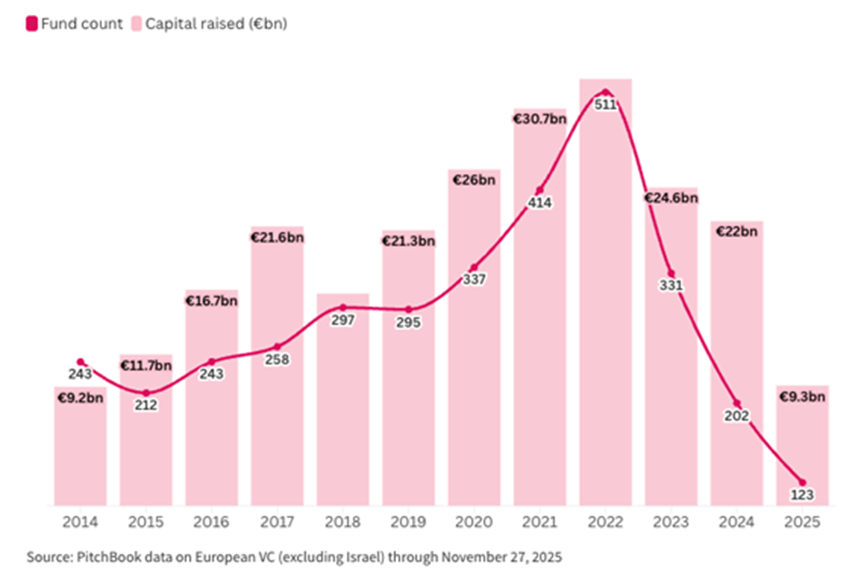
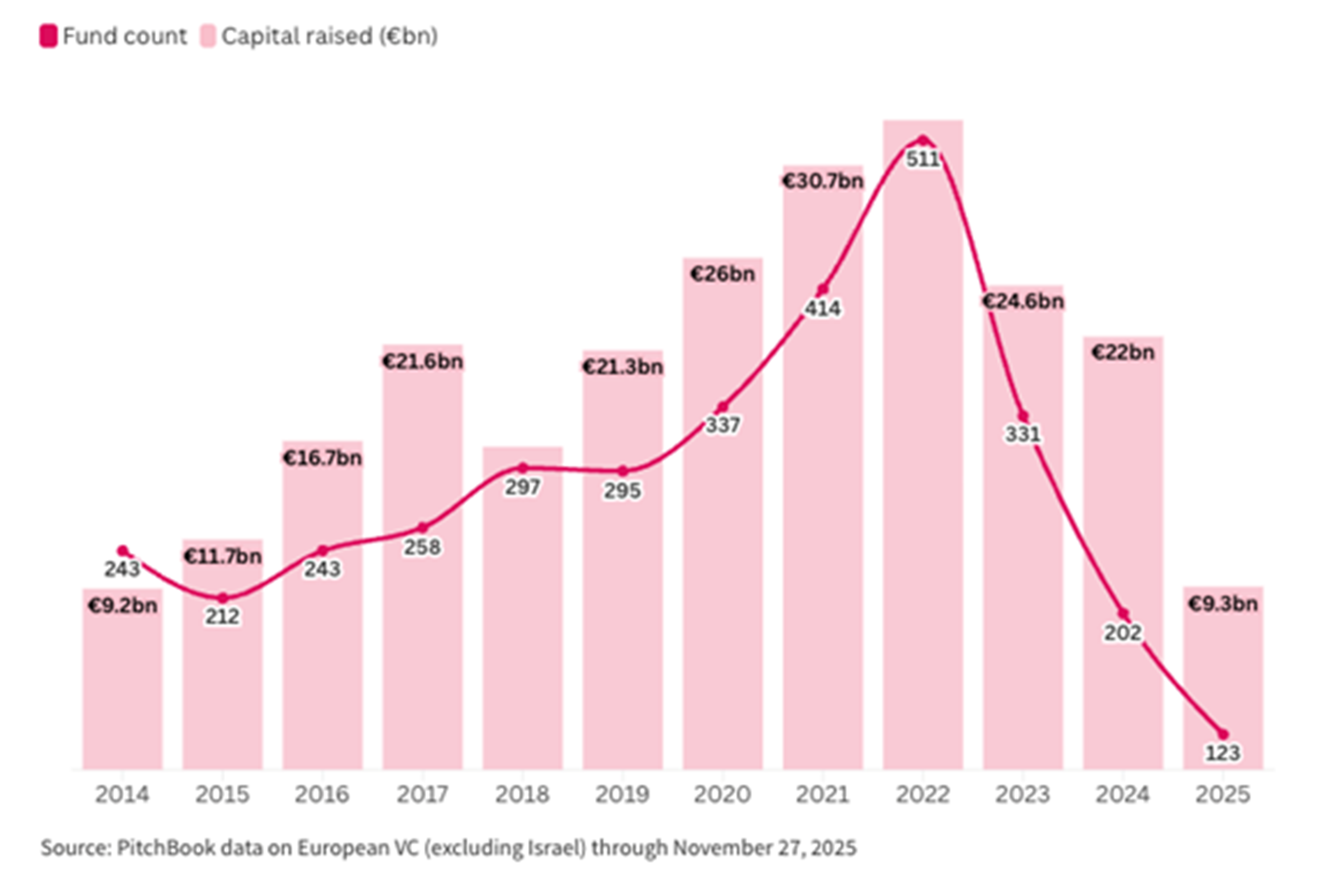
This chart from Pitchbook/Sifted indicates that to the end of November European VCs have raised €9.3bn, down 58% on the full year total of €22bn in 2024 and on track to be the weakest year of fundraising for European funds since 2014.
Deployments, as we also regularly chart, remain robust. Again, according to Pitchbook, to the end of September, the capital invested into Europe’s VC market is 5.2x the amount raised by the region’s investors. The sector continues to suffer from a lack of exits.
European VC fundraising in 2025 – Running c55% down yoy to the start of December
Source: Pitchbook, Sifted, R&Co.
Source: Pitchbook, Sifted, R&Co.
The US Venture market in Q4 2025
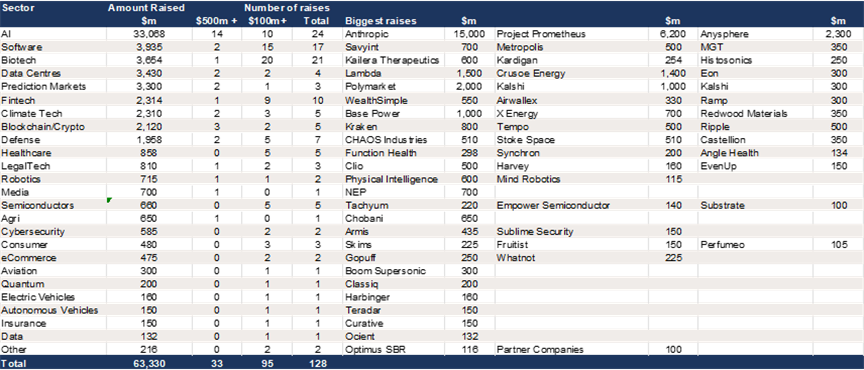
Our Rothschild & Co Deals Monitor tracks US VC deals of $100m or more. At time of writing (11 December) Q4 fundraising is at $63.3bn, up 31% from the whole of Q4 2024 at $48.3bn. Looking at October and November in isolation, the 2025 figure of $58.4bn was 80% up on the equivalent 2024 period. December has just under two weeks to go but has so far gone at a more modest pace than the preceding months.
The features of Q4’s fundraising are:
AI leads: 52% of Q4’s deals have been for AI businesses led by the $15bn raise for Anthropic, $6.2bn for Jeff Bezos’ Project Prometheus and $2.3bn for Anysphere, the vibe coding applied research lab.
Broadly defined AI even more so: AI’s dominance is reinforced if we take into account the raises in AI led sectors as well, with the AI phenomenon pulling through investment into associated industries. Data Centres is fourth on the list with $3.4bn of raises in the quarter, including two $1bn+ rounds. Two major application areas for AI, Robotics and Legal Tech, chip in $810m and $715m respectively. Semiconductors, where the focus of much of the VC money is on platforms and chips to reduce power use and speed up AI processing, was another $660m. Taking these into account the broader indicator of AI fundraising rises to 61% of the Q4 total.
Top three categories remain the same: After 9 months of 2025 the top three sectors in terms of funds raised were AI, software, and biotech. Those three sectors retained their positions in Q4 with software seeing $3.9bn of raises and Biotech $3.6bn, both c6% of the quarterly total.
Data Centres prominent: The debate in AI in recent months has seen a shift in focus from the disruptive capabilities and huge growth potential of AI towards the cost to deliver the phenomenon with the capex plans of the major AI players and their providers being closely scrutinised. Despite this in terms of VC funding Data Centres leapt from 14th place after nine months to fourth place in Q4 as a destination for funding. The $3.4bn raised in the quarter was across just four deals including two of more than $1bn, the $1.5bn raise for Lambda supported by NVIDIA and the $1.4bn raise for Crusoe Energy led by Mubadala and Valor Partners.
Who could have foreseen that? Bundling past fintech and climate tech into fourth position were prediction marketplaces. This was a new phenomenon for the year with three raises in the quarter, $2bn for Polymarket and two raises for Kalshi, of $1bn and $300m.
The return of blockchain and crypto: Maybe it never went away, but crypto went out of style following the collapse of FTX in November 2022, the subsequent revelations, the charges against Binance and its founder which led to convictions in November 2023 plus a supporting cast of bankruptcies and mishaps at the likes of Three Arrows Capital, Genesis Global, BlockFi, Voyager Digital, Celsius Network, Bittrex, and ComputeNorth.
The industry has recovered its poise post these vicissitudes under the umbrella of a more crypto friendly US administration and one of the features of 2025 has been the accelerating pace of growth equity deals for crypto businesses. In Q4 there were five deals in crypto and blockchain raising $2.1bn. Leading these was the $800m raise led by Jane Street for the crypto exchange Kraken, a globally scaled and regulated infrastructure stack that spans spot trading, derivatives, equities, tokenized assets, staking and payments. A subsequent $200m strategic investment by Citadel Securities was executed at a $20bn valuation. A substantial Series A raise for Layer 1 blockchain business Tempo was led by Greenoaks and Thrive Capital, valued the business at $5bn and was supported by the financial infrastructure and payment processing business Stripe and the crypto investment firm Paradigm.
Defense – the revival sector: The outlook for the defence sector changed in mid-February 2025 when US vice president JD Vance announced that, as far as the US was concerned, Europe must take responsibility for its own security, sparking a scramble by European counties to raise their GDP spending on defence and step up their direct support for Ukraine. Simultaneously the US has been redirecting its defence spending into new avenues to reflect the changing nature of warfare demonstrated by the evolving nature of the conflict in the Ukraine.
Defence companies raised $1.95bn in Q4, and year to date the sector has come from nowhere to be the sixth largest in terms of growth equity raises in 2025.
The Q4 raises were led by two companies who both raised $510m. CHAOS Industries raise was at a $5.1bn valuation. Its previous raise was a $275m Series C in May. CHAOS is building Coherent Distributed Networks (CDN™) systems that give ‘warfighters’ time to act against borders and autonomous threats. Essentially, this is sensor technology for the military sector. An array of sensors, such as the Vanquish radar to detect missiles, drones and aircraft and the Astria radar to monitor the environment for long periods act to give its military customers a better sense of its battleground environment and critically more time to react. Stoke Space is a dual mission civil and defence business which manufactures reusable rockets. Notably, it has a National Security Space Launch contract from the U.S. Space Force reflecting the growing demand for medium-lift capacity in defense and emerging architectures, such as the Golden Dome.
Legaltech – early strides in AI applications: This is one of the key sectors emerging as an early commercial application of AI. Legal firms have vast quantities of their own data and require access to vast quantities of external data to litigate cases. At the same time these businesses require tools to analyse internal workloads, perform assessment on the likelihood of winning and therefore of making a commercial return on cases, and often are underinvested in internal systems like management of workflows, links to accounting systems and billing.
The growth equity backed startups struggle to challenge the vast content capability of the established players in this field like Thomson Reuters Westlaw or RELX’s Lexis Nexis. The latter’s content sets comprise, for instance, 100+ billion documents with 2m documents added daily and 150+ billion connections. The new entrants instead can focus on ease of access to firms’ and clients own data ( Harvey – ‘Shared Spaces to allow clients and lawyers to work in the same AI enabled space - $160m raise), workflow tools (Clio –‘ an operating system for law firms’ -$500m raise) and low cost basic legal functions ( Even Up - drafting, reviewing, and strategizing for personal injury law based on case outcomes - $150m raise).
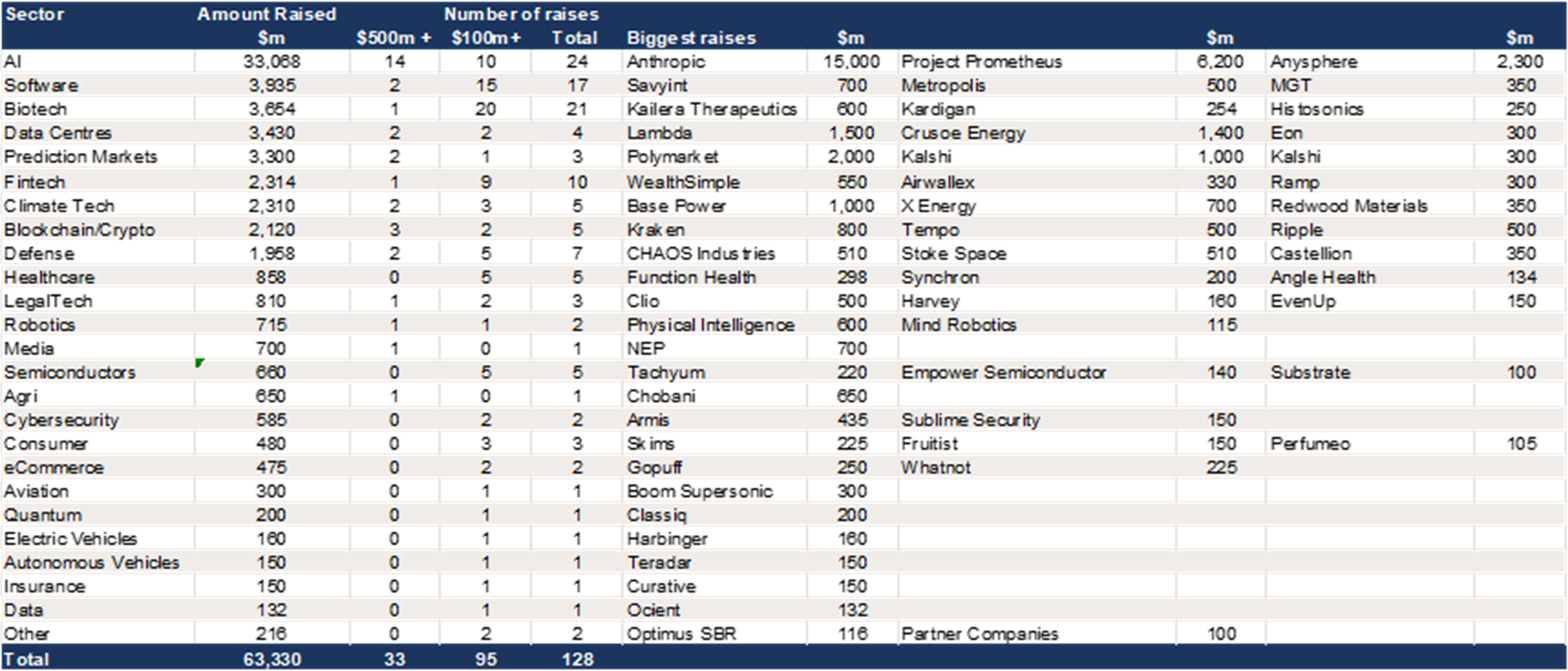
US VC fundraising by sector – Q4 2025 (to December 11)
Source: Rothschild & Co
Source: Rothschild & Co
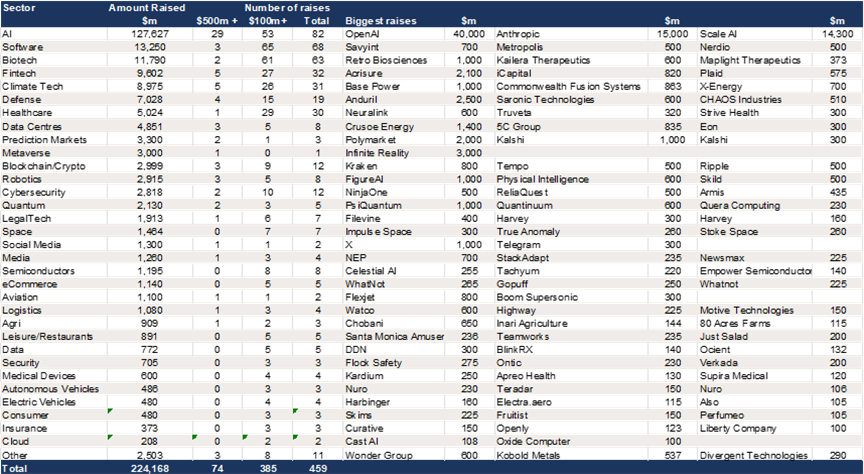
The next exhibit puts Q4 into context showing the total fundraising year to date in the United States in growth equity spilt by sector and highlighting the three largest raises in each sector.
Answering the usual question, 57% of all US fundraising ytd has been in AI, with €127.6bn of the $224bn total. Software with $13.3bn (6% of the total) and Biotech $11.8bn or 5% of the total, were the other two largest categories.
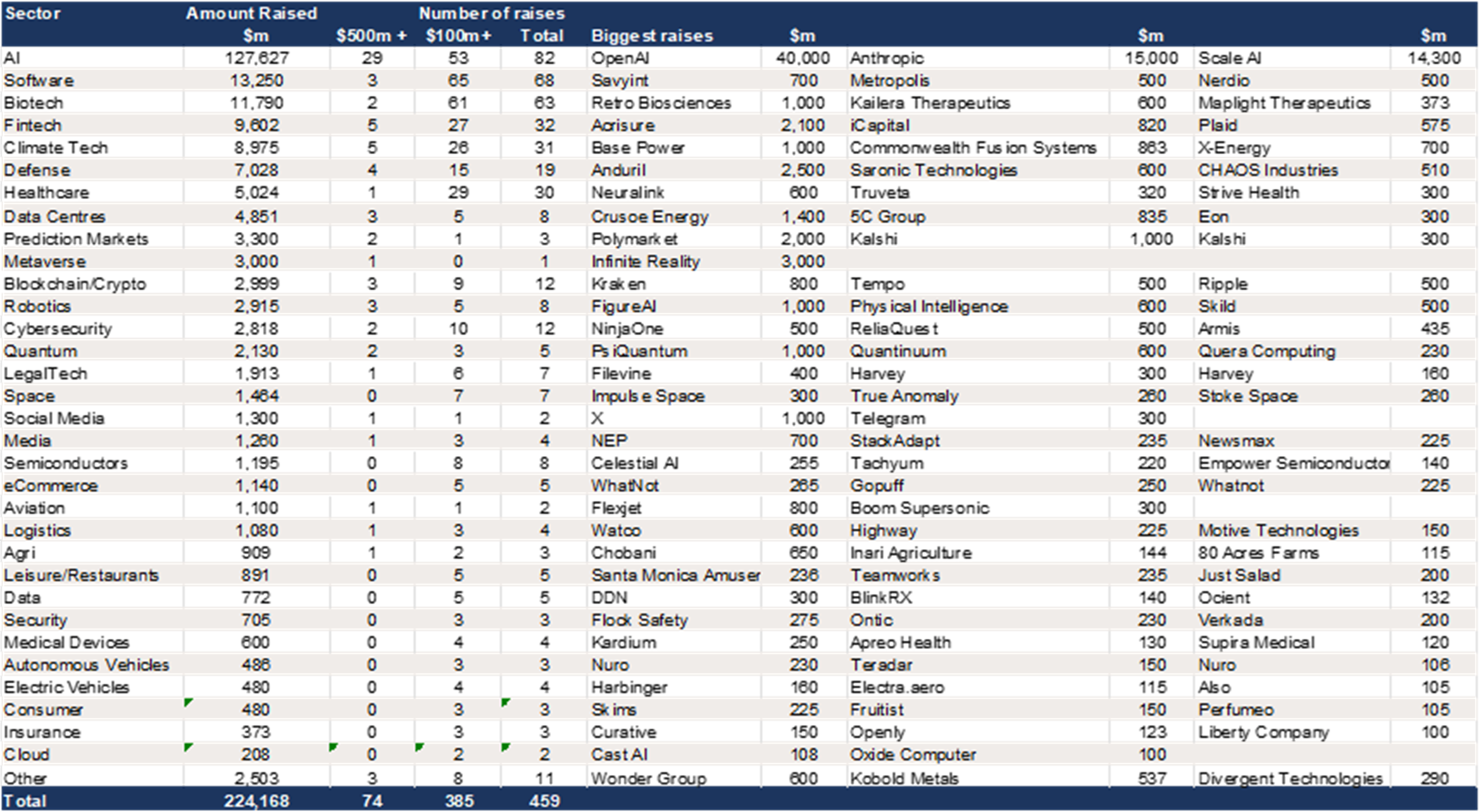
US VC Fundraising –2025 Year to date to December 11
Source: Rothschild & Co
Source: Rothschild & Co
The outlook for 2026
It’s been a three year plus bull market. Since the lows on October 12, 2022, the S&P500 is up by c90%, NASDAQ by c128% and the FTSE Venture Capital Index by almost 140%. ChatGPT was launched on a largely unsuspecting world on November 30, 2022. As we regularly chart in these Updates the US growth equity market is being driven along by AI with c60% of all investment ytd being in AI businesses. In public markets the Magnificent 7, dominated by AI businesses, is up 300% since October 2022.
So, the debate now turns to 2026. After three years of very positive returns the debate is whether this trend can survive into another year. We look at three indicators:
We start with the 2026-year end S&P500 forecasts from strategists at the major Wall Street firms.
A recap first on their recent performance
- In 2024 the Wall Street strategists as a group were too cautious. At the start of 2024 their forecasts for the end 2024 level of the S&P500 stood at 4,200 (JP Morgan) to 5,400 (Yardeni Research) with an average target across 20 firms of a 2% rise in the S&P 500 to 4,861. In the end the S&P 500 rose by 25% to 5,970.
- Chastened by having underestimated the bullish market sentiment in 2024, the start 2025 forecasts were more optimistic. The 14 estimates by Wall Street strategists at end 2024 forecast an average 10% rise in the S&P 500 to 6,718 by end 2025 with a range of 6,500 (MS) at the low end (+7%) to +18% to 7,000 (Wells Fargo, Yardeni, Capital Economics, Deutsche Bank) at the high end.
- Around the time of the Liberation Day tariff announcements a number of these targets were lowered and subsequently raised again as the shape of tariff concessions emerged.
As we write the S&P 500 stands at c6,850, up almost 15% ytd and just 2% higher than the average Wall Street forecast at the start of the year. There is still a vigorous debate amongst strategists as to whether the S&P500 can indeed broach 7,000 by the year end. All in all, not a bad bid of forecasting.
So, what about 2026? The exhibit shows the forecasts set by 18 Wall Street firms at the start of December.
- The average of the forecasts is for an end 2026 S&P 500 level of 7,572, a rise of just over 10.5% on the year
- The range is 7,100 to 8,000, a rise of 4% to 17%. No one forecasts the market going down.
At the top end are Capital Economics and Deutsche Bank both of whom also had the highest forecast for the S&P500 in 2025. For Deutsche Bank elevated valuations are offset by an anticipated acceleration in earnings growth.
‘In 2026, we see robust earnings growth and equity valuations remaining elevated. We expect a pickup in earnings growth in 2026 to 14% (from 10% in 2025), taking S&P 500 EPS to $320. Corporate cost-cutting and the labour market remain risks, but for administration policies we expect checks and balances in the run-up to the mid-term elections. At 25x, the S&P 500 trailing multiple is well above the historical average (15.3x) but easily explained by favourable drivers: higher payout ratios, higher perceived trend earnings growth, fewer large drawdowns in earnings, and inflation below its long-run average.’
Capital Economics thinks there will be more fiscal easing in 2026 and that the transformative economic effect of AI will further build, meaning market tolerance for higher valuations will persist while accepting that an AI fuelled bubble may exist.
AI is already lifting the US economy: by our estimates, it added around 0.5%-pts to GDP growth in the first half of this year. We expect this to continue in 2026, which underpins our above-consensus forecast for the US economy to grow by 2.5% next year. There is no question that equity valuations are high, especially in the US. But they are not yet as stretched as they were during the last tech-driven equities bubble in the late 1990s and earnings growth should remain solid. As such, we think equities can keep rallying for a while yet: we forecast the S&P 500 to rise to 8,000 by the end of 2026.’
We note one more in the bullish camp. JP Morgan has a central year end S&P 500 target of 7,500. It thinks though that if the Fed keeps cutting interest rates the market may go as high as 8,000. The 7,500 target is predicated on strong earnings growth of 13%-15% pa in the next two years and two more interest rate cuts (including the one just announced in December 2025). An improving inflation outlook with more rate cuts would be the precursor to switching to the 8,000 target. JPMorgan also looks through valuation and AI bubble concerns, observing
‘Despite AI bubble and valuation concerns, we see current elevated multiples correctly anticipating above-trend earnings growth, an AI capex boom, rising shareholder payouts, and easier fiscal policy. More so, the earnings benefit tied to deregulation and broadening AI-related productivity gains remain underappreciated."
At the more pessimistic end of expectations, we find Bank of America and Ned Davis Research both with a 7,100 expectation. Both had a pretty accurate mid-range 6,600 forecast for 2025.
Ned Davis Research is less optimistic on earnings growth and for the outlook for interest rate cuts. It highlights the risks of slowing earnings per share growth, high valuations, a less equity-friendly Federal Reserve and the already extended bull market, warning that growth areas could underperform during pullbacks.
Bank of America sees the momentum in the market running out in 2026. Like others it looks for strong earnings growth, with 14% anticipated. Unlike others BoA sees the buying power in the market fading arguing that the buybacks that have supported the market are levelling out with the big tech companies instead investing in AI infrastructure. It sees the combination of less money returned in buybacks, higher AI capex and the Fed pursuing quantitative tightening as unhelpful for the market. BoA is also cautious on valuation, though looking for a reset rather than a downturn. Unsurprisingly, it is cautious of calling AI a bubble but is prepared to see an ‘air pocket’ where the market, having run ahead, loses lift.
Much of the relative caution is around the valuation of AI stocks with BoA’s chief strategist observing a ‘buying the dream’ phenomenon with companies building out power infrastructure and AI data centres commanding peak multiples with little evidence for near-term monetization.
We’re paying a high multiple for growth stocks, but we don’t exactly know how this all plays out over the next few years…. The valuation reset is the big story for next year. Historically, if you look at years of really strong earnings growth, you haven’t necessarily seen the strongest market gains.”
The level of the S&P 500 at end 2026- Wall Street forecasts
Source: Press reports; Rothschild & Co
Source: Press reports; Rothschild & Co
The most recent BoA Global Fund manager survey shows increasing optimism amongst investors. Published in mid-November the key finding was that fund manager sentiment was at its highest level since February 2025.
- Asked on their expectations for the S&P 500 at the end of 2026 just 1% of respondents expect it to be at 8,000-8,500; 13% expect it to be at 7,500-8,000; 43% expect 7,000-7,500; 20% 6,500-7,000 (current level is c6,850); a surprisingly large 14% anticipate 6,000-6,500; with 9% at 5,500-6,000 or less.
- Specifically on European equities a net 77% of respondents expected near-term gains for European equities and a net 92% project upside over the coming twelve months. Both of these indicators were at a record high.
- Asked on the most likely outcome for the global economy in 2026, 53% expect a soft landing, 37% expect no landing and just 6% expect a hard landing.
- Global growth expectations are improving. Fund manager expectations for global economic growth turned from negative (net -8%) to positive (+3%) for the first time in 2025.
- Concerns about AI are apparent. 53% of investors said that AI stocks are already in a bubble (the October figure was 54%) and a record 63% observed that global markets are currently overvalued.
- Microsoft, Alphabet, Meta, and Amazon are collectively on track to spend c$370bn between them on capex in 2025, much of it on AI and datacentres. Fund managers appear to be cautious on this AI capex with the BoA survey showing a net 20% of investors indicating companies are overinvesting – the first time in twenty years that a majority have cited overinvestment
- The most bullish potential development of 2026 highlighted by fund managers is widespread AI productivity gains (43%), followed by accelerating Chinese growth (24%) and Fed rates below 3% (19%).
- The most bearish potential developments were cited as the combination of inflation and Fed rate hikes (43%) and a stalling of AI capex acceleration at 26%.
- Ranking likely relative 2026 market performance, 37% of investors cited Emerging Markets, ahead of NASDAQ at 13%, Euro Stoxx at 10%, the S&P 500 at 6% and the FTSE 100 at 3%.
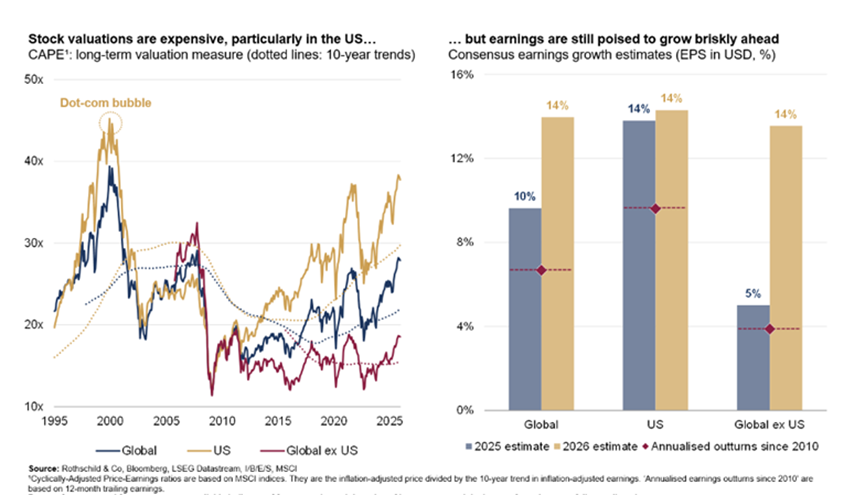
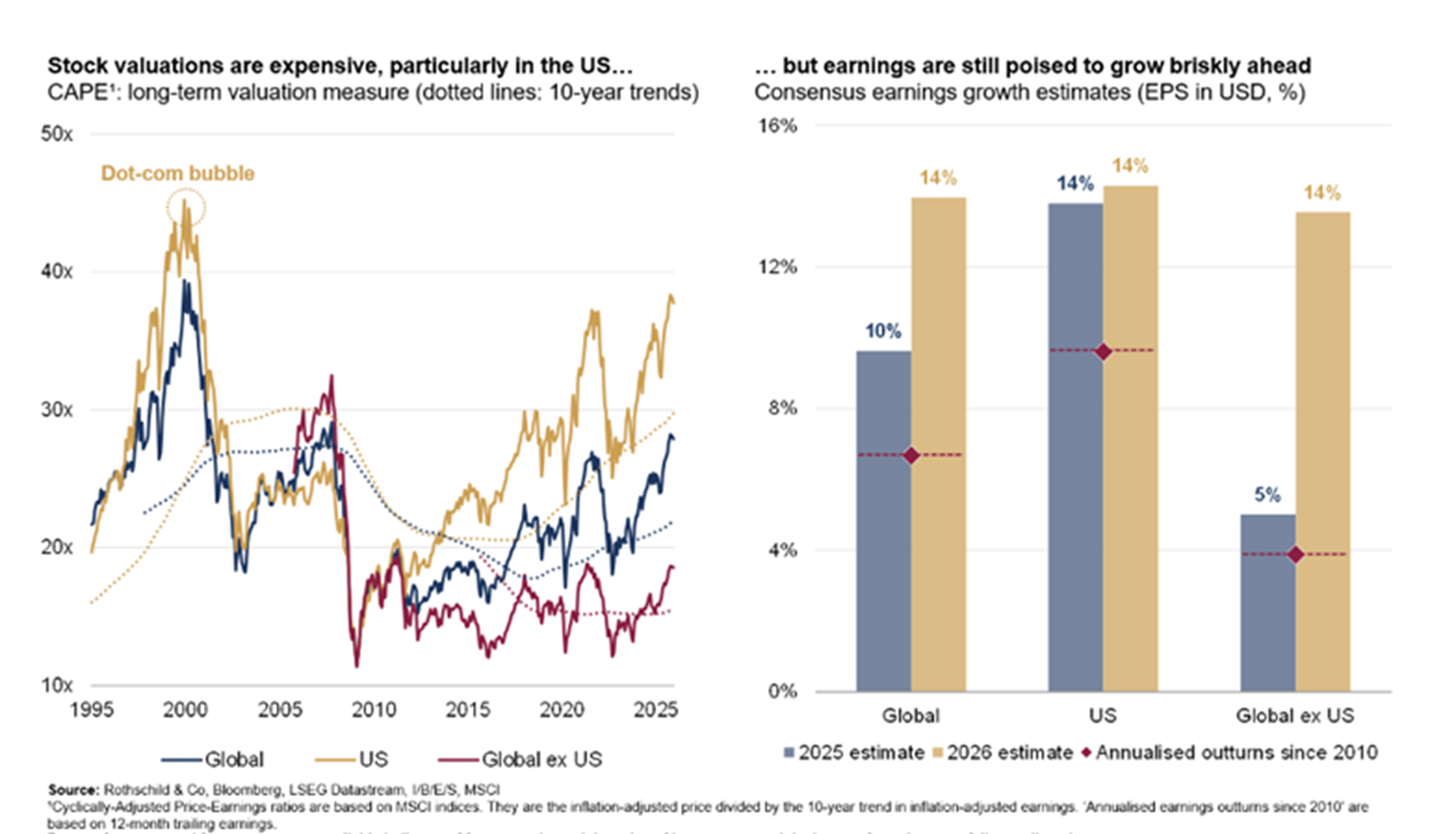
Our Rothschild & Co strategists Kevin Gardiner and Anthony Abrahamian note that valuations are high versus history, particularly in the US but that 2026 earnings growth, anticipated at 14% is also poised to be strong.
Valuations are testing but earnings growth is intact.
Source: Rothschild & Co
Source: Rothschild & Co
Their views on the current market outlook are summarised in the Exhibit.
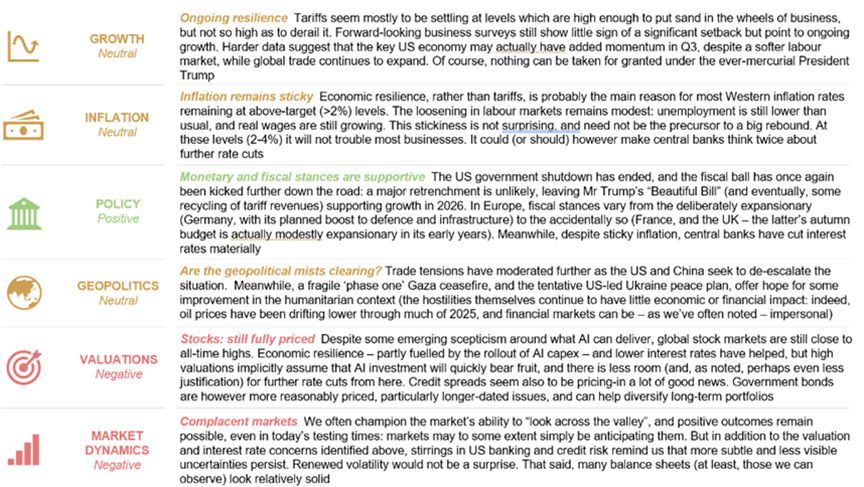
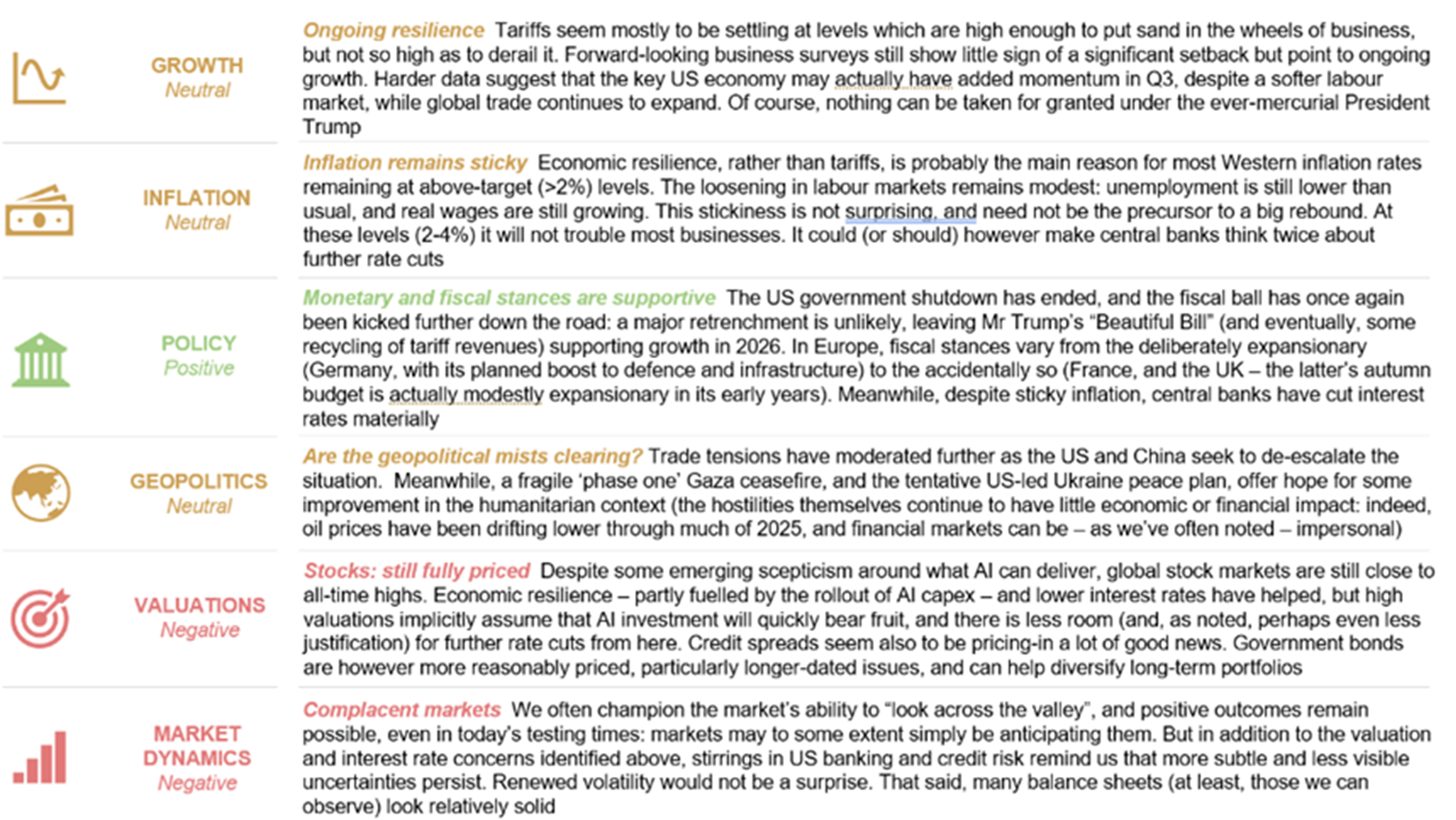
Source: Rothschild & Co.
Source: Rothschild & Co.
Looking forward into the 2026 timeline some key indicators to look out for:
US Interest rates: Following the 25bps cut at the Fed meeting on December 10 the Fed rate is at 3.5%-3.75%. The next Fed meeting is on January 28th, 2026, with a 76% expectation that rates will remain unchanged at that meeting. The current most favoured anticipated rate at the end of 2026 (the last meeting of the year is 9 December 2026) is 3%-3.25%, suggesting the market’s core expectation is 50bps of rate cuts in 2026.
New Fed Chair: The term of the current Fed chair, ‘stubborn’ Jay Powell runs out on May 15, 2026, although he can choose to remain as a Fed governor until the end of January 2028. President Trump in December 2025 made it clear that a ‘litmus test’ in his choice of new Fed chair will be their willingness to cut Fed rates. He will announce his nominee early in 2026 with the current favourite being US National Economic Council Director, Kevin Hassett, who has expressed his keenness to lower rates. The market likes the combination of economic growth and lower rates. The potential kickback is higher inflation – the US is already above target at c3%
US earnings season: With the market relying on mid-teens earnings growth in 2026 the early indicator of the US full year results season will be key. Based on historic reporting patterns Apple, Microsoft, Meta and Tesla are likely to report in the week starting January 26th with Alphabet and Amazon the following week and NVIDIA (which has a January year-end) in late February.
Fourth anniversary of Russian invasion of Ukraine; This comes on February 22nd. Could peace break out? Would that dull the momentum of defence stocks but rally markets? Generally, markets don’t like wars.
UK interest rates: The next BoE meeting is on 18 December and there is a strong expectation, given rising unemployment, weaker than expected GDP growth, and high (3.6% in October) but dipping inflation, that there will be a 25bps cut in rates to 3.75% at that meeting. With the Office for Budget Responsibility looking for inflation to average 2.5% in 2026 the market expectation is for interest rates to come down by 50-75bps to 3.0%-3.25% by year end.
European interest rates: The message coming out of the ECB in the last few months has been one of interest rates, now at 2%, having reached an equilibrium after a period of sharp rate cutting. At its end October meeting the ECB again held interest rates steady at 2%. ECB president Christine Lagarde observed after the October meeting that EU monetary policy is ‘in a good place’ and that the outlook for inflation is ‘broadly unchanged’. The market consensus looks for interest rates to remain unchanged through 2026.
Political risks: The UK has local elections on 7 May 2026. The ruling Labour Party is unpopular and polling poorly. Polymarket has a 41% possibility that UK Prime Minister Keir Starmer will be defenestrated by June 30th, 2026, and a 53% chance of that happening by the end of 2026. The US mid-term elections take place in early November 2026.
FIFA World Cup Final: This key event for the mood of market participants takes place between 11 June and 19th July 2026. The USA faces Paraguay on June 12, Australia on June 19 and its final first round opponent (one of Kosovo, Romania, Slovakia, Turkey) on June 25th. The top two teams in each group advance plus the eight best third placed teams, meaning that the US, ranked 14th in the world should make it. Much more importantly England, ranked fourth in the world, faces perennial bugbear Croatia (June 17) and potentially dangerous Ghana (June 23rd) in the first round as well as Panama (June 27). Scotland’s (FIFA rank 36) tournament should complete with a heroic narrow defeat to Brazil (FIFA rank 5) on 24th June, having been outplayed by Morocco (FIFA rank 11) on June 19th and going out on goal difference, having only scraped past Haiti (FIFA rank 86) 1-0 on the 14th of June opener.
November’s growth raises
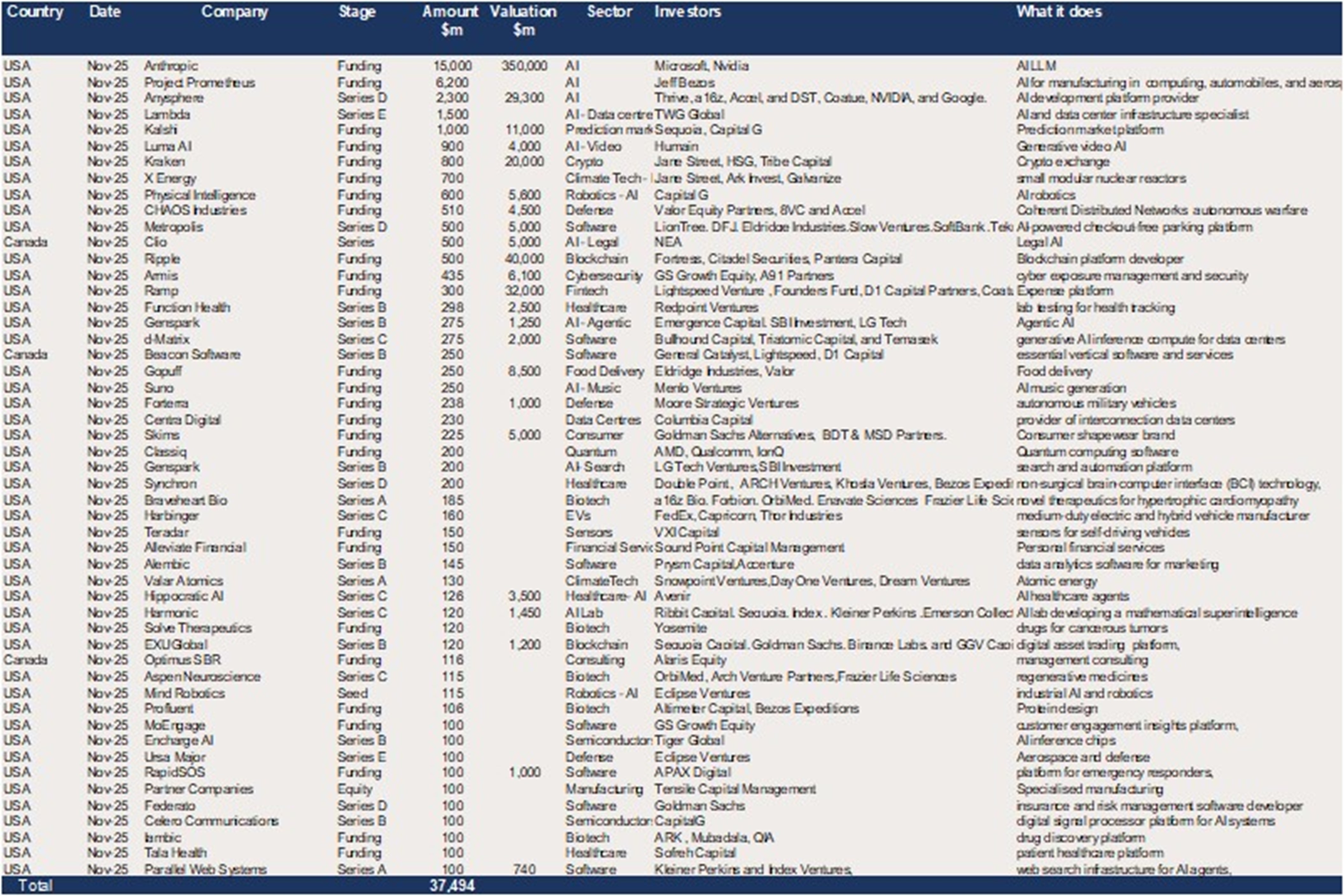
November’s European deal value at $3.8bn was up 69% yoy. The US at $37.5bn was up 128% yoy.
November continued the strong recent run of months in European growth equity raises. The Rothschild & Co Deal Monitor recorded $3.8bn of growth equity and VC deals of $20m and above across 48 raises.
That figure was 69% above the figure raised in November 2024 ($2.2bn). The last three months, September through November, have been very strong with $16.9bn raised in Europe, up 85% yoy.
The year-to-date European fundraising to end November is at $44.8bn, up 43% yoy.
The largest deal of the month was the $495m raised by the Dutch online grocery business Picnic, which serves two million customers across 200 Dutch towns from seven distribution centres. Picnic’s model is no-fee delivery with fixed delivery routes, and heavily managed fulfilment which relies on physical infrastructure to drive adoption. The money raised will support expansion in Germany, a market it entered in 2018. Picnic already operates a robotic distribution center in Utrecht, and its facility in Oberhausen in Northwest Germany is testing “robopicking” systems capable of handling more than 15,000 individual products.
Climate Tech was the largest category by value in the month with four deals totalling $526m. The largest of these was $253m raised for France’s HoloSolis which is a manufacturer of low carbon photovoltaic (PV) cells. The funds, raised from Calés Technologie and Forming plus existing investors will go to building one of Europe’s largest solar gigafactories in Sarreguemines-Hambach on the border of France and Germany. The UK’s Highview Power which is a long duration energy storage business specialising in liquid air storage, raised $162m for the development of a hybrid 3.2GWh liquid air and battery energy storage facility in Hunterston, Scotland. The round included the Scottish National Investment Bank, Centrica, Goldman Sachs, KIRKBI and Mosaic Capital.
AI businesses raised $416m across eight deals and included a LegalTech raise ($41m for DeepJudge which allows law firms to analyse their own data archives) and autonomous vehicle start up Vay whose $60m equity funding was led by the Singapore based ride hailing business Grab. The largest deals were both for $100m. Israel’s Wonderful helps enterprises deploy customer-facing AI agents across voice, chat, and email in all markets and languages. Physics X uses AI to design products across the manufacturing, aerospace and defence industries. The UK business raised $135m at a $1bn valuation in June this year and has now raised another $100m, this time from Nvidia.
Fintech saw two substantial raises totalling $345m. The UK consumer payments business Zilch raised $175m in debt and equity led by KKCG and involving an expansion of the £100m securitisation package introduced by Deutsche Bank in 2024. Danish business Flatpay, which offers payment solutions for small and medium sized businesses, raised $170m in a deal led by Dawn Capital, Smash Capital and AVP. In a related area, two crypto businesses, Deblock and Future, raised $35m and $32m respectively.
Five biotech raises gathered a total of $333m with two $100m plus deals. Italian business Aavantgarde raised $141m in a round led by Schroders Capital. It develops therapies for inherited retinal diseases. The UK’s Artios Pharma raised a $115m Series D to target the DNA damage response in cancer. The deal was led by SV Health Investors and RA Capital Management.
There were four deals in Cybersecurity in the month, all Israeli businesses, Guardio, Tenzai, Sweet Security and Clover Security, raising $266m between them.
In the secondary market a notable deal was a share sale by Revolut, believed to be c$2-3bn in size and said by the company to value the business at $75bn. The deal was led by Coatue, Greenoaks, Dragoneer, and Fidelity and other investors included Nvidia’s NVentures, Andreessen Horowitz, Franklin Templeton, and T. Rowe Price.
Europe – 48 deals raised $3.8bn in November
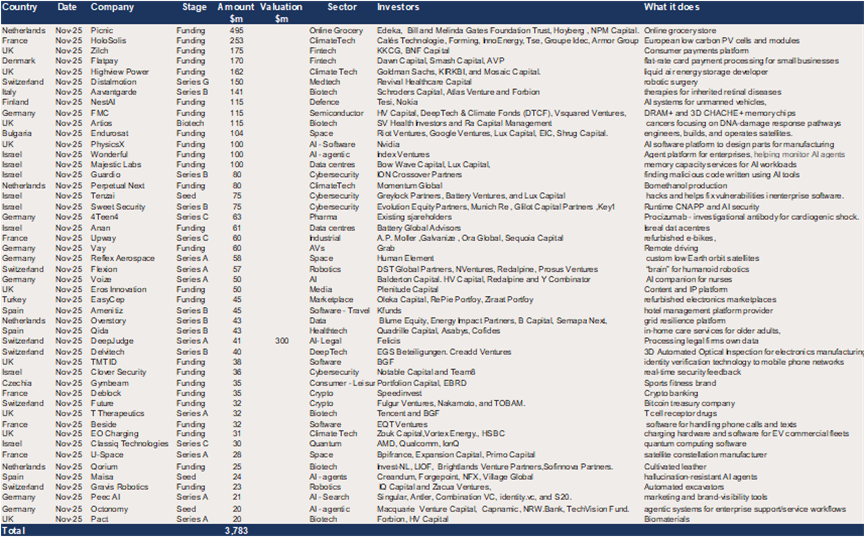
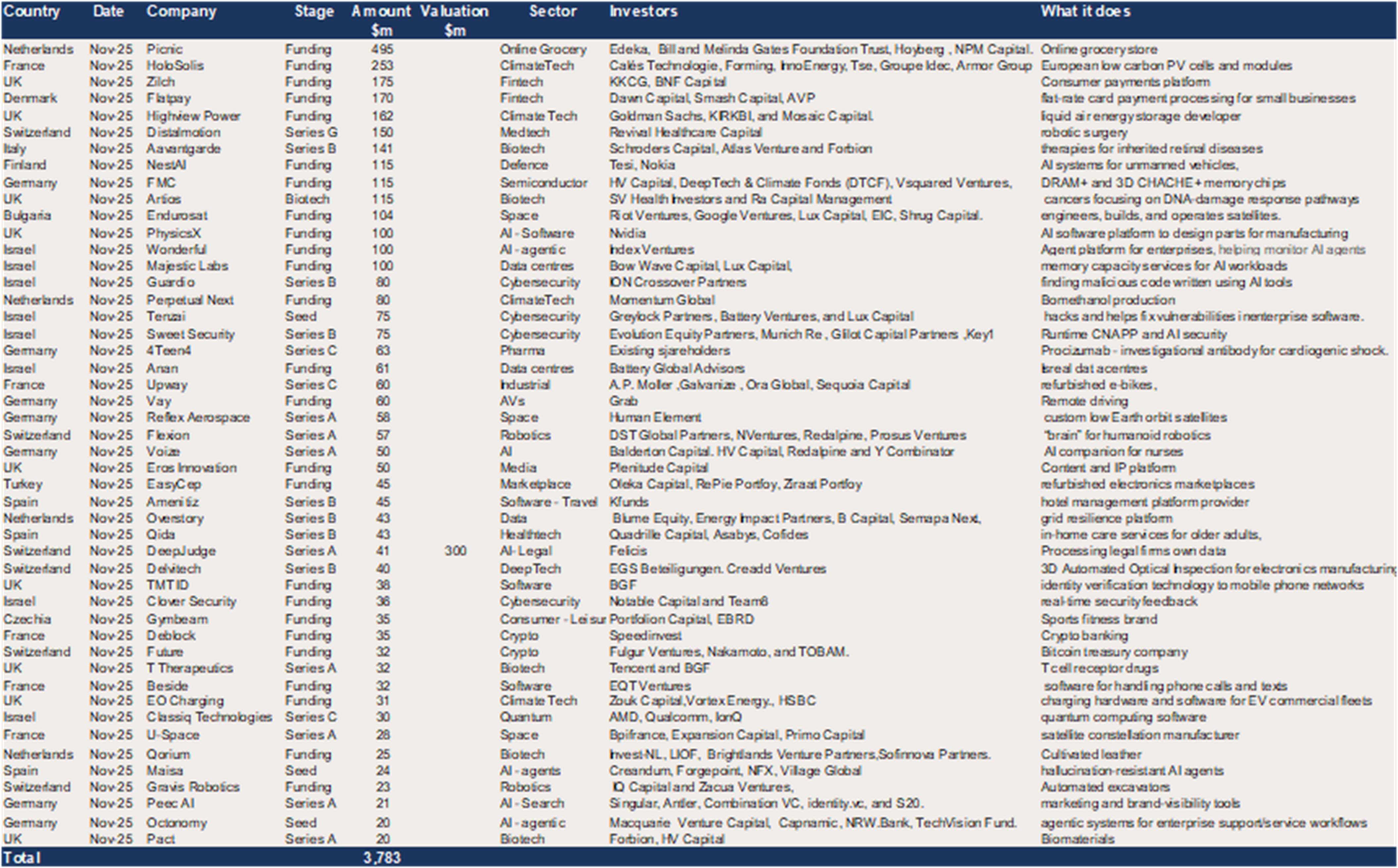
Source: Rothschild & Co
Source: Rothschild & Co
Only one of November’s deals, the $495m for Picnic, entered the top ten European deals by value year to date.
Europe – The top 10 VC raises by value ytd


Source: Rothschild & Co
Source: Rothschild & Co
The US had a spectacular November with 51 deals of $100m or more raising $37.5bn. This compares with 26 deals raising $16.4bn in November 2024, that year’s largest month. It represented a jump of 128% in deal value yoy. The $37.5bn month was the second largest year to date after the $50.7bn of March which included the $40bn raise by Open AI.
AI deals again led with the three biggest deals in November.
Hot on the heels of its $13bn Series F in September, Anthropic announced a new strategic partnership with Microsoft and NVIDIA. Anthropic is scaling its Claude AI model on Microsoft Azure, which is powered by NVIDIA. In one of AI’s typically clannish deals, Anthropic has committed to purchase $30bn of Azure compute capacity and to contract additional compute capacity up to one gigawatt while NVIDIA and Microsoft will invest respectively $10bn and $5bn in Anthropic.
Jeff Bezos is to be co-CEO of Project Prometheus a new AI business focused on building ‘AI for the physical economy’. In November the business announced that it had raised $6.2bn with Jeff Bezos and unnamed institutions as the major backers. It is an example of a ‘talent start up’ raise where there are as yet no products or revenues with the core attributes instead being the founders, Jeff Bezos and former Google X executive Vik Bajaj, plus staff drawn from a variety of businesses including OpenAI, Google DeepMind, and Meta AI.
Anysphere is the company behind Cursor, a software tool which tracks the techniques of software developers and is instrumental in prompting the next code to be written, the ‘vibe coding ‘phenomenon. The company raised $2.3bn at a valuation of $29.3bn in a round led by Accel and Coatue with Thrive Capital and DST. Google and the near ubiquitous NVIDIA were also involved.
Another seven AI deals, of which the largest were $900m for the AI video generation company Luma AI and $500m for the AI LegalTech business Clio, raised a total of $2.4bn bringing the AI total to the month to $25.9bn. This was 69% of the total funds raised in the month, slightly ahead of the c60% ytd average.
AI related sectors were additionally well represented. Two deals in Data Centres raised $1.73bn with Lambda raising $1.5bn in a round led by TWG Global. It previously raised a $480m Series D in February 2025 at a $2.5bn valuation. The company operates a number of data centres in the US and alongside this most recent raise announced, ‘a multibillion-dollar agreement with Microsoft to deploy AI infrastructure powered by tens of thousands of NVIDIA GPUs, including NVIDIA GB300 NVL72 systems.’ As we noted in the last Growth Equity Update, NVIDIA is an investor in Lambda.
Robotics, a sector closely tied to AI developments saw $715m raised in two rounds with $600m for Physical Intelligence led by Capital G and $115m by Mind Robotics led by Eclipse Ventures. There were two AI related semiconductor deals, each of $100m, by Encharge AI and Celero Communications led respectively by Tiger Global and Capital G.
In total these AI related sector deals gathered a further 2.65bn, another 7% of the monthly total.
Elsewhere there were eight software deals raising a total of $1.57bn with the largest being the $500m raised by the check out free parking platform, Metropolis.
A notable deal was the $1bn raised for prediction marketplace Kalshi in a deal led by Sequoia and (again) CapitalG. This follows the $2bn raised for fellow prediction market platform Polymarket in October. Prediction markets are shifting from niche blockchain operations to a new gambling-based asset class. Both platforms had their biggest months ever in November 2025 with Kalshi processing volume of $5.8bn and Polymarket $3.74bn.
Another ‘new’ sector was the fourth largest of the month, defense. Three deals raised $848m with CHAOS Industries- an autonomous warfare network at $510m at a valuation of $4.5bn, Forterra at $238m at a valuation of $1bn for its autonomous military vehicles and Ursa Major raising $100m for its aerospace and defense systems.
Filling out the top five sectors was climate tech with two deals raising $830m with small nuclear reactor business X Energy raising $700m from Jane Street and HSG.
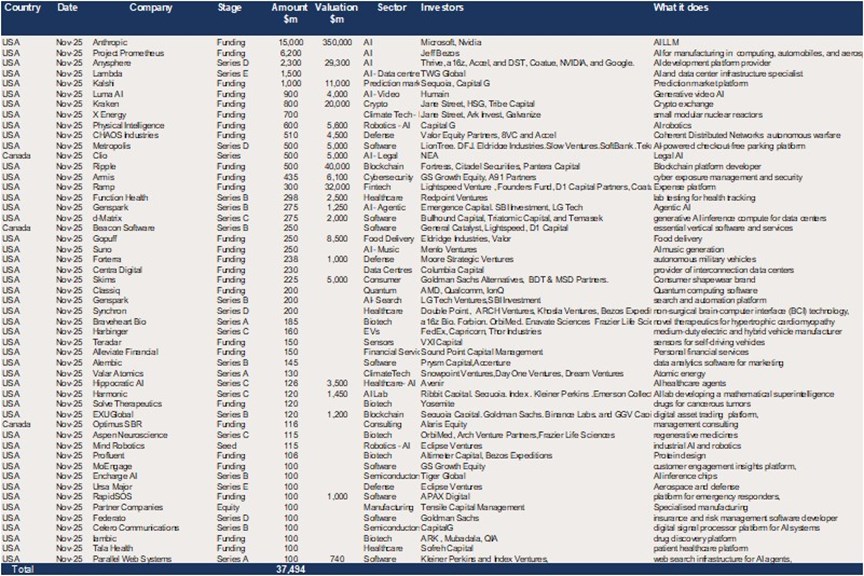
USA (and Canada) – 51 raises of $100m + in November for a total of $37.5bn
Source: Rothschild & Co
Source: Rothschild & Co
YTD US raises to end November are at $219.8bn, 2.3x the amount raised in growth equity in the first ten months of 2024 and twice the amount raised in the whole of 2024.
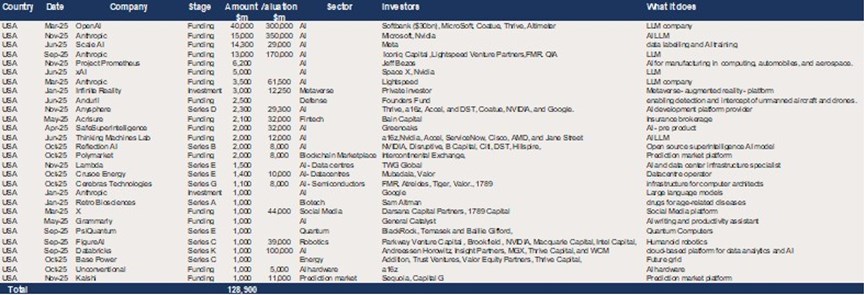
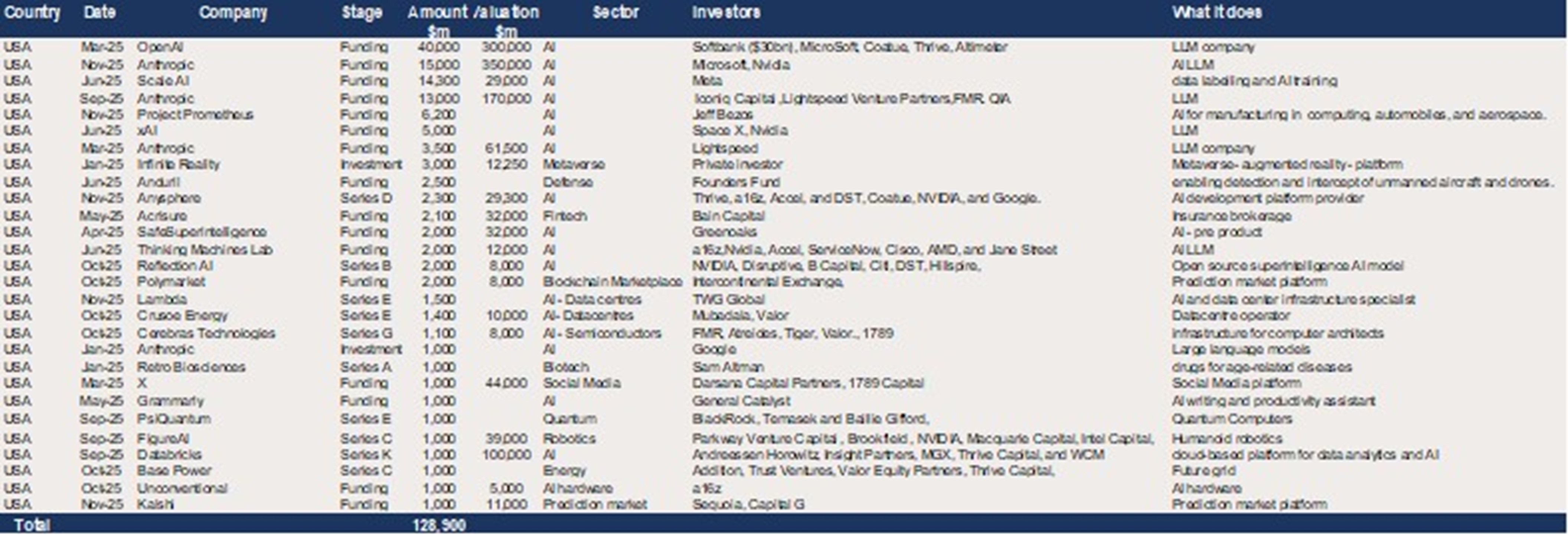
The scale of the dominance of AI deals, particularly amongst larger deals, is demonstrated in the next Exhibit. There have been 28 $1bn plus growth equity raises in the US ytd. Five of these deals were in November. In total the 28 deals have raised $128.9bn. Of these, 18 deals were for AI businesses including all of the top seven, and in total they have raised $112.3bn, 87% of the top twenty total.
US – Top 20 deals in first eleven months of 2025 – Dominated by AI
Source: Rothschild & Co.
Source: Rothschild & Co.
Fundraising outlook: $37bn of potential raises
The pipeline of impending raises remains robust
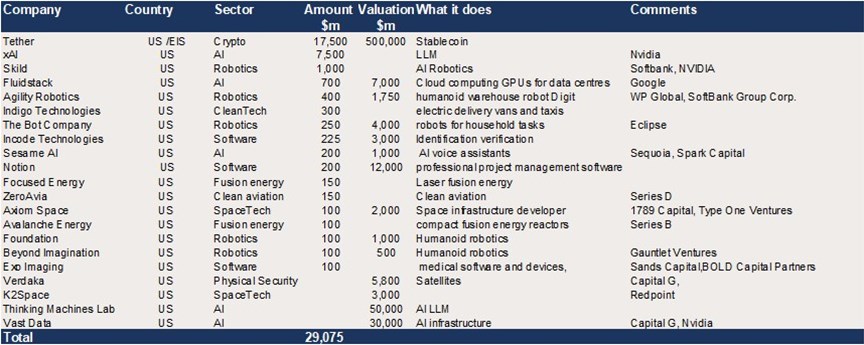
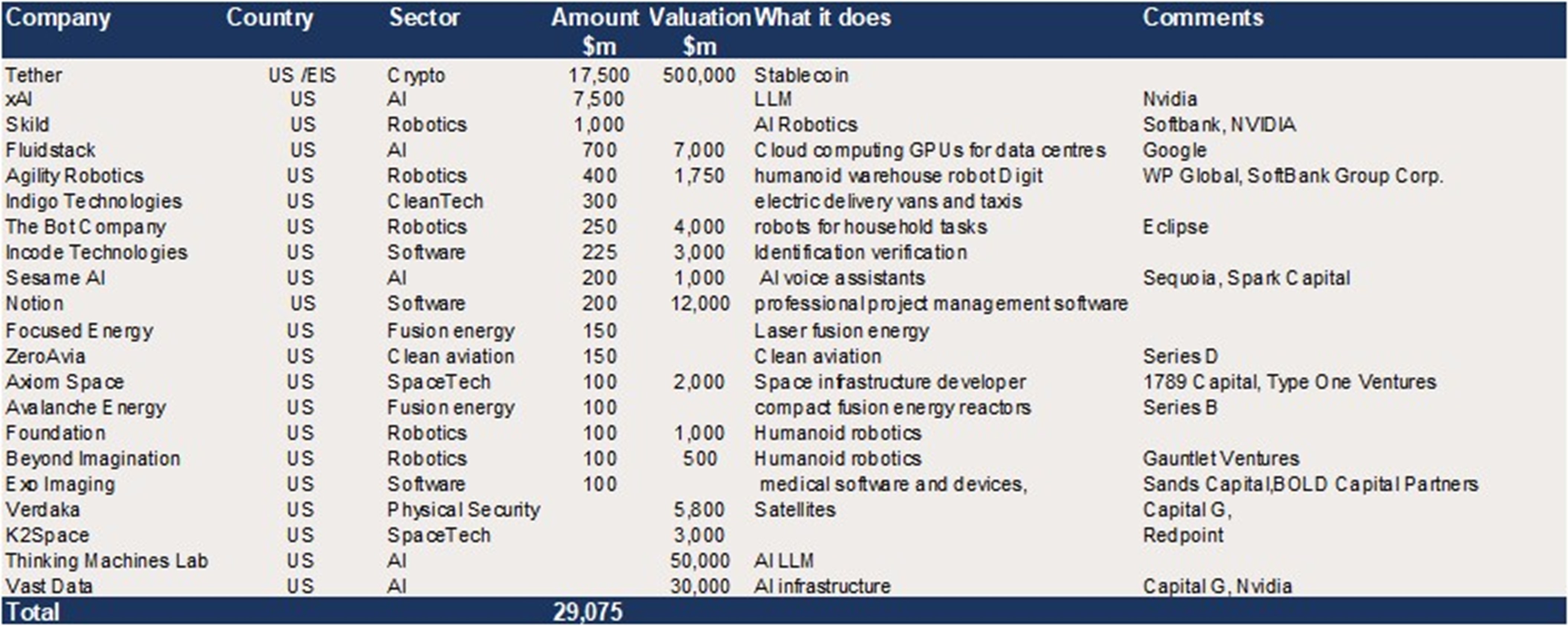
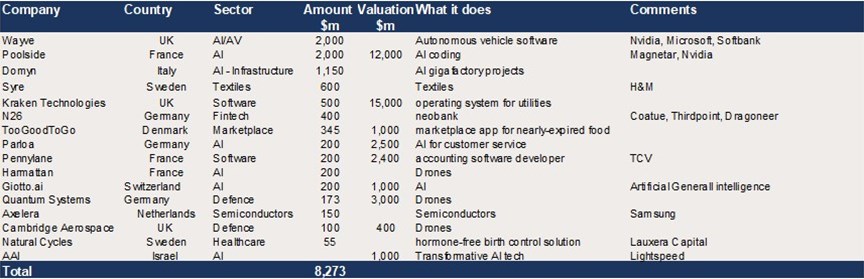
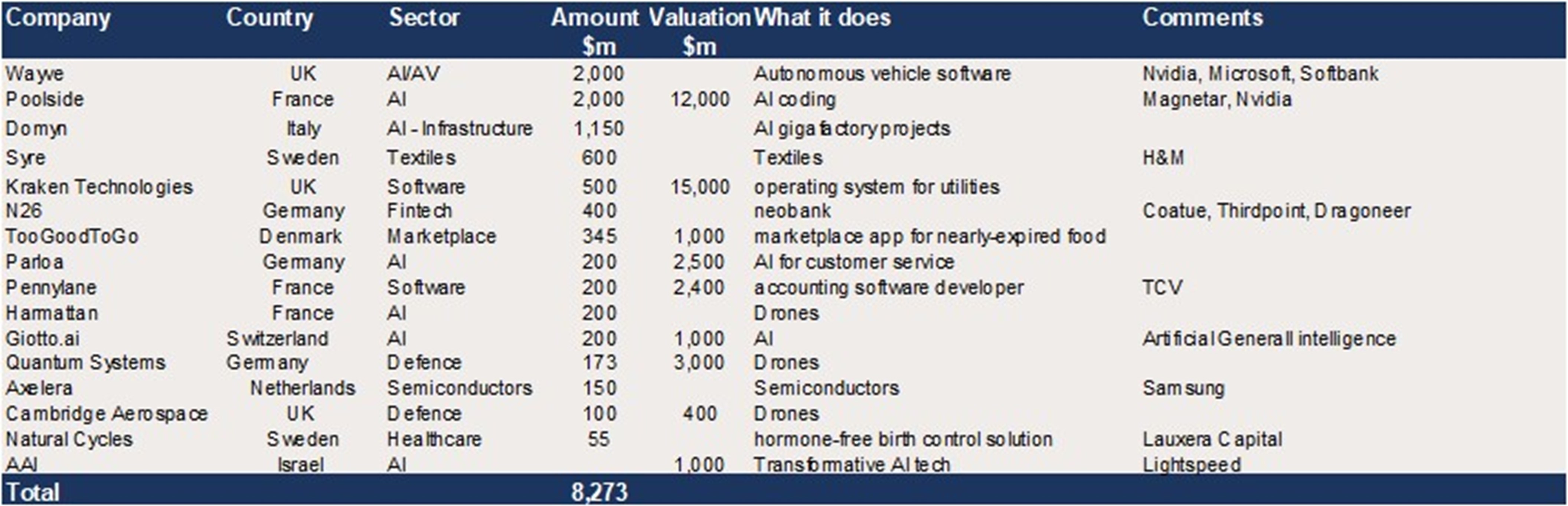
Our Deal Monitor of impending raises continues to look healthy. We identify c$29bn of impending US deals and $8bn in Europe.
Lambda ($1.5bn), Luma AI ($900m), Kraken ($800m), Physical Intelligence ($600m), Castellion ($350m) and Suno AI ($250m) have moved off the US list in the last month.
Joining the list are Robotics business Skild which is looking to raise $1bn from a combination of Softbank and NVIDIA. AI cloud computing business Fluidstack is looking to raise $700m at a $7bn valuation in a deal led by Google. Incode Technologies an identification verification business is looking for $225m at a $3bn valuation. Professional project management software business Notion is raising $200m at a putative $12bn valuation.
At the top of the US list and emphasising the return of crypto, Tether, the stablecoin issuer, is widely reported to be looking to raise between $15-$20bn for a c3% stake. xAI is pursuing a $20bn raise, this one for $7.5bn of equity plus c$12.5bn of debt.
In Europe Revolut disappears off the list after its c$3bn raise at a $75bn valuation.
The list is now headed by the expected $2bn raise for autonomous vehicles business Wayve, led by Nvidia, Microsoft and Softbank and $2bn for the French AI coding business Poolside led by Magnetar and Nvidia, plus $1.15bn for Italian AI infrastructure business, Domyn. Swedish textile impact business Syre (decarbonising and de-wasting the industry through textile-to-textile recycling) is raising $600m.
Additions to the list this month include a possible $200m raise for German AI for customer service business, Parloa and $200m for French accounting software business Pennylane.
US Growth Equity – c$29bn in reported upcoming raises
Source: Rothschild & Co; press reports
Source: Rothschild & Co; press reports
European Growth Equity – c$8bn in reported upcoming raises
Source: Rothschild & Co
Source: Rothschild & Co
Our views on the state of the venture capital markets
October 12, 2022, marked the low point for the S&P500 on the back of global inflation, rising interest rates, and increased geopolitical risk. It also ended the buoyant market conditions for the venture capital market that saw its activity and valuations peak in late 2021.
October 12, 2025, marked the third anniversary of the bull market that has seen the S&P500 rise by almost 90% and NASDAQ by 120%.
In that period the FTSE Venture Capital Index was up by almost 170% and since June 2025 has been back above its previous 2021 peaks.
This revival of the growth equity market has been led by the US and by a surge of interest in artificial intelligence model providers and for companies using AI to transform a range of underlying industries.
Ast the same time the venture industry has re-adopted strong underlying approaches to investment with companies in most sectors striving to achieve a better balance of growth, profitability and cash flow. The underlying quality of the cohort of VC backed companies has improved.
Our summary of the outlook
- There is substantial interest in venture capital to fund artificial intelligence, both the foundation LLM models and the applications of AI and industries (data centres, semiconductors) supporting the development of AI.
- Outside the AI space the VC market is regaining confidence with the strength of interest in Software being notable and fintech and biotech reviving strongly.
- There is a burgeoning interest in defence industries from investors with both the tense geopolitical political environment, the advances in AI applications and the experience of the combat in Ukraine contributing to investor focus. By contrast, ClimateTech, while still a substantial sector has become less prominent both as a result of some high-profile failures and being less favoured politically in the US under the current administration.
- Fund raising for venture capital firms remains subdued. Fund raising is concentrating into larger, established firms. Overall US VC fundraising was on a rate at H21 2025 to be at near decade lows.
- The speed of the investment process has slowed down since 2021-22. The level of diligence on deals has stepped up. This is true even in the ‘hot’ parts of the market like AI. Outside these areas it is marked – processes take time, downside protection is sought.
- Valuation priorities have shifted with investors having moved away from a pure emphasis on revenue growth and revenue multiples. There is a sharp focus instead on the combination of growth and profitability (or a rapid path to it) and on free cash flow.
Read the previous editions: May 2022, June 2022, June 2022 (2), July 2022, August 2022, Sep 2022, October 2022, November 2022, December 2022, January 2023, February 2023, March 2023, April 2023, May 2023, June 2023, July 2023, August 2023, September 2023, October 2023, November 2023, December 2023, January 2024, February 2024, March 2024, April 2024, May 2024, June 2024, July 2024, August 2024, September 2024, October 2024, November 2024, December 2024, January 2025, February 2025, March 2025, April 2025, May 2025, June 2025, July 2025, August 2025, September 2025, October 2025, November 2025
This document is being provided to the addressed recipients for information only and on a strictly confidential basis. Save as specifically agreed in writing by Rothschild & Co Equity Markets Solutions Limited (“Rothschild & Co”) this document must not be disclosed, copied, reproduced, distributed or passed, in whole or in part, to any other party.
This document does not constitute an offer, inducement or invitation for the sale or purchase of securities, investments or any of the business or assets described in it.
This document has been prepared from publicly available information. This information, which does not purport to be comprehensive, has not been independently verified by us or any other party. The document does not constitute an audit or a due diligence review and should not be construed as such. The information provided should not be relied on for any purpose and should not in any way serve as a substitute for other enquiries and procedures that would (or should) otherwise be undertaken.
No representation or warranty, expressed or implied, is or will be made and, save in the case of fraud, no responsibility or liability is or will be accepted by us, as to or in relation to the accuracy, sufficiency or completeness of this document or the information forming the basis of the document or for any reliance placed on the document by any person whatsoever. No representation or warranty, expressed or implied, is or will be made as to the achievement or reasonableness of, and no reliance should be placed on, any projection, targets, estimates or forecasts and nothing in this document should be relied on as a promise or representation as to the future.
Law or other regulation may restrict the distribution of this document in certain jurisdictions. Accordingly, recipients of this document should inform themselves about and observe all applicable legal and regulatory requirements. This document does not constitute an offer inducement, or invitation to sell or purchase securities or other investments in any jurisdiction. Accordingly, this document does not constitute a Financial Promotion under the Financial Services and Markets Act 2000 (Financial Promotion) Order 2005 or equivalent legislation in other jurisdictions. This document is being distributed on the basis that each person in the United Kingdom to whom it is issued is reasonably believed to be such a person as is described in Article 19 (Investment professionals) or Article 49 (High net worth companies, unincorporated associations etc.) of the Financial Services and Markets Act 2000 (Financial Promotion) Order 2005 or is a person to whom this document may otherwise lawfully be distributed. In other jurisdictions, this document is being distributed on the basis that each person to whom it is issued is reasonably believed to be a Professional Investor as defined under the local regulatory framework. Persons who do not fall within such descriptions may not act upon the information contained in this document.