CIO Lens: 7 August - Reciprocal tariff day
The US has followed through with its latest tariff offensive, introducing a raft of new import duties on trading partners, and marking an end to the extended Liberation Day pause. While the market response has been relatively muted, more than 90 countries have been directly impacted by the new tariff schedule. Notably, a higher 15- 50% levy has been imposed on those countries where the US has a significant trade deficit or where they perceived to engage in unfair trading practices.
Switzerland hit especially hard
Switzerland finds itself at the top of the US tariff list among Western nations, facing a steep 39% tariff on a broad range of exports (relative to an average effective duty of less than 1% in 2025). According to the Swiss Government1, nearly 60% of Swiss exports to the US are now subject to these duties, though key categories such as pharmaceuticals, semiconductors, consumer electronics, and precious metals, remain temporarily exempt and under review. Compared to other advanced economies with similar trade structures - the EU (15%), UK (10%), and Japan (15%) - Switzerland’s tariff burden stands out as particularly severe. The US Trade Representative’s office has repeatedly criticised Switzerland’s trade regime as rigid and slow to adapt. Areas of contention include:
-
Trade balance: The Trump administration has anchored its tariff policy in bilateral trade balances. Switzerland's strong export performance - particularly in gold - distorts official statistics. Although gold is largely exempt, its high volume inflates Switzerland’s apparent trade surplus.
-
Missed trade alignment: Switzerland declined to join recent US-led bilateral tariff-reduction deals. These were designed to reward countries that opened markets or aligned with US priorities (e.g., digital standards, pharmaceutical pricing reforms, and agricultural protections). Switzerland’s non-participation was seen as a lack of cooperation, grouping it with more protectionist economies.
Sector-Level Exposure
Switzerland’s export-heavy economy is most vulnerable in a few key sectors:
-
Watches: With CHF 4 billion in annual exports to the US, the watch industry is especially exposed. The 39% tariff directly threatens sales and margins, particularly for brands without US-based production.
-
Machinery & Precision Tools: Worth CHF 3 billion annually, these high-value goods are price-sensitive. Many SMEs face full tariffs and margin pressure due to their Swiss-based production.
-
Medical Technology: While some MedTech products are currently exempt, the sector remains at risk from future tariff extensions and pricing pressure - especially for firms lacking local manufacturing or partnerships.
-
Pharmaceuticals:Switzerland’s largest export category remains exempt, for now. However, the US has issued warnings. In July 2025, 17 major healthcare companies - including Novartis and Roche - were told to lower drug prices for US consumers or face retaliatory measures. These could include revoking exemptions and applying “most-favoured-nation” pricing rules.
Analysts suggest large firms may prefer absorbing tariff costs over restructuring global pricing, viewing tariffs as the lesser evil. Across all sectors, the full 39% tariff applies to companies that do not manufacture or assemble in the US - particularly specialised exporters and family-owned businesses. In contrast, multinationals with local production or joint ventures are better equipped to mitigate the impact. Additionally, US tariffs are imposed on the final product as it crosses the border, based on its classification, not on the origin of individual parts. If a product undergoes “substantial transformation” in a third country - meaning its essential character changes - the new country becomes the official origin for customs purposes. This limits the tariff impact on Swiss firms that use international production chains.
The impact on our portfolios is relatively contained
Market reaction to the tariffs has been relatively sanguine, with global stocks edging higher over the past week. Swiss equities have also been resilient, reflecting both the exemption of key sectors and the high-quality nature of many listed companies.
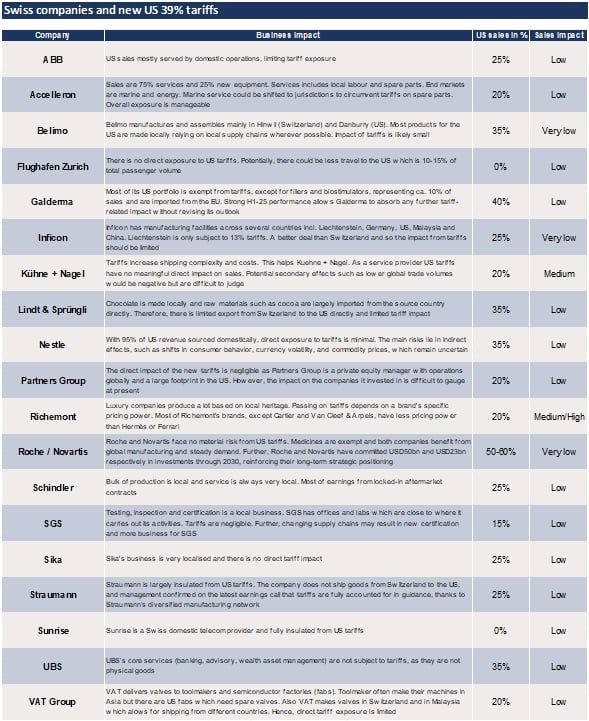
Following a detailed review of our Swiss equity portfolio, we estimate that only around 20% of holdings could face meaningful tariff-related earnings impact. Just 10% appear exposed to supply chain disruptions. This limited exposure reflects our investment philosophy: a focus on high-quality, resilient businesses that play mission-critical roles and command pricing power. Their products typically represent a small share of total customer costs - giving them room to offset tariffs without sacrificing competitiveness.
Graph: The proportion of Swiss equities in non-Swiss-Franc portfolios is very modest
Source: Rothschild & Co, Company reporting
Switzerland’s broader trade response
The US is Switzerland’s second-largest export market after the European Union, with goods worth CHF 65 billion annually - roughly 17% of total exports.2 The Swiss government remains engaged in dialogue with the US, aiming to reduce the scope or duration of these tariffs. Furthermore, the Federal Council is maintaining close contact with affected industries and has signaled potential relief discussions in the coming weeks.
Looking ahead: volatility without visibility?
With no clear timeline for resolution, trade policy remains fluid. Exemptions could change. Agreements may be reached. Diplomatic channels remain open, and a negotiated solution still remains a possibility. For exporters and investors alike, the guidance is clear: stay alert, be flexible, and prepare for possible volatility (even absent revived trade tensions). From an Asset Allocation perspective, we maintain our neutral stance on Swiss equities and regional positioning, and continue to actively wait, as outlined in our previous letter(s)3.
[1] Swiss Government, press release "US tariffs: Federal Council to continue negotiations with the United States"
[2] Swiss Federal Customs Administration (2024). Swiss Foreign Trade Statistics 2023. [Accessed: 08.08.2025].
[3] 7 April 2025, Staying the course
This article is produced by Rothschild & Co Bank AG, Zollikerstrasse 181, 8034 Zurich, for information and marketing purposes only. It does not constitute a personal recommendation, an advice, an offer or an invitation to buy or sell securities or any other banking or investment product. Nothing in this article constitutes legal, accounting or tax advice. Although the information and data herein are obtained from sources believed to be reliable, no representation or warranty, expressed or implied, is or will be made and save in the case of fraud, no responsibility or liability is or will be accepted by Rothschild & Co Bank AG as to or in relation to the fairness, accuracy or completeness of this document or the information forming the basis of this article or for any reliance placed on this article by any person whatsoever.
In particular, no representation or warranty is given as to the achievement or reasonableness of any future projections, targets, estimates or forecasts contained in this articlet. Furthermore, all opinions and data used in this articlet are subject to change without prior notice. Law or other regulation may restrict the distribution of this article in certain jurisdictions. Accordingly, recipients of this article should inform themselves about and observe all applicable legal and regulatory requirements. Neither this article nor any copy thereof may be sent to or taken into the United States or distributed in the United States or to a US person. Rothschild & Co Bank AG is authorised and regulated by the Swiss Financial Market Supervisory Authority FINMA.