Snatching victory from the jaws of defeat
While the US election is far from a foregone conclusion, the UK race is increasingly pointing to a change of leadership within the next twelve months. A general election must be held by the end of January 2025, and an autumn poll is looking very likely.
Talk of ‘oblivion’ for the incumbent Conservative party may be far-fetched, but the opposition party, Labour, has a decisive 25-point lead (and growing) in the polls. Even allowing for the wide margin of polling error and pending constituency boundary changes, it seems unlikely the Tories will snatch victory from the jaws of defeat.
However, setting any personal political sympathies aside, whether such a change of leadership matters to investors is open to debate.
UK opinion polls 2019 - 2024
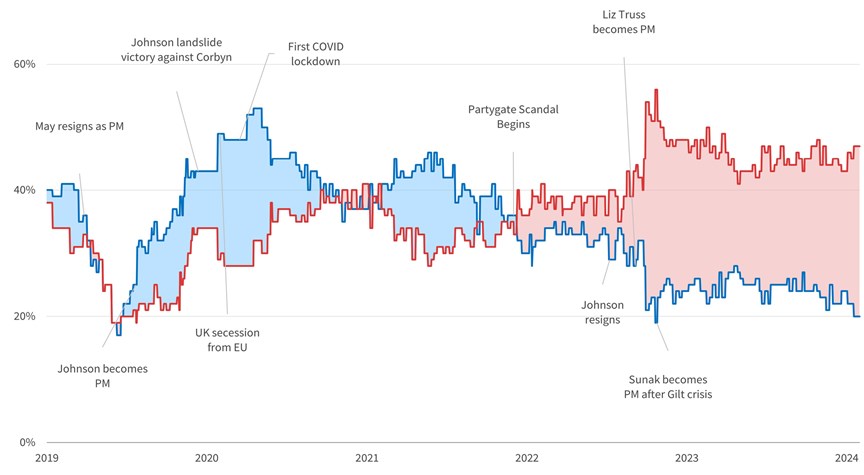
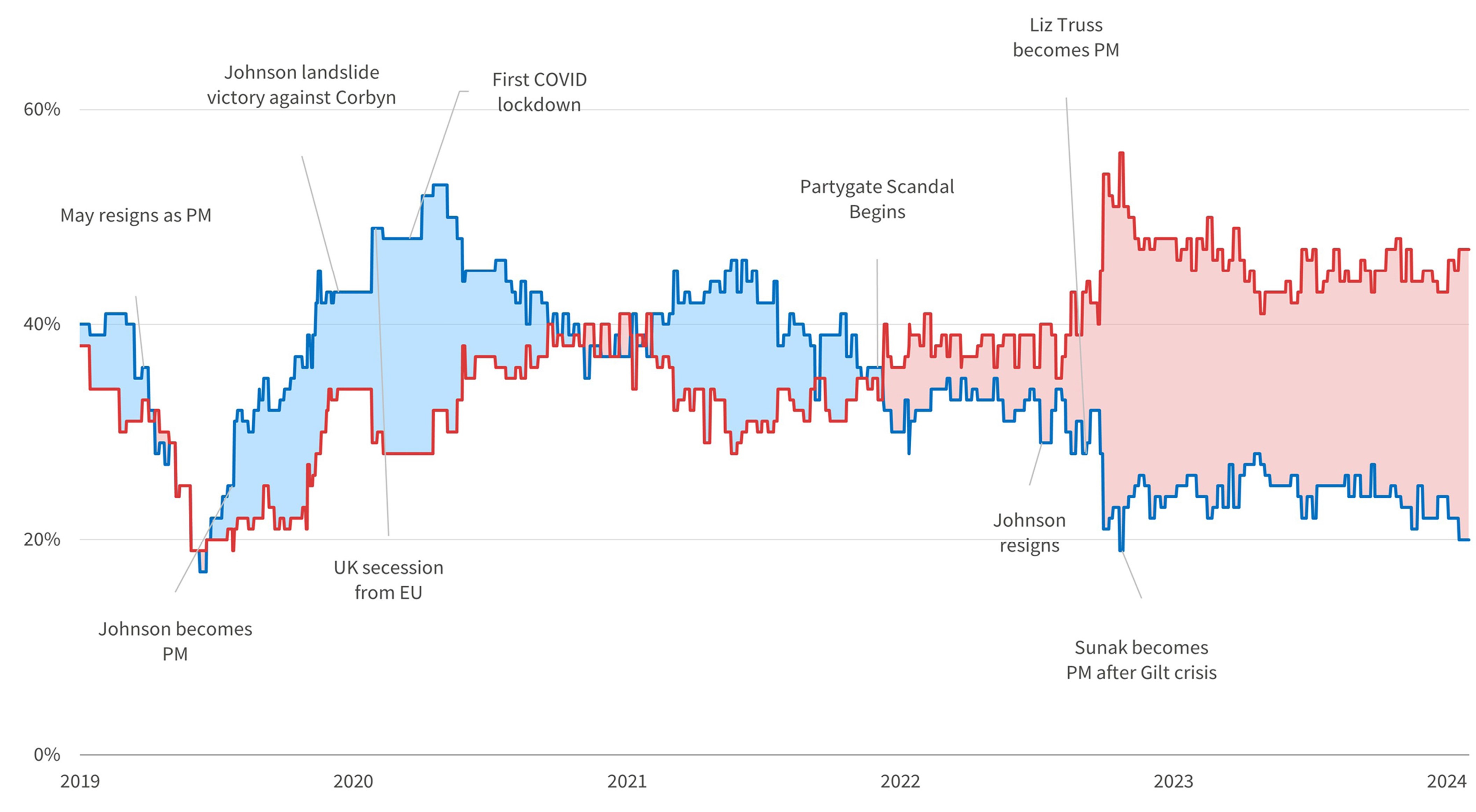
Source: YouGov, Bloomberg
Correct to 29th January 2024
Source: YouGov, Bloomberg
Correct to 29th January 2024
The Conservatives have been in government, mostly alone, for nearly 14 years. It would be too kind to suggest that the party’s fading popularity is simply a case of ‘incumbency fatigue’. Even PM Rishi Sunak’s own popularity ratings are the lowest they have ever been. Such poor approval ratings reflect the numerous policy missteps, high ministerial turnover, and persistent infighting. In the past 6 years, we have seen, among many other changes, four Prime Ministers, five Chancellors of the Exchequer, and a remarkable eleven different housing ministers.
Meanwhile, the opposition party, led by Keir Starmer, has finally shifted towards the centre ground, (“triangulated”, in the pollsters’ jargon), and seems determined to pitch Labour as the party of aspiration, sound governance, and stable finances. This latest iteration is arguably ‘New Labour’ – a Blairite and centrist party – in all but name.
Jeremy Corbyn – Starmer’s firebrand predecessor as recently as 2019 – has been consigned to the history books (at least for now: he has actually been suspended from the Labour Party whip and is likely to stand as an independent). Corbyn’s unreconstructed collectivist agenda – if implemented - could have caused a great deal of investor unease. Readers may recall talk of ‘fat cat’ levies, wealth taxes, the (re)nationalisation of certain industries, re-unionised workforces and more restrictive labour practices. As well as a further increase in the already-large portion of the economy accounted for by an unreformed welfare state.
A Starmer administration is unlikely to be anything like that. Indeed, that’s why he is ahead in the polls. Of course, this is informed speculation only at this point: Labour has yet to publish its manifesto. However, sweeping changes to tax policy seem unlikely. Nor are there big plans afoot to radically increase social spending. This is an opposition party determined – at least on the face of it – to keep the books balanced.
Admittedly, there are still some sectarian policies being mooted: charging VAT on private school fees is perhaps an obvious one. There are also mooted plans to reform the planning system – always a thorny issue. Climate related pledges, however, are conspicuously light on detail at this stage – and one existing pledge, namely, to spend £28bn per annum more on the energy transition, is being steadily watered down and seems likely to be postponed.
Admittedly, some of the wind has been taken out of Labour’s sails by recent Conservative changes, including the decision to raise corporate tax rates from 19% to 25% last year. As it stands, the UK economy’s overall tax burden is the highest it has been in the post-war period, with tax receipts at close to a third of GDP.
Despite the pending noise and grandstanding, this electoral race is unlikely to alter the macro outlook significantly, and interest rates, of course, are outside the government’s control to begin with. Meanwhile, the UK economy has already proved far more resilient in the last year than many (including the Bank of England) anticipated. The government deficit – which appears to be slowly retreating – has given the current Chancellor a little bit of headroom (perhaps enough to consider small pre-election giveaways in the Spring budget). Meanwhile, the UK’s favourable (if under-appreciated) structural characteristics – a growing population, liberal markets, its commercial culture - will remain in place.
Importantly, for investors, interim uncertainty might bring about some currency volatility, but absent a big change to spending and/or taxes – which might have implications for gilts and the domestic stock market – the election may prove to be a relatively uneventful, well-signposted affair. But as a rule of thumb, the business cycle – growth and inflation trends – usually matters more to portfolios than the party of government. And the biggest holdings of most multi-asset portfolios are stocks, not bonds, and these are driven more by the global business cycle than by the domestic one anyway.
It is even possible, though we wouldn’t take this for granted, that UK credibility could improve with a new occupant of No 10 and a different party in government. We wait with not-so-bated breath.
Sind Sie bereit, Ihre Reise mit uns zu beginnen?
Sprechen Sie mit einem Kundenberater in Grossbritannien oder in der Schweiz.
Past performance is not a guide to future performance and nothing in this article constitutes advice. Although the information and data herein are obtained from sources believed to be reliable, no representation or warranty, expressed or implied, is or will be made and, save in the case of fraud, no responsibility or liability is or will be accepted by Rothschild & Co Wealth Management UK Limited as to or in relation to the fairness, accuracy or completeness of this document or the information forming the basis of this document or for any reliance placed on this document by any person whatsoever. In particular, no representation or warranty is given as to the achievement or reasonableness of any future projections, targets, estimates or forecasts contained in this document. Furthermore, all opinions and data used in this document are subject to change without prior notice.