Growth Equity Update October 2026 - Edition 55
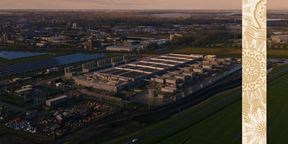
- ‘The Scaleup Europe Fund responds to the urgent need for Europe to boost investments in scaleups and close the gap with global leaders’ says the EU which launched the Scale Up Europe Fund in June 2026 with c€5bn funding. It’s a late-stage and growth fund, investing in promising European companies in strategic tech areas from Series B onward, with investments of c€100m. The aim is to catalyse funding rounds of several hundred € millions and to fill the much-identified funding gap for European companies as they scale up from seed and Series A.
- Off to a strong start. With EQT acting as manager of the fund, Scale Up Europe has already co-led the $3.5bn Mistral Series E, the $450m Series F for Finland’s ICEYE, the $450m Series C of German space business the Exploration Company, Lovable of Sweden’s $400m Series C, and the $100m Series B of Sweden’s Tandem Health.
- Like buses: You wait for ever for a $3bn + European raise and then two come along at once. We reviewed Mistral’s $3.5bn raise last month. This month we look at data centre operator Nscale’s $3.36bn raise which followed a couple of weeks later. Founder Josh Payne observes ‘AI…is leading to the largest infrastructure buildout in human history. Nscale is leading this buildout. We are building this foundation that the market sits on, the engine of superintelligence.’
- Remarkable nine months in US fundraising: Q3 US fundraising of $67.6bn brings the ytd total to $440bn, 2.7x the amount raised at 9m 2025. 71% of the fund raising is in AI. 58% of it is in just six companies – Open AI, Anthropic, xAI, Prometheus, Databricks and Safe Superintelligence.
- Europe strong as well: European saw $28bn of raises in Q3, 2.1x Q3 2025 meaning after nine months the total is $66.9bn,1.9x 2025 at the same stage. The key is the bigger number of $1bn+ deals. At 9m 2025 there were just two $1bn + deals – at 9m 2026 there are twelve. It’s a big step up – across the three years 2023-5 there were just five deals in total of that size.
- Sectors with momentum: On both sides of the Atlantic Defense, ($14.8bn raised ytd in the US, $5.7bn in Europe) is riding the wave of AI derived new technologies, heightened political tension and a renewed emphasis towards defense spending. The allied field of Space ($6.5bn US, $1.2bn in Europe) has grown sharply yoy. AI related sectors – Robotics ($7.7bn, $ 2.3bn) and Semiconductors ($5.85bn, $2.4bn) have good momentum. In Europe the private markets are seeing a strong uplift in Quantum raises ($1.74bn ytd).
Download a PDF version of the 55th Growth Equity Update
Scaling up Europe’s investments
The EU’s new €5bn commercial Scale Up Europe fund run by EQT is off to a strong start with investments in Mistral, Lovable, ICEYE, the Exploration Company and Tandem Health.
In her 2025 State of the Union Address, the EU Commission President Ursula von der Leyen announced the Scale Up Europe Fund as a key initiative aimed at making major investments in fast-growing companies in strategic tech areas, so that "the best of Europe can choose Europe".
The Scale Up Europe Fund emerged into being at the start of June 2026 as a c€5bn fund under the auspices of the European Innovation Council. It is a late-stage and growth fund aimed at investing in the most promising European companies in strategic tech areas. EQT is acting as the manager of the fund. It has highlighted AI, quantum, semiconductors, robotics and autonomous systems, energy, space, biotech, medical, advanced materials, and agritech, as key areas of focus.
The Scaleup Europe fund will directly invest in strategic technology companies from Series B onward, with investments in the range of €100m. The aim is to help catalyse funding rounds of several hundred millions and critically to fill the much-identified funding gap that exists for European companies once they start to scale up from seed and Series A. As the EIC says.
‘The Scaleup Europe Fund responds to the urgent need for Europe to boost investments in scaleups and close the gap with global leaders.’
The European Innovation Council’s Horizon Europe programme will provide €1bn of funding. Alongside the EIC the group of founding investors in the Fund includes Novo Holdings, EIFO (Export and Investment Fund of Denmark), CriteriaCaixa, Santander/Mouro Capital, Fondazione Compagnia San Paolo/ Intesa Sanpaolo/Fondazione Cariplo, APG Asset Management, Wallenberg Investments and Allianz. EQT, which has been chosen to run the fund will also commit a ‘significant’ amount of its own capital to the fund. The initial target for funding was €5bn. The FT reported Per Franzén of EQT saying in early July that investor interest has been ‘beyond what we had anticipated’ leaving the group ‘very, very comfortable about our ability to quickly and efficiently raise at least €5bn.’
One of the aims of the EU Scale Up Fund, perhaps not surprisingly, is to ensure that important technologies remain based in Europe. It will give preference to European exits, as well as maintaining economic security safeguards in the fund’s investment guidelines. The EIC observes
"When implementing investments, the Scaleup Europe Fund will ensure that supported companies retain the majority of their value creation, including intellectual property, within the EU or Horizon Europe associated countries.”
The fund will thus invest across all parts of Europe with its scope covering EU Member States and countries associated with the Pillar III of Horizon Europe. These ‘associated countries’ include non-EU states that have signed association agreements with Horizon Europe, such as Norway, Iceland, Israel, Switzerland and the United Kingdom.
Commenting on the UK, which has not yet committed funding to Scale Up Europe, Keith Sequeira, head of the European Innovation Council has said that up to 5% of the fund's capital can currently be invested in the UK although, subject to negotiation, this amount could eventually become unlimited.
The fund is a commercial entity. The intention is that the fund invests on commercial, merit-based terms with EQT taking investment decisions independently from the Commission and the fund's other investors.
The Scale Up Europe fund, as its name suggests, is a step up from existing EIC activity in stimulating funding for growth companies. Up to now, the EIC's largest equity investments were aimed at early stage and accelerator companies and were capped at €30m. The EIC Accelerator, run by Alter Domus of Luxembourg, remains the EU’s funding entry point for smaller companies.
The Scaleup Europe Fund has got off to a flying start. Having launched at the start of June it has already participated in a number of substantial rounds for emerging European tech businesses.
- Mistral: Alongside Samsung Electronics and PSG Equity the Scaleup Europe Fund was one of the three leads in the biggest European growth equity raise ever, the $3.5bn early September 2026 raise for the French LLM business Mistral, valuing the company at $24bn.
Mistral is offering a full stack alternative likely to appeal to governments and businesses in Europe that are sensitive to sovereignty issues. To accomplish this Mistral is moving beyond the production of LLM models to provide the data centres and infrastructure that a sovereignty offer requires. It has announced substantial plans to develop its own datacentres, focused on France and Sweden. In France Mistral has a 10MW datacentre at Les Ulis due to open by the end of 2026 and is developing a 40MW cluster in France in partnership with the Scaleway arm of Iliad. Mistral signed an agreement earlier this year to invest $1.4bn to build new datacentres with 23MW of computing power in Sweden. Overall Mistral plans to have 200MW of computing capacity available to it in Europe by the end of 2027.
Other investments so far by the fund include: - Lovable: The Scale Up Europe fund co-led with Menlo Ventures the $400m Series C round in Swedish vibe-coding business Lovable announced in August. As EQT pointed out:
‘Europe has no shortage of exceptional founders, breakthrough technology or global ambition. The challenge comes when its most successful companies reach the scale-up stage.
At that point, European companies have historically relied heavily on US growth capital. Global capital is an important part of building global companies, and Lovable's new investor base reflects that. But Europe also needs investors with the scale and ambition to continue backing its best companies as they grow. That's the gap the Scaleup Europe Fund was established to help address.
The objective isn't to keep European companies focused on Europe. It's to give founders greater choice: the ability to remain independent, continue taking risks and build global category leaders while maintaining strong roots in Europe.’ - The Exploration Company: Scale Up Europe co-led the $450m Series C by The Exploration Company which operates out of Germany, France, Luxembourg, Spain, and Italy and offers a reusable heavy lift space launcher to compete with SpaceX. The other co-leads were Bessemer and Atomico. It was the largest-ever Series C announced by a European space company and the largest funding round ever secured by an EU-headquartered company led by a female founder and CEO. The Series C will accelerate the development of Storm, Europe’s first reusable high-thrust rocket engine using oxygen and methane as propellants. Storm will provide the propulsion foundation for a future reusable European super-heavy launcher capable of placing up to 40 tons into low Earth orbit. Alex Ferrara, Partner at Bessemer Venture Partners commented “Space sovereignty is increasingly critical for Europe’s national security, particularly as space becomes the infrastructure layer that the modern economy runs on. Europe cannot rent its way to owning that access”.
- Tandem Health: Sweden’s Tandem Health offers a complete AI Medical Assistant that supports clinicians before, during and after a patient visit. It prepares patient summaries ahead of appointments, provides clinical decision support during the consultation, and automatically handles the documentation, coding and task management that follows. It is used by 10,000 care organisations across 14 European markets. Scale Up Europe led the company’s $100m Series B in September.
- ICEYE: The Scale Up Europe fund co-led the €450m Series F by ICEYE announced in June which valued the business at €10bn. ICEYE, based in Finland, owns and operates the world’s largest synthetic aperture radar satellite constellation. It enables users to monitor activity on Earth continuously and in all weathers with high resolution imagery down to centimetre level in all conditions. Originally focused on civil uses it has a clear capability for defence purposes, and it now provides sovereign space-based reconnaissance and tactical monitoring for national governments and NATO partners. It currently delivers end-to-end sovereign systems for seven European governments.
The Nscale $3.36bn raise
Nscale’s $3.36bn raise at the start of September is the second largest in the history of European growth equity, behind only Mistral’s $3.5bn raise in the same month.
Nscale raises $3.36bn: September was a remarkable month for European growth equity fundraising. The month started with the largest European growth equity raise ever, the $3.5bn Series D by Mistral valuing the company at $13.9bn. We covered this in September’s Growth Equity Update. Hot on its heels came the announcement of Europe’s second largest growth equity raise, the $3.36bn convertible loan note round for the UK data centre company, Nscale.
Nscale describes itself as the ‘engine of superintelligence’ with ‘full stack infrastructure powering the world’s most powerful systems from ground to cloud.’
The business was originally part of a crypto mining company, Arkon Energy founded in Australia in 2019 by the current CEO of Nscale, Josh Payne. The core activities of a crypto mining company – which builds and operates data centres, preferably in areas of low energy cost has obvious cross over with the building blocks of an AI oriented data centre business. Nscale was spun out of Arkon and incorporated in the UK in May 2024.
It raised $30m in seed funding in December 2023 and a year later, in December 2024, raised a $155m Series A led by Sandton Capital Partners with participation from Kestrel 0x1, Blue Sky Capital Managers, and Florence Capital.
Nscale declared that it ‘develops sustainable AI-ready data centres, deploys massive-scale GPU infrastructure, and delivers high-performance AI cloud services. This unique full-stack approach enables Nscale to co-design the data centre and GPU supercluster infrastructure to deliver unrivalled speed, performance, and efficiency on AI workloads.’
The company announced that since May 2024 it had built its pipeline of greenfield data centres across Europe and North America from 300MW to 1.3GW, with 120MW planned for 2025 to support large supercluster deployments for global hyperscalers and LLM platforms.
In early 2025 Nscale announced plans to invest $2.5 billion in the UK’s data centre industry over three years with its first data centre to be sited in Loughton, equipped to support 50 MW of AI and HPC capacity and due to go live in Q4 2026.
In September 2025 Nscale made a number of UK oriented commitments:
- Nscale and Microsoft announced they had entered a commitment to deliver the UK’s largest AI supercomputer on Nscale’s Loughton campus. The site is intended to deliver 50MW of AI capacity, scalable to 90MW, and will initially house 23,040 NVIDIA GB300 GPUs delivered in Q1 2027 to power Microsoft Azure services. A delay to securing a power supply to the site has pushed back its planned launch until after 2030 and led Microsoft to withdrew from its Loughton commitment in October 2026.
- Nscale, OpenAI and NVIDIA established Stargate UK, an infrastructure platform with a focus on sovereign workloads. OpenAI was to ‘explore’ offtake of up to 8,000 NVIDIA GPUs in Q1 2026 with the potential to scale to 31,000 NVIDIA GPUs over time.
- Nscale committed to deploy 4,600 NVIDIA GB300 GPUs in partnership with NVIDIA DGX™ Cloud, including for the DGX Lepton Marketplace, to support AI developers across the country.
In March 2025 Nscale and InfraPartners, a builder of prefabricated AI data centres, announced a partnership to redevelop the existing 30MW data centre in Glomfjord in Norway to create a 60MW AI data centre with the facility set to go live in Q2 2025.
In July 2025 Nscale, Aker and OpenAI pledged to establish Stargate Norway, a 100,000 Nvidia GPU AI gigafactory powered by renewable energy in Narvik in northern Norway. Stargate Norway is designed to provide secure, scalable, infrastructure for sovereign AI workloads across Europe. The facility will deliver 230MW of capacity, with ambitions to expand by an additional 290MW.
In September 2025 the Aker-Nscale joint venture and Microsoft signed a customer agreement with a contract value of approximately $6.2bn, securing Microsoft’s access to AI compute capacity to be delivered in staged deployments beginning in 2026.
A critical part of Nscale’s success is its ability to source key components, in particular Nvidia GPUs. Nvidia has invested over $2bn in Nscale and has a $1.2bn deal to lease capacity from it.
In October 2025 Nscale signed an expanded deal with Microsoft to supply approximately 200,000 Nvidia GB300 GPUs. Nscale will deliver approximately 104,000 NVIDIA GB300 GPUs to be deployed in a ~240MW hyperscale AI campus in Texas, supporting the phased delivery of NVIDIA AI infrastructure services to Microsoft from Q3 2026. The site is leased from Ionic Digital with Nscale planning to scale its footprint to 1.2GW over time. Microsoft holds an option on a second phase of 700MW starting in late 2027.
It was announced in the same month that Nscale would deploy 12,6300 Blackwell Ultra GPUs at the SIN01 Data Centre in Sines, Portugal owned by Start Campus. Using this capacity Nscale will deliver NVIDIA AI infrastructure services to Microsoft while providing European customers with sovereign AI solutions within the EU.
In April 2026 Nscale expanded its agreement with Microsoft adding 30,000 Vera Rubin GPUs to the 230 MW Narvik campus. In May 2026 it announced the deployment of 66,000+ NVIDIA Rubin GPUs, starting in late 2027 at the Start Campus in Portugal. In total the value of contracts signed with Microsoft is reported to be c$44bn.
In November 2025 Nscale announced a planned 16MW facility in Iceland in partnership with Verne deploying 4,600 NVIDIA Blackwell Ultra GPUs.
Financing – Series B and beyond: In September 2025 Nscale raised what it dubbed the largest Series B in European history, a $1.1bn raise led by Aker ASA and supported by existing shareholders, including Sandton Capital, Blue Owl Managed Funds, Dell, FMR, G Squared, Nokia, Nvidia, Point72 and T.Capital. Aker led the round with $285m of funding and payment in kind, a portion of its Narvik land portfolio in northern Norway. Aker received a 9.3% stake in Nscale whose implied valuation was c$3bn.
The company indicated it would use the proceeds to accelerate its deployment of large-scale AI infrastructure across Europe, North America and the Middle East, enabling the rapid rollout of the company’s AI factory, data centres for projects like Stargate UK and Stargate Norway, and the expansion of its vertically integrated AI cloud platform.
The Series B was followed a month later with a $433m pre–Series C SAFE offering. A SAFE is a financing contract in which an investor supplies capital immediately in exchange for the right to receive company shares later, usually after another financing round or IPO. The raise was backed by Blue Owl Managed Funds, Dell, Nvidia and Nokia, along with some of the Series B and new investors.
Using GPUs as collateral, Nscale announced a $1.4bn Delayed Draw Term Loan in February 2026 backed by PIMCO, Blue Owl, and LuminArx Capital Management allowing Nscale to use debt for capex spend associated with multiple GPU clusters for customers with executed contracts.
In March 2026 Nscale announced its $2bn Series C valuing the company at $14.6bn. The round was again led by Aker joined by 8090 Industries and supported by Astra Capital Management, Citadel, Dell, Jane Street, Lenovo, Linden Advisors, Nokia, Nvidia, and Point72. The $2bn included the proceeds from the $433m SAFE – making it $1.56bn of fresh funds. Alongside the fund raise Sheryl Sandberg —former Chief Operating Officer of Meta, Susan Decker former President of Yahoo, Inc and Nick Clegg former UK Deputy Prime Minister joined the board of the company.
With the Series C Nscale announced that the Aker Nscale joint venture would move to being fully under the control of Nscale. In March 2026 Nscale announced the acquisition of American Power and Intelligence Corporation including a 2,250 acre site in Mason County, West Virginia known as the Monarch AI site. Nscale signed a letter of intent with Microsoft to provide 1.35 gigawatts of AI compute capacity at the Monarch campus deploying Nvidia Vera Rubin NVL72 GPUs, although a full contract has not yet been confirmed. Nscale has estimated the Monarch campus will cost $70bn to build and equip fully. Anthropic is reported to have signed a deal to rent 460MW of capacity at the Monarch site worth c$45bn over six years.
The Nscale expansion involves substantial capital commitments. The company is making additional investment of €230m in shared infrastructure and €465m in a second 200MW building at the SINES Data Campus.
In May 2026 it received $790m of bank financing to fund a 115MW expansion of the Narvik AI data centre. A $900m RCF followed in July 2026 to provide flexible liquidity to accelerate its AI data center build-out and capital deployment across the US, Europe, and APAC.
Nscale has signed $3bn in loan facilities to support its 200MW Ward County, Texas campus and its 40MW Madison, North Carolina site.
As a result, at the start of October 2026 Nscale was able to announce that it now has over 50,000 GPUs in operation powering production workloads across six active data centres in five countries
This was the precursor to the announcement of the $3.36bn raise via convertible loan notes made up of an initial $2.36bn tranche and a $1bn commitment from Nvidia. The loan notes are convertible into ordinary shares (non-voting in the case of Nvidia) automatically upon completion of an IPO by Nscale.
The round was led by Third Point and supported by Nvidia, Apollo, Citadel, Hudson Bay Capital, Abu Dhabi Investment Council, and 8090 Industries. Other investors participating included Davidson Kempner, Qube Research & Technologies (QRT), Context Capital Management, Longaeva Partners, Wellington, Castleknight, Ghisallo Capital, LionTree, L.P., Javelin Venture Partners, and Irving Investors.
According to press reports (FT September 18, 2026) Nscale had 55MW of active computing power operating at the end of August, consisting of 7MW in its own data centres and 48MW running in rented data centre space. These are supplying contracts worth $2.6bn. It has a further 1.3GW of capacity in the pipeline to fulfil a further $101bn of contracts not yet started. Actual revenues were $33m in 2025, 73% of which were from a single customer. In H1 2026 revenues jumped to $141m.
As CEO Josh Payne commented at the time of the Series C raise
‘Over the next 5 years, Artificial Intelligence will be integrated into every industry, every product, and every job. … This is leading to the largest infrastructure buildout in human history. Nscale is leading this buildout. We are building this foundation that the market sits on, the engine of superintelligence.’
Remarkable nine months in US fundraising
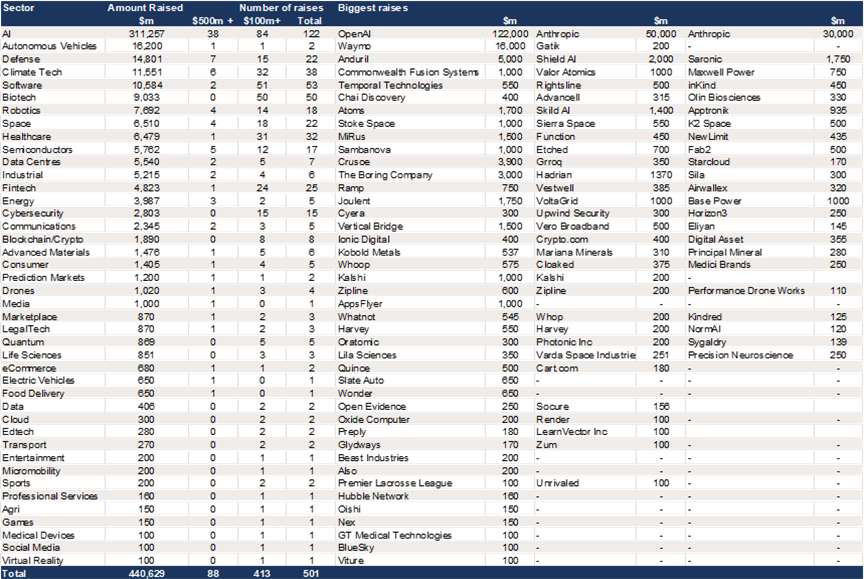
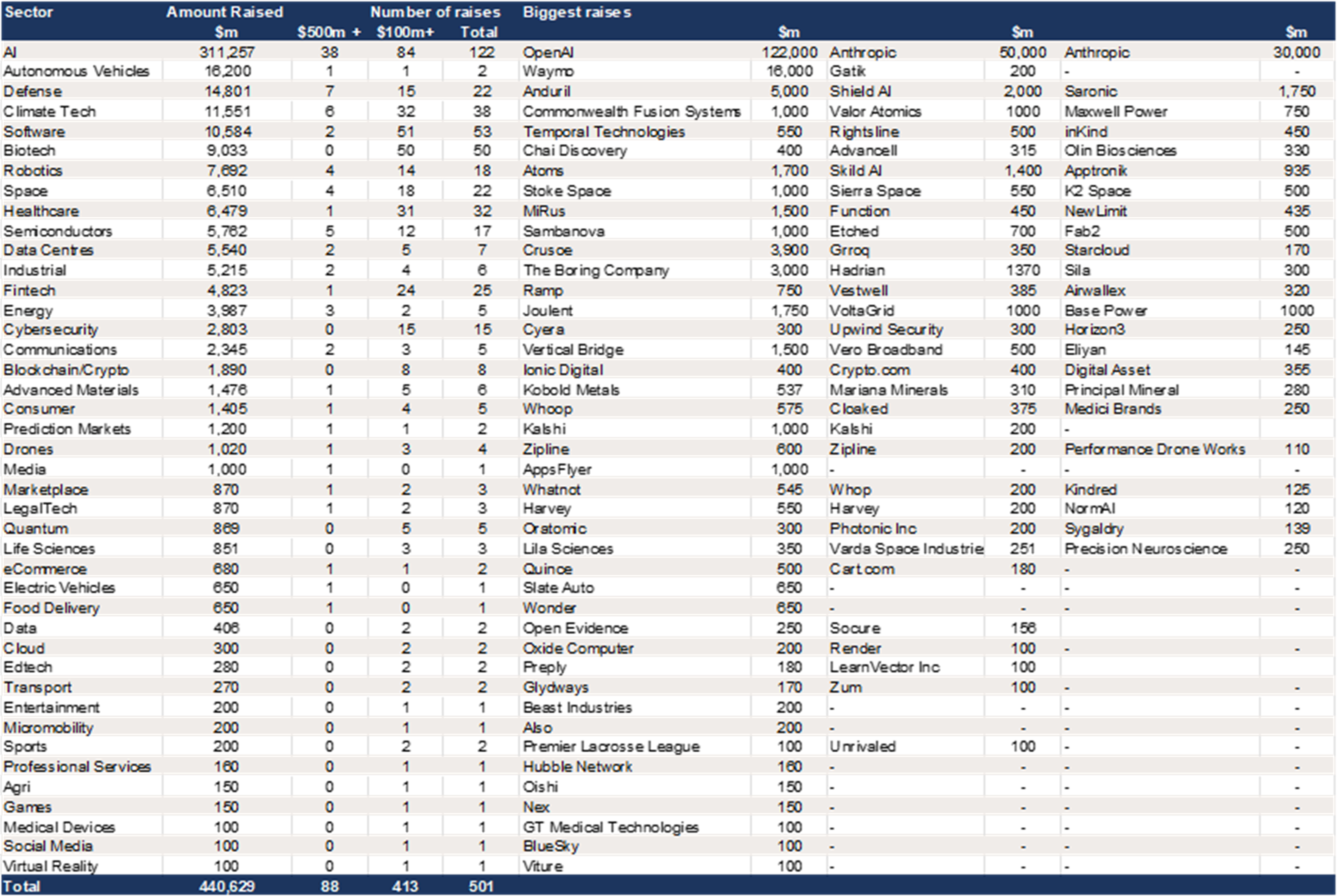
Q3 fundraising of $67.6bn brings the ytd total to $440bn, 2.7x the amount raised in the same period in 2025. 71% of the fund raising is in AI. 58% of it is in just six companies – Open AI, Anthropic, xAI, Prometheus, Databricks and Safe Superintelligence.
It has been a remarkable first nine months of 2026 for US growth fundraising with $440bn raised across just over 500 deals of $100m or more. The amount raised is more 2.7x the 9m 2025 total of $161bn and more than 7x the $62bn total for 9m 2024. Indeed, the top two fundraisers of the first nine months of 2026 (OpenAI $122bn and Anthropic $80bn) each raised more than the entire US growth equity fundraising of the first nine months of 2025.
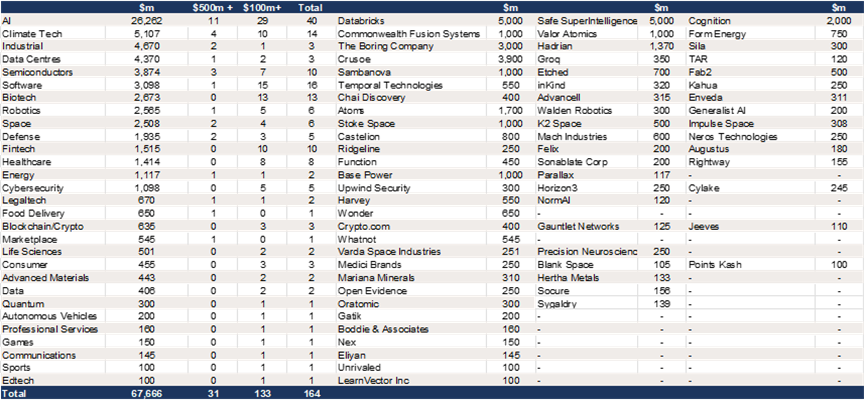
Q3 2026 is the smallest quarter year to date with $67.6bn raised (Q1 was $247bn, Q2 $126bn). Nevertheless, it was still 1.6x bigger than the already buoyant Q3 2025 total of $42.2bn.
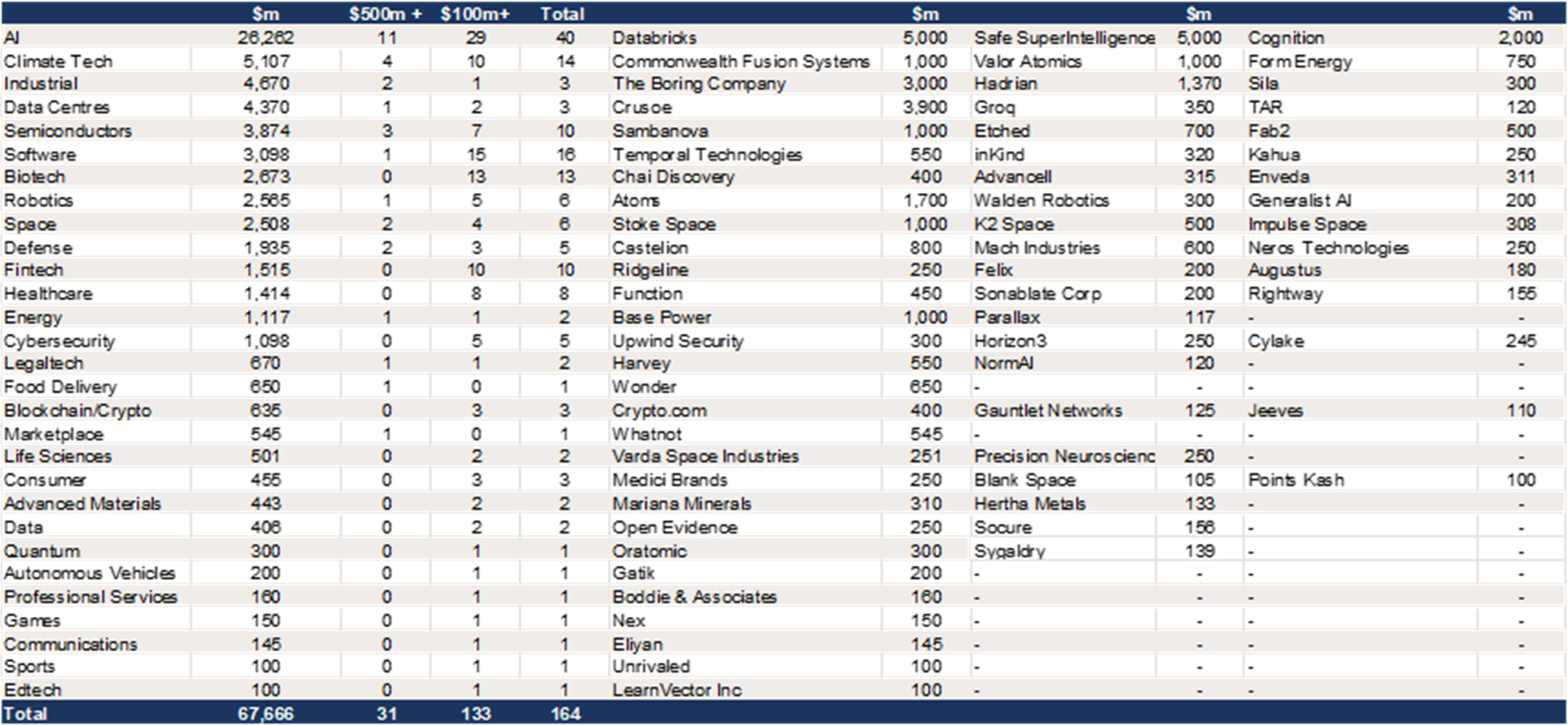
The next Exhibit breaks down year to date fundraising by sector. It is no surprise that AI has dominated fundraising year to date in 2026. AI has seen $311bn raised across 122 deals absorbing 71% of total funds raised in the US.
The big LLMs did their fundraising in the first half with OpenAI, Anthropic, xAI and Prometheus raising $240bn between them. In Q3 they were joined by Safe Superintelligence which raised $5bn. The most notable raises outside this group came from Databricks, the data warehouse and engineering business with a total of $12bn, a $7bn raise in February followed up with a $5bn raise in August.
Together these six companies raised $257bn in the first nine months of the year, 58% of total growth fundraising and 83% of the AI total in the first nine months.
The next largest category is Autonomous Vehicles – a closely related sector to AI – where a $16bn raise by Waymo in February meant that it took 4% of fundraising in the first 9 months.
The standout mover year on year in terms of sector is Defense which is in third position after nine months (sixth in FY2025) with $14.8bn raised (3.4% of the total) with substantial deals from Anduril ($5bn), ShieldAI ($2bn) and Saronic ($1.74bn). Keeping up the momentum in Q3 Castellion raised $800m and Mach Technologies $600m. The sector is riding the wave of AI derived new technologies in drone and battlefield command and control systems, heightened political tension and a shift towards defense spending by countries that had previously thought themselves under a larger shield of US defense assurance.
Perhaps surprisingly Climate Tech remains well positioned in fourth position by sector funding (fifth in 2026). The sector was buoyed by a couple of big deals in Q3. Commonwealth Fusion Systems, which is using revolutionary high temperature superconducting magnets developed in collaboration with MIT to build smaller and lower-cost tokamak fusion systems, raised $1bn in July. Valor Atomics is looking to build small modular nuclear reactors using helium as a coolant instead of water, a method yet to be approved by the US Nuclear Regulatory Commission. These flexible power plants could be used to power AI datacentres, providing an AI link to the Climate Tech revival. It raised $1bn in August.
Despite the vicissitudes of the SaaS Apocalypse, and reflecting the revival of public company software stocks, Software was the fifth biggest fundraiser in the first nine months (albeit down from second place in 2025) with its $10.6bn total representing 2.4% of funds raised. The largest software raise ytd was in Q3 with Temporal Technologies, a software business providing infrastructure to enable AI agents to work reliably, having a $550m Series E in September.
US - $440bn of growth equity raises after 9m of 2026 – 71% in AI
Source: Rothschild & Co
Source: Rothschild & Co
The sectors with noticeable momentum relative to 2025 are:
Robotics moved from 12th position in 2025 to seventh position after nine months of 2026 with the $7.7bn raised easily exceeding the 2025 full year total of $3.8bn. Robotics is a key extension of AI techniques. H1 saw the $1.4bn Series C for SkildAI led by Softbank and NVentures for its ‘omni bodied’ brain to operate any robot for any task. Apptronik raised $935m for its Apollo humanoid robots in a Series A in February backed by Google and Mercedes Benz. The largest robotics raise ytd was though the $1.7bn raise for Atoms led by a16z. Atoms is led by Uber founder Travis Kalanick, incorporates his automated kitchens venture Cloud Kitchens and is expanding into heavy industries like mining and construction.
Space was in 16th position in 2025 with $1.6bn raised. After nine months of 2026 it is in eighth position with $6.5bn raised. There is interest in defence applications with companies like Sierra Space. Civil applications also remain prominent. The biggest raise ytd is the $1bn Series E of Stoke Space which is developing a heavy launcher to rival that of Space X.
Semiconductors, another sector fuelled by AI interest and one that is hot in the public markets as well has climbed from 20th place in fundraising in 2025 to tenth position after nine months of 2026 with $5.85bn raised. Sambanova has developed AI inference chips and racks to support AI models. It raised $1bn in July. Etched which also builds AI inference clusters and which is supplying systems to Jane Street raised $700m at a $21bn valuation in August and is already said to be receiving inbound investor enquiries at twice that valuation.
US - $68bn of growth equity raises Q3 2026 – by sector
Source: Rothschild & Co
Source: Rothschild & Co
Europe – Strengthening through the year
European Growth Equity had a strong Q3 which saw $28bn of raises, 2.1x the level of Q3 2025. This means that after nine months the total has risen to $66.9bn,1.9x the level of 2025 at the same stage. By volume there were 500 deals of $20m or more in 9m 2026 versus 472 in the same period in 2025. Average volume size has thus increased from $74m to $134m.
The main reason for this is the much bigger number of $1bn+ deals thus far in 2026. After nine months of 2025 there were just two $1bn + deals, a $2bn raise for Mistral and a $1.1bn raise for Nscale, both in September 2025. In the first nine months of 2026 there have been twelve such deals. This is a substantial step up – across the three years 2023-5 there were just five deals in total of that size.
The exhibit shows that six of these deals are AI related. There are three LLMs, the $3.5bn raised for Mistral in September, the $1.1bn for Ineffable Intelligence in April and the $1.03bn for Advanced Machine Intelligence Labs in March. There are two substantial raises for the AI data centre business Nscale, $2bn in March 2026 and a further $3.4bn in September. Isomorphic Labs uses AI models to advance drug discovery – it raised $2.1bn in May.
A couple of the raises are in industries closely aligned with AI. The German humanoid robotics business Neura Robotics raised $1.4bn in June. Autonomous vehicles business Wayve raised $1.5bn in February.
There are a couple of notable Defence raises, both in Germany in July, the $1.8bn Series E for Helsing in July and the $1.2bn Series D for Quantum Systems.
The group is rounded out by one Climate Tech deal, the $1.6bn round to secure the future of Stegra (formerly H2 Green Steel) as part of a restructuring to allow it to complete the construction of its hydrogen-based green steel plant in Boden, Sweden.
Europe – 12 deals of $1bn+ year to date


Source: Rothschild & Co
Source: Rothschild & Co
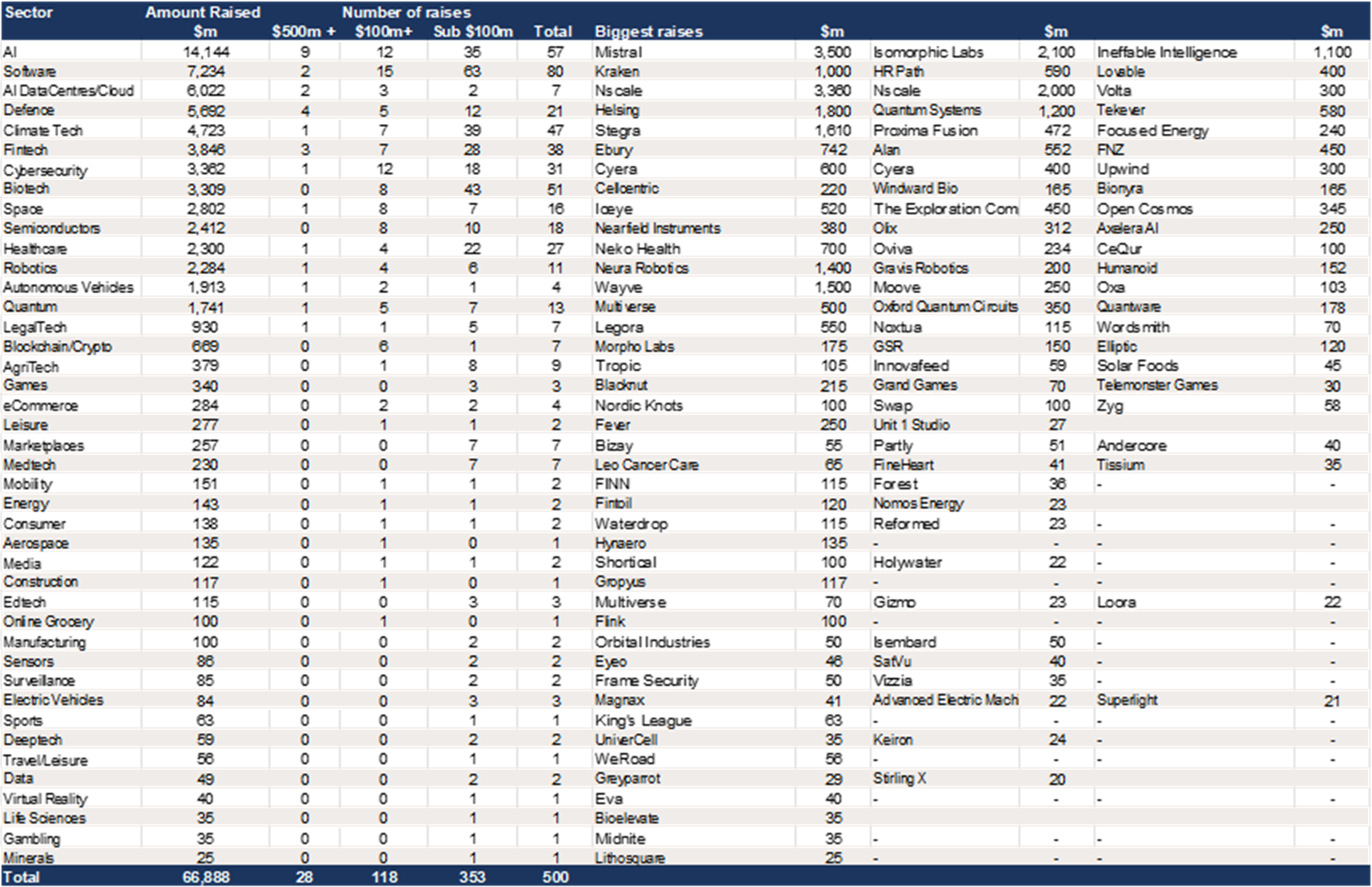
Looking at the breakdown of deals by sector in the first nine months of 2026
- AI leads the way with $14.1bn, 21% of the total raised, boosted by the substantial deals for the three big AI labs, Mistral, Ineffable Intelligence and Advanced Machine Intelligence Labs.
- Software retains a strong second position with $7.2bn raised, 11% of the nine-month total led by Kraken, HR Path and Lovable.
- The two substantial raises for Nscale plus $300m for the emerging Volta pushes Data Centres into the third slot with $6bn, 9% of the total.
- Defence surges up the list. Ninth in FY 2025 with $1.7bn raised it is fourth with $5.7bn raised after nine months of 2026, a testimony to the surge in interest in defence post the JD Vance address at the Munich Security Conference in February 2025.
- The top five is rounded out by Climate Tech with $4.7bn raised, 7% of the total.
There are four sectors with notable momentum
- Space (11th in FY 25 with $1.02bn raised) which has moved to ninth with $2.8bn raised after 9m 2026. There is interest in the civil applications of Space but also increasing interest in the crossover into defence and security applications, as with the ICEYE $520m raise.
- Semiconductors rise from 12th place in 2025 to tenth after 9m of 2026 with $2.4bn raised versus $953m in 2025 – it is a function of the strength seen in the sector on the back of AI applications.
- Robotics, again AI related, rises from 15th place and $684m raised in FY2025 to 12th and $2.3bn after 9m 2026.
- Quantum is seeing accelerating appetite both for developers of quantum computing like Multiverse Computing and Oxford Quantum Circuits and for the applications and tools layers. Ytd Quantum has seen $1.74bn raised, already ahead of the $1.4bn total for the whole of 2025.
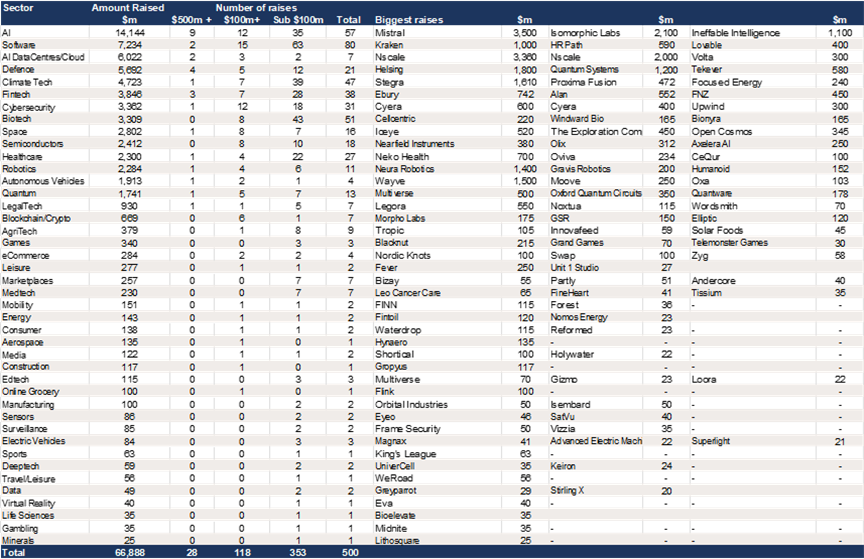
Europe -$67bn raised across 500 deals of $20m or more in first nine months of 2026
Source: Rothschild & Co
Source: Rothschild & Co
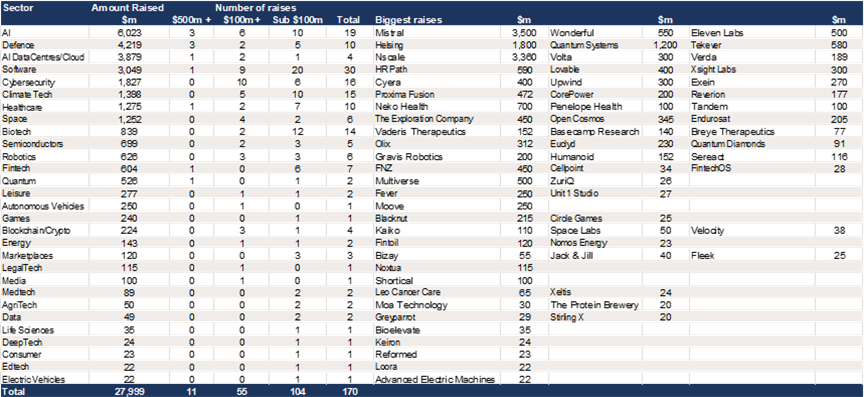
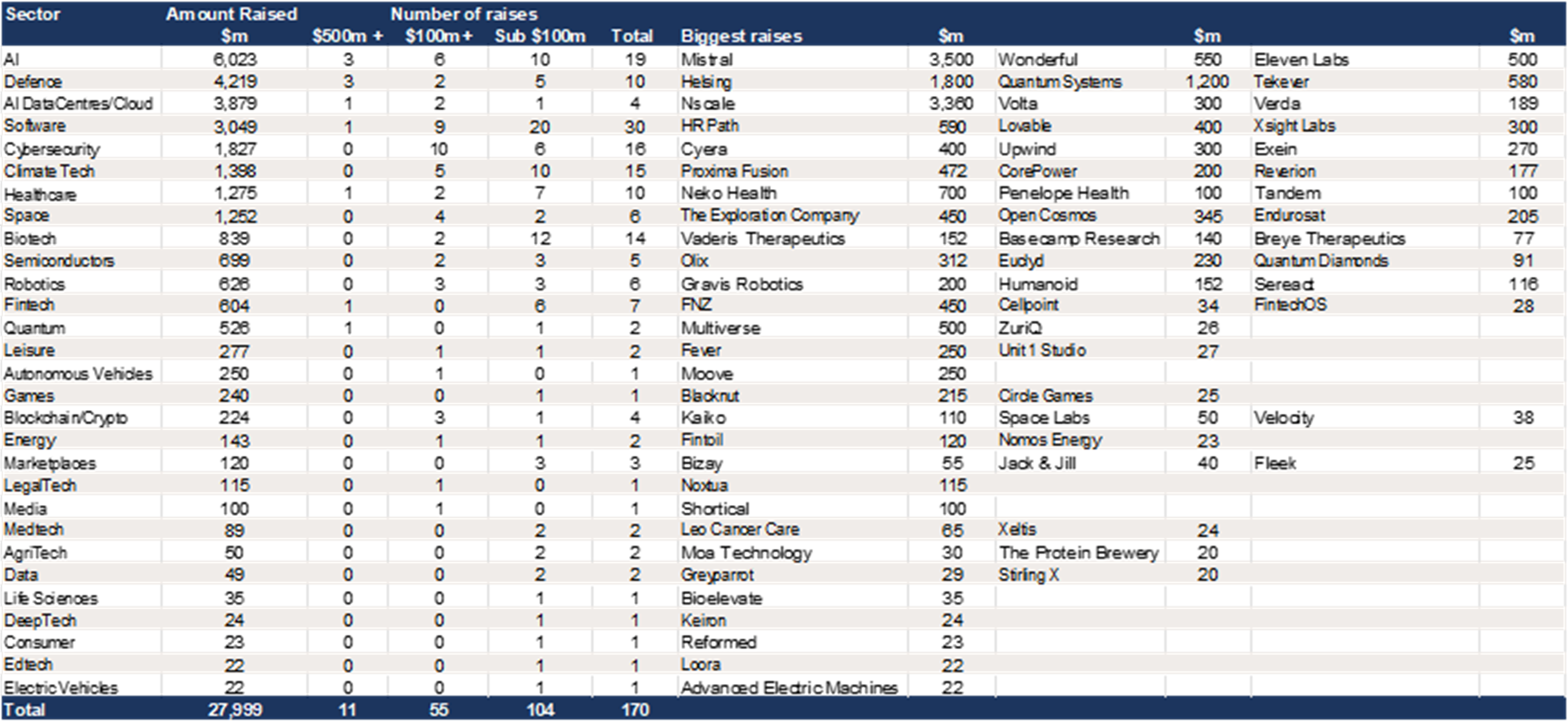
Europe -$28bn raised in Q3 2026
Source: Rothschild & Co
Source: Rothschild & Co
Public markets – "I've been expecting you, Mr. Bond"
The period from the start of September to mid-October (13th, date of writing) saw strong performance in US tech stocks with the SOX semiconductor index up 6%, the Magnificent 7 up 8.5% and the S&P Software index holding its own, up 1%. This rally has come despite mixed news in AI as OpenAI ARR appeared to shrink to c$50bn from c$70bn and appears to be in expectation of a strong Q3 tech earnings season.
Year to date to October 13 this means that NASDAQ is up 17% and the S&P 500 14%. Less tech and more oil exposed the FTSE100, and Euro Stoxx have both retreated in the last six weeks and are now both up just over 7% for the year. Reflecting the strength of tech stocks, the FTSE Venture Capital Index rose 16% in the last six weeks and has finally edged above its start of year levels, up 4% ytd.
At present the markets are weighing up the reality of higher bond yields, uncertainty into the November mid-term elections and the expectation of rising interest rates with anticipation of a strong Q3 earnings season and growing optimism over the outlook for earnings in 2027.
Since the end of August bond markets have been weak, driving US bond yields higher with the yield on ten-year US Treasury bonds up from 4.6% at the start of August and the recent low of 4% at the end of February to 5.2% in mid-October. US bond yields were last this high in 2001 albeit prior to that US 10-year bond yields were consistently above 5.4% from 1967-2001. French and German bond yields are also around their 15-year highs.
There are all sorts of reasons why bond yields have been rising –inflation prospects caused by Iran War led higher oil prices, the prospect of higher US interest rates for longer, the impact of AI businesses and their massive capital needs tightening the market through competition for capital ( SpaceX is currently looking to raise $40bn of loans and bonds to purchase Nvidia chips, Coreweave’s 2032 debt is on a yield of near 15%) and growing sensitivity around high government deficits around the world ( the IMF recently urged ‘major advanced economies with high debt need concrete measures anchored in credible medium-term plans and realistic assumptions. This is essential to put debt on a sustainable path.’).
Rising bond yields should slow corporate profitability and make it harder for equities to outperform. Yet we have seen that even as bond yields have risen the US equity market has performed strongly with the S&P 500 up 1.6% in the last six weeks and NASDAQ up over 3%.
The drivers behind d this relatively sanguine approach from investors are captured by the latest Bank of America global fund Manager survey.
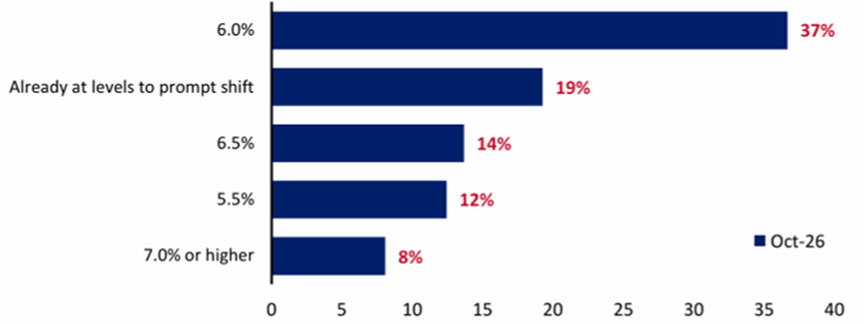
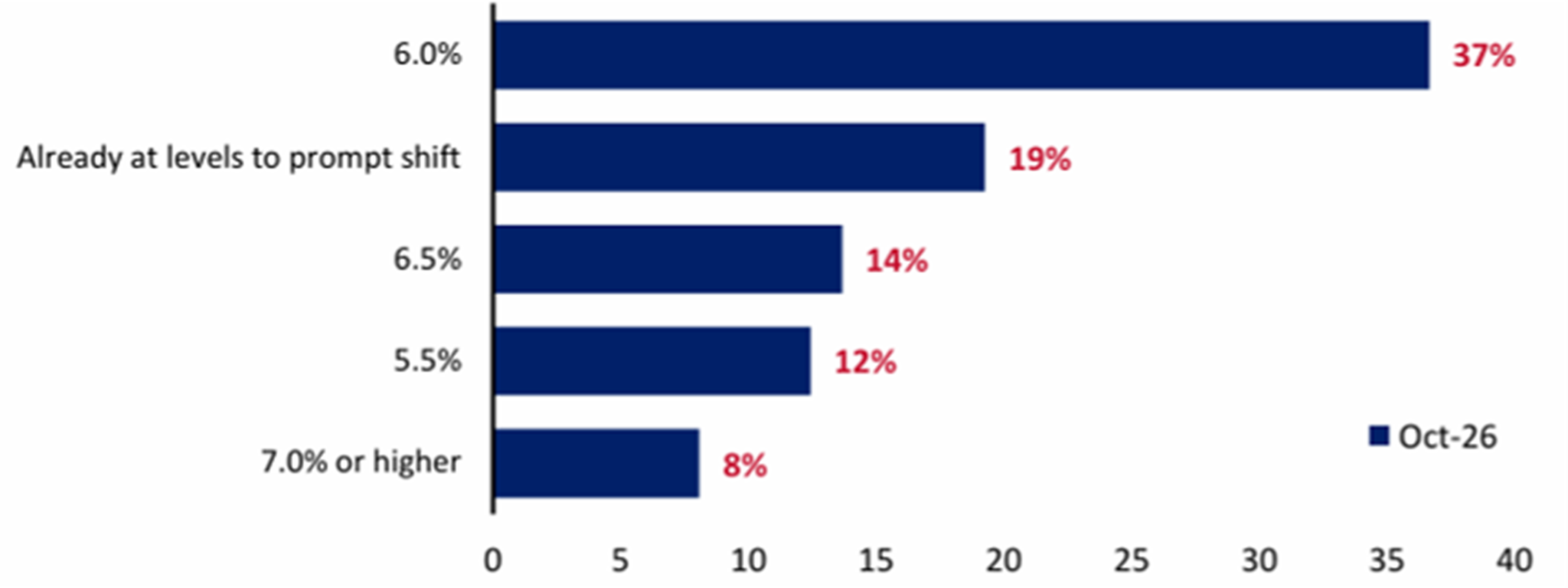
Critically this suggests that fund manager relative optimism on equities can be sustained even with bonds at these and higher levels. Commentators had looked at a 5% US Treasury yield as a potential moment of capitulation for equity investors, but the BoA survey suggest that their tolerance is much higher than that. When surveyed 59% of respondents would need bond yields at 6% or above (37% at 6%, 14% at 6.5%, 8% at 7% or higher) to induce a switch away from equities. Only 19% think the present levels of just above 5% are sufficient to cause such a shift.
Investors think 10 Year Treasuries at 6% would be needed to induce a shift from equities to bonds
At what 10-year Treasury yield would you consider shifting your allocation from stocks to bonds?
Source: BofA Global Fund Manager Survey
Source: BofA Global Fund Manager Survey
Why are investors so confident? A mix of factors.
A key one is that sentiment on the bond market appears to be turning, with an expectation that bond yields will fall from here. In turn this is linked to an expectation that oil prices may fall back to c$80 per barrel. WTI crude topped $100 in mid-September but has fallen back to around $95.
The next Fed meeting is on October 28th. At the previous meeting in mid-September the Fed raised rates by 25bps to 3.75%-4% with Fed Chair Kevin Warsh saying that it was a ‘responsible decision’ reflecting that “inflation is too high and has been for too long.’ Immediately post the decision there was an expectation that interest rates would be held at the next Fed meeting on October 28th and this is the expectation reflected in the responses to the BoA survey.
This rosy picture was then disturbed by the September inflation number, released in mid-October which saw inflation rise to 3.7% against expectations of 3.6% and the August figure of 3.4%. Core inflation rose from 2.4% to 2.6%. It was the first rise in US inflation since May. The market expects no rate rise at the October Fed meeting but by the last meeting of the year – December 9th – only 11% of commentators expect rates still to be at 3.75%-4% with 76% looking for a 25bps rise and 13% for 50bps.
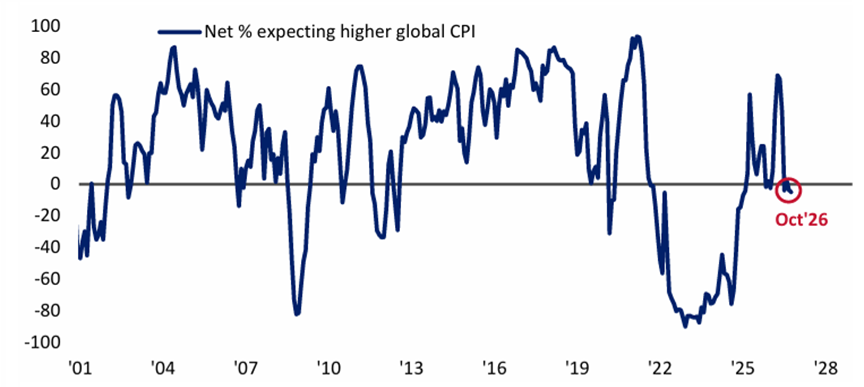
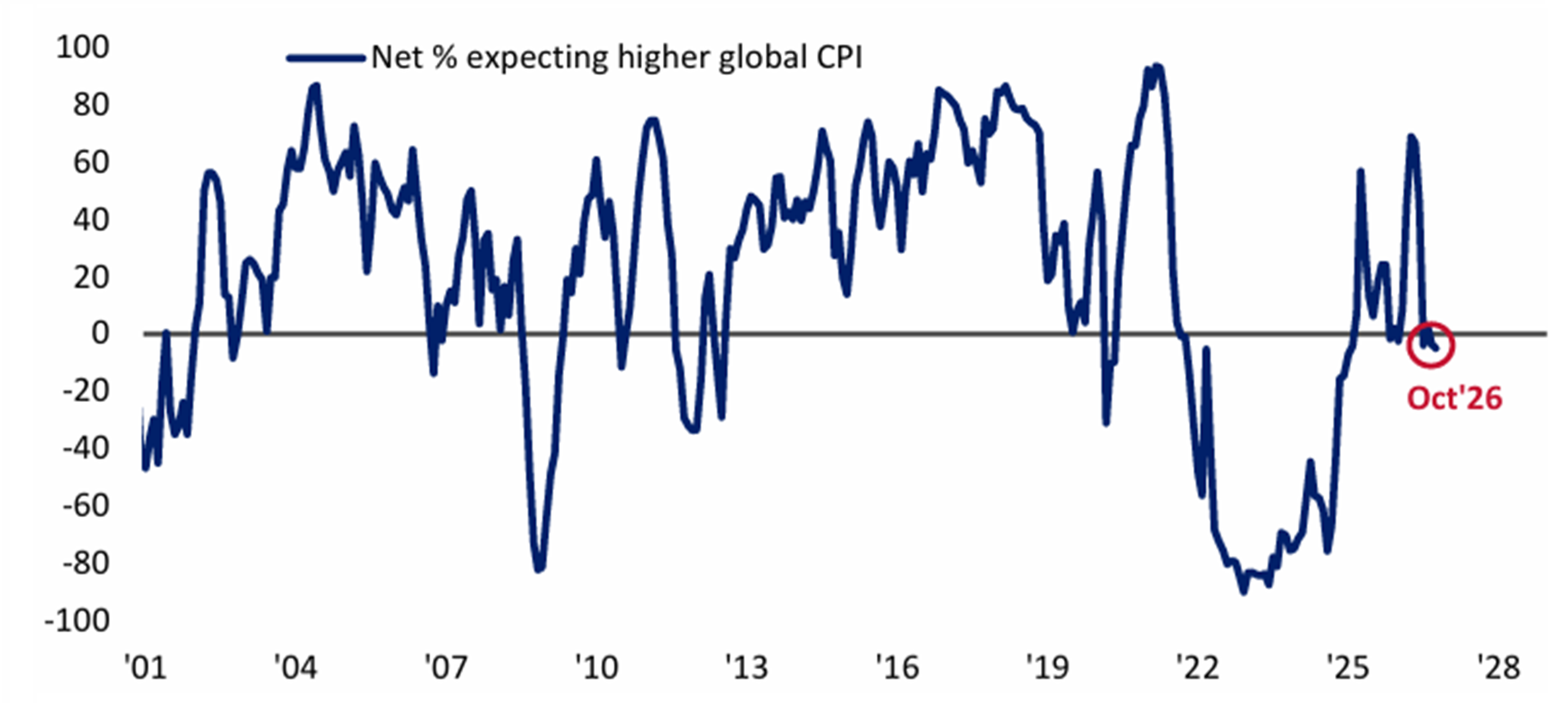
Inflation expectations fall to lowest since January 2025
Source: BofA Global Fund Manager Survey
Source: BofA Global Fund Manager Survey
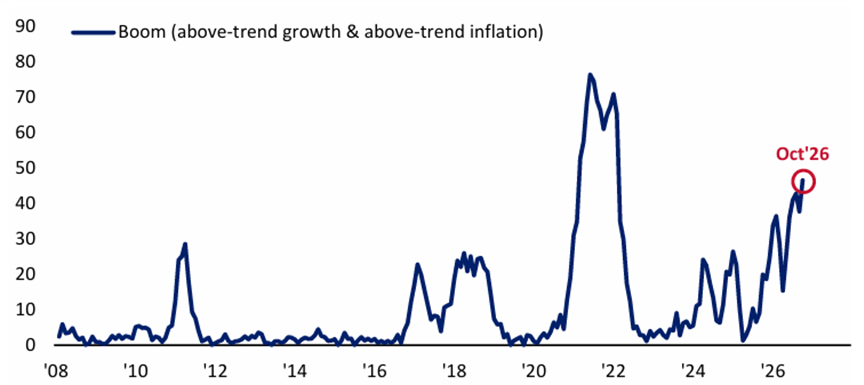
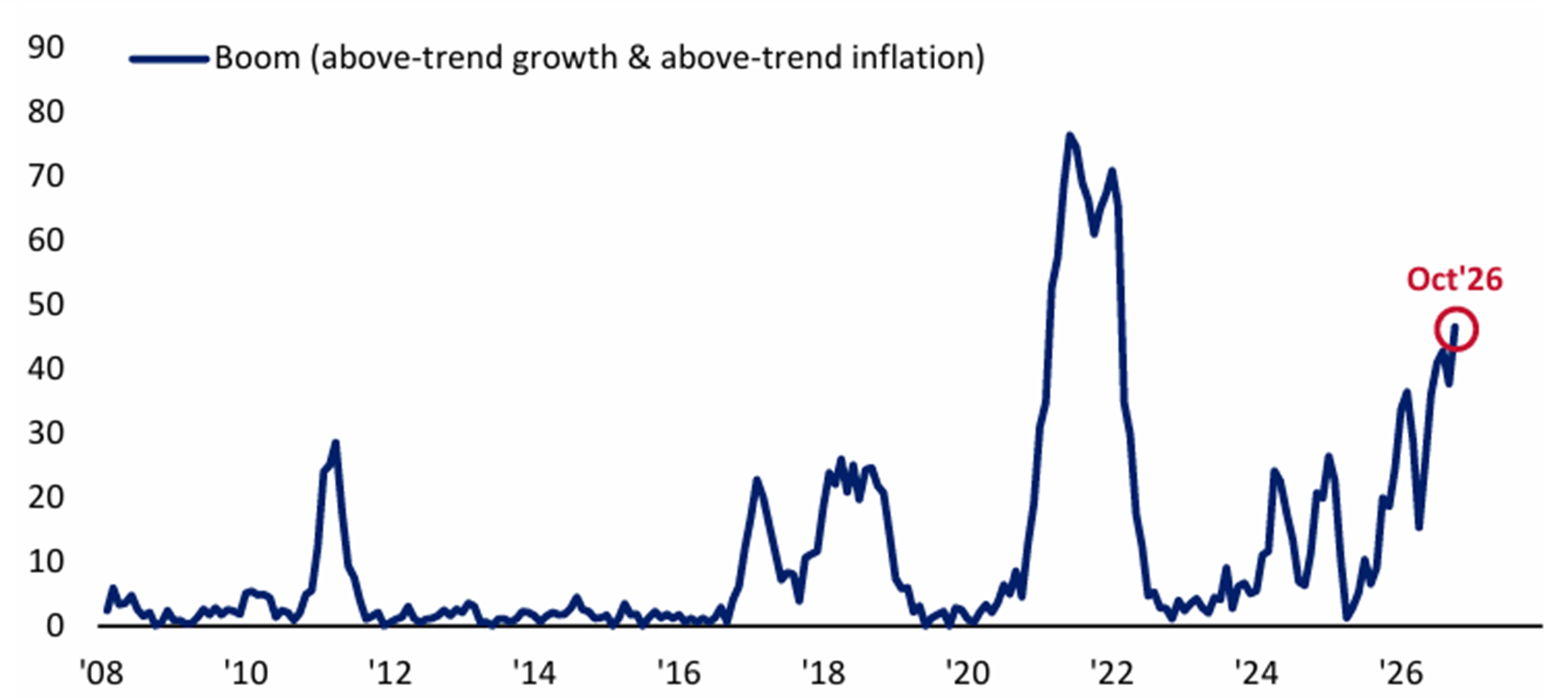
At the same time the bullishness of investors is expressed by the BoA survey ‘boom indicator’ with a net 47% of investors expecting above trend growth and inflation, the highest level since February 2022.
"Boom" expectations highest since Feb'22
Source: BofA Global Fund Manager Survey
Source: BofA Global Fund Manager Survey
Earnings growth in the US is Q3 is expected to hit 29.6% according to FactSet which would be the third straight quarter of more than 25% growth. Growth is expected to be driven by the Energy sector (+120% yoy) and technology (+65%) driven by AI expansion. Significantly the market is positive into next year with 2027 S&P 500 earnings growth currently expected, despite the tough comp, at around 16%-17%. European earnings are expected to grow c20% in 2026 and c9% in 2027.
Meanwhile European inflation accelerated sharply again in September up to 3.8% versus the August read of 3.2% driven by energy inflation, up 18.8% compared with 14.3% in August. It was the highest read since September 2023. Core inflation rose modestly from 2.4% to 2.5%.
The ECB raised rates by 25bps to 2.25% in June, its first-rate increase since August 2023, held at 2.25% in July, but with the renewed energy shock, raised in early September by a further 25bps to 2.5%. The market expects rates to be held in October but for them to rise by 25bps by the end of the year and to hold that 2.75% rate though 2027.
UK inflation was 3.1% in August 2026, the highest in five months, albeit in line with market expectations. It was up from 2.9% in July. Core inflation, which excludes food and energy, held steady at 2.6%.
The Bank of England again held rates steady at 3.75% in September with the vote again 6-3 to leave rates unchanged. The BoE in a change of tone signalled that rates may need to rise as the effects of the Iran War on oil prices persist, the governor Andrew Bailey stating, ‘The longer this volatility persists, the bigger the impact it will have on inflation, and the more likely it is that we will need to raise the bank rate to ensure that inflation falls back to our 2 per cent target.”
There are two more BoE meetings this year, on November 5th and December 17th and the market is firmly expecting a 25bps rise at the first of these and potentially another rise in December.
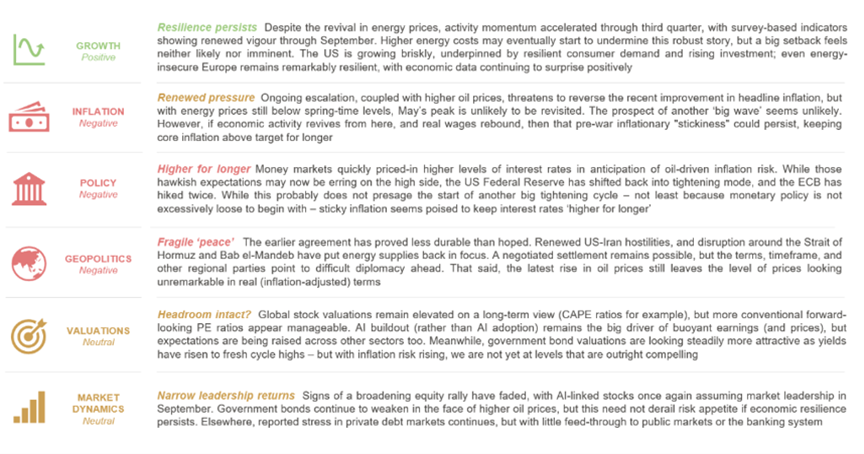
The views of Rothschild & Co’s strategists Kevin Gardiner and Victor Balfour on the current market outlook are summarised in the Exhibit.
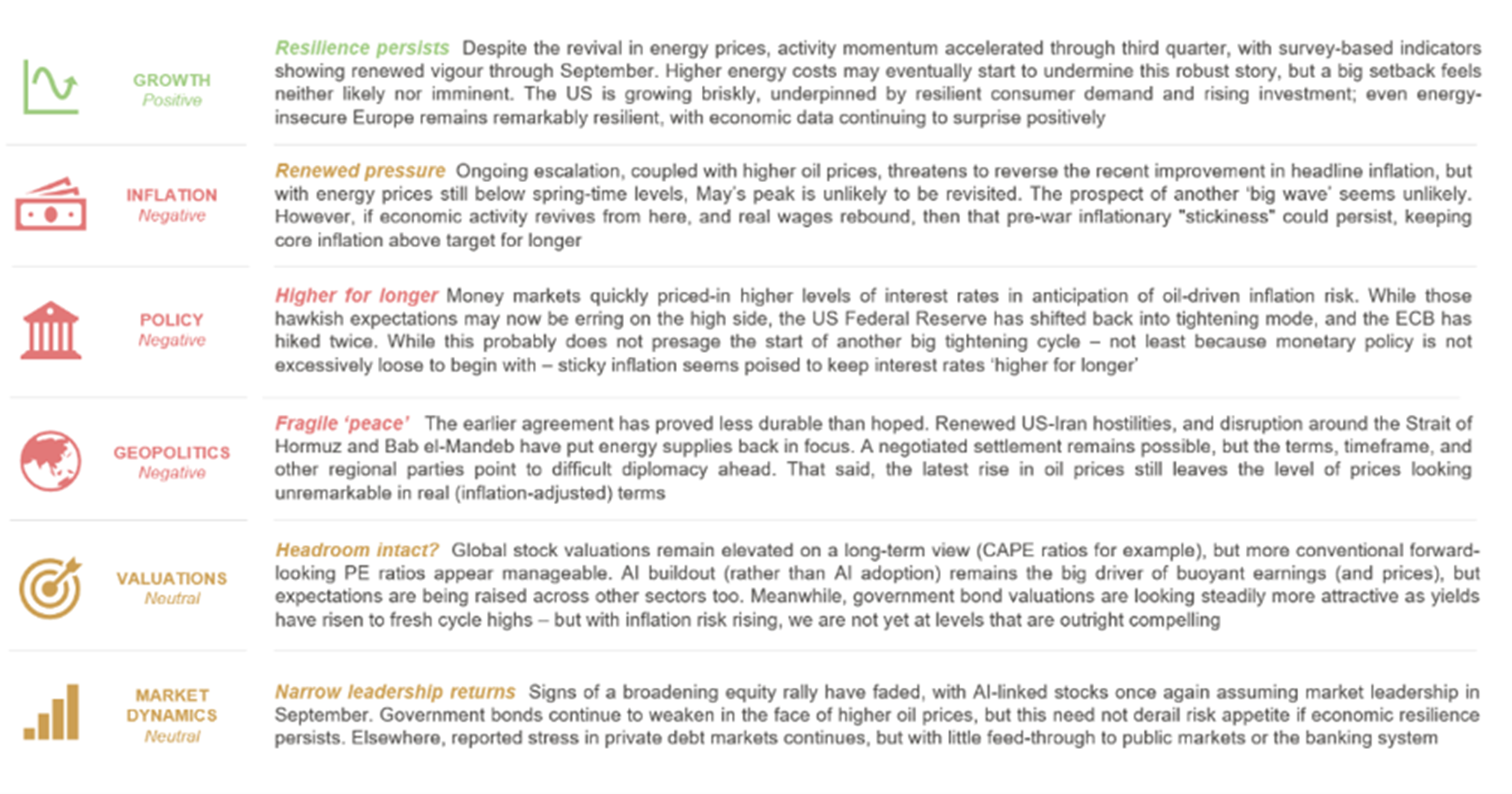
Source: Rothschild & Co
Source: Rothschild & Co
US fundraising in September – Solid
Another $20bn+ month in US growth equity
There were 69 raises of $100m or more in the US in September, by volume the largest month in three years. By value, at $26.7bn, it was only the sixth biggest month of a remarkable year in which $441bn has been raised in the 9 months to end September. The September total was up just 1% yoy. The ytd total is up 2.7x yoy.
AI and related sectors once again dominated with total funds raised of $13.3bn being 50% of the total. There were no super-sized raises although there were four raises of $1bn and above. The largest raise in the month was for the AI datacentre operator Crusoe. Its $3.9bn raise valued the company at $30.9bn and was supported by Atreides, Mubadala, Valor, Founders Fund and, of course, Nvidia. Crusoe comments.
‘With over $140bn in total contracted value across its vertically-integrated platform, the additional capital will help Crusoe scale its existing programs and support the build out of its own AI factories, from large-scale, vertically-integrated campuses to modular Crusoe Spark units, fuelling the rapid growth of Crusoe Cloud. Operating the entire value chain enables Crusoe to serve customers across the AI ecosystem at the speed the market requires and has come to expect from Crusoe’s execution’
So far Crusoe has 1GW of gross capacity delivered and operational. It has 6GW of gross contracted capacity across data centres and cloud.
Cognition raised a $2bn Series E at a $48bn valuation led by Andreessen Horowitz, Accel, Founders Fund, General Catalyst, and Avenir. Its valuation has almost doubled since its last raise a $1bn Series D in May, just four months previously, at a valuation of $25bn.
Cognition is developing Devin, an AI coding agent and software engineer that helps developers build better software faster. The user prompts Devin in natural language and the agent generates a plan and develops the code. Rapid take up means that Cognition is claiming annual run rate revenues of $900m up from $492m in May. Counterpart Cursor had ARR of $2bn when it was bought by Space X for $60bn in April this year. That was a multiple of 30x ARR versus the c53x that has just been paid in the latest Cognition round. The Information reports that the cash burn at Cognition is running at $800m pa, reflecting the size of the Nvidia cluster that it runs. It explains the requirement to raise more cash as well as Nvidia’s presence on Cognition’s cap table.
The General Catalyst Customer Value fund offers non-dilutive financing to start ups. It works by funding sales, marketing and customer acquisition costs for maturer businesses treating the customers acquired as assets and being repaid from the money generated by the specific customer cohorts it has financed. It has appeared occasionally in the ranks of our monthly monitor. Motive provides AI based cameras used for monitoring professional driver performance including phone use, fatigue and distance travelled. The company has around 100,000 customers across trucking, construction, energy, field service, manufacturing, and agriculture and is at $600m of ARR growing 30% pa.
The rise of Instinct has been remarkable. The company has developed an AI powered personal assistant which is designed to manage everyday tasks. In late August it raised $350m at a $2.5bn valuation in a round co-led by Index Ventures and Benchmark. A month later it has raised $1bn in a Series C at a $10bn valuation in a round led by Sequoia, Benchmark Capital, and Coatue. This enthusiasm for Instinct has come despite the launch in between the two rounds of Meta’s app based personal assistant Muse
Raises in AI related sectors included $550m for the legaltech Harvey, led by Diffusion and Lightspeed, $250m for the healthcare data assistant Open Evidence led by a16z and Byers Capital and $100m for Maven Robotics, led by RoboStrategy and LocalGlobe. There was a total of $930m raised for semiconductor businesses led by the $500m for Fab2 which builds and mass produces small chip fabs.
Elon Musk’s The Boring Company which builds safe, fast-to-dig, low-cost transportation, utility and freight tunnels and which operates the Vegas Loop transportation system has raised $3bn in a Series D led by the UAE where it is contacted to build the Dubai Loop. Other backers included Human Capital, Vy Capital, Valor Equity Partners, Sequoia, a16z, Temasek, Shamal Holding, and Baron Capital.
Software raises were, as usual, well represented with nine raises for a total of $1.85bn led by the $550m at a $12.5bn valuation for Temporal Technologies in a Series E round led by Lightspeed, Wellington and Goldman Sachs Alternatives. Temporal is an open-source platform powering AI applications. Kahua which develops enterprise software for the construction sector raised $250m from Bain Capital.
Looking at two of the fast-developing sectors of 2026 there were three raises in Space and one in Defence. Stoke Space raised a $1bn Series E led by Point72 Ventures and Spark Capital. The company is preparing its Nova Pathfinder rapidly reusable launch vehicle for its first flight in early 2027. The higher capacity Nova Block 2 vehicle is already under development and aims to deliver fifteen metric tons to low Earth orbit. Its first launch is targeted for 2029.The company is (or will be) a director competitor to SpaceX. Impulse Space raised $308m for its in-space mobility solutions – its vehicles move payloads between orbits with 137 Ventures, BANNER and Lux Capital supporting the raise. The Hubble Network is a low earth satellite network platform which tracks assets using Bluetooth devices. The $200m funding led by Smith Point Capital with Seraphim, Carthona Capital, Earthshot Ventures, RPM Ventures, and Y Combinator will enable Hubble to expand its fleet from six satellites to 60 by end 2029.
In Defense Mach Industries raised a $600m Series C+ led by Ribbit Capital. It produces a range of autonomous systems including the Viper vertical take-off attack drone, the Pike long distance equivalent, the Glide high altitude- low-cost drone and the Dart kinetic interceptor for counter drone operations.
US – 69 raises of $100m+ in September for a total of $26.7bn
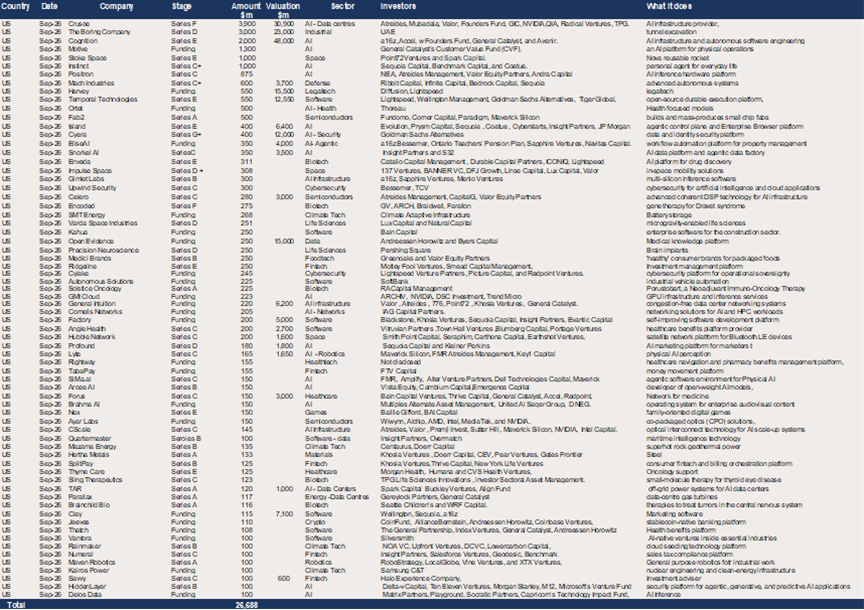
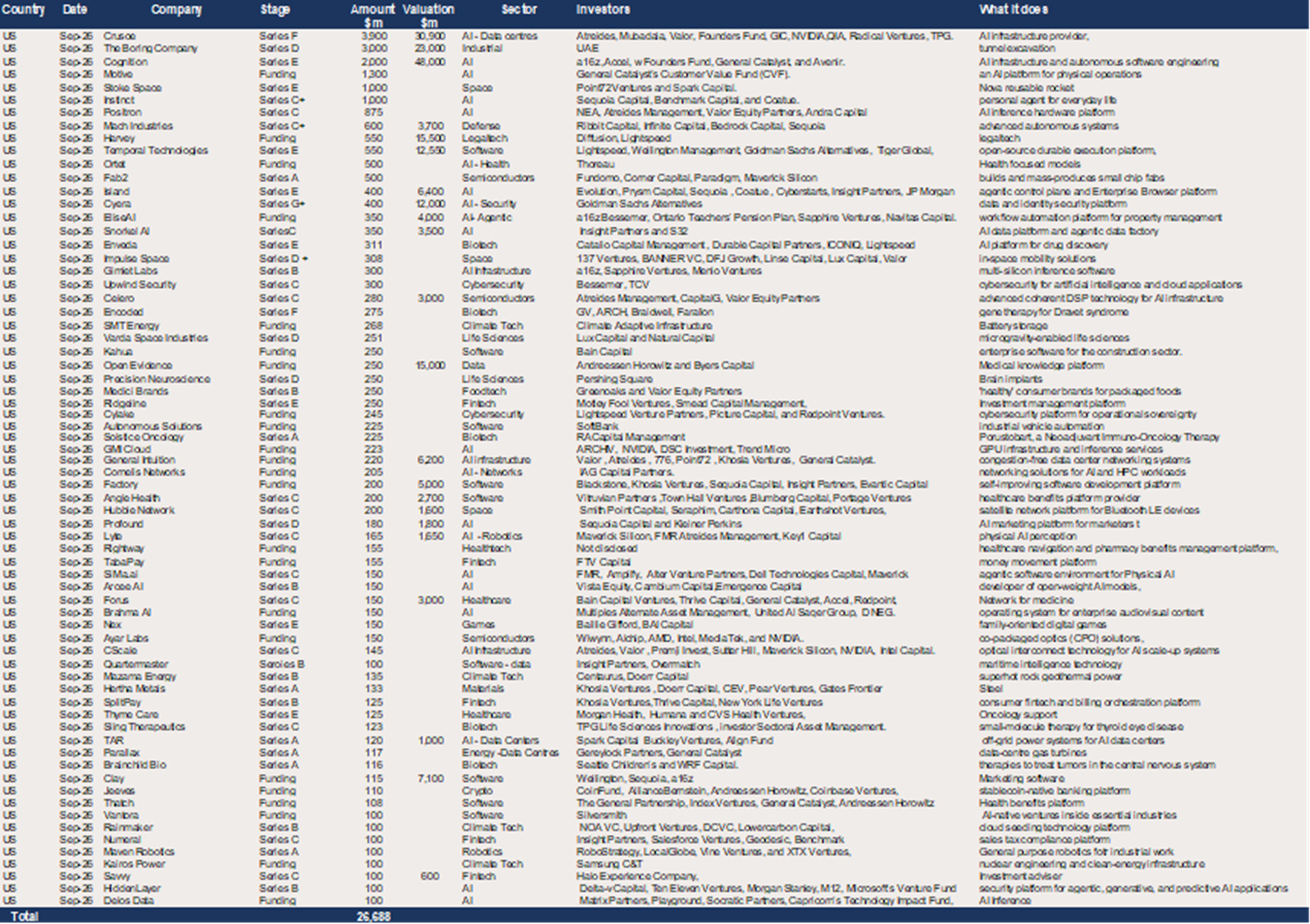
Source: Rothschild & Co
Source: Rothschild & Co
Europe – Records shattered
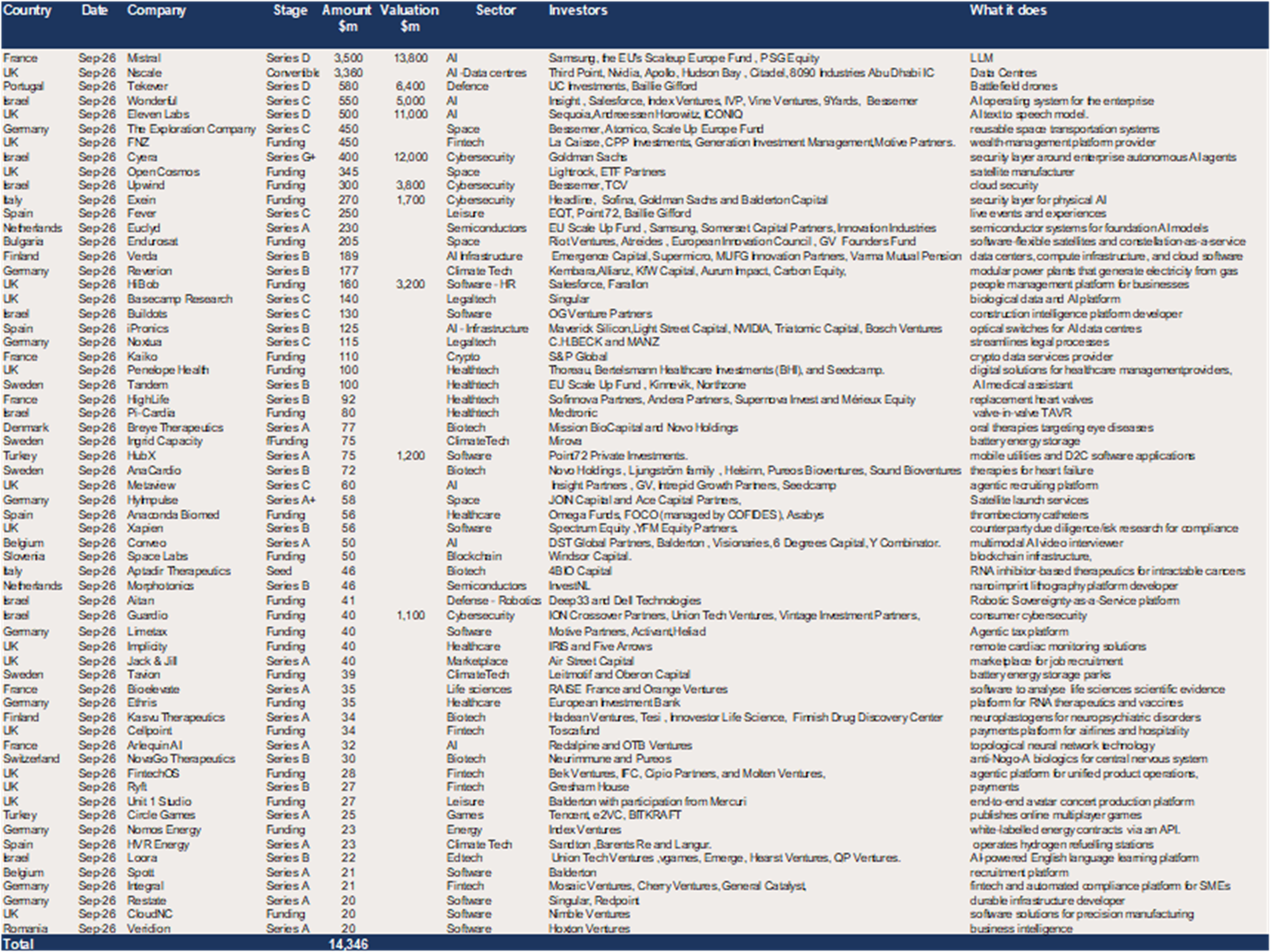
Europe bursts through the $10bn barrier - $14.4bn raised in September.
Until September 2026 Europe had never seen a month in which the $10bn mark for growth equity raises was breached. It came tantalisingly close in July with growth equity fundraising of $9.86bn, itself a record beating the $8.3bn of June 2026. For context the largest monthly total of raises in 2025 was September’s $7.1bn, in 2024 it was January’s $4.3bn, in 2023 September’s $6.9bn and in 2022 the $5.1bn of June.
September 2026 blasted through the $10bn barrier with a total of $14.4bn raised across 62 deals of $20m+. Almost half of this came in two big AI raises. French LLM Mistral raised $3.5bn in its Series D led by Samsung, the EU Scale Up Fund and PSG Equity valuing the company at $13.8bn. The UK data centres business Nscale announced a $3.36bn raise via convertible loan notes, led by Third Point and supported by Nvidia, Apollo, Citadel, Hudson Bay Capital, Abu Dhabi Investment Council, and 8090 Industries. Nscale’s full stack AI cloud platform serves hyperscalers, frontier model labs, AI natives, and enterprises building and scaling AI and has $103bn in total contracted value. We covered the Mistral raise extensively in last month’s Growth Equity Update and the Nscale raise is reviewed in this edition.
There were another 22 raises of more than $100m in the month including three more of $500m or above. In total that is 24 raises of $100m or above, again a monthly record beating the 21 such raises seen in July.
Four of the top five were AI related. Apart from Mistral and Nscale, Wonderful and Eleven Labs both came in at the $500m mark. Wonderful of the Netherlands raised a $550m Series C at a valuation of $5.5bn in a round led by Insight, Salesforce and Index Ventures. Six months ago, in March, it raised $150m in its Series B at a valuation of $2bn also led by Insight. The Wonderful AI OS Platform is designed to coordinate agents, workflows, and AI applications with companies’ own data, context, and existing integrations and works with any AI model and tech stack.
The AI voice start up Eleven Labs raised $500m at an $11bn valuation, a threefold valuation increase in a year. The new raise will see it focus on its enterprise platform for voice and conversational AI, to support customer experience, sales and marketing, and internal workflows with interactive voice agents. The round was led by Sequoia Capital with a16z, ICONIC, Lightspeed Venture Partners, Evantic Capital, and BOND participating. Rapid enterprise adoption meant that Eleven Labs closed 2025 with ARR of over $330m.
The final $500m+ raise came from Defence company Tekever, which raised $580m in a Series D at a $6.4bn valuation. The round was led by Baillie Gifford and UC Investments. The drone company was recently selected by the UK Ministry of Defence to deliver CORVUS, the British Army’s new surveillance capability, under a programme worth up to a potential £400m over the next ten years. Tekever says this ‘reinforces the company’s position as a long-term strategic capability partner for Europe, able to develop, industrialize and continuously evolve sovereign defence technologies at scale.’
Buoyed by the two $3bn+ raises AI was the leading sector in Europe in June with a total of $8.4bn, 58% of the total. Space was second with four raises for $1.06bn. These included a $450m Series C for The Exploration Company led by Bessemer, Atomico and the Scale Up Europe Fund. The Exploration Company develops reusable space transportation systems, including spacecraft and rocket engines, for public and commercial space operators. It has raised to date c$680m alongside more than $2bn in contracts globally, including projects with the European Space Agency and NASA.
Satellite manufacturer Open Cosmos raised $345m from Lightrock and ETF Partners. It has announced that 192 satellites will form the core of its connectivity backbone, ConnectedCosmos, a low Earth orbit constellation. It is aiming to launch 96 low earth orbit satellites by 2028, growing to 192 by 2030.
Endurosat raised $205m in funding from Riot Ventures, Atreides, the European innovation Council, Google Ventures and Founders’ Fund. The Bulgarian company is building standardized, software-flexible satellites and a streamlined constellations-as-a-service model.
Cybersecurity was again well represented in September’s raises with $1.01bn raised across four deals. The two largest were the Series G+ by Cyera which saw Goldman Sachs Alternatives add to the $600m initial Series G raise led by Evolution Partners. The new cash injection valued the company at $12bn. Upwind, the Israeli cloud security company raised $300m at a $3.8bn valuation. Its $250m Series B earlier this year came at a valuation of $1.5bn. Italy’s Exein raised $270m at a $1.7bn valuation for its security layer for physical AI protecting robots, drones and other autonomous machines.
Fintech saw five rounds raising a total of $560m with the majority coming from the $450m raised for the UK wealth management platform provider FNZ. Software had nine raises amassing a total of $542m with $160m for the UK’s HiBob global HR system backed by Salesforce and Farallon being the largest followed by the $130m raised for the Israeli construction intelligence platform developer, Buildots.
Europe – 62 $20m+ deals raised a record $14.4bn in September
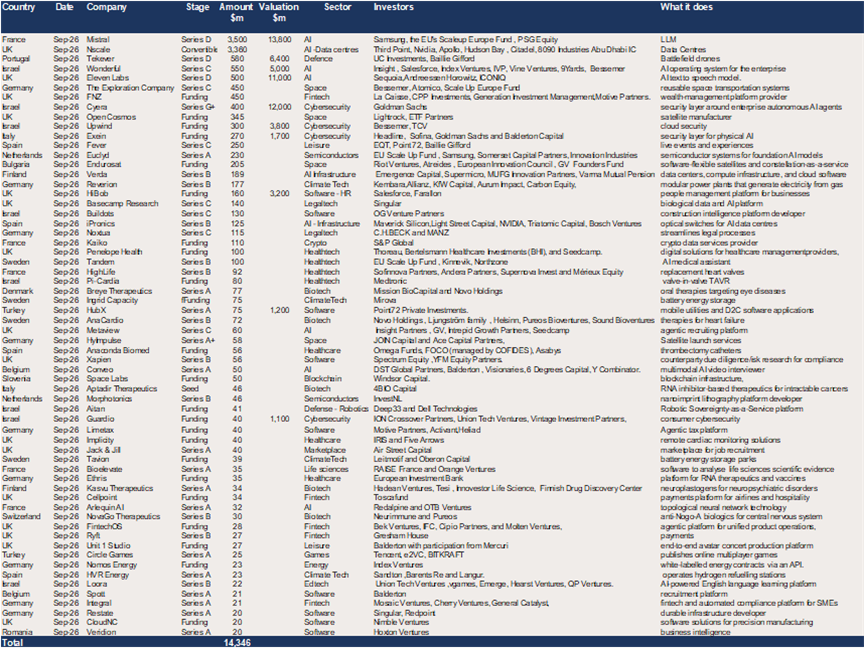
Source: Rothschild & Co
Source: Rothschild & Co
Fundraising outlook: c$61bn of impending raises
Pipeline is c$55bn in impending US deals and c$5.5bn in Europe
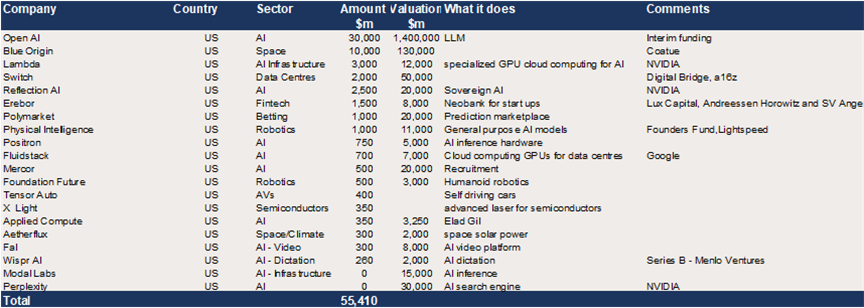
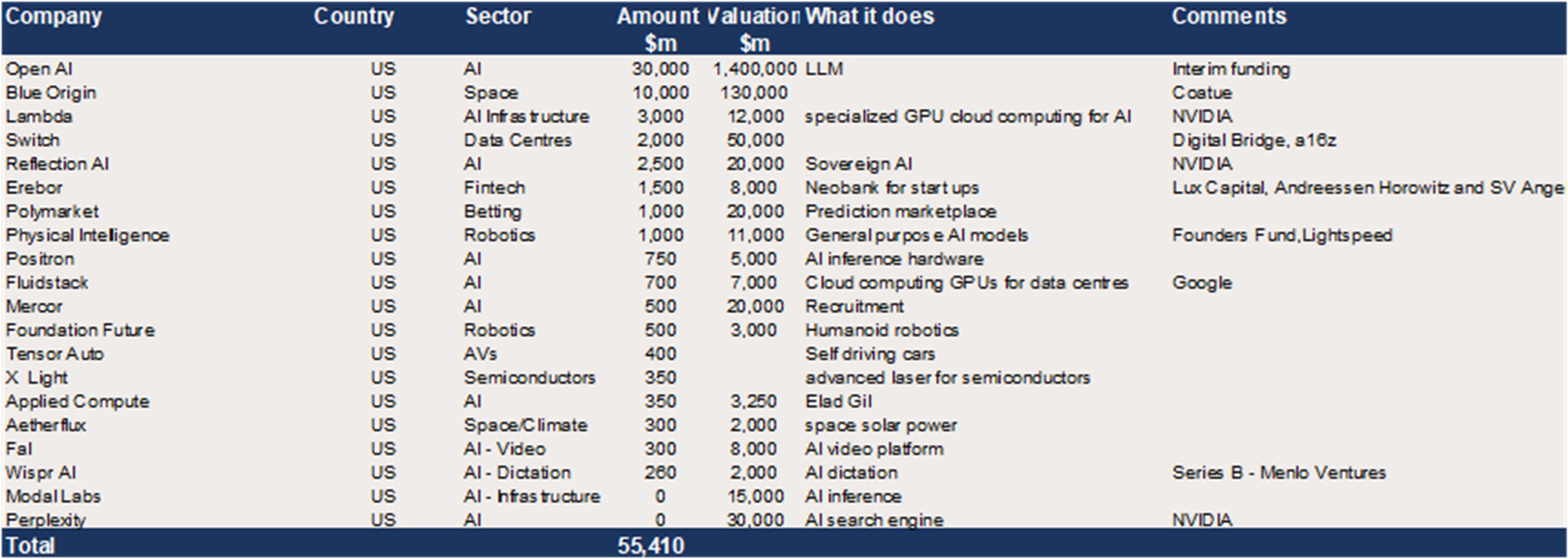
Our list of impending US raises rises again, from c$35bn at the end of August to $56bn at end September.
The jump in value marks a number of big, completed deals offset by one major new potential one.
The new entrant is OpenAI which has formally announced that it will not IPO in 2026 having previously filed for a listing in June this year. Instead, it is reported that the company is seeking to raise $30bn in a new funding round at a valuation of $1.4 trillion. The company has already raised $122bn ytd in 2026. The company estimates its likely cash burn at $280bn to the end of 2030 with negative free cash flow of $278bn in the five years 2026-30. OpenAI forecasts spending c$850bn on computing power and infrastructure by end 2030. It also anticipates revenues of $350bn pa by 2030, up from the current run rate of $36bn.
Otherwise, we mainly have removals from the list. Amongst these are the Boring Company, which raised $3bn instead off our projected $4bn, Crusoe which raised $3.96bn rather than the $3bn we had pencilled in, Cursor which was taken over by SpaceX, Instinct which raised $1bn, legaltech Harvey which raised $550m and Elise AI which raised $350m.
After the projected $30bn for OpenAI the list is led by Jeff Bezos’ space rocket venture Blue Origin. The company is reported to be looking to raise $10bn at a $130bn pre money valuation supported by Coatue with Jeff Bezos contributing c$2bn.
US Growth Equity – c$55bn in reported upcoming raises
Source: Rothschild & Co; press reports
Source: Rothschild & Co; press reports
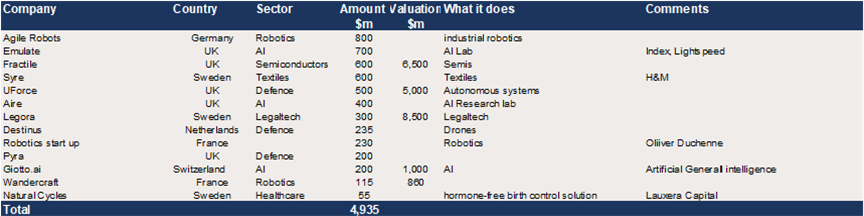
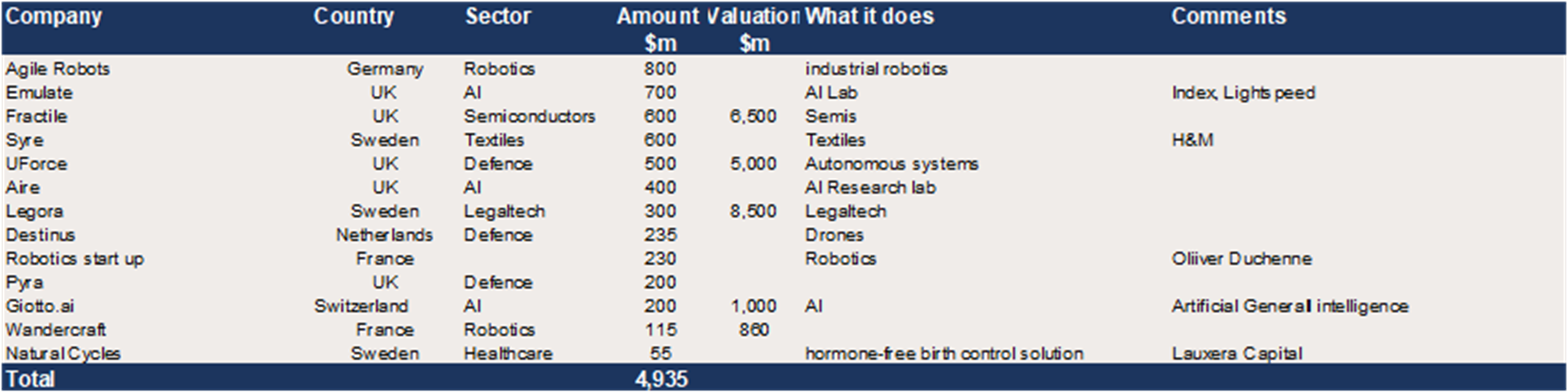
In Europe the total of identified impending raises has shrunk from c$8bn to $5.5bn.
The main reason for the fall is the completion of the $3.5bn raise for the French LLM business Mistral. Defence business Tekever which raised $550m in September, Eleven Labs which raised $500m and Bulgarian satellite company Endurosat also come off the list. The Exploration Company, which raised $450m rather than the expected $300m and semiconductor business Euclyd which raised $230m are also removed.
UK AI lab Emulate, founded in the summer of this year by three former Google DeepMind researchers is believed to be close to raising a $700m seed round at a $3.7bn valuation, led by Index Ventures and Lightspeed. It’s a talent raise. At the moment the business has no product and does not appear to have a website. UK defence company UForce is said to be raising $500m at a $5bn valuation having raised $50m at a $1bn valuation as recently as March. It builds autonomous platforms, counter-drone systems, strike drones, uncrewed surface vessels, and battlefield management software and has seen its equipment deployed extensively in Ukraine.
The size of the impending Legora raise is now becoming clearer. It is looking like an additional $300m. Its US counterpart Harvey raised $550m in September. The former head of robotics at Mistral, Olivier Duchene, is said to be raising $230m for a robotics start up called Ora
European Growth Equity – c$5bn in reported upcoming raises
Source: Rothschild & Co; press reports
Source: Rothschild & Co; press reports
Our views on the state of the venture capital markets
This revival of the growth equity market has been led by the US and by a surge of interest in artificial intelligence model providers and for companies using AI to transform a range of underlying industries.
At the same time the venture industry has re-adopted strong underlying approaches to investment with companies in most sectors striving to achieve a better balance of growth, profitability and cash flow. The underlying quality of the cohort of VC backed companies has improved.
Our summary of the outlook
- There is substantial interest in venture capital to fund artificial intelligence, both the foundation LLM models and the applications of AI and industries (data centres, quantum, semiconductors, new energy sources like nuclear and fusion) supporting the development of AI.
- The influence of AI is percolating through many other industries such as drug discovery, defence, robotics, legaltech, autonomous vehicles, and cybersecurity fuelling a broader advance in the growth equity market.
- Overall, the VC market is regaining confidence with the strength of interest with fintech, blockchain/crypto and biotech reviving strongly.
- There is a burgeoning interest in defence industries from investors with both the tense geopolitical political environment, the advances in AI applications and the experience of the combat in Ukraine contributing to investor focus. By contrast, ClimateTech, while still a substantial sector has become less prominent both as a result of some high-profile failures and being less favoured politically in the US under the current administration.
- Fund raising for venture capital firms remains subdued. Fund raising is concentrating into larger, established firms. US VC fundraising in 2025 was concentrated in larger firms and at near decade lows.
- The speed of the investment process has slowed down since 2021-22. The level of diligence on deals has stepped up. This is true even in the ‘hot’ parts of the market like AI. Outside these areas it is marked – processes take time, downside protection is sought.
- Valuation priorities have shifted with investors having moved away from a pure emphasis on revenue growth and revenue multiples. There is a sharp focus instead on the combination of growth and profitability (or a rapid path to it) and on free cash flow.
Read the previous editions: May 2022, June 2022, June 2022 (2), July 2022, August 2022, Sep 2022, October 2022, November 2022, December 2022, January 2023, February 2023, March 2023, April 2023, May 2023, June 2023, July 2023, August 2023, September 2023, October 2023, November 2023, December 2023, January 2024, February 2024, March 2024, April 2024, May 2024, June 2024, July 2024, August 2024, September 2024, October 2024, November 2024, December 2024, January 2025, February 2025, March 2025, April 2025, May 2025, June 2025, July 2025, August 2025, September 2025, October 2025, November 2025, December 2025, January 2026, February 2026, March 2026, May 2026, June 2026, July 2026, August 2026, September 2026
Rothschild & Co: Selected recent deals in Growth Equity and Private Capital
A selection of recent deals on which we have advised: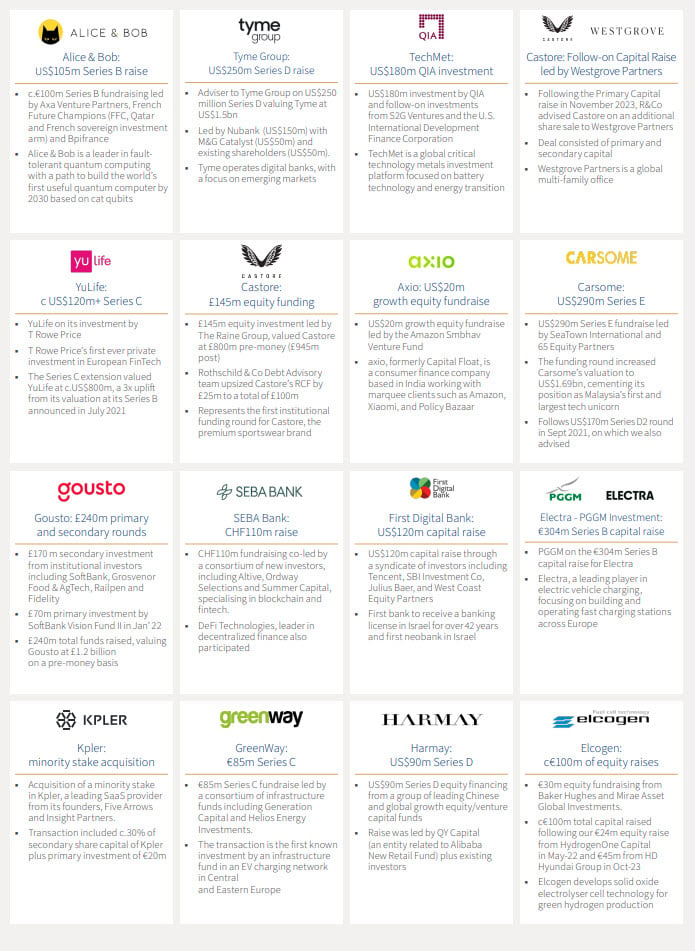
For more information, or advice, contact our Growth Equity team:
Mark Connelly
Co-Head of Global Market Solutions
+1 212 403 5500
+1 917 297 5131
Chris Hawley
Global Head of Strategic and Private Investors.
+44 20 7280 5826
+44 7753 426 961
Patrick Wellington
Vice Chairman of Equity Capital Markets Europe
+44 20 7280 5088
+44 7542 477 291
Antoine de Guillenchmidt
Co-Head of Equity Capital Markets Europe
+44 20 7280 5377
+44 7907 712 978
Pete Nicklin
Co-Head of Equity Capital Markets Europe
+44 20 7280 1668
+44 7912 395 294
Laura Klaassen
Head of Private Distribution
+44 7926 905 488
Thomas Chung
Head of Private Capital, North America
+1 212 403 5559
+1 917 594 7208
Cyrus Danesh
Director of Private Distribution
+44 20 7280 1085
+44 7718 205 387
This document is being provided to the addressed recipients for information only and on a strictly confidential basis. Save as specifically agreed in writing by Rothschild & Co Equity Markets Solutions Limited (“Rothschild & Co”) this document must not be disclosed, copied, reproduced, distributed or passed, in whole or in part, to any other party.
This document does not constitute an offer, inducement or invitation for the sale or purchase of securities, investments or any of the business or assets described in it.
This document has been prepared from publicly available information. This information, which does not purport to be comprehensive, has not been independently verified by us or any other party. The document does not constitute an audit or a due diligence review and should not be construed as such. The information provided should not be relied on for any purpose and should not in any way serve as a substitute for other enquiries and procedures that would (or should) otherwise be undertaken.
No representation or warranty, expressed or implied, is or will be made and, save in the case of fraud, no responsibility or liability is or will be accepted by us, as to or in relation to the accuracy, sufficiency or completeness of this document or the information forming the basis of the document or for any reliance placed on the document by any person whatsoever. No representation or warranty, expressed or implied, is or will be made as to the achievement or reasonableness of, and no reliance should be placed on, any projection, targets, estimates or forecasts and nothing in this document should be relied on as a promise or representation as to the future.
Law or other regulation may restrict the distribution of this document in certain jurisdictions. Accordingly, recipients of this document should inform themselves about and observe all applicable legal and regulatory requirements. This document does not constitute an offer inducement, or invitation to sell or purchase securities or other investments in any jurisdiction. Accordingly, this document does not constitute a Financial Promotion under the Financial Services and Markets Act 2000 (Financial Promotion) Order 2005 or equivalent legislation in other jurisdictions. This document is being distributed on the basis that each person in the United Kingdom to whom it is issued is reasonably believed to be such a person as is described in Article 19 (Investment professionals) or Article 49 (High net worth companies, unincorporated associations etc.) of the Financial Services and Markets Act 2000 (Financial Promotion) Order 2005 or is a person to whom this document may otherwise lawfully be distributed. In other jurisdictions, this document is being distributed on the basis that each person to whom it is issued is reasonably believed to be a Professional Investor as defined under the local regulatory framework. Persons who do not fall within such descriptions may not act upon the information contained in this document.