Growth Equity Update November 2026 - Edition 56
- Quantum Computing deep dive: Seen as a key enabling technology for AI, quantum computing has experienced a significant step up in public and private funding in the last 18 months – there are now nine US quoted quantum companies including two European transplants (IQM of Finland and Pasqal of France) and European private rounds worth $3.7bn since the start of 2025. Forecasters have global revenues for quantum computing at c$1bn in 2026. McKinsey has that growing to $4bn by 2028 and BCG to c$170bn by 2040.
- Quantum advantage: We look at how quantum computing may progress from its current unstable and error-prone NISQ phase; to quantum advantage in 2027-30 where it can outperform classical computing; to fault tolerant commercial scale quantum computing targeted for 2030-35. We assess how investors might approach the industry.
- NVIDIA extending its presence in European startups. In a recent tour of France, the UK, Sweden and Germany, NVIDIA announced new funding worth $2bn for European tech including investments in 14 European startups from Doctolib and Pigment in France, to Riverlane in the UK, and Agile Robots in Germany.
- UK pension money into private companies: Scottish Widows has launched a UK venture growth portfolio within its CG Scottish Widows Growth long-term asset fund ‘Our proposition helps connect our workplace pension customers' long-term savings with some of Britain's most innovative, high-growth companies’. It will be managed by IP Group.
- Canada’s largest ever private raise: Cohere, which builds large language models specifically designed for enterprise workflows, announced a $5bn (CAD $7bn) Series E in October, valuing the company at $25.7bn (CAD $35.7bn). The largest private raise ever in Canada was supported by a CAD $1.6bn investment by the Government of Canada.
- October 2026 – a bit slower: US raises of $100m+ were at $28.5bn up 36% against October 2025 but only the sixth largest month ytd. In Europe, after September’s record shattering $14.4bn, October was the first yoy down month of 2026 with $5.6bn raised, -8% on October 2025. November has started with an $11bn OpenAI raise at a value of $1.25trn, smaller than the $30bn at $1.4trn originally expected.
Download the 56th Growth Equity Update
Quantum – the search for a scalable, fault tolerant quantum computer
"I think I can safely say that nobody understands quantum mechanics" Richard Feynman, 1965 Nobel Physics prize winner
‘If someone says that they can think or talk about quantum physics without becoming dizzy, that shows only that they have not understood anything whatever about it.’ Murray Gell Mann, 1969 Nobel Physics prize winner
‘If I have seen further than others, it is because I am surrounded by dwarfs.’
Murray Gell Mann
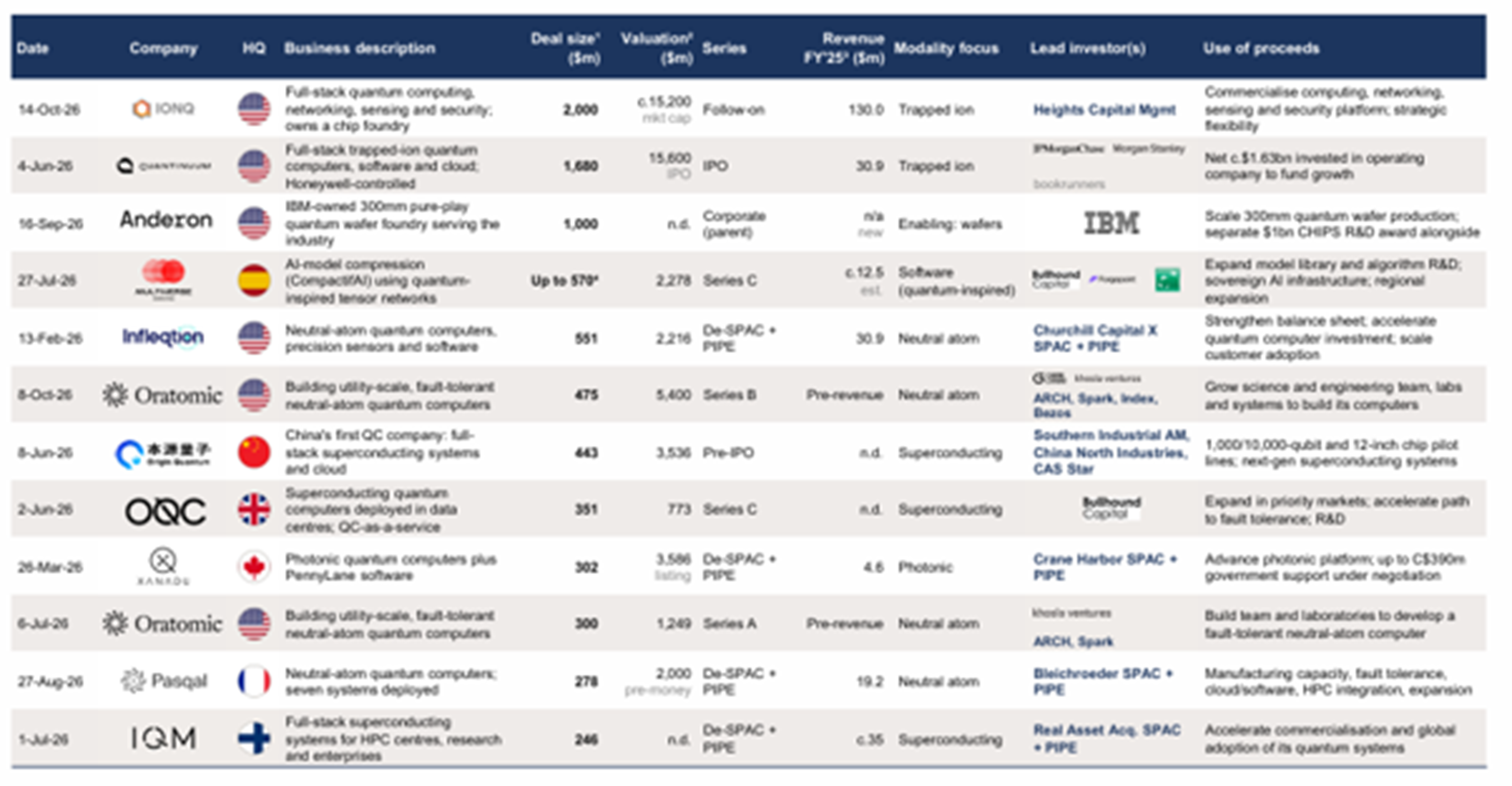
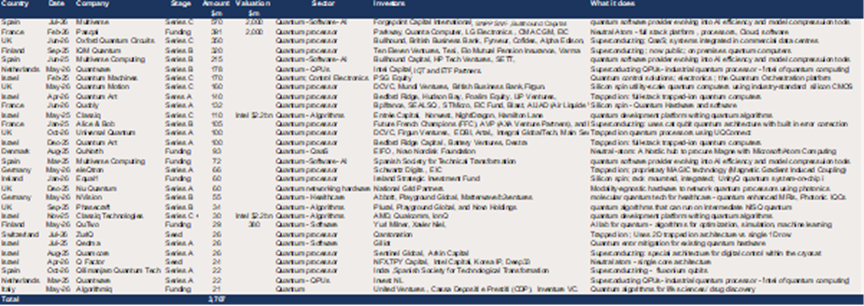
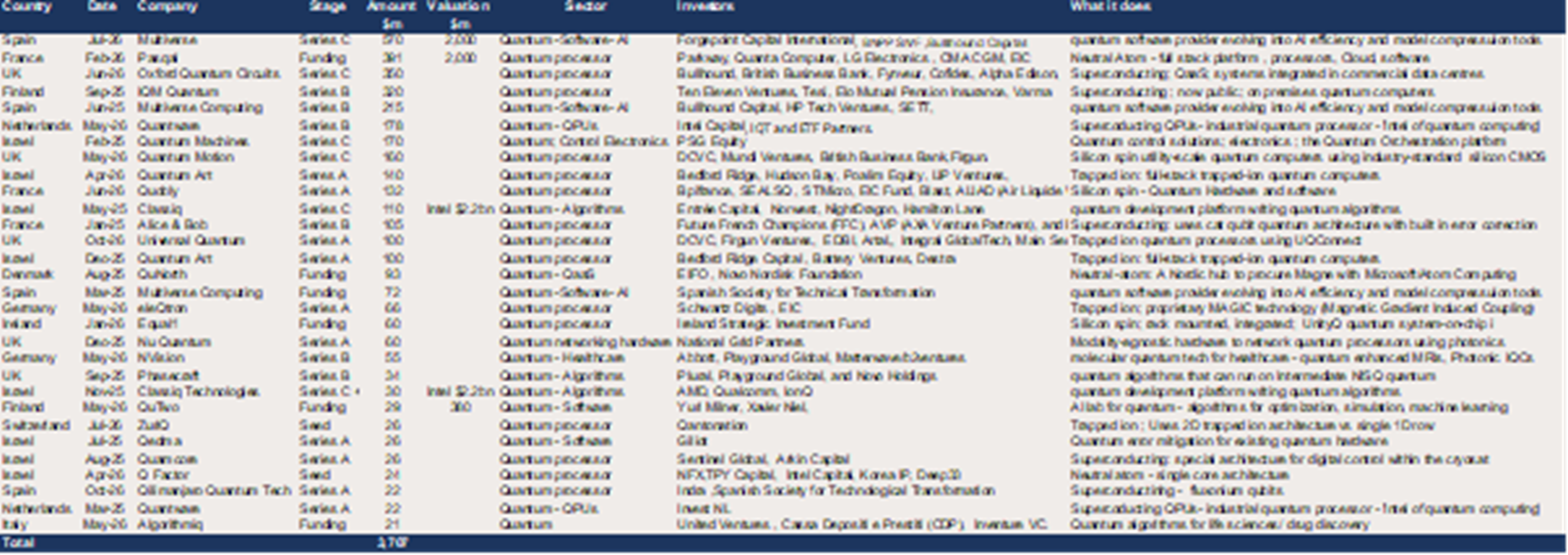
In one of our occasional deep dives into industries favoured by venture capital we look this month at quantum computing. There has been a significant step up in public and private funding for quantum in the last 18 months – there are now nine US quoted quantum companies including two transplants from Europe (IQM of Finland and Pasqal of France) and there have been European private rounds worth $2.3bn ytd in 2026 and $3.7bn across 2025 and the first nine months of 2026.
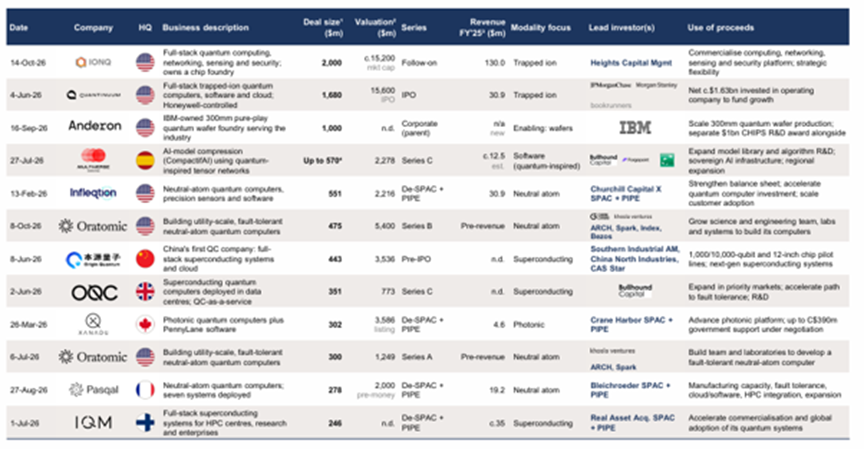
Largest quantum raises globally 2026 YTD
Source: Rothschild & Co
Source: Rothschild & Co
Quantum computing uses quantum mechanics to process complex data much faster than traditional computers. It will be used for two types of tasks: modelling the behaviour of physical systems and identifying patterns and structures in information. It is not designed to replace conventional computing but in certain functions its capability vastly exceeds that of classical computing, and it should gain a critical position in specialized, high-capacity tasks.
Potential use cases are in optimisation (logistics, finance, energy), security (cybersecurity, cryptography, defence) and molecular simulation (new materials, biotech, drug discovery) in science, medicine, finance and applied materials.
It’s in the AI basket – Quantum is an industry seen as closely linked to AI. Indeed, the two capabilities are seen as complementary and mutually reinforcing. Quantum computers can perform billions of ‘train of thought’ operations, potentially vastly accelerating the ability of AI models to process and learn from data. This will enable companies to train AI models faster, improve inference capability, and handle larger data sets while potentially being more energy efficient. It is viewed as the next stage of AI beyond the GPU.
It’s deep tech: Quantum computing is hard, revenues are embryonic, and scalable fault tolerant quantum computers available for commercial use are unlikely before the mid-2030s. Multiple funding rounds are likely to be required before these businesses become self-supporting. The potential though is huge. Independent forecasters think global revenues for quantum computing are c$1bn in 2026. McKinsey has that growing to $4bn by 2028 and BCG to c $170bn by 2040.
Quantum Computing - $3.7bn of European raises in 2025-2026 YTD
Source: Rothschild & Co
Source: Rothschild & Co
Quantum computing – what is it? The science bit
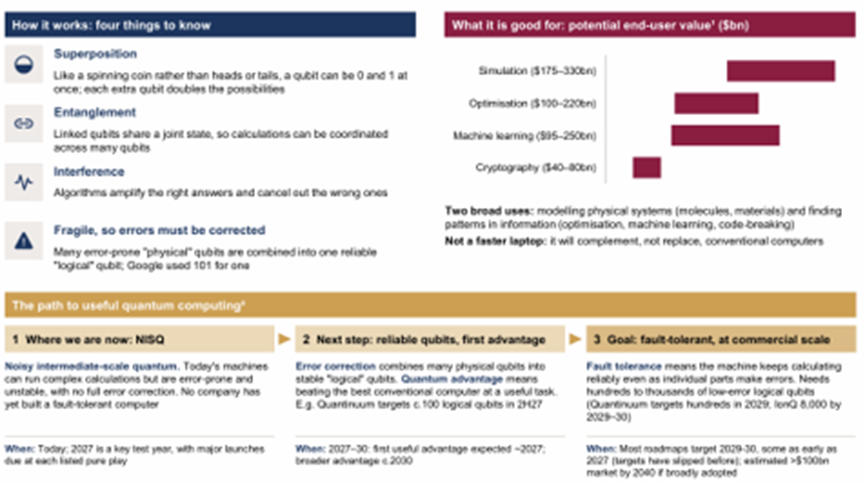
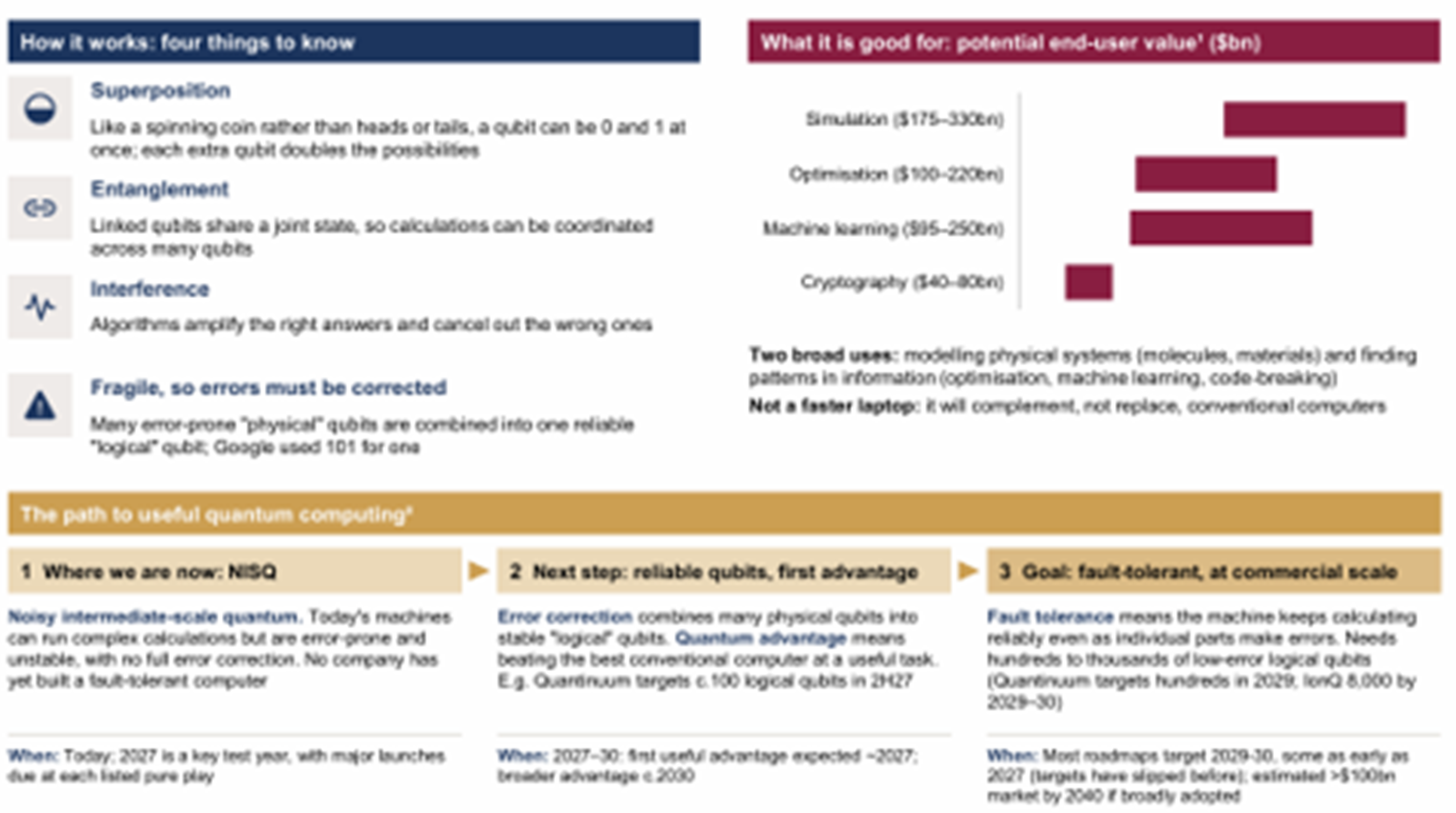
A superposition of computational states: A computation on a quantum computer works by preparing a superposition of computational states. A quantum circuit entangles qubits and generates interference patterns, governed by a quantum algorithm. Many possible outcomes are cancelled out through interference, while others are amplified. The amplified outcomes are the solutions to the computation
Quantum bits: The primary difference between classical and quantum computers is that quantum computers use qubits instead of bits. Think of quantum bits as a spinning coin– a classical computer uses ones and zeros – heads or tails; a qubit is an inherently unstable spinning coin combining both simultaneously.
Exponential complexity in combined qubits: A qubit can act like a bit, storing either a zero or a one, but it also exists as a weighted combination of both simultaneously. When qubits are combined, their superpositions grow exponentially in complexity. With 100 qubits, the range of possibilities is astronomical.
Quantum - how it works, what it’s for, where we are at
Source: Rothschild & Co
Source: Rothschild & Co
Stage of development? Experimental rather than proven
Where we are now – NISQ: At present quantum computing is in its NISQ phase -Noisy intermediate-scale quantum. Quantum computers can achieve complex calculations, typically in laboratory conditions or controlled states, but are error prone and inherently unstable.
Next step – Quantum advantage: Quantum processors produce hundreds or thousands of physical qubits. These form the foundation for logical qubits and error corrected stable logical qubits can perform complex computations. Most quantum processor roadmaps see quantum advantage, the point at which a quantum computer outperforms a classical computer, arriving at some point between 2027-30.
Goal - Fault tolerant, scalable commercial use: Quantum advantage is not enough. Scalable, reliable quantum computing in commercial environments operating c100-1000 qubits with 99.96% error correction is the goal – quantum computers able to be put to commercial use. This is typically targeted for 2030-35.
Four ways to approach quantum
There are four main types of company in quantum.
Quantum processor specialists: These are dedicated developers of quantum computers – combining the quantum processing unit (the chip), control electronics (reading the chip), error correction (QEC, managing the logical qubits), the control software, and the algorithm layer (adapting the capability to real life use cases).
Quoted companies include Quantinuum, IonQ, Rigetti, DWave, Infleqtion, IQM, Quantum Computing Inc, Xanadu and Pasqal.
Private companies with recent raises include Oxford Quantum Circuits, Oratomic, Quantum Motion, Quantum Art, Alice&Bob, Quandela, Quamcore, and Atom Computing.
This group offers the most geared plays into the success of quantum. They are pure vehicles where the bulk of economic value will likely lie in the event of success. The key risks are the pace of development and the competing approaches, with no clear winner as yet amongst the different modes (modalities) of quantum computing.
Major tech businesses undertaking quantum: A number of major tech companies have a significant presence in quantum including IBM, which targets its Starling computer to offer fault tolerant quantum with 200 qubits by 2029; Google Quantum with its Willow superconducting processor but also its recent branching out into neutral atom; Honeywell which created Quantinuum by merging Honeywell Quantum Solutions with Cambridge Quantum in 2021; and Microsoft which has a unique approach to quantum, centred around topological qubits. These companies often form part of traded quantum ‘baskets’ but given their size and other more substantial exposures offer only a very diluted exposure to quantum.
Software and applications: Quantum computing requires a highly performing and stable software stack to write, optimize and execute quantum programs and algorithms to take current quantum technologies from quantum utility to quantum advantage. There are several layers including quantum software development tools for developing algorithms ( such as Phasecraft in materials and chemistry, Multiverse Computing in AI model optimisation and machine learning) ; quantum applications (such as PQShield and SandboxAQ in cryptography, QuantFi for the financial services industry) ; quantum hardware simulators ( Azure Quantum); quantum compilers (Classiq); quantum error correction specialists (Riverlane, Qedma) and quantum control systems ( Keysight Technologies) . Critically it is not necessary to have access to quantum computers to develop quantum software – the work can be done using simulators on classic computers that simulate the behaviours of quantum processing units.
Suppliers (picks and shovels) to the quantum industry: There are a number of businesses facilitating the quantum ecosystem. These offer an interesting way to gain exposure to quantum. Key component specialists including cryogenics (Quantum Design International – owners of Oxford Nanoscience), control electronics (Quantum Machines, QBlox), control software (Quantum Machines) and lasers (Coherent Corp). A potential drawback is that some are dependent on particular modalities and are thus tied to the relative success of a particular modality, while the gearing to the upside value is more concentrated in the processor companies.
Four major types of quantum companies
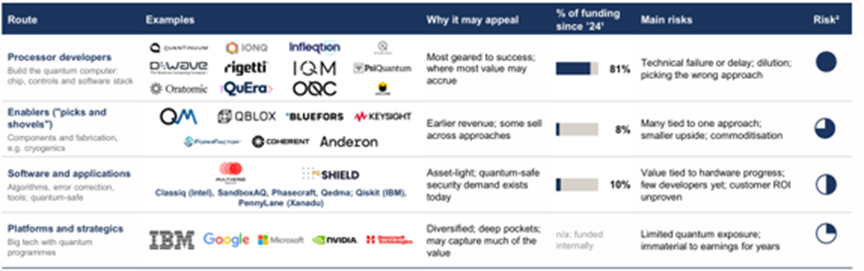
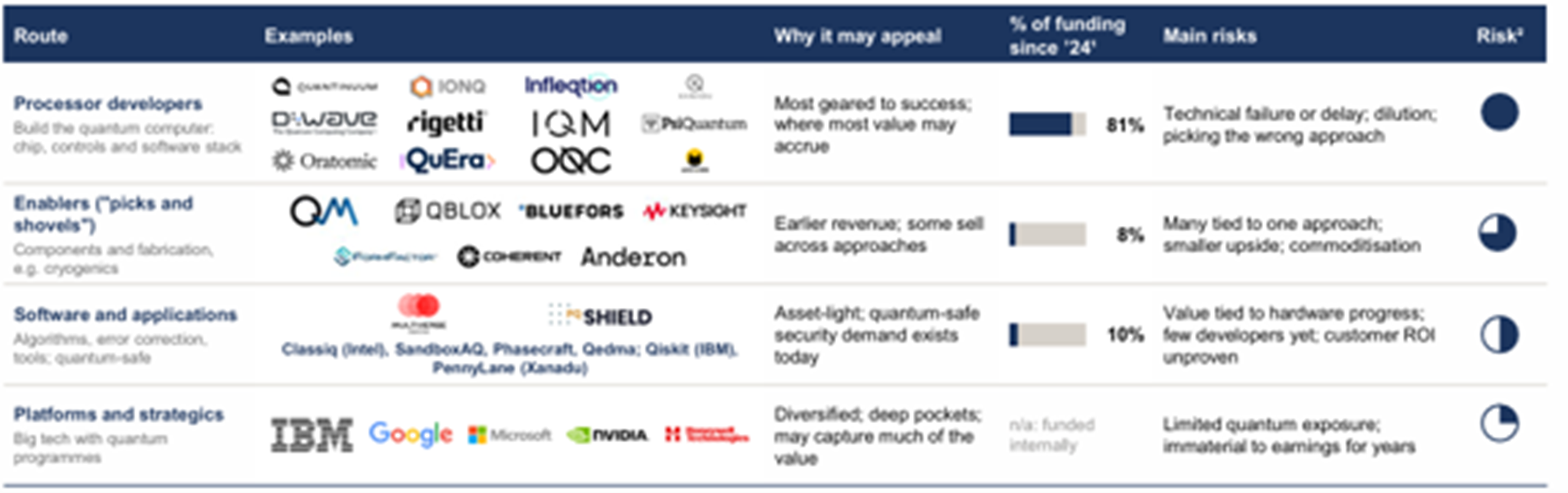
Source: Rothschild & Co; Notes: 1. Share of c.$22.8bn equity raised Jan 2024–Oct 2026 by quantum companies (incl. IPOs and listed raises), Rothschild & Co classification; c.1% other not shown. 2. Rothschild & Co view of relative risk (full = highest; quarter = lowest)
Source: Rothschild & Co; Notes: 1. Share of c.$22.8bn equity raised Jan 2024–Oct 2026 by quantum companies (incl. IPOs and listed raises), Rothschild & Co classification; c.1% other not shown. 2. Rothschild & Co view of relative risk (full = highest; quarter = lowest)
Quantum computers – Three major types, six major modalities.
Quantum computing is hard and difficult to scale. The quantum processor industry spends its time devising ways to make inherently unstable qubits function effectively. There are three main types of quantum computer
Gate based systems- Quantum universal models- general purpose quantum machines (eg Rigetti, Quantinuum, IQM, IonQ, Quantum Computing Inc)
Analog systems: Quantum annealing: These have limited application being purpose-built for optimization and sampling tasks. They are less sensitive to decoherence than universal gate systems. They have been scaled to perform scheduling, logistics, and traffic routing but cannot run general computer programmes. (DWave)
Analog systems: Quantum simulators: Simulators are special purpose devices designed to provide insight about specific physics problems -it is a controllable quantum system used to simulate the behaviour of another, less accessible quantum system. (QuEra)
Six major modalities
There are (at least) six different ways of creating physical qubits which, when combined, form logical qubits. Different companies adopt different approaches – most major on a single modality – typically the expertise is not transferable across modalities and most quantum processor companies focus on a single modality.
There is no current consensus on which is the ‘best’ approach – each has advantages and shortcomings. The prevailing wisdom is that there may be no single winner and that multiple modalities will emerge as functional with different modalities emerging as better at different end tasks.
The leading modalities
Superconducting- IQM, Google, IBM, Rigetti, Alice&Bob, Oxford Quantum Circuits
Pros
- Quantum gate operations are very fast (nanoseconds), meaning that basic quantum operations can be performed quickly.
- Printed circuits are easy to manufacture at scale – uses standard semi equipment
- Has been demonstrated at commercial scale and made available via cloud services.
Cons
- There is a major cooling requirement – unlike other modalities, hardware must be to be cooled to fractions of a degree above zero Kelvin.
- Logical qubit life tends to be very short
Trapped ion – IonQ, Quantinuum
Pros
- Trapped ions have some of the lowest error rates
- Quantum states can remain stable for seconds or minutes
- Individual ions are cooled using lasers, avoiding having to cool the entire device as with superconducting computers.
Cons
- Trapped ions sacrifice speed for precision and gate speeds are slow - roughly hundreds to a thousand times slower. This restricts applications with a large number of sequential operations such as the Schor’s algorithm, a benchmark test for quantum functionality.
- It is challenging to get the ions in their initial states
- Decoherence is an issue when scaling
Pros
- Can scale to large numbers of highly connected atoms per array - 6,000 in one experiment compared with low tens for trapped ions. Coherence times are long.
- Faster gate speeds than trapped ions (although not as fast as superconducting)
- Already in use for a range of applications including sensing, positioning and timing.
Cons
- Gate speeds are slower than superconducting
- Requires very high specification lasers and ultra-high vacuum chambers
- The path to large-scale fault tolerance is not yet proven.
The up-and-coming modalities
Photonics - Xanadu, QCi, Quantum Computing
Pros
- Uses light rather than matter, photonics can operate at room temperature using standard fibre-optic cables
- Components are thus cheap to manufacture
- And can be installed very quickly - devices are relatively easy to deploy in conventional datacentres.
Cons
- Systems tend to suffer photon loss through absorption or scattering
- Difficulty in generating photons, and efficient detection methods
- Photons have no natural stationary memory state, making long-duration quantum storage challenging.
Silicon spin - Diraq, Photonic Inc, Silicon Quantum Computing.
Pros
- Silicon spin qubits store information in the spin of a single electron confined inside a tiny quantum dot fabricated on a silicon chip
- Silicon spin qubits are compatible with existing semiconductor industry manufacturing processes
- They have long coherence times and are capable of a very high qubit density
Cons
- Spins and coupling are challenging to control
- Cryogenic cooling is a requirement
Topological- Microsoft, Google, Quantinuum
Pros
- Microsoft has spent two decades pursuing a topological approach based on Majorana zero modes
- The approach has an intrinsic protection from errors
- The potential scalability is high
Cons
- It requires the creation of exotic states of matter such as topological superconductors and "Majorana zero modes" which are very hard to manufacture and verify.
- Despite years of investment it remains at an early stage
- Some of the fundamental claims about topological’s capabilities are still dispute
Quantum – the six major modalities of quantum computing
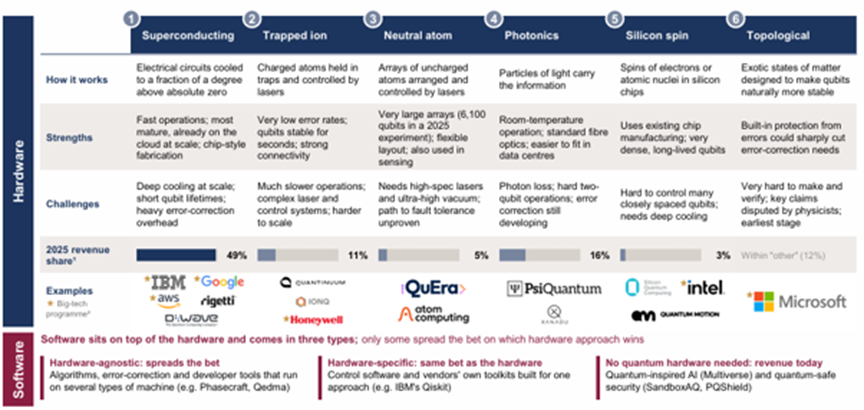
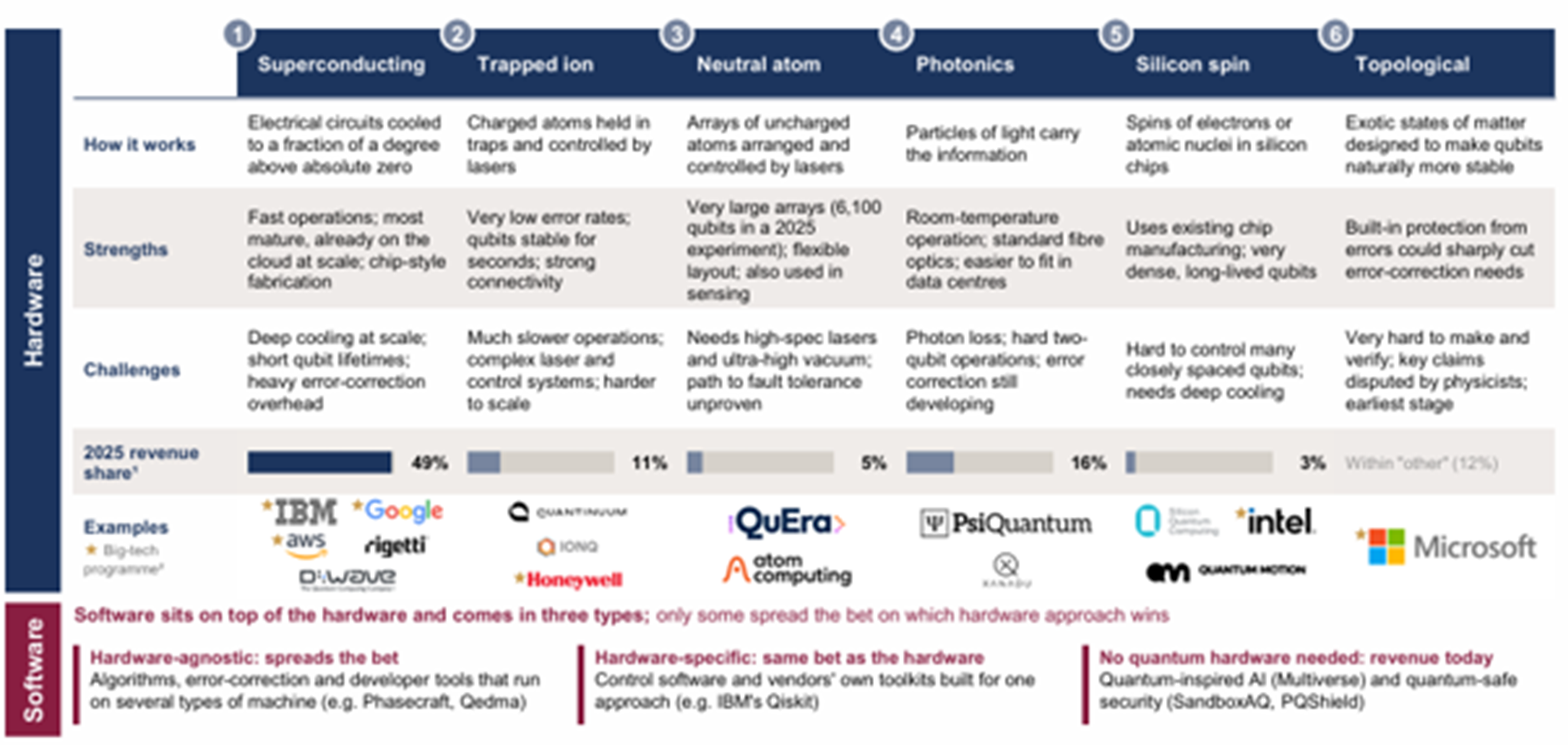
Source: Rothschild & Co
Source: Rothschild & Co
How to think about this
Hardware issues to surmount: We are still in NISQ, moving towards quantum advantage, but are some way from fault tolerant computing.
Software not there: A fault tolerant computer needs software and algorithms to run on it – a quantum processor needs sophisticated software.
The revenue model: Outright sale? Quantum as a service? The revenue model needs to be developed.
Mainstream, production-grade fault-tolerant systems are still estimated to be 5 to 10 years away.
Not all will make it “Given the current market size, Gartner believes the market is overcrowded. Gartner expects that by 2030, an exhaustion of viable commercial revenue will force over 50% of quantum computing startups out of business, as the market rejects qubit modalities that fail to achieve fault-tolerant quantum computing."
Baskets: One response might be to invest across a range of modalities and take a basket approach – reducing the lottery of picking a modality winner.
Governance is a big issue– Trading on 50-100x sales, and in a highly complex and technical industry, confidence in management is critical.
Slippage: The companies each have roadmaps for hitting quantum advantage and scalable fault tolerant quantum – typically in a 2028-35 range; such targets have previously been missed, and the feeling is that timescales are shifting to the right.
An Overview of the Quantum Computing ecosystem
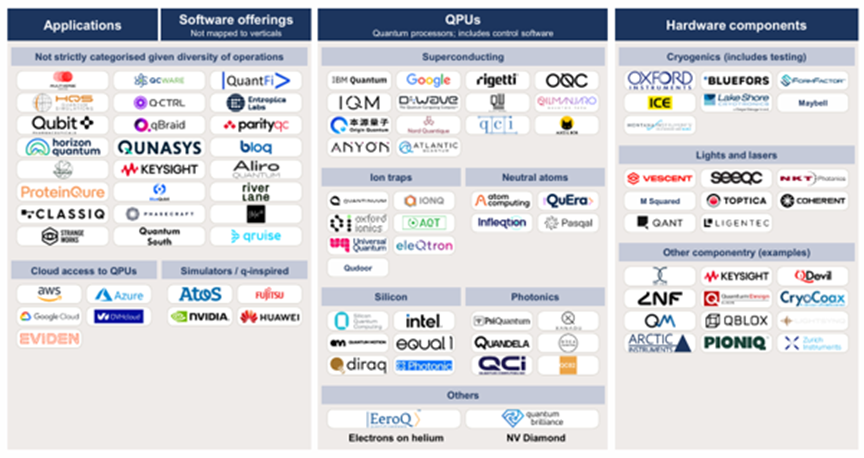
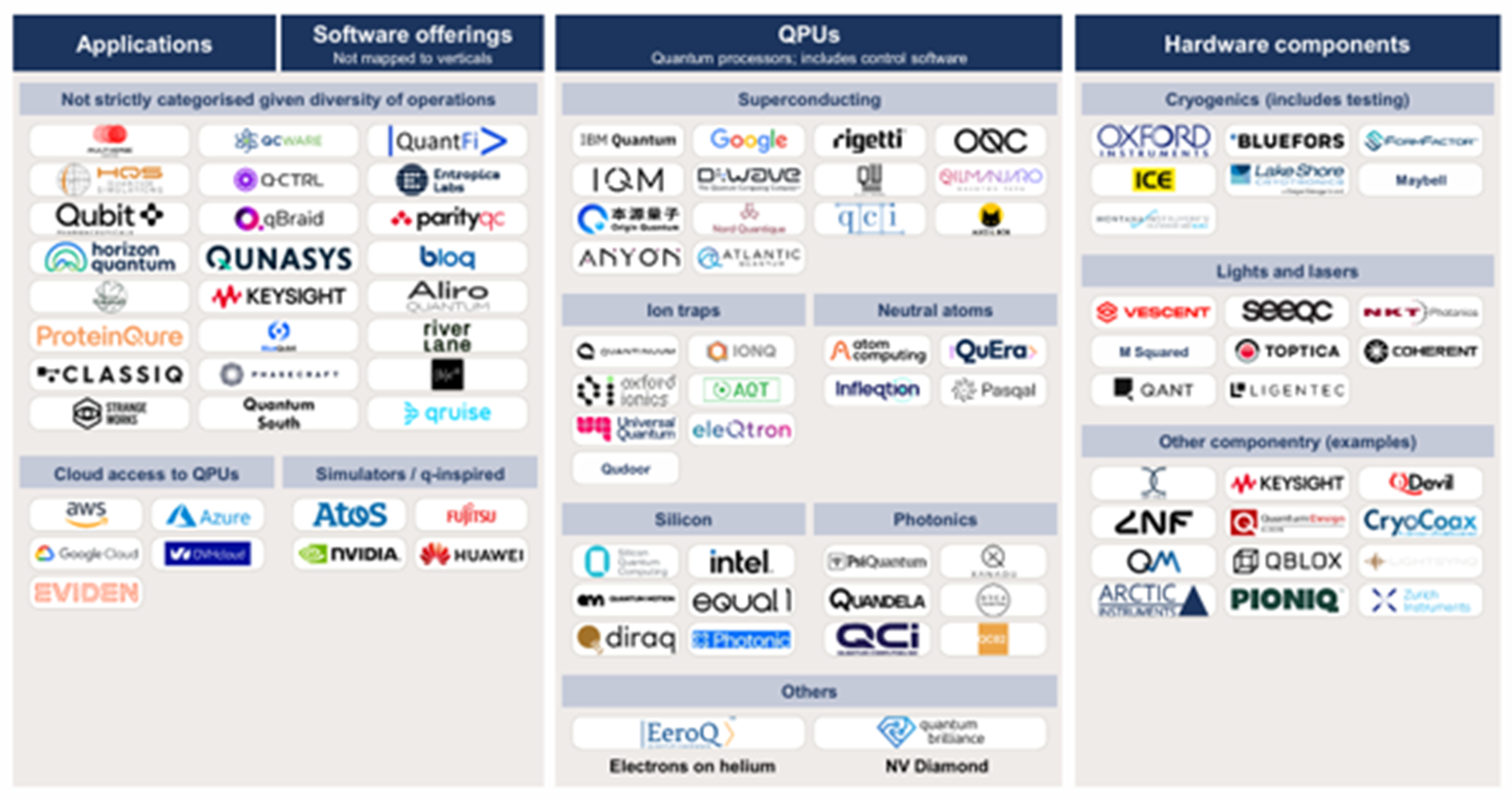
Source: Rothschild and Co
Source: Rothschild and Co
Nvidia – Extending its European investments
Another $2bn going in...
NVIDIA has become a mainstay of the growth capital investment scene in both the US and Europe. During October NVIDIA’s CEO Jensen Huang swept through Europe announcing new investment in Europe’s AI infrastructure and new funding worth $2bn for a series of European tech start-ups. NVIDIA estimates that its cumulative investment in Europe’s technology ecosystem has reached $10bn.
Jensen Huang’s European tour took in Paris on October 13th (investments announced in four start-ups), London on the 14th (five new investments), Sweden on the 15th (launch of Sferical One, a Swedish supercomputer using NVIDIA chips) and Germany on October 20-22 (five new investments).
In total fourteen new investments across three countries. The size of the individual investments was not revealed. A total of $2bn spread across 14 business would be an average contribution of $143m but some of the companies are quite small, suggesting that the $2bn figure also captures funding into some of the programmes announced alongside the investments, such as the Swedish supercomputer, $330m of computing resources announced for UK AI safety research and a partnership with Siemens in Germany.
Nvidia already has a significant presence in these countries.
In France, Mistral AI is building an end-to-end cloud platform powered by 18,000 NVIDIA Grace Blackwell systems in the first phase, with plans to expand across multiple sites in 2026. The infrastructure will host Mistral AI’s cloud application service, which customers can use to develop and run AI applications with Mistral AI’s and other providers’ open-source models.
Mistral AI and NVIDIA are collaborating with Bpifrance and MGX, the UAE’s investment fund to establish Europe’s largest AI campus — to be located in the Paris region and expected to reach a capacity of 1.4 gigawatts. The campus will feature advanced NVIDIA compute infrastructure to support the full AI lifecycle, from model training and inference to deployment of generative and applied AI systems.
NVIDIA participated in Mistral’s €2bn Series C round in September 2025 and its €3bn Series D in September 2026.
NVIDIA, which had previously invested $500m in Paris based Poolside’s Series B, struck a deal with Poolside in August 2026 paying $6bn to license its "Model Factory" software (AI models that write code) and investing $1bn for a stake, valuing Poolside at $12bn.
In October 2026 Jensen Huang met with President Macron discussing NVIDIA’s support for the Franco-German open research initiative and announcing it was taking minority stakes of undisclosed size in four French start ups. These are:
Doctolib – The healthcare platform provides health professionals with a suite of AI agents including a consultation assistant, assistants that deal with administrative tasks like coding, billing, and document management and is working on clinical decision support assistants. Doctolib claims that 100 million patients and 580,000 health professionals use its services. The company says it has been using NVIDIA technologies for a year and that NVIDIA’s investment will support the recruitment of AI talent and the development of its solutions. Doctolib will get NVIDIA support to train its models in Europe.
Genesis AI is a humanoid robotics business based in France and the US. Its core general purpose robot is Eno, a humanoid designed for use in factories, laboratories, hospitals, and homes. The robots are based on its GENE software platform. The company raised $105m in a seed round in July 2025 and is said currently to be looking to raise $500m at a $3bn pre money valuation.
Pigment is a French enterprise software company with a planning platform that helps businesses forecast performance, model scenarios and make decisions across finance, sales, workforce and operations.
Entalpic accelerates the engineering of advanced materials at the atomic scale, an expertise with uses in surfaces and interfaces for semiconductor manufacturing and next-generation electronics.
NVIDIA has previously invested in France’s start up ecosystem through quantum business Alice&Bob, the AI voice agents’ business Gradium, and via Scintil Photonics, which is an integrated photonics platform for AI infrastructure.
The UK: In mid-September 2025 NVIDIA announced an investment of £2bn in the UK ‘to catalyse the nation’s AI startup ecosystem and scale the next generation of globally transformative AI businesses. The new capital will be used to foster economic growth, develop more innovative AI technologies, create new companies and jobs, and empower the U.K. to compete in the AI market globally.’ NVIDIA will work in collaboration with Accel, Air Street Capital, Balderton Capital, Hoxton Ventures and Phoenix Court to accelerate the UK AI ecosystem with new capital for AI startups.
In London in October 2026 NVIDIA declared ‘We’re not your largest investor, but we are your best investor.’ The company committed $330m of computing resource to the Oxford BOLD project on AI safety research and announced new investments in five companies.
Boltz is an open-source AI model suite used to predict the structures and binding propensities of biological molecules. Its primary uses are for screening chemical compounds in the development of new medicines. The company, founded by former MIT researchers, raised a $28m seed round supported by a16z in January 2026.
Foresight: Research suggests that c90% of large-scale infrastructure projects are delivered late or over budget. In AI infrastructure, delays directly impact capacity activation, financing costs, customer commitments and competitive positioning. One can see why NVIDIA might have an interest in resolving this. Foresight has developed its Predictive Project Delivery platform which operates as a unified AI control system for complex infrastructure programmes, and which helps developers of major infrastructure projects predict completion dates, mitigate risks and accelerate time to revenue. It previously raised a $25m Series A in March this year led by Macquarie Capital
Hiverge has an algorithm discovery engine called Hive which uses agentic AI to write and optimise code and algorithms for uses like AI training, quantum development (it works with Quantinuum) and complex logistics planning. The business is based in Cambridge and its founders used to be at DeepMind. An early-stage company it previously raised $5m in a seed round led by Flying Fish in September 2025.
Prima Mente ‘We generate our own data, build general purpose biological foundation models, and translate discoveries into research and clinical outcomes’. The company addresses neurogenerative diseases like Alzheimer’s, Parkinson’s and ALS by building foundation models to uncover what is happening in the brain without directly accessing it. The business had previously received initial funding from the UK’s Sovereign AI fund which was launched in the Spring of 2026 to support strategically important UK AI businesses.
Riverlane is a Cambridge-based quantum computing startup which builds error correction hardware and software that work across all the major quantum modalities and thus helps quantum processor developers accelerate the process of delivering a fault tolerant quantum computing. It previously raised $75m in August 2024 in a round led by Planet First Partners.
In Germany, NVIDIA and its partners are building the world’s first industrial AI cloud for European manufacturers. It will be powered by NVIDIA DGX B200 systems and NVIDIA RTX PRO servers featuring 10,000 NVIDIA Blackwell GPUs and will be used accelerate manufacturing applications including design, engineering, simulation, digital twins and robotics.
Leading start up German AI companies are closely aligned with NVIDIA. Black Forest Labs, which specialises in AI image generation, has a partnership with the company to accelerate the development of its AI models using NVIDIA’s infrastructure and TensorRT framework. DeepL, the German developer of AI translation software, is among the first to deploy the DGX SuperPOD which, it is said, would make it capable of translating the entire internet in 18 days, down from a previous 194 days.
In Germany in October 2026 NVIDIA announced investments in Agile Robots, in healthtech via Avelios Medical, in the AI audio business Mirelo and in the spacetech Reflex Aerospace.
Agile Robots builds a series of robotic devices ranging from robotic arms (the Diana 7) which can carry out precision tasks such as miniature electronics assembly, to humanoid robots such as the Agile One used in manufacturing, logistics and healthcare. Agile One is powered by NVIDIA’s Jetson Thor compute and Isaac GROOT vision -language-action systems. Since its inception in 2018 Agile Robots has raised c$1.5bn and reports in the summer of 2026 suggested it was looking to raise a further $800m with SoftBank set to invest c$300m. The size of the NVIDIA investment has not been disclosed.
Avelios Medical has developed a modular hospital information system to manage patient treatment and clinical documentation and administrative workflows. Avelios says that NVIDIA’s planned investment will ‘help Avelios expand its operations and AI engineering teams as it brings its software to more European hospitals.’
Mirelo develops AI audio models that generate sound effects, speech and music for video. It helps creators and production teams produce high-quality audio that matches their visuals on screen. Prior to the investment Mirelo was part of the NVIDIA Inception programme. In December 2025 it raised $41m in a seed round led by Index Ventures and a16z.
Reflex Aerospace manufactures high-performance Low Earth Orbit satellites for synthetic aperture radar (SAR – used for high resolution imaging), optical Earth observations, intelligence, surveillance and reconnaissance and satellite communications. It describes itself as producing ‘high-performance satellites for missions that can’t wait’ with rapid design and assembly of its satellite platform allowing customers to go from vision to satellite within twelve months. It raised a €50m Series A in November 2025 led by Human Element and Alpine Space Ventures.
NVIDIA has previously invested in n8n (workflow automation and orchestration platform) as part of its Series C in October 2025 and in the frontier AI lab, Black Forest Labs in its $300m Series B in December 2025.
Preparation is everything - Scottish Widows and UK venture growth
Scottish Widows has announced the launch of a UK venture growth portfolio within its CG Scottish Widows Growth long-term asset fund (LTAF).
We have written regularly on the progress of the UK government sponsored Mansion House Accord published in May 2025. In the Accord, 17 of the UK’s largest workplace pension providers pledged to invest 10% of their DC default funds in assets that boost the UK economy such as infrastructure, property, and private equity by 2030, with at least half allocated to the UK. The government says that this should release ‘£25 billion directly into the UK economy by 2030.’
The signatories to the Mansion House Accord manage around 90% of active savers defined pension contributions. They are Aegon, Aon, Aviva, Legal & General, LifeSight, M&G, Mercer, NatWest Cushon, Nest, NOW: Pensions, the People’s Pension, Phoenix Group, Royal London, Smart Pension, SEI, TPT Retirement Solutions and the Universities Superannuation Scheme (USS).
The signatories to the Accord have stated that £252bn of assets are subject to the pledge. Based on historical growth rates (17% pa) and reflecting further consolidation in the pensions market, this could rise to around £740bn by 2030.
Scottish Widows was one of the original backers of the initial Mansion House Compact in 2023 but decided not to subscribe to the Mansion House Accord when it was signed in May 2025.
Scottish Widows observed that its investments were already geared to the UK, with c21% of its £165bn of total assets over which it has investment influence allocated to the UK. Around £5.5bn of its c£72bn default pension investments is invested in UK equities, around 7.6%.
At the time Scottish Widows said “It is great to see the Government and industry focusing on further private investment into the UK. We’ve announced plans to launch a Long Term Asset Fund, as part of our ongoing commitment to providing innovative investment solutions for customers. We hope to be able to have this live by the end of the year so that our customers have the option to invest further in private markets. We remain committed to the original Mansion House Compact target of investing 5% of our default funds in unlisted equities by 2030.’
The fruition of this is that in October 2026 Scottish Widows announced it has launched a UK venture growth portfolio within its CG Scottish Widows Growth long-term asset fund (LTAF).
The mandate will focus on new investments in areas of strategic importance to the UK, including quantum computing, advanced battery technology and AI-enabled healthcare.
Aberdeen, which manages the growth sub-fund for Scottish Widows, has appointed IP Group to manage the UK venture growth portfolio within the fund. IPGroup is a VC specialist founded in 2001, closely linked with the university infrastructure in Oxford, Cambridge and at Imperial London and has a reputation for investing in healthtech, deep tech, life sciences and ClimateTech.
Two of the initial investments are expected to be in quantum processor businesses - Oxford Quantum Circuits, which is building superconducting quantum computing systems and a quantum as a service model and Quantum Motion, which is using the alternative silicon-spin technology to build utility scale quantum computers.
These businesses are a good example of the use of patient capital to fund long term businesses within a UK context.
Quantum technology is a difficult technology with today’s quantum computers being unstable and error prone. The industry anticipates moving to quantum advantage, where quantum computers under controlled conditions can outperform conventional computers, sometime between 2027-30. The ultimate aim is fault tolerant quantum computing at commercial scale, unlikely to arise before 2030-2034.
At present there are at least six types (modalities) of quantum computing, and the industry is unsure which will develop best and indeed whether all modalities will succeed.
Revenues in global quantum are c$1bn in 2025, maybe just $4bn by 2028 but it is estimated could reach $170bn by 2040.
The two other potential investments are noted by IP:
- Nyobolt which develops high power battery systems using niobium tungsten oxide cells which are used in warehouse robotics, data centre power infrastructure and mobility.
- Genomics Limited which is applying AI, machine learning and large-scale genetic datasets to transform preventative healthcare and drug discovery.
Of these four businesses IP Group already has a stake in three, owning 11.3% of Genomics, 4.6% of Quantum Motion and 0.7% of Oxford Quantum Circuits.
Peter Fitzgerald, Chief Investment Officer of the Scottish Widows commented,
"We believe pension savers should be able to benefit from the growth and innovation taking place across the UK. Our proposition helps connect our workplace pension customers' long-term savings with some of Britain's most innovative, high-growth companies, giving them access to investment opportunities that have traditionally been available mainly to institutional investors."
Public markets – Rotation from tech to defensives
A sharp turnaround in markets as the Democrat sweep of the US midterm elections at the start of November combined with fears over the scale of required AI investment and slowdowns in revenue growth rates at the leading LLMs to send the tech heavy indices tumbling.
NASDAQ dropped 6% in October and started November poorly before staging a recovery to be flat November to date (to 9th November). Ytd NASDAQ is now up just 8% and has been overtaken by the tech lighter S&P 500, which was down only 1.4% in October and is now up 9.6% for the year.
The market took on an AI winner down, AI losers up approach. The Philadelphia Semis Index dropped 18% in October and is down another 3% at the start of November (but is still up 39% ytd) whereas the S&P Software index rose 6.6% in October, is flat in November to date and is up 12% on the year. The Mag 7 stocks were down 5% in October and are now up just 5% ytd with widely varying performances (three up ytd, four down with, at the extremes, Apple up 29% and Tesla down 13%).
Within these market movements there has been substantial rotation. Tech stocks are down sharply with the NASDAQ 100 10% off its highs at the start of October while defensive stocks have rebounded with the S&P 500 Consumer staples Index up 13% in the same period.
The less tech and more oil price sensitive FTSE100 and Euro Stoxx have both performed better in the month helped by a retreating oil price after the midterms, with the price of WTI crude dropping sharply from c$105 per barrel to around $90 in the aftermath of the Democrats victory. The STOXX600 is now the best performing index to date with its 3.2% rise in October taking it to up 10% for the year. The FTSE 100, also up 3% in October, is now matching NASDAQ ytd up 8.4%.
Reflecting the weakness in AI related stocks, the FTSE Venture Capital Index which had hit its peak on the 9th October fell back sharply in the month and is now down 13.5% ytd.
The capital requirements for AI roll out continue to rise amongst the major tech companies. The combined spend of the four major hyperscalers – Amazon, Alphabet, Microsoft and Meta is expected to reach c$770bn in 2026 up from $413bn in 2025, with the money spent on AI infrastructure build and GPUs. In 2027 the annual spend is expected to reach $1trn with the strain on free cash flow heaviest at that time. Additionally, the market is scrutinising the specialised data centre businesses like Coreweave which rent compute to the hyperscalers. Coreweave’s capex is around $37bn in 2026 and is expected to rise to c$48bn in 2027 . With a substantial debt load the yield on Coreweave’s 2032 debt has risen to c16%.
At the same time we have seen some signs that the progress of the major LLMs is not as smooth as might have been hoped. OpenAI has postponed its planned IPO until 2027. Having announced that it would not IPO in 2026 the company was reported as seeking to raise $30bn in a new private funding round at a valuation of $1.4trn. At the end of October this was reported as being downscaled to a raise of $20bn at a $1.25trn post money valuation. In early November this was further downsized with the company raising $11bn at the $1.25trn valuation against the background of the post midterm elections AI sell off. Meanwhile Anthropic’s Q3 figures showed a sharp deceleration in its revenue growth rate with 47% sequential quarter growth after 145% in Q2.
SoftBank, which has pivoted substantially towards AI investments in the last four years, recorded an unexpected c$7bn (¥1.1trn) loss in Q3 with the numbers pulled back by a $3.7bn (¥597bn) write off on US data centre projects. As a proxy for AI sentiment SoftBank shares are down 55% since their recent peak at the start of June and down 42% since the start of October.
Looking at broader market factors we observed in the last Growth Equity Update that investors remained relatively sanguine about broader markets based on the expectation that US bond yields would likely fall back, that inflation would also reduce and that earnings for the market would remain strong.
The outlines of this have come to pass
- Bond yields have fallen back. The yield on ten-year US treasury bonds, which had exceeded 5.2% in mid-October, remain elevated but have dropped back to c4.85%
- Oil prices have started to turn with WTI crude prices, which topped $100 in early October now back below $90 on growing peace hopes with Iran following the US midterm elections.
- The Fed meeting on October 28th held rates at 3.75%-4% but subsequent inflation figures (September 3.7%) have maintained expectations that rates will rise further by the end of the year. Fedwatch has a 89% certainty that rates will rise by 25bps to 4%-4.25% at the final meeting of the year on December 9th and a 59% chance of another 25bps rise at the January 27 meeting with the favoured rate for end 2027 at 4.5%-4.75%.
- The US Q3 earnings season was strong with expectations of 29.6% growth in earnings being exceeded. Q3 growth emerged at c31.5% with 84% of S&P500 constituents beating consensus estimates. This was the third straight quarter of more than 25% growth. Earnings growth expectations for FY 27 edged up to 33% and the market remains positive into next year with 2027 S&P 500 earnings growth currently expected, despite the tough comp, at c16%-17%.
Meanwhile European inflation rose again in October reaching 4% after 3.8% in September and 3.2% in August. Energy inflation was 20.8% after 18.8% in September and 14.3% in August. It was the highest read since September 2023. Core inflation was unchanged 2.5%.
The ECB raised rates by 25bps to 2.25% in June and by another 25bps to 2.5% in September. Rates were held at the October meeting, but the market expects a 25bps rise to 2.75% by the end of the year and the ECB to hold that 2.75% rate though 2027.
UK inflation was 3.1% in August 2026 and 3.5% in September led by fuel costs and airfares. Core inflation, which excludes energy, rose from 2.6% to 2.8%. The Bank of England has indicated that it expects inflation to reach 4.5% in Q1 2027 and 5% in Q2 2027.
The Bank of England responded at its November 5th meeting by raising interest rates 25bps to 4% in line with expectations. Given the worsening inflation outlook, it indicated that another 25bps rise is likely at either its December or February meeting. The November vote was 8-1 with the majority supporting the 25bps rise and the outlier one of 50bps.
The Governor of the BoE Andrew Bailey referred to ‘significant’ inflationary pressures, to ‘inflationary pressure in the pipeline’ and observed
“Today’s increase shouldn’t be seen as the first in an inevitable long sequence of hikes but unless the conflict in the Middle East is resolved, neither does it seem to be the last increase.”
At the same time UK GDP growth is robust with the BoE now looking for GDP growth of 1.6% in 2026 (was 1.1% in July) and 1.3% (was 1.1%) in 2027.
The views of Rothschild & Co’s strategists Kevin Gardiner and Victor Balfour on the current market outlook are summarised in the Exhibit.
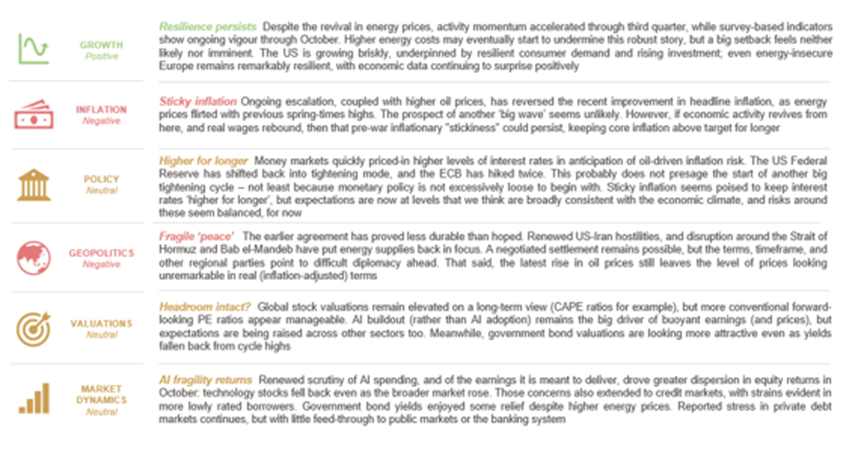
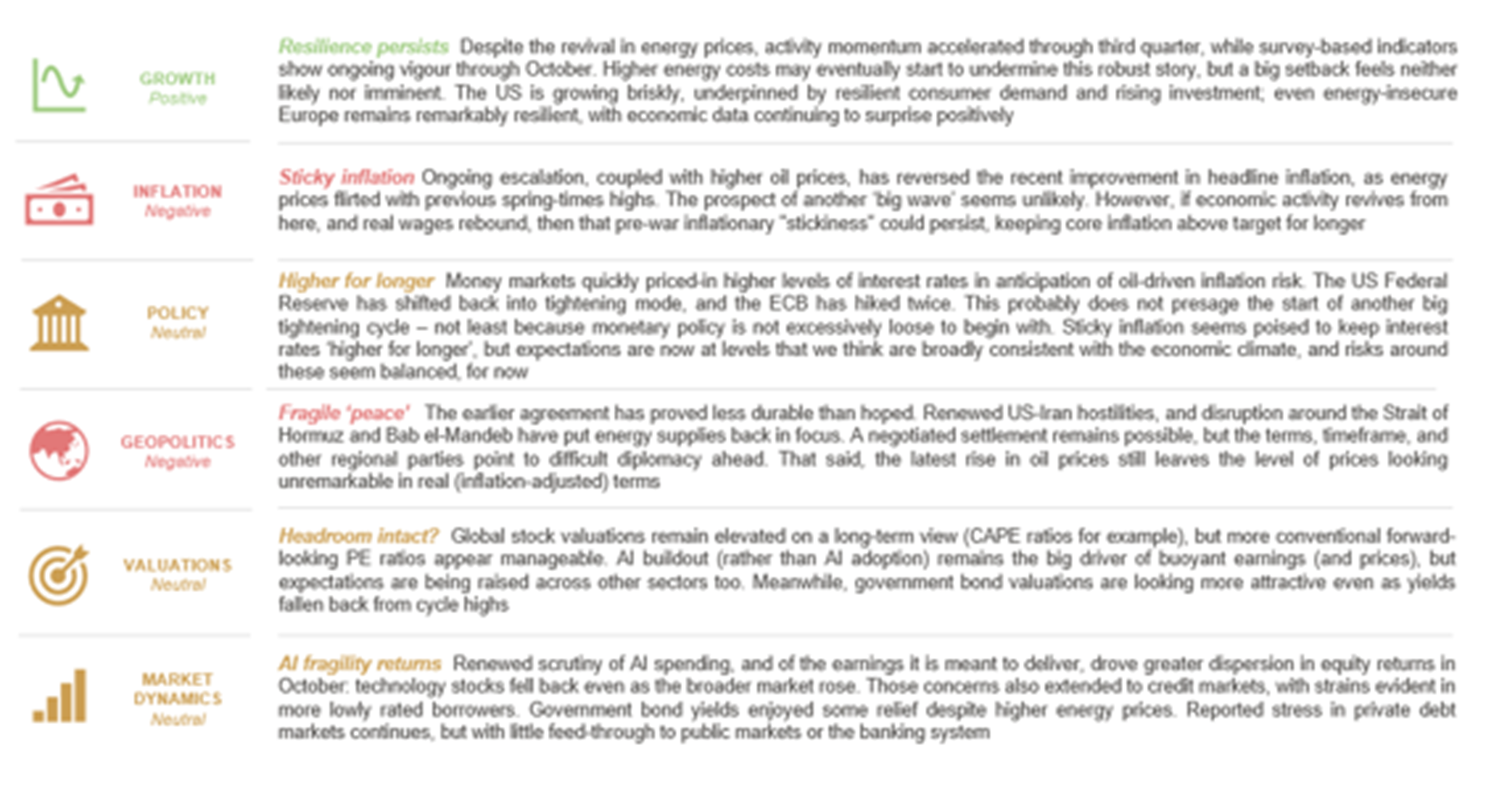
Source: Rothschild and Co
Source: Rothschild and Co
US fundraising in October
Another $20bn+ month in US growth equity – AI less dominant
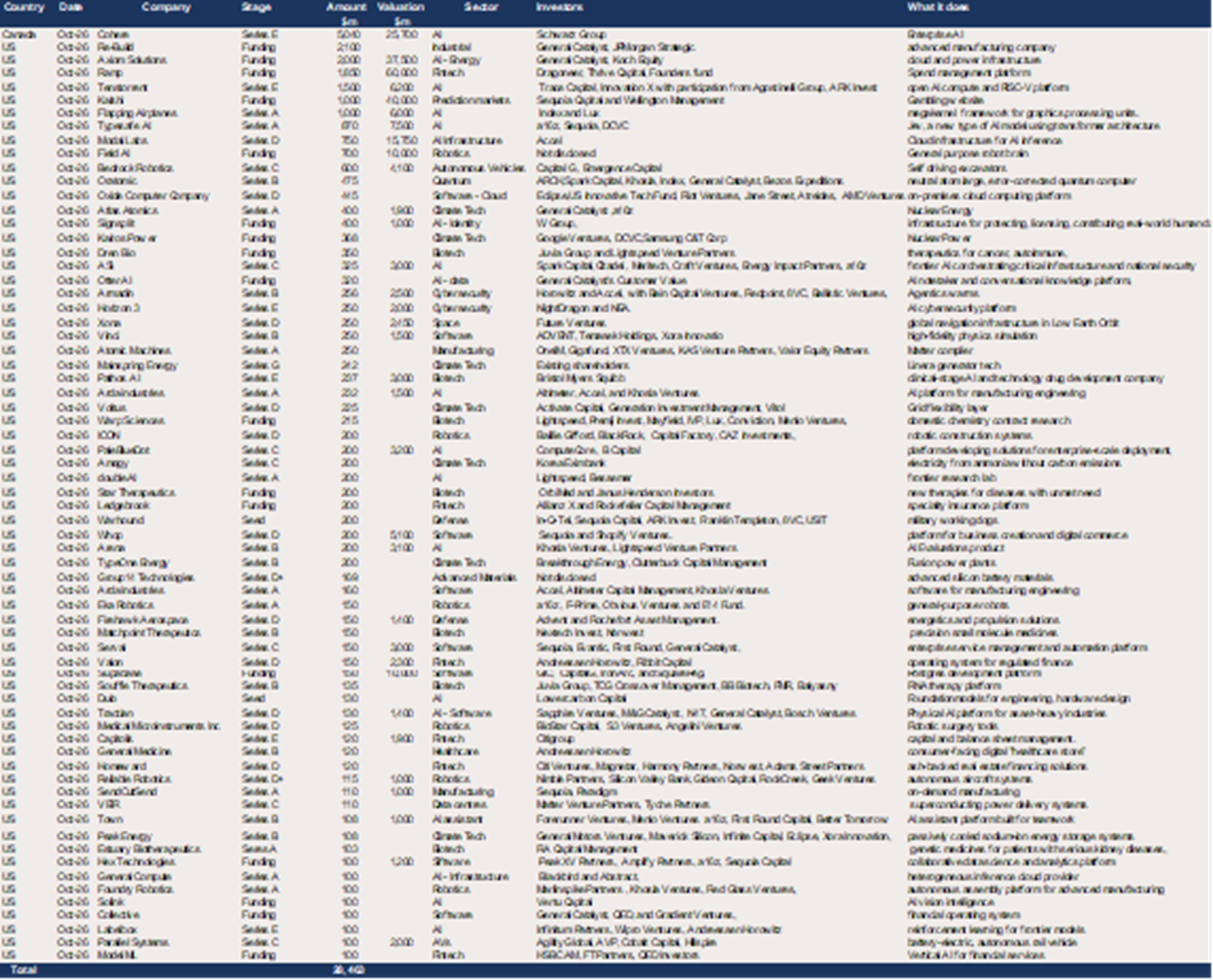
There were 69 raises of $100m or more in the US and Canada in October, by volume matching September which had the highest number of $100m+ raises in three years. By value October was at $28.5bn up 36% against October 2025 but only the sixth largest month ytd. The monthly average for VC raises in the US in 2026 is $46.9bn if one includes the mammoth $181bn of February which included a $110bn raise for OpenAI and a $30bn raise for Anthropic. Excluding February, the average monthly raise total is still $32bn. Ytd to end October the US market has seen raises of $469bn, up 157% yoy.
AI was once again the largest sector in October albeit that with $11.7bn raised was 41% of the total, below the 50% of September and the 71% share in the first nine months of the year. There were no super-sized raises although there were four raises of $1bn and above.
Canada’s largest ever raise. The honour of the largest raise fell to Canada’s Cohere, which announced a Series E funding round of $5bn (CAD $7bn), valuing the company at $25.7bn (CAD $35.7bn). It is the largest private raise ever in Canada and was supported by a CAD $1.6bn investment by the government of Canada. Echoing some of the approach of Europe’s Scale Up Fund Evan Solomon, Canada’s Minister of Artificial Intelligence and Digital Innovation said,
"It is not enough for great companies to start in Canada. We want them to grow here, build here and create good jobs here. That means giving Canadian entrepreneurs the conditions to turn ambitious ideas into globally successful businesses. Investing in Cohere sends a clear message: you should not have to leave Canada to build a company that succeeds around the world. We are backing Canadian talent and giving Canadians a stake in that success."
Other investors in the round include Schwarz Group, one of Europe's largest investors in AI and cloud infrastructure, as lead plus Bell Ventures, Bullhound Capital, Inovia Capital, NVIDIA and Prosperity7 Ventures. Cohere builds large language models specifically designed for enterprise workflows which allow corporates to customise their tools for integration in their products and workflow.
There were two other $1bn + AI raises. Tenstorrent which builds AI hardware and semiconductors as a rival to NVIDIA raised $1.5bn in a Series E led by Trace Capital and Innovation X. It valued the business post money at $6.2bn. The AI research lab, Flapping Airplanes raised $1bn at a $6bn valuation in a Series A led by Index Ventures and Lux Capital.
In the closely related area of AI data centres Axiom Solutions raised $2bn from General Catalyst and Koch Equity. The company is a supplier to AI data centres supplying power supplies, liquid cooling technology and rack-scale integration.
The second largest sector by value was fintech with six raises for a total of $2.5bn. This was dominated by the $1.85bn for Ramp led by Dragoneer, Thrive Capital and the Founders Fund. Ramp has a financial operations and spend management platform used by c70,000 corporates.
Unusually the third largest sector in October was manufacturing with a total of $2.5bn raised across three rounds. Chief amongst these was the $2.1bn raised by Re-Build, led by General Catalyst and JP Morgan Strategic. Re-Build is a manufacturing accelerator which designs products and their manufacturing methods simultaneously to ensure products can be brought successfully to market. The company’s capabilities incorporate custom automation., industrial robots and factory software.
Thereafter four sectors were closely clustered in terms of October’s fundraising.
Climate Tech saw seven rounds raise $1.74bn led by a $400m Series A for Atlas Atomics led by General Catalyst and a16z. It is a nuclear energy business looking to use heavy water technology to avoid reliance on enriched uranium. The second largest raise was also for a nuclear energy business with Kairos Power raising $368m from Google Ventures and DCVC for its small modular reactors using a low-pressure, high-temperature liquid fluoride salt coolant.
Software businesses raised $1.55bn across eight rounds. The largest was the $114m Series D for the Oxide Computer Company for its on-premises cloud systems. The company builds rack-scale systems that combine compute, storage, networking and open-source software to provide cloud-style automation in customer data centres. The round was led by US Innovative Technology, Riot Ventures, Jane Street and Atreides.
Robotics was prominent with six rounds raising $1.39bn led by $700m at a $10bn valuation for Field AI for its general-purpose robot brain.
Biotech had seven raises, also for $1.39bn led by $350m for Dren Bio which is developing power protein-based technologies to deplete pathogenic cells
A couple of other notable raises. The prediction marketplace gambling website Kalshi raised again, this time a $1bn Series G at a $40bn valuation led by Sequoia and Wellington Management. The previous raise was also $1bn in May 2026 at a $22bn valuation.
This Growth Equity Update has focused on quantum and there was one large quantum raise in the US in October, Oratomic’s $475m Series B. Oratomic is a quantum processor business building its quantum computer using neutral atoms which employ lasers to reduce the number of physical qubits to produce the logical qubits. The company has targeted building a utility scale fault tolerant quantum computer by 2030.
US and Canada– 69 raises of $100m+ in October totalling $28.5bn
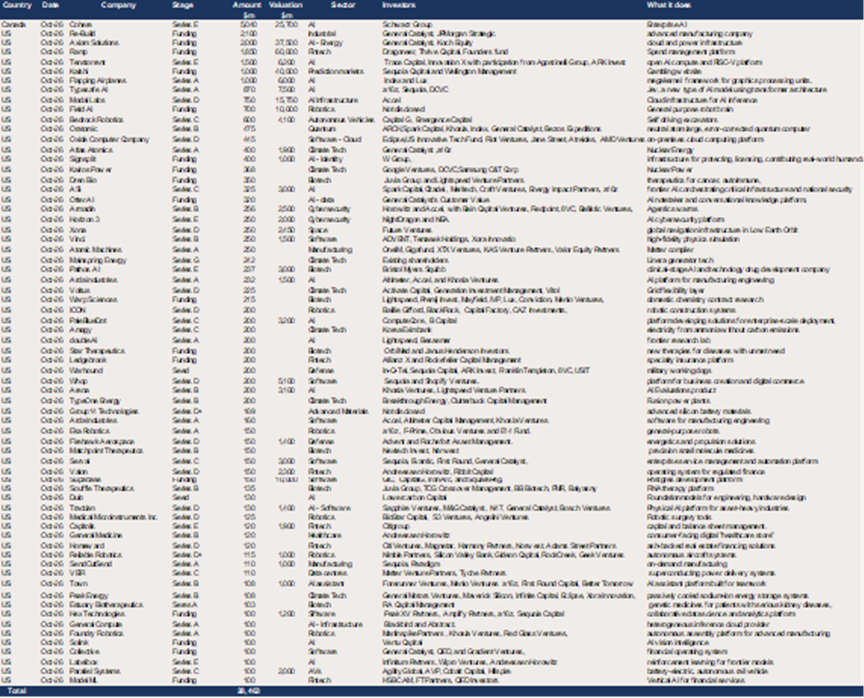
Source: Rothschild and Co
Source: Rothschild and Co
Europe – Back to reality
After September’s record shattering $14.4bn, October was the first yoy down month of 2026 with $5.6bn raised, -8% vs October 2025.
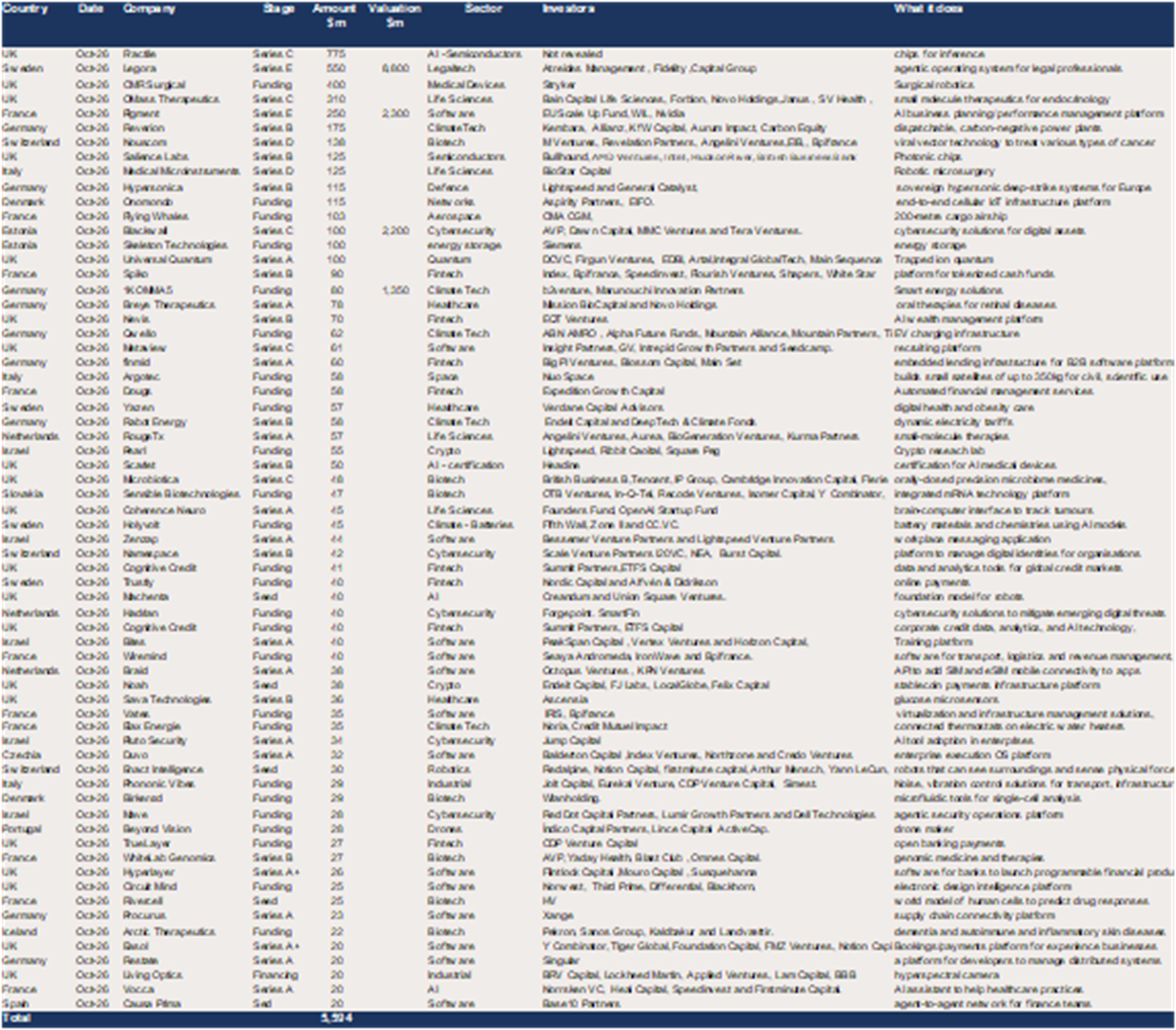
After September’s record breaking, Europe had a more ordinary month in October with 66 raises of $20m or more for a total of $5.6bn. It was the first month of the year down against its equivalent in 2025 with an 8% yoy fall and followed three months which had all been twice the previous year’s total. The $5.6bn compares with a monthly average fundraise of $7.2bn in 2026, including the $14.3bn of September (Mistral, Nscale). Excluding September, the average monthly fundraise in 2026 has been $6.45bn.
It was a diversified month for raises. AI topped the sector list with four raises for $885m led by the $775m for Fractile which develops semiconductors and associated software to speed up AI computing. AI accounted for just 16% of the monthly total down from the 21% that AI represented in the first nine months of the year.
Software companies were in second place with $674m raised across 14 rounds. Only one of these was of a significant size. The French AI business planning performance management platform Pigment raised $250m at a $2.3bn valuation in its Series E. The raise was supported by the European Scale Up Fund- an entity whose activities we reviewed in last month’s Growth Equity Update, by World Innovation Lab and by NVIDIA as a part of its European tour.
Legora, the Swedish legaltech, which is applying AI workflow techniques to legal firms raised a $550m Series E led by Atreides at an $8.8bn valuation. The capital will be used to fund US expansion which is already Legora’ s largest market by revenues despite having only opened its first US office in spring 2025. It will also fund investment in the Legora aOS, its agentic operating system bringing new products like agentic in-take, horizon scanning and legal research. The valuation was $8.8bn post money, up from $5.6bn in the previous round. With ARR at $200m it represents an EV/sales valuation of 41x.
There were $537m of raises in Life Sciences led by the $310m Series C led by Bain Capital Life Sciences for the UK’s OMass Therapeutics which produces small molecule therapeutics for endocrinology.
A couple of other notable raises. The medical device business CMR Surgical received a $400m equity investment from Stryker, the US healthcare products and equipment business. CMR is a leader in robotic assisted surgery specialising in soft tissue procedures. Stryker has an option to buy the balance of the business.
There was one notable quantum raise in the month, a $100m Series A for Universal Quantum which is building a trapped ion quantum processing unit. The round was co-led by DCVC and Firgun Ventures,
Universal Quantum is focused on the iQPU processor which features integrated controls and UQConnect, its modular interconnect, built in from the start. By allowing processors to connect and operate as a single larger system, Universal Quantum believes it has a practical path to utility-scale quantum computing.
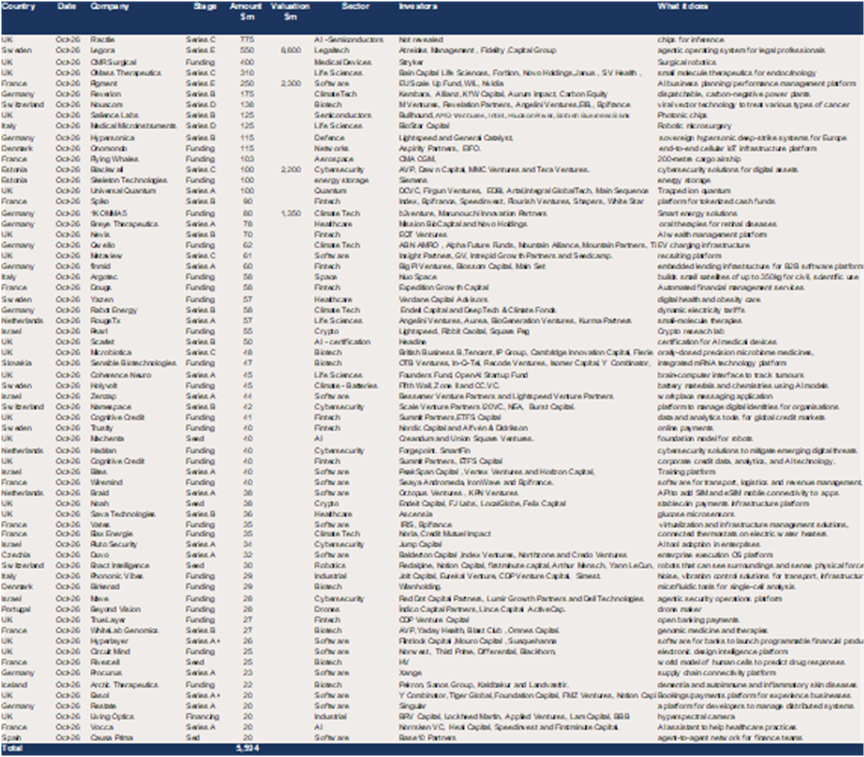
Europe – 66 deals of $20m+ raised $5.6bn in October
Source: Rothschild & Co
Source: Rothschild & Co
Fundraising outlook: c$22bn of impending raises
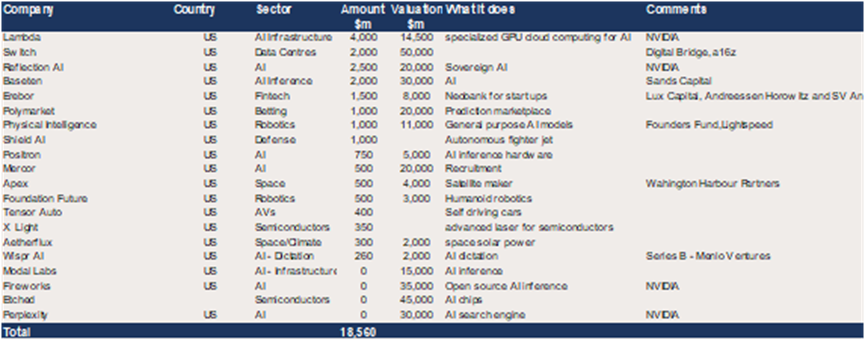
Pipeline is c$22.5bn with $18.5bn in impending US deals and c$4bn in Europe
The pipeline figure drops sharply from $61.5bn to c$22.5bn
The major change is with OpenAI which raised $11bn at a $1.25trn valuation at the start of November. This is a much-reduced size of round. Having announced that it would not IPO in 2026 the company was reported as seeking to raise $30bn in a new funding round at a valuation of $1.4 trillion. At the end of October this was reported as having been downscaled to $20bn at a $1.25trn post money valuation. In the end the company raised $11bn at that valuation against the background of the post mid-term AI sell off.
Also removed from the list Blue Origin, Jeff Bezos’s space business raised $10bn at a valuation of c$140bn with Jeff Bezos supplying $2bn of the funding.
Fal which, by contrast, raised $1.3bn at the start of November instead of the earlier reported $300m also departs the list. The round valued the AI inference business at $16bn, twice the level of its raise in April. Data centre business Fluidstack comes off the list having raised a $1.5bn round with Jane Street. Also departing is cloud platform Applied Compute after its $350m raise at a $3.25bn valuation at the start of November.
The two main additions to the list are Baseten and Shield AI. Baseten which enables AI model infrastructure raised $1.5bn in June at a $13bn valuation and is reportedly now seeking a further $2bn at a $30bn valuation. Defense business Shield AI, which is developing an autonomous fighter jet, is raising $1bn.
US Growth Equity – c$18.5bn in reported upcoming raises
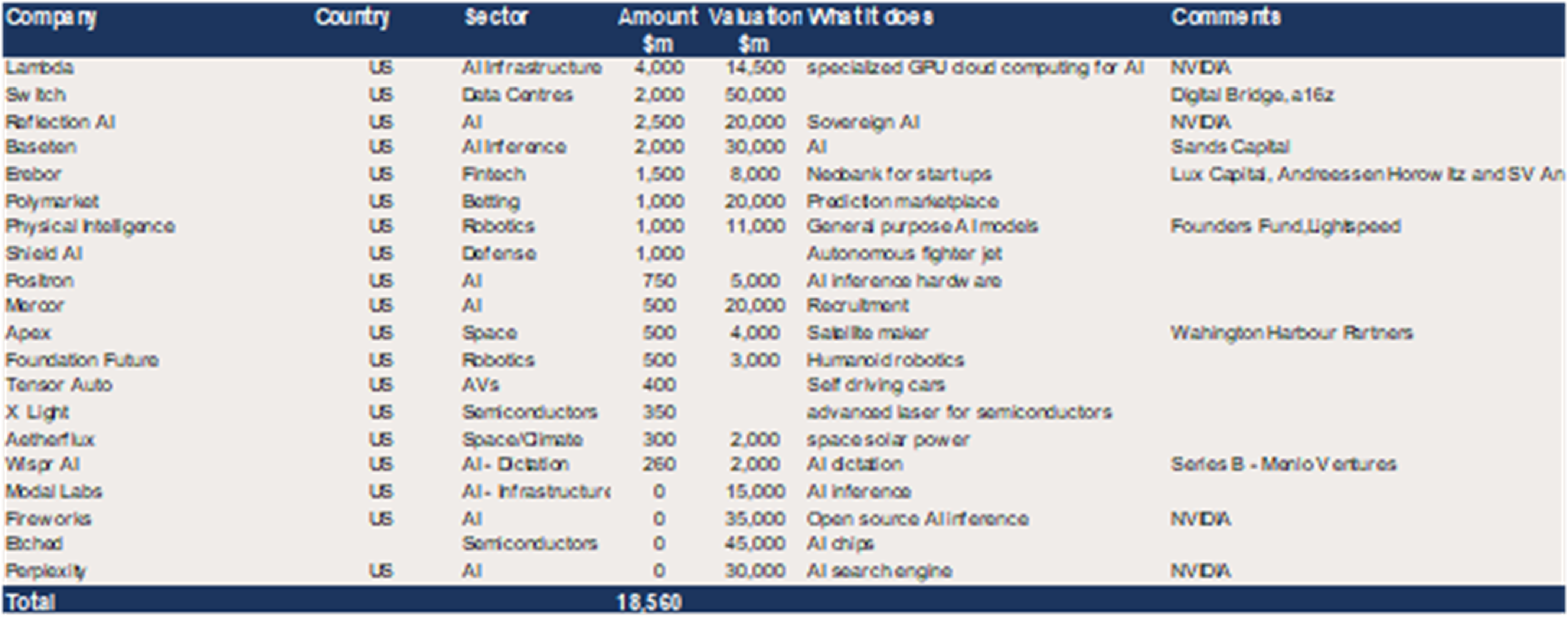
Source: Rothschild & Co; press reports
Source: Rothschild & Co; press reports
In Europe the total of identified impending raises has shrunk again from c$8bn to $4 bn
The major changes are in completed raises. Sweden’s Legora raised a larger than expected $550m round in October (it had been reported at $300m). Fractile, the AI semiconductor business also had a larger than expected raise at $775m versus the reported $600m.
With no major additions to the list this month it remains headed by Agile Robots. The German industrial robots business is said to be raising $800m in a round led by Softbank.
In second is the UK AI lab Emulate, founded in the summer of this year by three former Google DeepMind researchers, which is believed to be close to raising a $700m seed round at a $3.7bn valuation, led by Index Ventures and Lightspeed. It’s a talent raise. At the moment the business has no product.
UK defence company UForce is said to be raising $500m at a $5bn valuation having raised $50m at a $1bn valuation as recently as March. It builds autonomous platforms, counter-drone systems, strike drones, uncrewed surface vessels, and battlefield management software and has seen its equipment deployed extensively in Ukraine.
European Growth Equity – c$4bn in reported upcoming raises
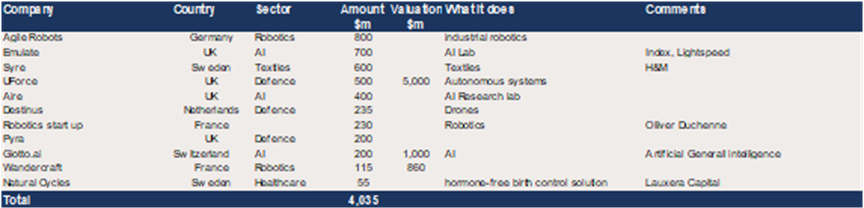
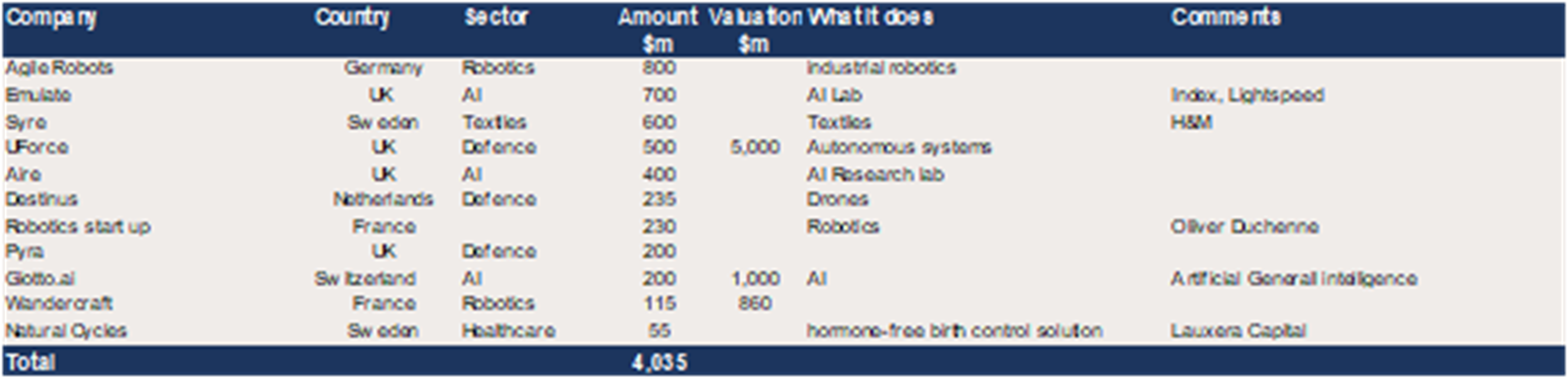
Source: Rothschild & Co; press reports
Source: Rothschild & Co; press reports
Our views on the state of the venture capital markets
This revival of the growth equity market has been led by the US and by a surge of interest in artificial intelligence model providers and for companies using AI to transform a range of underlying industries.
At the same time the venture industry has re-adopted strong underlying approaches to investment with companies in most sectors striving to achieve a better balance of growth, profitability and cash flow. The underlying quality of the cohort of VC backed companies has improved.
Our summary of the outlook
- There is substantial interest in venture capital to fund artificial intelligence, both the foundation LLM models and the applications of AI and industries (data centres, quantum, semiconductors, new energy sources like nuclear and fusion) supporting the development of AI.
- The influence of AI is percolating through many other industries such as drug discovery, defence, robotics, legaltech, autonomous vehicles, and cybersecurity fuelling a broader advance in the growth equity market.
- Overall, the VC market is regaining confidence with the strength of interest with fintech, blockchain/crypto and biotech reviving strongly.
- There is a burgeoning interest in defence industries from investors with both the tense geopolitical political environment, the advances in AI applications and the experience of the combat in Ukraine contributing to investor focus. By contrast, ClimateTech, while still a substantial sector has become less prominent both as a result of some high-profile failures and being less favoured politically in the US under the current administration.
- Fund raising for venture capital firms remains subdued. Fund raising is concentrating into larger, established firms. US VC fundraising in 2025 was concentrated in larger firms and at near decade lows.
- The speed of the investment process has slowed down since 2021-22. The level of diligence on deals has stepped up. This is true even in the ‘hot’ parts of the market like AI. Outside these areas it is marked – processes take time, downside protection is sought.
- Valuation priorities have shifted with investors having moved away from a pure emphasis on revenue growth and revenue multiples. There is a sharp focus instead on the combination of growth and profitability (or a rapid path to it) and on free cash flow.
Rothschild & Co: Selected recent deals in Growth Equity and Private Capital
A selection of recent deals on which we have advised: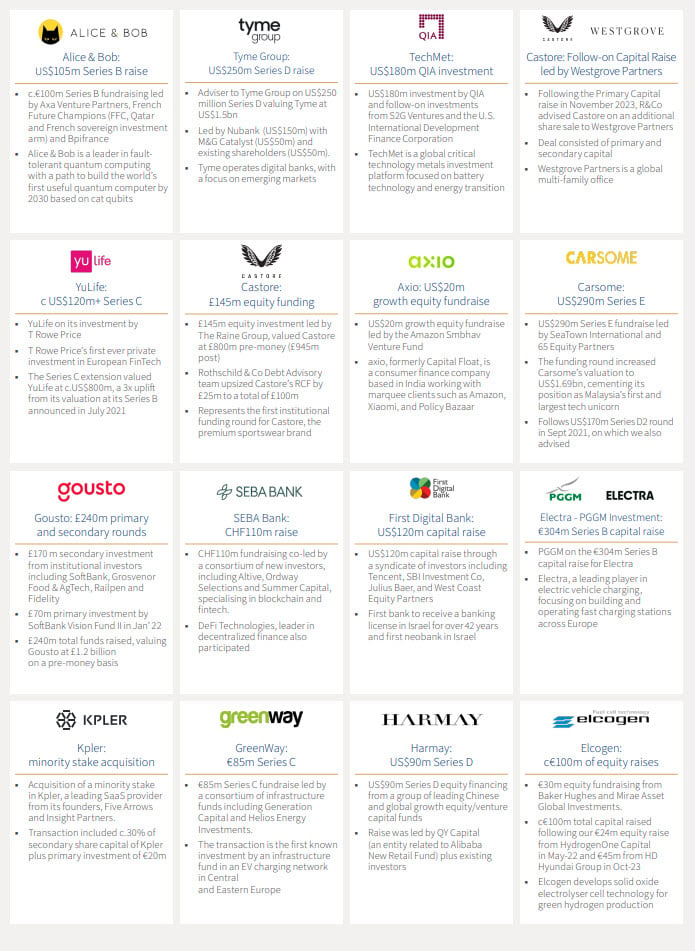
For more information, or advice, contact our Growth Equity team:
Mark Connelly
Co-Head of Global Market Solutions
+1 212 403 5500
+1 917 297 5131
Chris Hawley
Global Head of Strategic and Private Investors.
+44 20 7280 5826
+44 7753 426 961
Patrick Wellington
Vice Chairman of Equity Capital Markets Europe
+44 20 7280 5088
+44 7542 477 291
Antoine de Guillenchmidt
Co-Head of Equity Capital Markets Europe
+44 20 7280 5377
+44 7907 712 978
Pete Nicklin
Co-Head of Equity Capital Markets Europe
+44 20 7280 1668
+44 7912 395 294
Laura Klaassen
Head of Private Distribution
+44 7926 905 488
Thomas Chung
Head of Private Capital, North America
+1 212 403 5559
+1 917 594 7208
Cyrus Danesh
Director of Private Distribution
+44 20 7280 1085
+44 7718 205 387
This document is being provided to the addressed recipients for information only and on a strictly confidential basis. Save as specifically agreed in writing by Rothschild & Co Equity Markets Solutions Limited (“Rothschild & Co”) this document must not be disclosed, copied, reproduced, distributed or passed, in whole or in part, to any other party.
This document does not constitute an offer, inducement or invitation for the sale or purchase of securities, investments or any of the business or assets described in it.
This document has been prepared from publicly available information. This information, which does not purport to be comprehensive, has not been independently verified by us or any other party. The document does not constitute an audit or a due diligence review and should not be construed as such. The information provided should not be relied on for any purpose and should not in any way serve as a substitute for other enquiries and procedures that would (or should) otherwise be undertaken.
No representation or warranty, expressed or implied, is or will be made and, save in the case of fraud, no responsibility or liability is or will be accepted by us, as to or in relation to the accuracy, sufficiency or completeness of this document or the information forming the basis of the document or for any reliance placed on the document by any person whatsoever. No representation or warranty, expressed or implied, is or will be made as to the achievement or reasonableness of, and no reliance should be placed on, any projection, targets, estimates or forecasts and nothing in this document should be relied on as a promise or representation as to the future.
Law or other regulation may restrict the distribution of this document in certain jurisdictions. Accordingly, recipients of this document should inform themselves about and observe all applicable legal and regulatory requirements. This document does not constitute an offer inducement, or invitation to sell or purchase securities or other investments in any jurisdiction. Accordingly, this document does not constitute a Financial Promotion under the Financial Services and Markets Act 2000 (Financial Promotion) Order 2005 or equivalent legislation in other jurisdictions. This document is being distributed on the basis that each person in the United Kingdom to whom it is issued is reasonably believed to be such a person as is described in Article 19 (Investment professionals) or Article 49 (High net worth companies, unincorporated associations etc.) of the Financial Services and Markets Act 2000 (Financial Promotion) Order 2005 or is a person to whom this document may otherwise lawfully be distributed. In other jurisdictions, this document is being distributed on the basis that each person to whom it is issued is reasonably believed to be a Professional Investor as defined under the local regulatory framework. Persons who do not fall within such descriptions may not act upon the information contained in this document.