Bonds, ballots, and the elephant in the room
Foreword
Three themes have been shaping portfolios through the summer: politics; bond yields; and (inevitably) AI.
The collapse of the US-Iran ceasefire has pushed oil prices higher again, but not (yet) to levels which threaten more significant disruption to global business. Further escalation is possible – but, even at this stage, so too are more constructive outcomes.
More generally, populism remains rampant, and not just in the US. Below we survey the field, from looming US midterms to France’s presidential race in 2027. The most common theme may be an instinct to “stick it to the man”, but its investment implications are unclear.
Meanwhile, that rebound in oil prices has coincided with a further re-think on interest rates and bond yields, with central banks following through as we write. Many longerdated yields in particular have reached levels not seen for a while.
However, we argue that those yields are in fact not (yet) that remarkable – recent history has hardly been “normal” – and that their drivers are more nuanced than headlines suggest. And if economic growth is one of those drivers, it is far too soon to see yields themselves as recessionary.
The third theme – AI – must, in this Market Perspective, remain the elephant in the room.
Our longer-term thinking on stocks has not changed, but our view of 2026 corporate earnings certainly has.
AI has driven a big chunk of a remarkable surge, which is supporting stock prices and muting the impact of higher discount rates on near-term valuations. With US stock indices recently touching all-time highs, the 12-month forward P/E ratio is 20x – which, with Return on Equity at a record 20%, is far from outlandish.
The problem, of course, is that it is the build-out of AI capacity, not its use, which is largely driving those earnings. Despite the increasingly King Lear-like proclamations of its creators (“I will do such things… What they are, yet I know not: but they shall be… The terrors of the earth!”) we still suspect that AI's near-term impact may be less dramatic.
Kevin Gardiner & Victor Balfour
Global Investment Strategists
Bonds: licence to thrill?
“It’s the economy, stupid!” – James Carville, 1992
SOARING YIELDS, SURGING CRUDE, STIFLING DEBT
Boring bonds? Not recently. After spending most of a decade at historic highs, bond prices slumped as interest rates rebounded sharply after 2021. They seemed to settle in 2024-25, but in 2026 the slide has resumed, gaining momentum and visibility (bonds are in the news!) in recent weeks.
As prices fall, yields rise. Longer-dated bonds, with their greater duration (a measure of where their cash flow is centred) have been the most volatile.
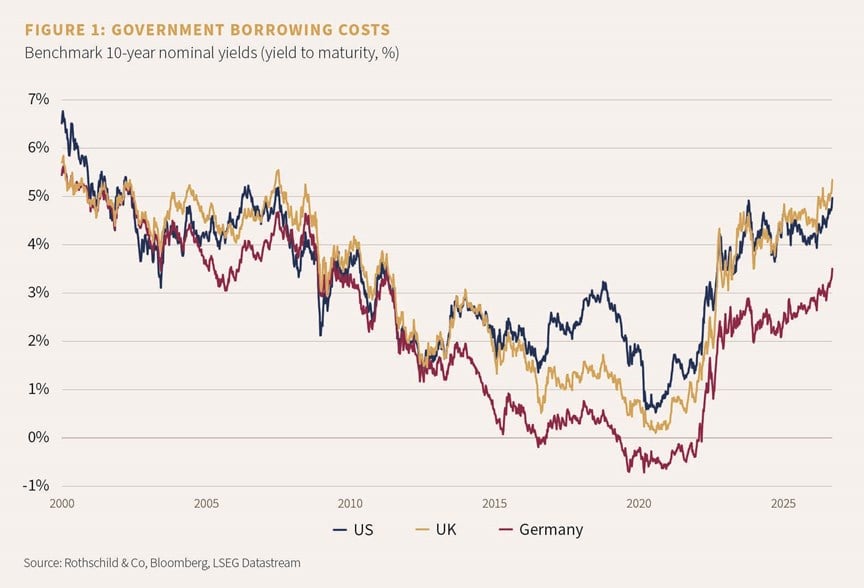
The biggest moves and highest yields are at the illiquid, far end of the yield curve, a noisy place at the best of times. The 30-year UK gilt yield is at levels last seen in 1998. But some more liquid and influential ten-year yields, notably in Germany and the UK, have also broken out of recent trading ranges and are at post-GFC (Global Financial Crisis) highs (figure 1).
The renewed slide in bonds in 2026 has coincided with the US-Iran conflict, and the inflation risk associated with higher oil prices. Indeed, the conflict can sometimes seem to be moving yields on a day-to-day basis.
It has also coincided with concerns about government borrowing. US federal debt has just breached an eye-catching $40 trillion; this month’s UK administration has wasted no time in dodging difficult decisions; there are chronic fiscal concerns in France, Italy and Japan; even Germany seems poised to run a meaningful deficit, perhaps as much as 4% of GDP in the current fiscal year.
SOME PERSPECTIVE
However, today’s “soaring” yields may not be quite as alarming as all this makes them sound.
The history which makes them look “historic” is itself far from normal. Meanwhile, oil prices and government borrowing are not the only drivers: there may be other, more routine forces at work too.
There have been bigger moves in yields quite recently – most notably after the pandemic.
Then, interest rates and bond yields had only recently begun to rebound from “emergency” low levels established after the GFC, when lockdowns struck, and yields dipped to new (all-time) lows. However, confident proclamations that “things will never be the same” were followed within a year by an old-fashioned, business-as-usual inflationary surge (amplified subsequently by Russia’s invasion of Ukraine).
So, just as economists had convinced themselves that negligible or negative levels of interest rates were normal, significant positive discount rates re-emerged. This “normalisation” was much more dramatic than this summer’s events. Again, figure 1 refers.
That surge in yields had little visible effect on the big economies, despite many confident predictions (again) that “zombie” businesses and mortgaged consumers wouldn’t be able to cope. Food for thought, perhaps, as we gauge the likely impact of today’s moves (and see below).
WHAT LIES BEHIND?
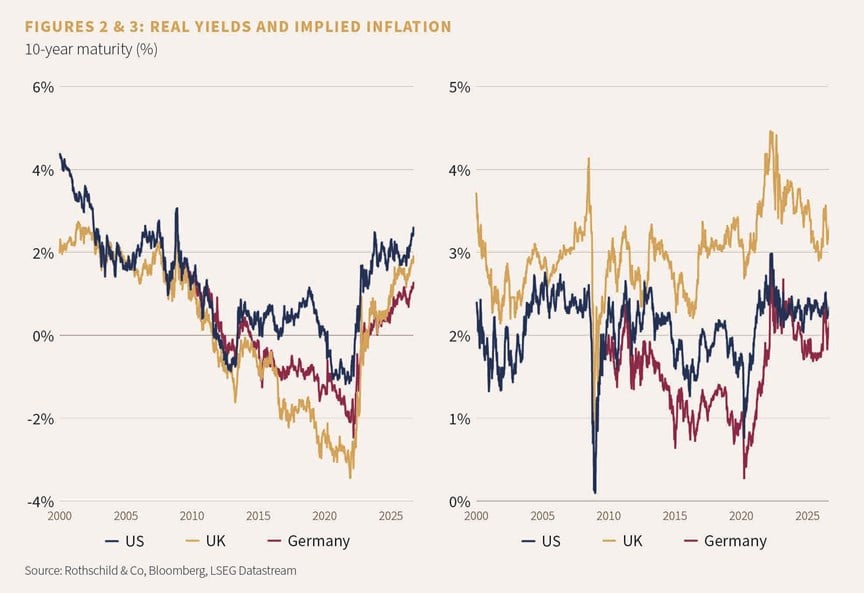
Digging a bit deeper, the existence of inflation-indexed bonds (“index-linked” gilts in the UK) allows us to decompose yields into the implied inflationary and real components priced-in by markets. The normalisation of longer-term yields since 2021 mostly reflects not a change in expected inflation, but higher real yields (figure 2). This seems to be true of this summer’s moves too, at least in the US. Oil-related inflation – which is in any case short-term in nature – may not be the only driver of higher yields.
The influence of government borrowing may also be smaller than it looks. The eye-catching numbers are not quite as dramatic when scaled according to the size of national economies. Of course $40 trillion is a very large number – but $32 trillion, the size of US GDP, is in the same ballpark, and the relationship between the two, the debt/GDP ratio, has not changed much recently.
Moreover, even when this and other such ratios do change, there is very little sign – even in “normal” times – of it durably affecting the level of yields. This is true not just over time, but across countries too. Countries with very different levels of borrowing can have similar bond yields (for example, Germany and Japan), and vice versa (Canada and Switzerland).
The recent widening of the gap – “spread” – between UK and German yields for example is as likely to reflect divergent inflation and growth prospects (see below) as it is debt levels.
The image of “bond vigilantes” ruthlessly, precisely and constantly policing the levels of government borrowing is a misleading caricature.
This does not mean we are in favour of governments borrowing thoughtlessly or irresponsibly!
There may well be a threshold above which government borrowing has a more visible impact on yields: intuitively, we’d expect some sort of connection. But we haven’t found it yet – not for want of trying: see Reinhart and Rogoff’s “This Time It’s Different: Eight Centuries of Financial Folly” published in 2009).
The debt arithmetic itself is not as scary as the “debt-interest-is bigger-than-the-defencebudget” headlines suggest. As we note elsewhere, small changes in the relative growth rates of revenues and expenditures can transform prospective debt levels – in either direction.
In the case of the US government, whose 10-year borrowing costs give the world’s capital markets their notionally “riskless” discount rate, taxes could rise (eventually) by five percentage points of GDP and it would still be a relatively low-tax economy.
Another reason why yields don’t seem to be neatly correlated with debt is that lots of other things might matter to borrowing costs too. Which brings us to…
Its the economy, stupid."
This was Clinton campaign adviser James Carville’s reminder of what mattered most to voters.
It is good advice when it comes to bond markets too.
The business cycle is the most visible driver of bond yields. Inflation (and not just that component of it linked to oil prices) is an important component of the cycle – but so too is real growth, and the impact it can have on real yields.
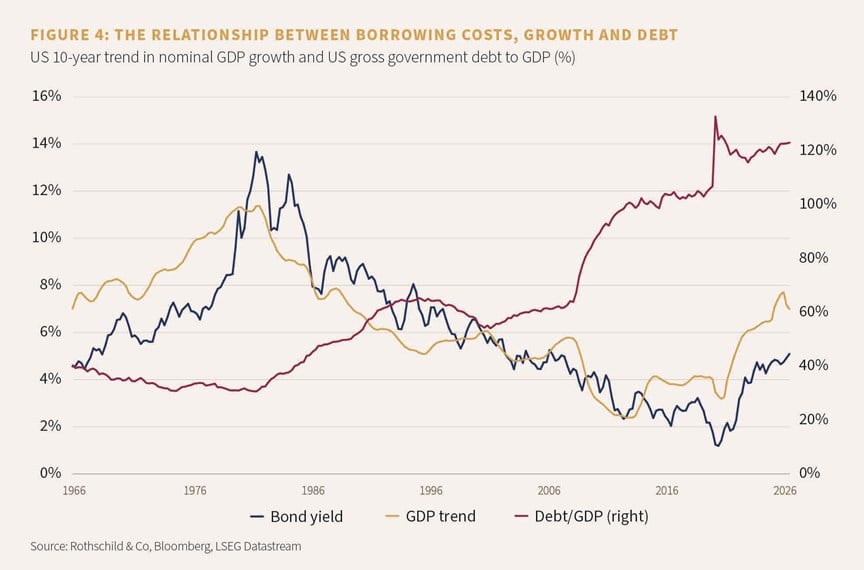
Figure 4 makes the point very clearly, showing how the US 10-year Treasury yield moves much more in line with trend growth in nominal GDP – inflation plus real growth – than it does with the debt/GDP ratio (a similar picture can be drawn for the UK).
Received wisdom has been downbeat on growth (part of what we’ve called the “Wall of Worry”) since the GFC. Pundits have mistakenly seen another major setback around almost every corner. They didn’t expect the pandemic, but were quick to extrapolate lockdowns into that long-awaited slump. Then it was to be the post-2021 rebound in interest rates that would deliver it; then energy costs in 2022; then tariffs; and most recently, the US-Iran conflict and trade disruption.
Slowly, and unacknowledged yet in official forecasts, consensus thinking may be registering that the global economy can be pretty resilient.
Healthier trend growth, in relatively fully-employed economies, means more underlying inflation risk, bigger returns to capital, and higher demand for it by from growing businesses.
Intriguingly, however, the rising real yields which growth brings can help keep a lid on the inflation expectations it might otherwise arouse. By sanctioning those higher yields with higher policy rates, central banks tighten monetary conditions, which acts to keep a lid on longerterm inflation expectations – as is perhaps happening now. Inflation risk can show up as higher real yields.
Certainly, the central banks seem to have learned their lessons from the post-pandemic inflation surge, when they left rates far too low for too long. The new Federal Reserve Chairman in particular seems laudably keen to assert his independence – remarkably so, given that it was the President who nominated him for the job.
A very visible driver of current growth of course is the continuing AI build-out, which has contributed significantly to US GDP gains in particular, and pushed US profitability to record levels.
That profitability itself may be (yet) another short-term influence on bond yields. If US Inc can deliver a 20% return on equity, shouldn’t other forms of capital also be more productive?
Meanwhile, the build-out itself may shortly tip US Inc into financial deficit. Private sector borrowing however doesn’t get the attention that government borrowing does – and either, or both, still correlate less well with yields than the business cycle itself.
WHERE SHOULD YIELDS SETTLE?
As shown in Figure 4, a useful rule of thumb is that bond yields (and interest rates generally) will, over time, tend to match trend growth in nominal GDP.
This sort of makes sense. A “neutral” Treasury yield or bank rate might be one which is consistent with a stable government balance sheet, and borrowing costs in line with growth in the tax base (which is what nominal GDP is).
We have both judgmental and statistical models of “neutral” yields, with nominal GDP featuring in both. For almost as long as we can remember, the judgemental model has suggested fair value yields of 4-5% for the US and UK, and 3-4% for the eurozone.
This left us looking very bearish on bonds through much of the post-GFC period, when yields – and often nominal GDP growth – fell far short of this. Luckily, the possibility of yields staying “lower for longer” was pretty quickly visible, saving our tactical blushes.
Now, if anything, today’s US and UK 10-year yields look to us as if they are overshooting – a bit.
At the risk of stating the obvious, anyone who says, after the last decade’s roller coaster ride in yields, that they know exactly where “fair value” lies, is kidding themselves. We referred to the “normalisation” of yields earlier, and we have our opinions; but none of us can be sure whether “normal” even exists. We are all to some extent looking for our bearings.
CONCLUSION
The reasons for higher bond yields are more nuanced than headlines suggest: it’s not just about oil prices and government debt.
Expectations of firmer trend economic growth; a background of proactive monetary policy; currently-elevated returns on corporate capital, and a looming surge in AI-related demand for capital; and uncertainty over what “normal” yields really look like these days – we think all these things are playing a role.
If the economy is indeed a big part of the story, then cause and effect is currently running from GDP to yields (as it does most of the time – figure 4 again). At some stage, if yields and mortgage costs rise far enough, and/or consumer and business confidence and cashflow falter, causality could reverse and lead to a recession – but that (still) does not feel imminent.
Whatever the exact combination of forces at work, if government and monetary credibility remain intact (as we expect), more and more bonds are offering plausibly inflation-beating returns.
Clearly, yields could overshoot more materially, and other assets might remain more attractive.
Tactically, we remain on the fence. But today’s yields, held to maturity, may make bonds useful as sources of long-term returns in their own right, not just as diversifying investments.
Politics and populism
The curse of the midterms
We are entering the final weeks of the US midterm campaign, and the prospect of the Democrats regaining at least one chamber of Congress has moved firmly into focus. The House looks the more vulnerable of the two chambers: all 435 seats are being contested, the Republican majority is narrow, and the polling is firmly in one direction (figure 5). The Senate remains a closer call, despite a larger-than-usual number of Republican-held seats on the ballot. As ever, national polls are an imperfect guide to district- and state-level outcomes, but the direction of travel is no longer ambiguous.
The Republican midterm campaign is increasingly centred on Trump himself: tax cuts, deregulation, immigration controls, tariffs and an unapologetically transactional foreign policy.
But that record is also marked by controversy: a roughshod approach to due process, strained alliances and tariff rates at levels not seen in a century. There is also the obvious omission: the Middle East conflict and Iran’s Weapon of Mass Disruption. Echoes of the late President Carter’s unceremonious exit from office loom large.
This has been a performative administration, rich in pageantry and theatrics. His latest plan, a proposed $5,000 handout to voters, looks less like serious policy than a masterclass in deflection. It is legally questionable, fiscally reckless and unlikely to pass muster with Congress (Republican controlled or otherwise). But that is beside the point: the populist offer creates goodwill, dominates the news cycle and distracts from the unresolved – often self-inflicted – challenges facing the administration.
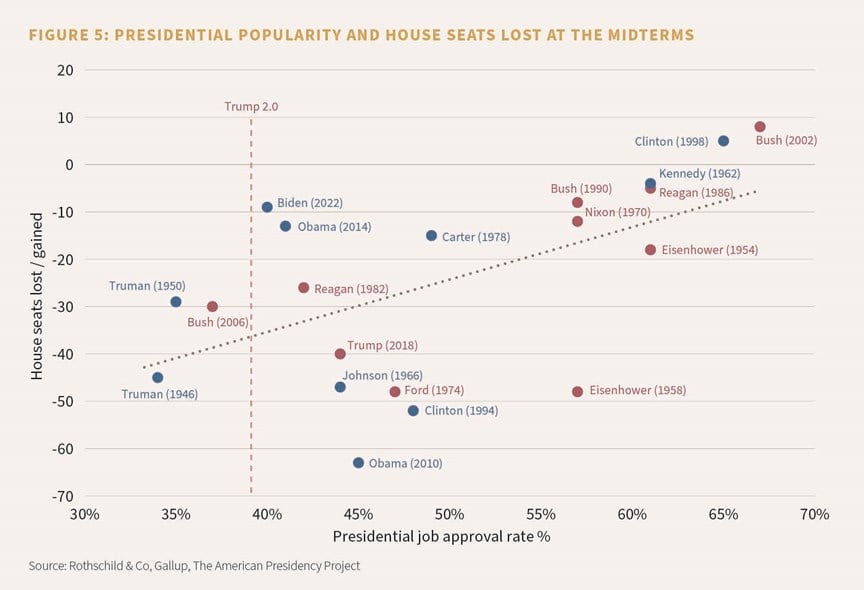
Democratic momentum seems driven less by a compelling alternative offer than by familiar cyclical forces: persistent cost-of-living concerns, incumbent fatigue and unease with an administration that has moved fast and attempted to break things. That approach may now be running out of road. Trump’s approval ratings are among the weakest recorded by any recent president, including during his own first term.
Outside the US, the midterms have attracted less global attention than in previous cycles. They may have been overshadowed by other events, including hostilities in the Middle East.
But there is another not-so-subtle point: perhaps investors suspect that the composition of Congress matters less than it once did. Trump has often governed by executive fiat, resorting to unusual mechanisms and obscure legislation to advance a polemical agenda, while a divided Republican Congress has been unable – unwilling – to constrain executive overreach.
Even if the Democrats retake control of Congress, holding the President to account for his transgressions is a long and tortuous road – the bar for impeachment may be low, but conviction is another matter. A ‘clean sweep’ could introduce considerable friction into the political system: confirmations would be slower, budget negotiations more dysfunctional and any big legislative agenda would need bipartisan support. But the point is that Donald Trump’s lame-duck status – if that is indeed what awaits him – may not make the current situation dramatically more uncertain than it already is. That said, a visible political pivot back towards the Democrats could ease their path back to the Oval Office in 2028 – if they can unite behind a credible candidate.
Political uncertainty is usually unhelpful for markets, and the coming weeks may well bring more volatility. Trump’s second term has unsettled trade policy and diplomacy, but the economic damage has so far been less visible than the rhetoric – and many economists – suggested. The portfolio consequences of further US political dysfunction may simply not be large enough to justify taking evasive action.
EUROPEAN POPULISTS
The US is not alone in finding itself in a state of political flux: Europe’s political landscape is shifting too.
The UK has already moved on to yet another prime minister, with the political emphasis again seemingly falling on the “levelling up” of left-behind regions, using higher taxes and bigger government if need be (a strategy that has had limited success in the past). The government itself may be drawn from one of the established parties, but it is looking over both shoulders at populist challengers. Ahead, France, Germany and possibly Italy all face meaningful political pressure, at least if weak approval ratings are a guide (figure 6).
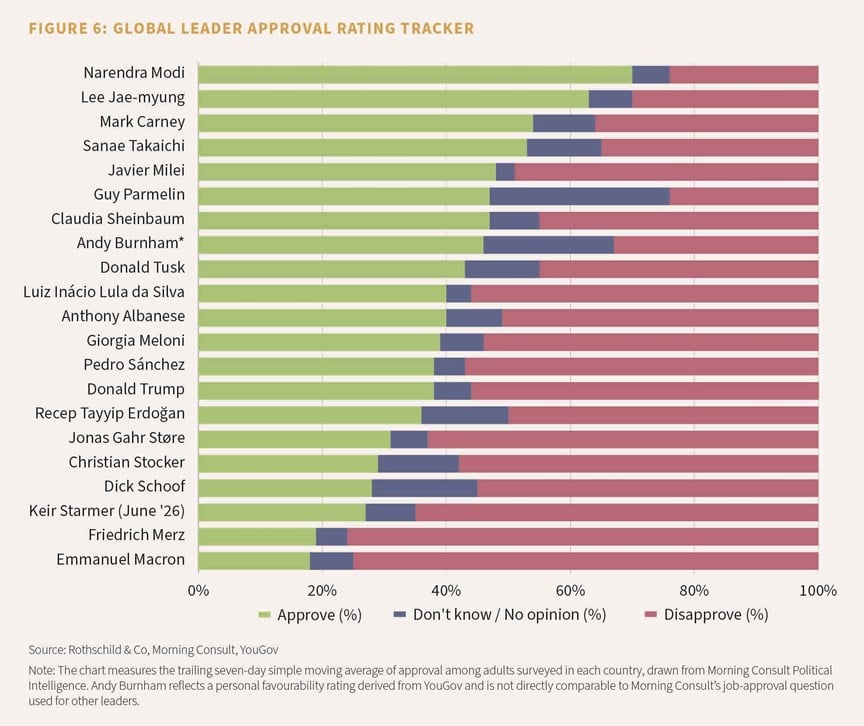
The public debate has become more ill-tempered, divisive and partisan – and arguably less rational. It would be tempting to see the rise of nationalist-populist parties as part of a single, sweeping narrative: a wholesale rejection of the EU, globalisation and even liberal democracy itself. But this would be an oversimplification.
The sources of tension are varied: political incompetence, fiscal largesse, foreign competition, fading living standards and the symbolic weight of irregular migration (even super-composed Switzerland, which remains part of the Schengen group, had a failed referendum on capping its population at 10 million people over the summer). Inequality and artificial intelligence add to the unease: the labour share of national income appears to be at, or close to, record lows in many economies, while AI is intensifying – perhaps prematurely – concerns about worker displacement.
If there is a unifying theme, it may simply be that of 'sticking it to the man'. But exactly who the man is, has varied over time and across countries."
France looks like Europe’s most consequential political fault line. When Emmanuel Macron first arrived on the scene, En Marche ! (later ‘La République En Marche !’ before being officially renamed ‘Renaissance’ or RE in September 2022) was seen as a youthful riposte to the established parties.
His parliamentary majority has disappeared, and the revolving door of prime ministers – four in the past two years – underlines the Sisyphean task of restoring fiscal probity. The political backdrop is now increasingly polarised between Marine Le Pen’s right-wing Rassemblement National and Jean-Luc Mélenchon’s left-wing La France Insoumise, with the latter arguably the more unsettling prospect for markets. A larger state and talk of debt restructuring are unlikely to improve France’s cyclical fortunes or reverse the rise in borrowing costs.
Le Pen, who appears well placed ahead of next year’s presidential race, has rebranded the party, distancing it from its uglier and more divisive roots. Even so, the risk of a hung parliament points to a fractious — and legislatively awkward — political landscape. The likely policy direction would be less supportive of fiscal consolidation, more restrictive on immigration and more confrontational towards aspects of EU governance.
Germany’s traditional party system – and the era of the Grand Coalition between the CDU/CSU and SPD – is also under pressure from the rise of the Alternative für Deutschland (AfD). Friedrich Merz’s initial momentum, including the loosening of the debt brake and ambitions for economic reform, has been only partially successful. Growth has been tepid, and German industrial competitiveness is being undermined by both cyclical and structural headwinds. The much-debated and long-awaited fiscal stimulus aimed at boosting defence and infrastructure spending has yet to take effect.
The AfD has been effective at channelling discontent. Calls for tighter migration policy remains the most obvious flashpoint, but so too the debate over Germany’s fiscal and industrial strategy. Although the next federal election is not due until 2029, further AfD gains in state elections may pose the most immediate threat to Merz’s authority. Germany’s proportional representation system limits what the AfD can achieve without coalition partners, but that assumes that the so-called “firewall” remains intact.
For much of the past four years, Italy has offered a reassuring counterpoint to the more alarmist interpretation gripping the Franco-German axis. Giorgia Meloni has been a rare beacon of stability – presiding over the longest uninterrupted post-war term in office. However, this political stability still risks being upended at next year’s general election by the rise of Futuro Nazionale, a Eurosceptic populist party formed in February and already polling higher than Meloni’s coalition partners at around 8%. It’s possible that Italy’s general election - which must be held no later than the end of 2027 – might be brought forward to head off FN’s momentum.
Eurosceptic contenders aside, Meloni’s coalition has shown that politicians can enter office with nationalist and anti-establishment credentials but govern more pragmatically once confronted with fiscal and political reality.
We are wary of Big Pictures at the best of times. As we have argued before, “populism” is better understood as a tactic than an ideology. It can attach itself to the left or the right, to fiscal expansion or fiscal restraint, and to cultural grievance as much as economic insecurity. A strong showing for populist parties would be politically significant, but it would not necessarily amount to a decisive setback for European integration. A workable populist majority still looks unlikely, and these parties remain divided on many of the issues that matter most for policy: Russia, Ukraine, fiscal transfers, defence, agriculture and national interests.
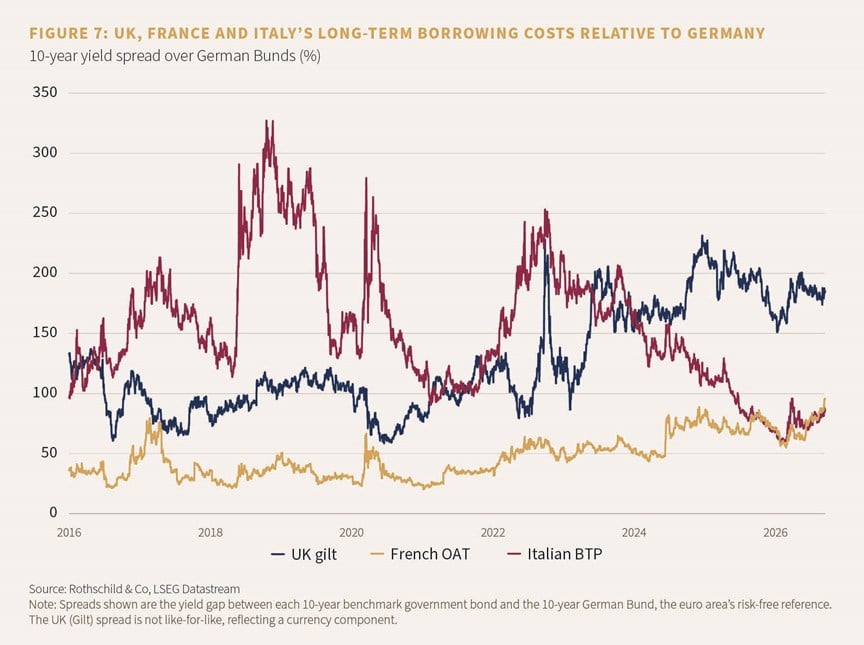
For investors, the more immediate risk is not nationalism, but whether ambitious political promises undermine the fiscal arithmetic (and European rules). On this count, France appears most vulnerable to fiscal slippage concerns, but even here rising borrowing costs are not yet signalling distress (figure 7).
We should be careful not to overstate the likely macroeconomic impact: local economic and business conditions should prove reasonably resilient, and need not be overwhelmed by fragmented politics. Market volatility may resurface, but this need not point to a fundamentally more difficult European economic outlook.
Ready to begin your journey with us?
Speak to a Client Adviser in the UK or Switzerland
Past performance is not a guide to future performance and nothing in this blog constitutes advice. Although the information and data herein are obtained from sources believed to be reliable, no representation or warranty, expressed or implied, is or will be made and, save in the case of fraud, no responsibility or liability is or will be accepted by Rothschild & Co Wealth Management UK Limited as to or in relation to the fairness, accuracy or completeness of this document or the information forming the basis of this document or for any reliance placed on this document by any person whatsoever. In particular, no representation or warranty is given as to the achievement or reasonableness of any future projections, targets, estimates or forecasts contained in this document. Furthermore, all opinions and data used in this document are subject to change without prior notice.