Growth Equity Update September 2026 - Edition 54

- Ranking Venture capitalists: In early September Pitchbook issued its latest global ranking of venture capitalists based on a survey of the deal and exit history since 2010 of 37,000 venture firms, aiming to identify consistently successful VC firms producing successful investment outcomes. Its top five global firms emerged as Accel, Index Ventures, Sequoia, Benchmark and Andreessen Horowitz. Its highest ranked European firms were Index Ventures, Balderton Capital, Global Founders Capital, HV (Germany) and Seedcamp.
- Sequoia, Andreessen Horowitz and Accel do consistently well: There is a relatively high correlation with the results of the Strebulaev-Jackson Venture Ranking, a new 2026 ranking of the top 100 US-based VC firms over a 30-year window which we reported on in July. Its ‘transparent, fully data-driven ranking of which VC firms are actually best at what they do’ also ranked Sequoia, Andreessen Horowitz and Accel in its top five.
- Mistral’s $3.5bn Series D - the largest VC raise ever in Europe: Mistral’s recently announced $3.5bn raise is the largest ever for a European start up, beating Mistral’s own $2bn Series C in September 2025. The latest round was led by Samsung Electronics, the Scaleup Europe Fund (managed by EQT) and PSG Equity, valued Mistral at $24bn and will facilitate Mistral’s shift towards offering a full stack alternative likely to appeal to governments and businesses in Europe that are sensitive to sovereignty issues. To accomplish this Mistral is moving to open weight LLM models and towards providing the data centres and private infrastructure a sovereign offer requires.
- Europe and Venture capital funding: Europe’s governments continue to look to stimulate venture growth. The brand-new, later stage, Scaleup Europe Fund has already invested in Mistral, Lovable and the Exploration Company. We review the EU’s recent snappily titled report ‘Study of barriers to, and drivers of, the scaling up of funds investing in innovative and growth companies’ and review external commentary on what the EU might do to stimulate growth investment.
- No slowdown in the summer: Not much of a summer break for either the US or European VC market in August. US venture raises totalled almost $21bn (vs $6.5bn in August 2025) and European raises of $3.8bn were twice the August 2025 total.
Download a PDF version of the 54th Growth Equity Update
Ranking the top VC firms
Independent surveys of the best VC firms see Sequoia, Andreessen Horowitz, Accel, Index and Lightspeed do consistently well.
In the July edition of the Growth Equity Update we reported on a fascinating study by Stanford University’s Ilya A. Strebulaev and Ohio University’s Blake Jackson which ranks venture investors. Published in mid-June, the authors’ 2026 Venture Ranking of the top 100 US-based VC firms was drawn from more than 230,000 investments by nearly 13,000 venture capitalists over a 30-year window. They describe it as a ‘transparent, fully data-driven ranking of which VC firms are actually best at what they do.’
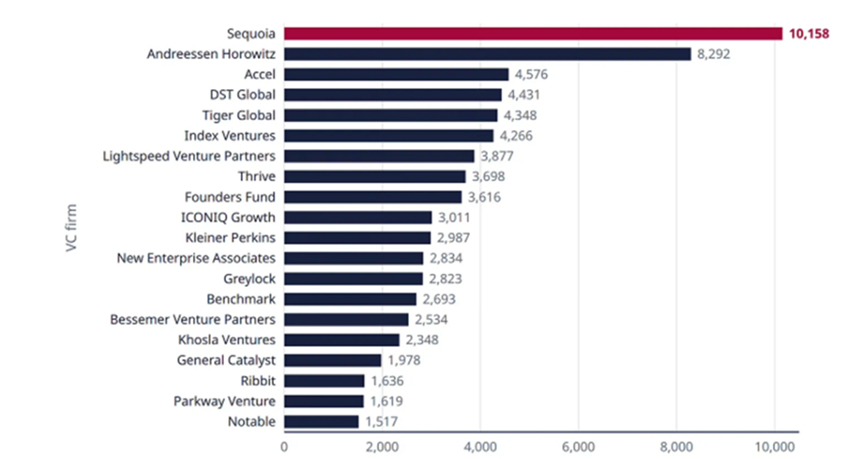
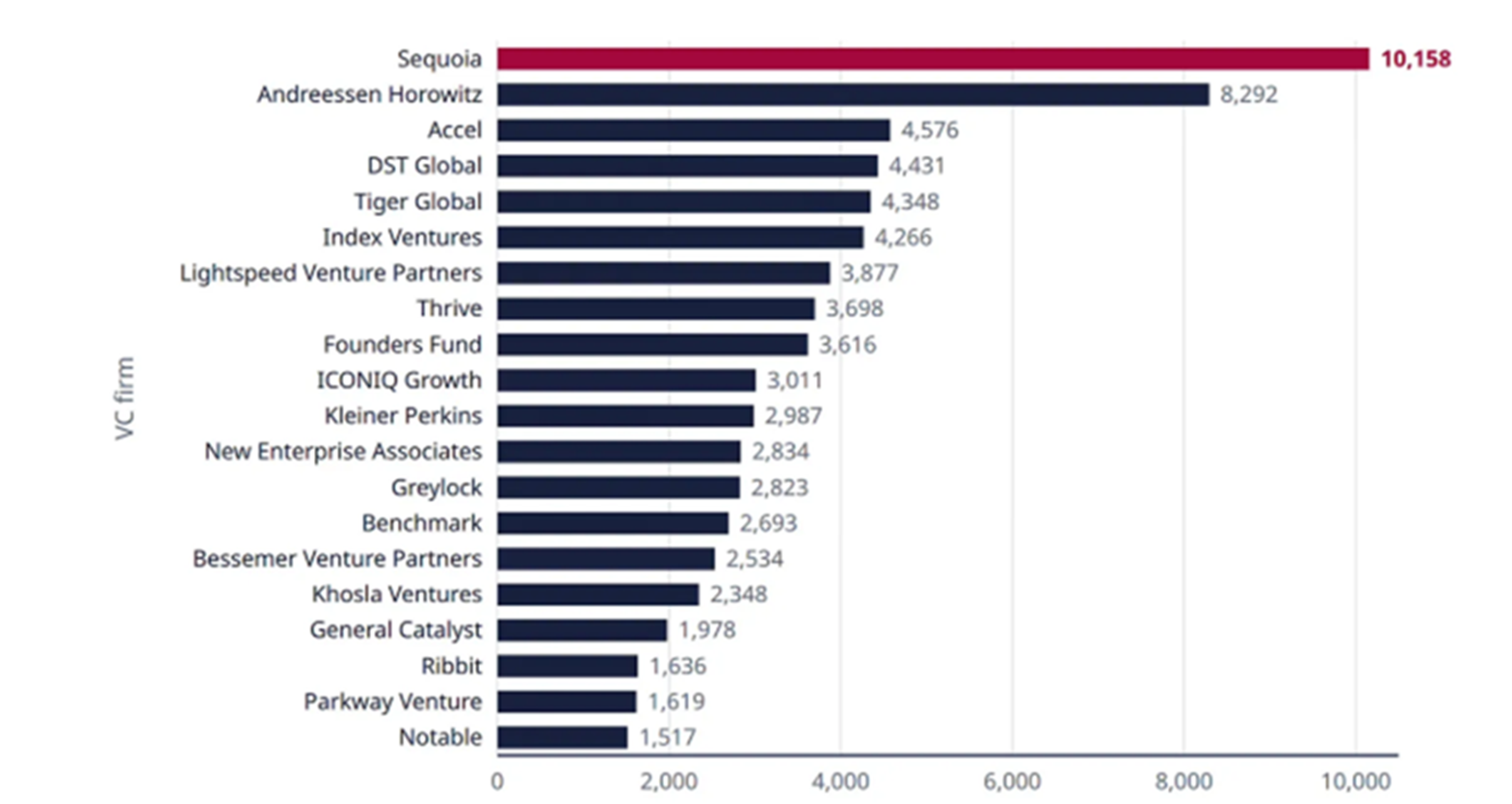
Sequoia headed the rankings. The points base system produced the top 20 ranking shown in the Exhibit. The top two firms, Sequoia and Andreessen Horowitz, stand out on the ranking by some distance with Sequoia having 2.2x the score of the third ranked firm and Andreessen 1.8x. The top five is filled out by Accel, DST Global and Tiger Global with Index Ventures a close sixth.
Their paper can be found here: https://docsend.com/view/gjgpksyptqi855he
Top 20 firms by the Strebulaev-Jackson Venture Ranking score
Source: Strebulaev-jacksoin Venture Ranking score
Source: Strebulaev-jacksoin Venture Ranking score
In early September Pitchbook issued its latest global ranking of venture capitalists based on the outcomes of their investments using PitchBook data on each firm’s deal and exit history. It employs different criteria to the Strebulaev-Jackson study. It is based on three key criteria and in each case investors must have at least 15 examples to be included. The three criteria are.
The exit rate: The share of a firm’s investments that reached an acquisition, buyout or public listing. Investments must be at least five years old or have an exit to qualify as an exit opportunity to allow for investments to sufficiently move toward an exit event.
The follow-on rate: The share of portfolio companies that raised another round of funding after the firm led a round.
Only investments that are at least two years old or have a follow-on are included as follow-on opportunities.
Valuation growth: The average annual increase in a company’s valuation between the round the firm led and the following round.
- The average CAGR of valuation change between rounds is the average annualized valuation step-up (post-money to pre-money) between the investor-led round and the following round.
- There must be at least one year between the rounds. This avoids massive CAGRs that result from very short periods between funding rounds.
Firms qualify for the Pitchbook ranking once they have enough investment history to measure, with longer track records carrying more weight. More than 37,000 venture firms were analysed by Pitchbook. Like in the Strebulaev-Jackson survey the aim is to identify consistently successful venture capital firms that produce successful investment outcomes across many deals, rather than just one or two well-known wins.
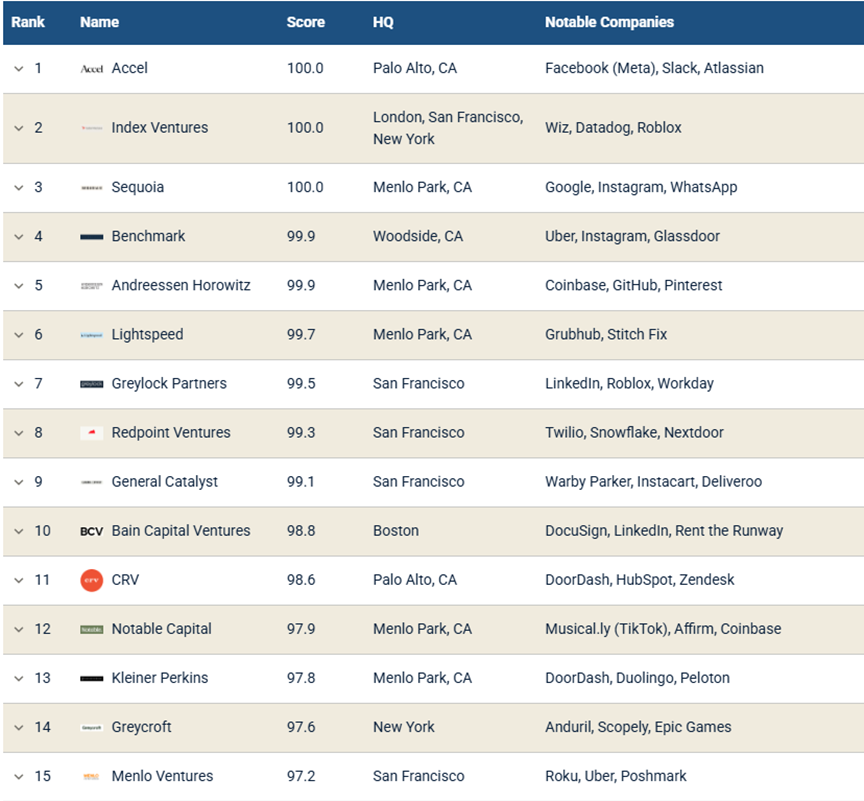
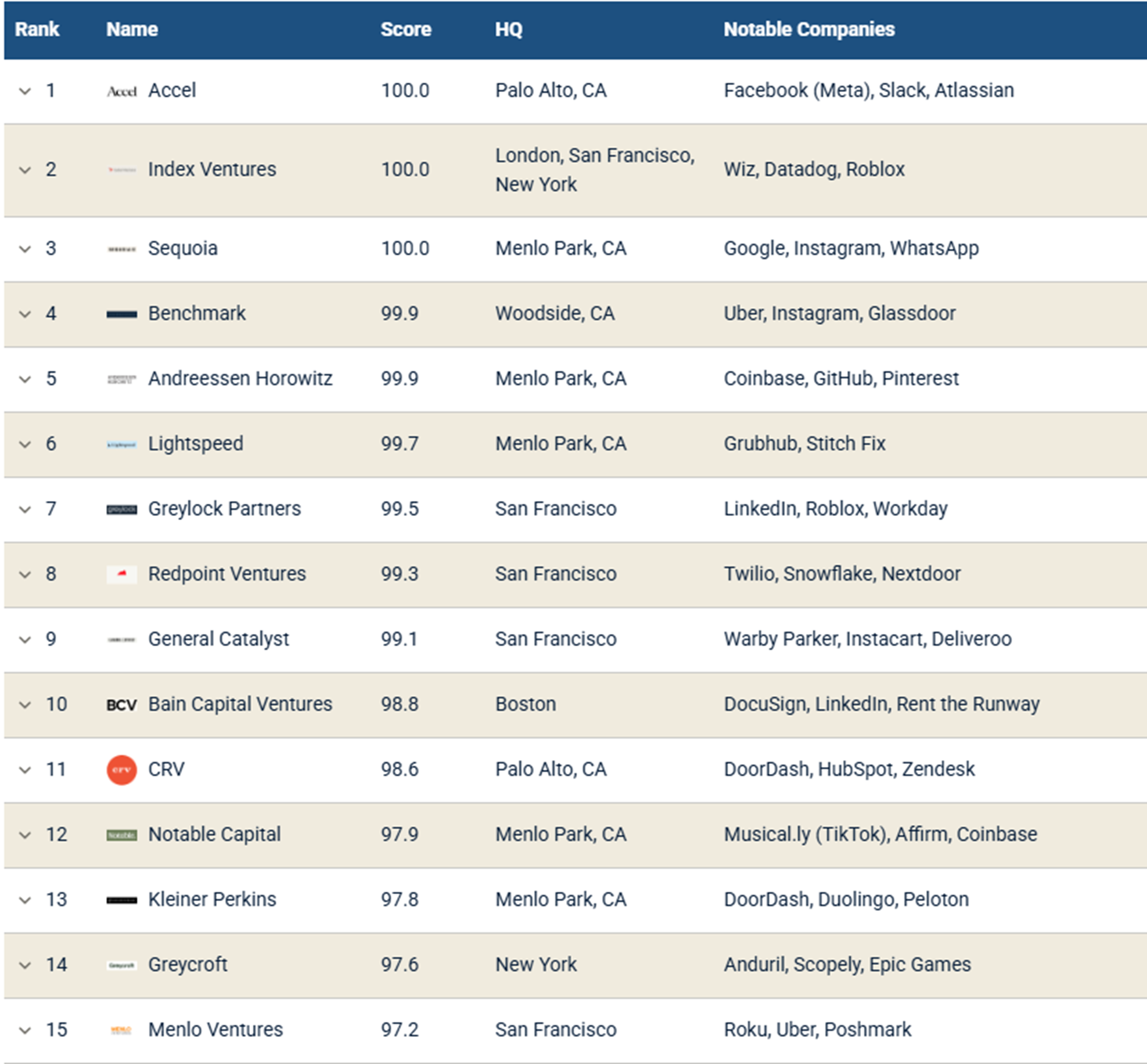
The top 15 global investors emerging from the Pitchbook rankings are shown in the chart.
Pitchbook - Ranking of top VC firms globally
Source: PitchBook
Source: PitchBook
The two studies are based on different time periods and criteria. Nevertheless, there is a high correlation at the top of the list.
The Strebulaev-Jackson survey has as its top three US firms (in this rank order) Sequoia, Andreessen Horowitz and Accel.
The Pitchbook survey (we use the global version) has each of those firms in its top five with Accel first, Sequoia third and Andreessen Horowitz fifth. The Pitchbook top five is filled out by Index in second place (sixth in Strebulaev-Jackson) and Benchmark at fourth (14th in Strebulaev-Jackson).
PitchBook also produces a separate ranking of European firms based on the same criteria. Here the top three ranked firms are Index Ventures, Balderton and Global Founders Capital.
Pitchbook - Ranking of top European VC firms
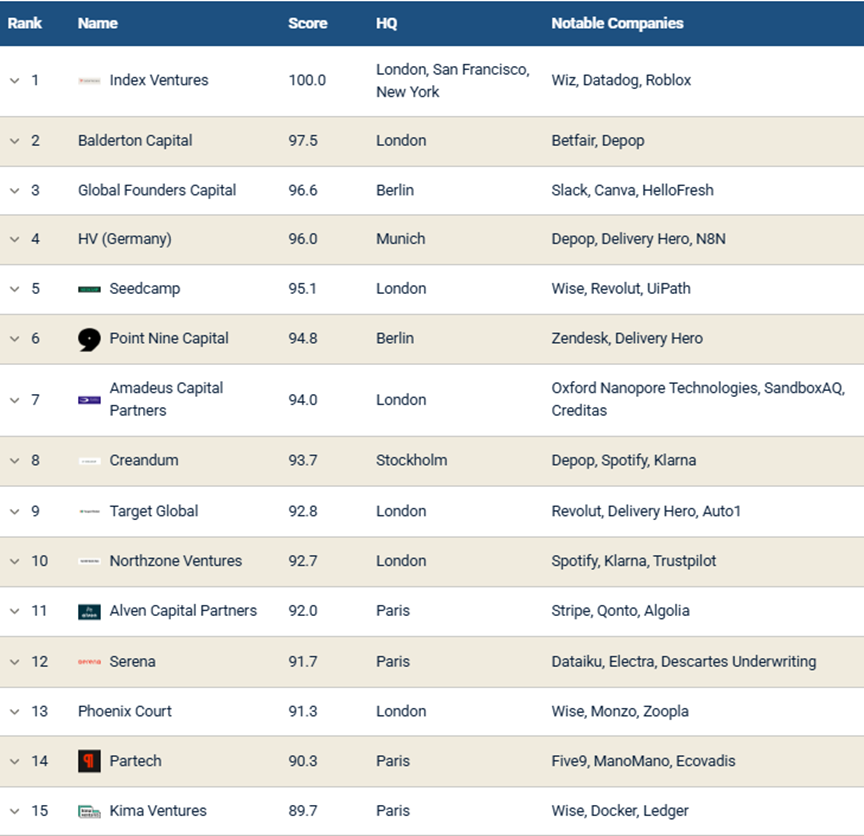
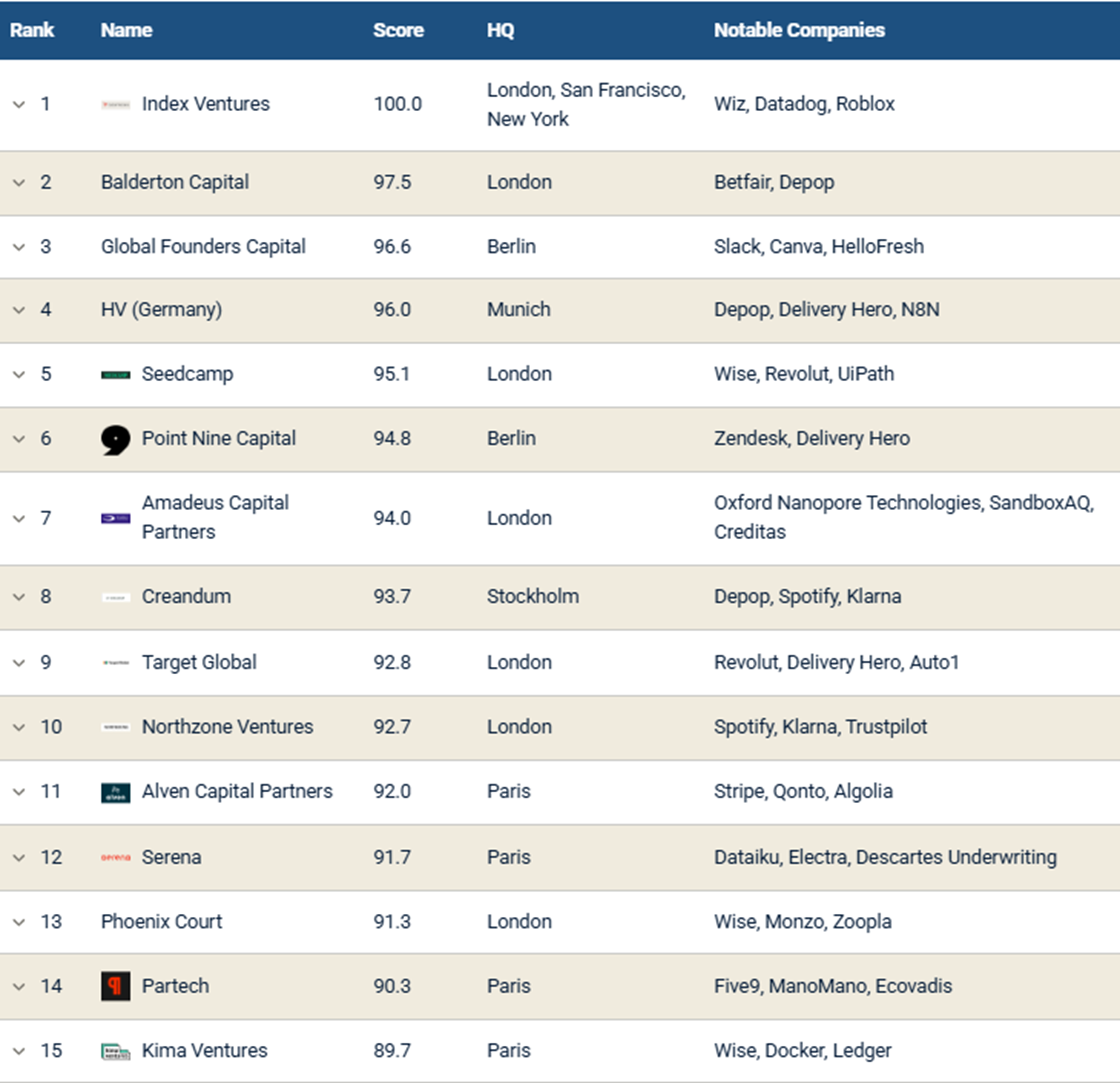
Source: PitchBook
Source: PitchBook
The Mistral $3.5bn raise
We analyse Mistral’s $3.5bn raise, the largest ever venture raise in Europe.
In early September the French LLM business Mistral announced the biggest European growth equity raise ever. Its $3.5bn raise (€3bn) valued the business at $24bn (€21bn). It is the largest European raise since… the last Mistral raise, which was its $2bn Series C in September 2025 at a $13.8bn valuation.
The September 2025 raise was led by Dutch semiconductor equipment company ASML which invested $1.5bn of the total and emerged with an 11% stake in Mistral. Existing Mistral investors DST Global, Andreessen Horowitz, Bpifrance, General Catalyst, Index Ventures, Lightspeed, and Nvidia also supported the round.
Mistral’s latest round was led by Samsung Electronics, the Scaleup Europe Fund (managed by EQT) and PSG Equity. Mistral says of the round,
The round will significantly expand Mistral's frontier research, which is the foundation underpinning its infrastructure, products and sovereignty. While allowing Mistral to scale its compute capacity for training powerful models, it will help Mistral expand infrastructure and accelerate its commercial growth and international footprint. The company now operates across 20 countries and supports 125+ global enterprises’ mission-critical AI transformation, including Airbus, ASML, and HSBC.
There has been an evolution of the strategy at Mistral since its last major round. The focus on sovereignty is much more pronounced. The raise took place in the week in which it was revealed that Anthropic had withheld its Claude Mythos 5.1 model from scrutiny by the UK’s AI security institute, triggering fears of greater protectionism by the major US tech groups. In its raise announcement Mistral highlights the sensitivity of sovereignty issues to its customers.
‘Organizations and governments are now asking ... how to harness the power of AI for their mission-critical needs without surrendering control over the infrastructure and intelligence loop. Demand for that combination of performance with control, choice and independence is growing internationally, as enterprises and governments weigh the long-term technology dependencies, data governance requirements and deployment choices that come with any AI investment.’
Mistral promises that its direction of travel will allow customers to retain full control over their data and workflows.
‘Mistral’s full-stack and open approach also allows organizations to build on it without exposing their most valuable data, workflows and institutional knowledge to anyone outside their own walls. That's what makes Mistral’s stack the sovereign AI layer, meaning retaining control across four dimensions: data that stays inside the organization's boundaries, models that are controllable and customizable, compute that is private and predictable, and systems in production that are fully controllable and auditable.’
This pivot has a number of advantages for Mistral. It is clearly tough for the company to compete directly head-to-head with its major US counterparts, Open AI and Anthropic, who this year alone have raised almost $225bn in funding between them. Instead, Mistral is offering a full stack alternative likely to appeal to governments and businesses in Europe that are sensitive to sovereignty issues. To accomplish this Mistral is moving beyond the production of LLM models to provide also the data centres and infrastructure that such a sovereignty offer requires.
In August Mistral expanded on this strategy in a blog post saying
‘At Mistral, we believe every enterprise and country must be in control of the models it uses, choose where the intelligence runs, control the compute capacity to scale it, and retain its compounding value…. we are taking three concrete steps as we build the foundations of our customers' AI sovereignty: strengthening the reliability and regional control of inference, expanding access to third-party open models within that infrastructure, and bringing together enterprises and institutions to secure long-term commitments for compute capacity in Europe.’
In turn this means that Mistral needs its own data centre capacity to deliver on the sovereignty approach. This has led it to announce substantial plans to develop its own datacentres, focused on France and Sweden. In France Mistral has a 10MW datacentre at Les Ulis due to open by the end of 2026 and is developing a 40MW cluster in France in partnership with the Scaleway arm of Iliad. Mistral signed an agreement earlier this year to invest $1.4bn to build new datacentres with 23MW of computing power in Sweden to be built and run by EcoDataCenter and due to open in 2027. Overall Mistral plans to have 200MW of computing capacity available to it in Europe by the end of 2027.
Separately Mistral has a deal with Microsoft which is increasing its European data centre capacity by 40% over the next two years. Microsoft offers a sovereign cloud offering (although the ultimate efficacy of it is debated) and Mistral’s frontier European models will be made available on it.
Another aspect of Mistral’s strategy is that it is focusing on open weight models rather than the closed environments of OpenAI and Anthropic. This has both a sovereignty aspect - open-weight allows customers to download, customise and run models on private infrastructure instead of sending information through a third-party cloud platform- and it offers a lower cost to the customer.
Mistral hopes that the new funding will enable it to exceed its target of annual recurring revenue of $1bn+ in 2026.
Looking at the structure of the round, the leads were Samsung Electronics, the Scaleup Europe Fund and PSG Equity. Most of the existing players on the cap table supported the raise including a16z, ASML, Bpifrance, BNP Paribas CIB, DST Global, General Catalyst, Index Ventures, Lightspeed, Nvidia, and Salesforce Ventures. Blackrock and the Grand Duchy of Luxembourg also participated.
Samsung has said it will develop AI models with Mistral combining semiconductor technology and manufacturing data from Samsung Device Solutions with Mistral’s AI model technology. These AI models will be deployed across all aspects of Samsung’s semiconductor operations to improve manufacturing efficiency and quality and enhance productivity. The companies will also jointly build an on-premises AI platform and operating system for semiconductor operations.
The Scaleup Europe Fund is a vehicle of the European Innovation Council and is a multi-billion late-stage and growth fund aimed at investing in the most promising European companies in strategic tech areas. It has highlighted AI, quantum, semiconductors, robotics and autonomous systems, energy, space, biotech, medical, advanced materials, and agritech, as key areas of focus. Given its mandate it would have been hard for it not to be involved in the Mistral raise.
Alongside the Commission, the group of founding investors in the Fund include Novo Holdings, EIFO (Export and Investment Fund of Denmark), CriteriaCaixa, Santander/Mouro Capital, Fondazione Compagnia San Paolo/ Intesa Sanpaolo/Fondazione Cariplo, APG Asset Management, Wallenberg Investments and Allianz. EQT was chosen to manage the fund.
The Scaleup Europe Fund was established in June 2026 saying it was set to make its first investments in autumn 2026. It also co-led a $400m Series C funding round in Swedish vibe-coding business Lovable announced in August and the $450m Series C by The Exploration Company which operates out of Germany, France, Luxembourg, Spain, and Italy and offers a reusable heavy lift space launcher to compete with SpaceX.
PSG Equity, also co-leading, is an existing Mistral investor and has previously partnered with Mistral to accelerate Al adoption across its portfolio of software companies. Dany Rammal, Head of Europe at PSG Equity commented.
"We first partnered with Mistral as part of its Series C in 2025, recognising its position as a global leader in Al and the strength of its technology, team and vision. Co-leading this latest round enables us to deepen that relationship and reflects our conviction in the long-term trends shaping the Al market, from accelerating enterprise adoption to growing demand for trusted and sovereign Al solutions. We believe Europe has a significant opportunity to build global technology leaders and that Mistral is exceptionally well placed to be at the forefront of this. We are excited to continue supporting Arthur and the team as they advance their R&D ambitions and continue to scale the business globally."
The Grand Duchy of Luxembourg chipped in its €10m after Mistral signed a strategic partnership with the Luxembourg government in June 2025 focused on the adoption of AI in the public sector, collaboration with public research institutions and data sovereignty and a collaboration with the Luxembourg Armed Forces.
Commenting on the latest Mistral raise French President Emmanuel Macron said.
"ASML a year ago, Samsung today: Mistral demonstrates its ability to forge strategic partnerships with the major industrial players to elevate Europe among the world's leading AI powers. This is the entire meaning of the vision we share with the President of South Korea: to build together a third way in AI by joining our forces and our players."
Europe and Venture Capital Funding
In recent editions of the Growth Equity Update we have been looking at the efforts of both European and UK public bodies to stimulate investment in venture backed companies.
In particular, we have looked at the relative lack of domestic funding for UK and European businesses once they emerge from the seed and early stages and move into later stage investment. Many of these issues are picked up by the October 2025 report by the EU – ‘Study of barriers to, and drivers of, the scaling up of funds investing in innovative and growth companies.’
This snappily titled report lays out its thoughts over 219 pages.
Its core arguments are:
Venture and growth capital funds are essential for financing startups and scaleups. The EU supports domestic money as the provider to ensure venture and growth capital financing is sizeable, and ecosystems are sufficiently developed to compete with other developed economies and to allow European companies to become global champions in their fields while retaining a large EU footprint.
It observes that the EU investor ecosystem is fragmented, with most fund managers concentrated in Western Europe, with Southern Europe and CEE underrepresented. Cross-border investment is common, particularly in growth capital but EU scaleups are heavily reliant on non-EU capital, reaching 70-90% of funding in some countries with domestic capital insufficient to close the gap.
This is illustrated in the graphic from the supporting OECD survey.
Domestic and foreign investment: number and volume of deals, by location
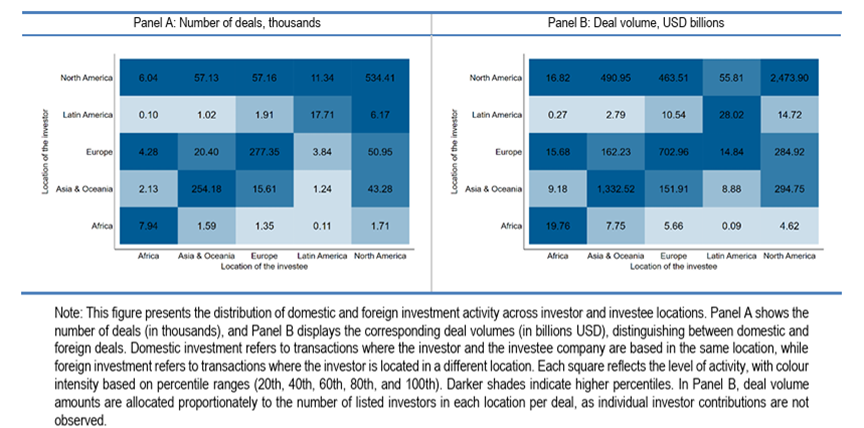
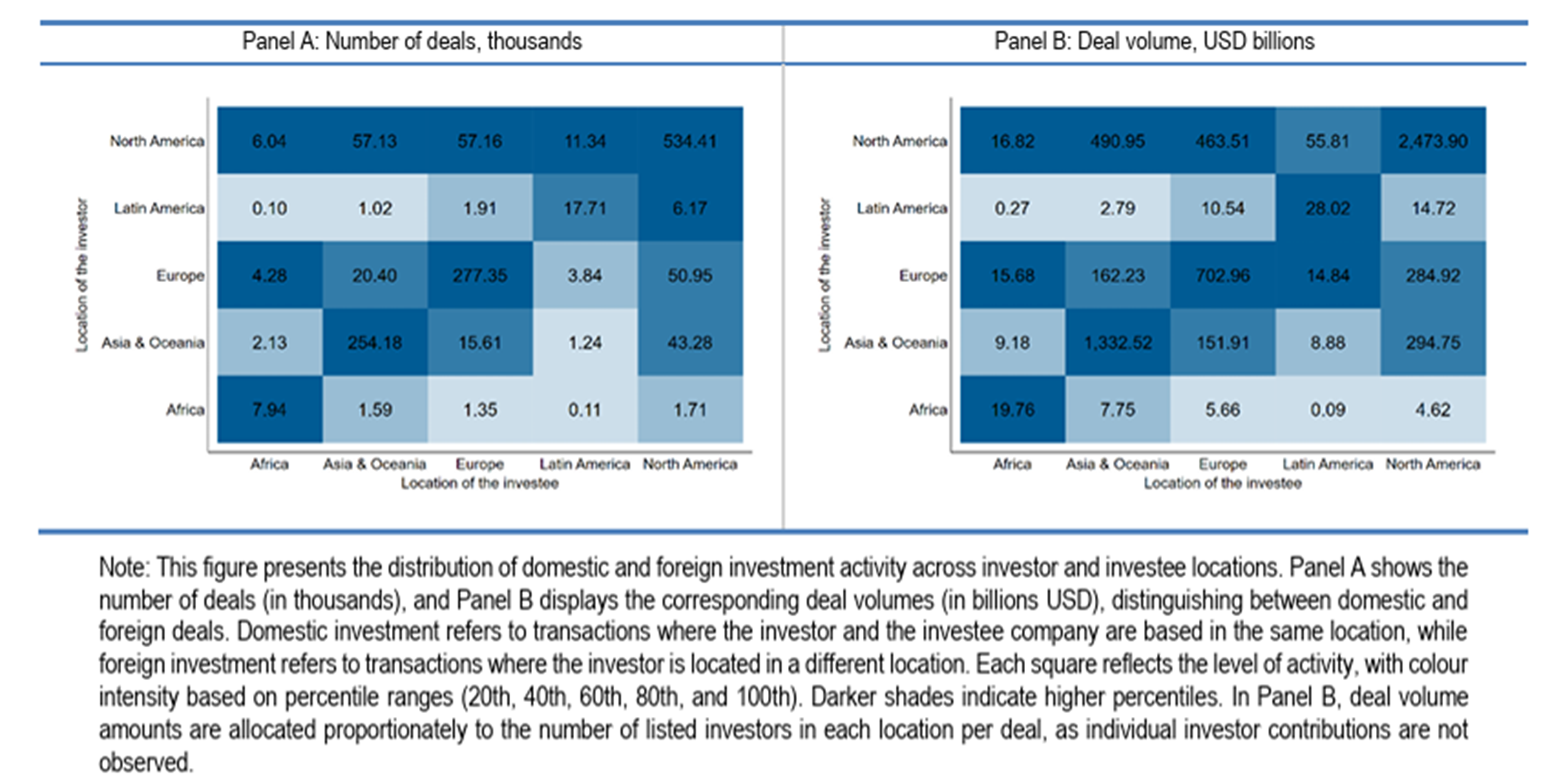
Source: OECD Start-ups Database, June 2025
Source: OECD Start-ups Database, June 2025
Cautious allocation criteria and capital gains tax the key uncertainties: Based on its interview programme with venture, growth and institutional fund managers and LPs the two biggest barriers to the fundraising process identified that might be solvable through legislation were (i) the conservative national-level caps on alternative asset investment and capital requirements, especially when exacerbated by portfolio prudential rules amongst pension funds, insurance companies and banks and (ii) uncertainties related to capital gains taxes.
Legislative fragmentation: Reporting and disclosure obligations, prescribed in the scope of AIFMD and disclosures required during the fund lifecycle (AML/KYC disclosures, CSRD/ ESRS reporting etc), were highlighted as a barrier that raises the costs of operating venture and growth capital funds, with a high workload in proportion to the number of LPs. The costs stemming from legislative fragmentation across Member States adds another layer of complexity.
Market and structural barriers: Fund manager “home bias” due to lack of network abroad, strong competition and difficulties in finding co-investment partners for completing transactions is an issue impacting cross-border investing.
Another factor making fund managers more cautious when investing is the fear of not being able to realise gains due to poor exit prospects, especially in regions with fewer active buyers or unattractive listing prospects (and subsequently lower valuations).
The EU report concludes that
‘Taken together, market and regulatory frictions reinforce one another. Structural issues on the demand side of capital, combined with fragmented rules on the supply and deployment side, contribute to persistent under-scale and geographic concentration in the European venture landscape.’
What are the proposed remedies?
Supervisory coordination may help tackle fragmentation and the cumulative burden of compliance for fund managers, especially in terms of aspects related to fund governance, marketing process and reporting requirements.
Solutions for harmonising the incorporation of fund vehicles or a concept of EU entity for an investment fund may be explored, particularly if it can help to standardise governance procedures and tax treatment of capital gains and carried interest across the Member States.
More proportionate approaches to reporting, fees and governance requirements based on assets under management may support smaller fund managers.
Standardising reporting templates across jurisdictions may further decrease fund manager and LP costs and the amount of administrative work.
Less formalistic approach to compliance: The industry encourages a more practical, less formalistic approach to compliance, authorisation procedures and investment process practices as well as a harmonised approach by national supervisors.
For institutional investors Solvency II was recently reviewed, and the possibility of a more favourable risk weight of 22% for long-term equity will apply from January 2027.
Initiatives to address the risk aversion culture and promote the benefits of the venture and growth asset classes would be particularly important.
The full report can be found here: https://op.europa.eu/en/publication-detail/-/publication/6531d67f-a978-11f0-89c6-01aa75ed71a1/language-en
In this context some interesting thoughts from Josh Lerner of the Harvard Business School which appeared in Vox EU.
Josh Lerner observes, as have we, the declining share of global venture investment activity attributable to European firms. He cites Pitchbook figures to characterise the €66.2bn deployed in European venture capital in 2025 as just 22% of the amount invested in the US despite the similar overall size of the two economies.
To assert the relevance of this he quotes the 2024 Draghi Report on European Competitiveness in which the Former Italian President observed that
‘… no EU company with a market capitalisation over €100 billion… has been set up from scratch in the last fifty years, while all six US companies with a valuation above €1 trillion have been created in this period.’
Each of those six – and subsequently two others that passed the $1 trillion barrier - were initially funded by venture capital. More broadly about half of all US companies that have gone public over the last 20 years were backed by venture capital.
As usual – and as we pointed out in the July Growth Equity Update, Europe is not short of academic centres of excellence or entrepreneurial ideas. It is though short of adequate domestic financing, particularly in the scale up stages. Josh Lerner identifies three reasons for this:
- The relatively poor returns from European venture funds: He cites State Street Research figures to illustrate that the annual rate of return of European venture funds in recent decades is 8.6%, lagging 10.4% for emerging market funds and 14.6% for US funds.
- The boom in AI growth and funding has exacerbated the picture in the last three years with this funding concentrated, even more so than in venture as a whole, in a very few hubs. The Bay Area took up half of global AI venture funding in 2024 versus its typical share of overall venture funding of c25%. In stark terms Europe’s key LLM business Mistral has just raised $3.5bn, by some distance Europe’s largest ever VC fundraise. Its US counterparts have raised on a different scale> looking at this year alone the raises are OpenAI $122bn, Anthropic $95bn, xAI $20bn, Prometheus $12bn, and SafeSuperIntelligence $5bn.
- A winner takes all flywheel effect: Access to investment in the most successful businesses enhances the returns of the firms investing in them, making them more attractive to LPs, attracting more capital, which in turn makes them the most attractive investors amongst the most sought-after companies. It is a ‘winner takes all’ flywheel.
As Lux Capital observed in its Q4 2025 report
‘The concentration of private capital is only matched by the concentration in equities. Nearly $340 billion flowed into U.S. deals, the second-highest amount ever, yet it was packed into the fewest deals of the decade, with nearly half the capital concentrated in a few dozen deals over $500 million. The top 1% of companies by valuation now absorb a third of all venture capital deployed. The bottom half get 7%, technically “venture-backed” but also kind of like sitting in the parking lot at a concert and claiming you saw the show. Half of all venture money went to 0.05% of deals, while half of all LP capital went to a handful of funds’.
European VC is in the role of ‘sitting in the parking lot at a concert and claiming you saw the show.’
What to do about it?
Lerner observes that short-term circumstances may help defray US dominance and improve the European position. Notably the US administration’s Munich Speech policy of reducing its commitment to defend Europe has created a new-found emphasis in Europe on increasing the level of GDP devoted to defence and looking for European sovereign solutions in defence rearmament. This has given a substantial boost to VC funded defence businesses with $1.5bn raised for such companies in H1 2026. Pursuit of sovereign solutions is also a factor supporting Mistral’s recent $3.5bn raise. Similarly, the cutbacks to federal funding of academic research in the US and the well-publicised moves of some leading US academics to Canada and other jurisdictions may help to reverse the long-term flow of European scientists and technologists to the US.
As well as taking advantage of these windfalls Lerner suggests three positive actions that Europe could undertake:
A consolidated European high tech oriented public market: The US system sees VC backed companies raise money widely through North America and elsewhere before floating on substantial markets – like NASDAQ - geared to entrepreneurial businesses. By contrast European raises are often more local (ie French firms get French government and fund backing and list in Paris). The most promising firms look to list in the US, deemed more growth oriented and where valuations and the ecosystem are deemed to be stronger. The weak IPO exit markets in Europe are a discouraging factor for would be venture investors and companies. The suggestion is a revival of the EASDAQ concept, the pan European market founded by venture capitalists during the first internet boom which operated from 1996 to 2001. The idea would be a pan European, tech focused market to rival the supremacy of NASDAQ.
Clustering: Lerner’s second proposal is to cluster. This breaks with the typical approach of UK and European policymakers to encourage geographically widespread venture activity both between and within countries. Interestingly as an example of this we have seen the new UK administration adopt ‘growth in every postcode’ as its slogan while external commentators like the Centre for Cities argue that economic growth is inherently uneven and that growth efforts should be concentrated in big secondary cities.
The Lerner argument picks up on this arguing that around the world, entrepreneurial businesses are clustered geographically and venture-backed businesses even more so, particularly in science-based entrepreneurship. It’s another flywheel effect as academic institutions, companies, people and supply chains cluster in areas of strength. Lerner’s argument is that publicly funded initiatives should recognise this and focus on developing those key clusters rather than casting the seed widely.
Attractive policies for entrepreneurship: The Lerner approach here is simply to copy. Work out what is attractive to entrepreneurs and shape policy – in areas like taxation – to encourage them to site their businesses in Europe.
https://cepr.org/voxeu/columns/venture-capital-challenge-europe
Support for UK venture
The ‘growth in every postcode’ theme continues.
In last month’s Growth Equity Update we looked at some of the ideas floating around the new Burnham administration to support growth businesses in the UK as the fresh government pursues its ‘growth in every postcode’ theme.
Looking back to the previous article there are some aspects of the Burnham approach that recognise the benefits of investment clustering:
Good Growth Funds: ‘These reforms will be augmented by supporting mayors to establish Good Growth Funds across the country, backed by national Public Financial Institutions – such as the National Wealth Fund- and supported by the Local Government Pension Scheme as a key local investor, to assist mayors in investing for the long term in their local economies. We will also support local places to reindustrialise by building on frontier sector and cluster strengths.’
and
‘On reindustrialisation, we will support every region to set clear and credible industrial ambitions – and provide the support to achieve them, encouraging more cross-UK partnership between places with complementary industrial clusters, as Cambridge and Manchester have done on life sciences.’
Mainly though the approach appears to be to spread investment widely. Already in June, the British Business Bank committed up to £90m to ten new micro funds as part of the first Investor Pathways Capital cohort. In August John Healey, the new Chancellor of the Exchequer announced the latest £100m phase of the British Business Bank’s Investor Pathways Capital Initiative.
Applications for the next cohort, which is part of this £100m deployment, will open in Autumn 2026. The aim is to support first-time venture capital investment fund managers from a wide range of backgrounds. The initiative, which will invest £400m in total, helps businesses scale up as the fund managers provide the early capital to help scale up early-stage businesses across the country.
Separately, the British Business Bank announced it will be the principal investor in Molten Ventures’ new £350m Growth Fund, committing £75m in the first close of £175m. The fund will provide support to UK and European technology companies at the Series B stage and in subsequent financing rounds, with a focus on sectors such as space, AI, fintech, quantum computing, deep tech and hardware.
In May this year the British Business Bank contributed £50m to Longwall Venture Partners’ £100m deep tech fund and £25m in Antler’s UK Fund II.
Public markets – oil, tariffs, bond yields, interest rates.
Some stumbling blocks to performance.
Markets enjoyed a relatively good August. The US indices rallied between end July and the 8th of September with the S&P500 up 2% and NASDAQ up 4%. Both the SOX semiconductor index, up 5% and the S&P500 Software and Services index, up 7% performed well along with the Magnificent 7 also up 5%. European indices did less well, with both the FTSE 100 and the Euro Stoxx declining by c1.5%.
Year to date to September 8th NASDAQ is up 13%, the S&P 500 is up 12%and the FTSE100 and Euro Stoxx are up 7.5%. The Magnificent 7 are up 4%. After a strong August, up 9%, the FTSE Venture Capital index is now down just 3% for the year.
Markets always need something to worry about. Post strong earnings season the market reverted to fretting about its four favourite causes for potential concern:
Oil prices: There was a point in August when it felt as if the US-Iran conflict had simply petered out. The price of WTI crude, having hit $90 by the 24th of July fell back to a low of $75 in early August and remained in the mid $80s through much of August. Awakening from its torpor another bout of mutual missile slinging at the start of September has sent the WTI price from $86 to $96 in the first week of September. The average price of gas at the pump for the US consumer was $4.14 on Labor Day, a dollar higher than a year ago and a record for Labor Day, sparking low poll ratings for President Trump and renewed inflation fears.
Tariffs: This month has also seen a revival of tariff tensions. Notably towards the end of August US-Canadian talks on resolving outstanding trade issues turned sour with both sides blaming the other for the rupture. Substantial reciprocal tariffs have subsequently been imposed, and the US has announced some outright bans on Canadian products like alcohol, dairy products and motorcycles. Lake Ontario has been renamed – in US eyes at least – as Lake America.
Bond yields: The back end of August saw a relatively sharp rise in bond markets with the yield on ten-year US government bonds reaching 4.8% up from 4.6% at the start of August and the recent low of 4% at the end of February. It is just short of its five-year highs (albeit lower than it was for most of the 1980-2007 period). French and German bond yields are at c15 year highs. There are various debates about why bond yields have been rising – although inflation prospects, the potential for rising short term interest rates, strong economic growth and fears of an oversupply as the US government deals with its deficit – have all been put in the frame. Rising bond yields make it harder for equities to outperform and may slow corporate profitability growth. In theory though, the equity market can still perform while bond yields rise, as long as they don’t jump too suddenly.
Interest rates: Short term US interest are in turn influenced by a number of factors with oil prices and tariffs feeding into one of the key considerations, inflation. Jobs also matter of course as do the inclinations of the new Fed Chair, Kevin Warsh.
We have touched on oil prices and tariffs, both presently contributing to a sense of upwards inflation effects. Actual US inflation fell more sharply than expected from 4.2% in May to 3.5% in June with the 40bps month on month fall the largest since April 2020. July saw inflation edge further down to 3.4% with falling gas prices a factor in both months. The August inflation number, out on September 11, saw headline inflation again at 3.4% and core inflation at 2.4%. Core inflation, which excludes food and energy prices, fell from 2.9% in May to 2.6% in June and to 2.5% in July.
Meanwhile the US jobs numbers in August were much better than for preceding months with 162,000 jobs added. July was revised up from a loss of 23,000 jobs to a gain of 21,000 and June from 20,000 to 31,000. The unemployment rate was steady at 4.1%.
In his inaugural Jackson Hole address in late August Kevin Warsh, the Fed chair, hit a more hawkish note than expected reaffirming both the commitment to 2% inflation and maximum employment while arguing that the Fed’s dual mandate is not contradictory – ‘high inflation is very harmful to economic prosperity.’
‘.there should be no misunderstanding: The Fed's price-stability objective of 2 percent, as measured by the personal consumption expenditures (PCE) price index, is a firm, fixed target. Let's be equally clear about another aspect of the objective: Price stability is not self-executing, nor is inflation necessarily mean-reverting. It is the Fed's job to deliver stable prices.’
He declared himself satisfied that ‘On the employment side of the Fed's dual mandate, our country is doing well…. But on the price-stability side of our mandate, the numbers are more concerning…. Here is my standard: We must be confident that underlying inflation is moving to our objective, clearly and at sufficient speed. Otherwise, we have work to do. That's our job.’
At the Fed’s July meeting, the second under Mr Warsh, rates were held unchanged at 3.5%-3.75%. In June the decision to hold rates was unanimous. In July there were three dissenters who supported an increase of 25bps in rates. Since then, we have had a satisfactory job report and a less satisfactory inflation report.
By putting inflation ahead of jobs currently as a priority the market’s assumption is thus that rates must rise with FedWatch putting the prospect of a rate rise of 25bps at the next meeting on 16 September at 88%. By the last meeting of the year, on 9th December FedWatch has the chance of rates still being at the current 3.5%-3.75% at just 2%, with a 23% prospect of a 25bps rise, a 50% chance of a 50bps rise and a 25% chance of a 75bps increase.
European inflation was 2.9% in July up from 2.8% in June driven by energy costs up 10% (8.5% in June). Core inflation rose modestly from 2.4% to 2.5% with both goods and services inflation trending slightly higher. August then saw inflation accelerate to 3.3% boosted by energy price inflation of 14.3%. Core inflation – which excludes energy – fell back to 2.4%.
With inflation accelerating and having spent six months above the 2% ECB target, a rate rise was inevitable. The ECB raised rates by 25bps to 2.25% in June, its first-rate increase since August 2023, held at 2.25% in July, but with the renewed energy shock, raised in early September by a further 25bps to 2.5%. The market expects another rate rise by the end of the year.
UK inflation was 2.6% in June, the lowest for 15 months, helped by lower petrol, food and clothing prices. July bounced back, in line with expectations, at 2.9% as the new OFGEM energy price cap kicked in. Core inflation, which excludes food and energy, held steady at 2.6%.
The Bank of England held rates at 3.75% in July with a vote of 6-3 to leave rates unchanged versus a 7-2 vote in June. Despite the jump in inflation the expectation is that the Bank of England will hold rates at its 17th September meeting and indeed market forecasts are that the rate will be held for the rest of the year.
The views of Rothschild & Co’s strategists Kevin Gardiner and Victor Balfour on the current market outlook are summarised in the Exhibit.
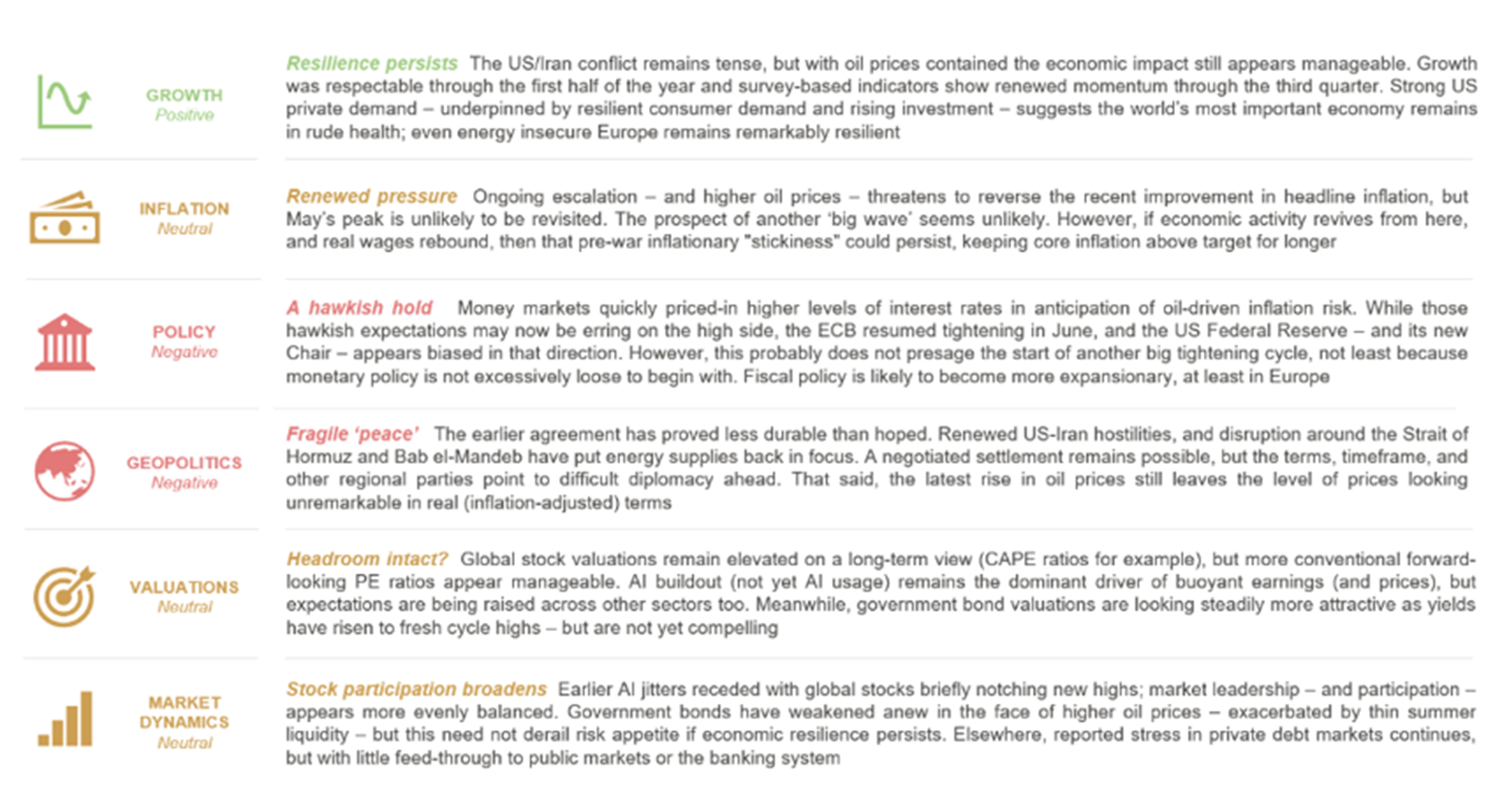
Source: Rothschild & Co
Source: Rothschild & Co
US fundraising in August – no summer holiday
The pace of US fundraising appears unrelenting – August saw another $20.9bn of raises.
There was not much in the way of a summer break for the US VC market in August. The month is typically one of the smallest of the year. One could say that was the case also in year with the $20.9bn raised being the second smallest monthly total (July’s $20.6bn is the smallest) year to date. On the other hand, the total was better than seven of the 2025 monthly totals and the number of deals –49 of more than $100m - was well up to the 2026 pace.
As is typical AI and related sectors dominated. The AI raises were led by a $5bn round for Databricks at a valuation of $190bn led by Coatue Management. Databrick’s platform allows companies to build and scale data and AI apps, analytics, and agents. The business continues to grow rapidly, counts 70% of the Fortune 500 amongst its customers and has in total 20,000 customers worldwide. Alongside the raise the company announced that it has exceeded a $7bn pa revenue run rate with revenues growing more than 80% yoy and that it has delivered positive adjusted FCF over the last twelve months.
There was just one more $1bn + raise in AI in the month. This was the $1.1bn seed and Series A raise by River AI led by General Catalyst and AMP PBC. Nvidia and AMD were also in there as strategic backers. River AI was started by the co-founder of xAI, Igor Babuschkin. Its mission is to use open weight models to provide tools that help clients build personalized AI models on their own data. Igor Babuschkin comments ‘AI should be open, freely available, and affordable. It should feel like it is working for the person using it, not the lab that trained it."
In total there were eleven AI rounds in August raising a total of $8.7bn, 42% of the monthly total. AI is less dominant in terms of the percentage of raises than earlier this year partly because of the scale of raises in AI related sectors. Robotics raised $1.6bn across two rounds, the largest of which was $1.37bn for Hadrian, a manufacturing tech business developing automated factories for aerospace and defence. There was a $350m raise for Groq in datacentres and $1.2bn across three raises for AI semiconductors led by a $700m raise for Etched at a $21bn valuation led by Jane Street, Kleiner Perkins and Sequoia.
Outside of AI the notable sectors were Climate Tech, Defense and Space.
In Climate Tech there were six deals raising $2.35bn with the largest a $1bn Series B for Valor Atomics led by Sequoia, Apandion and Atreides. The company aims to produce mass manufactured nuclear power plants. Form Energy, which provides 100-hour batteries for grid electricity storage, raised a $750m Series G led by Blindspot Ventures and Breakthrough Energy.
There were two raises in defence for a total of $1.05bn. Castellion which secured an order from the US Navy in June for 50 early operational capability pre-production Blackbeard hypersonic missiles raised $800m in a Series C led by Andreessen Horowitz, Carlyle, Lightspeed and Lavrock. Neros Technologies a defence drone manufacturer raised $250m in a Series C led by the American Strategic Technology Fund and Sequoia.
There were two raises in Space for a total of $500m. Muon Space is an end-to-end provider of space-based infrastructure whose Series C of $250m valued the business at $1.5bn. The Series A+ from Starcloud also raised $250m for orbital data centres and space-based GPU infrastructure.
US – 49 raises of $100m+ in August for a total of $20.8bn
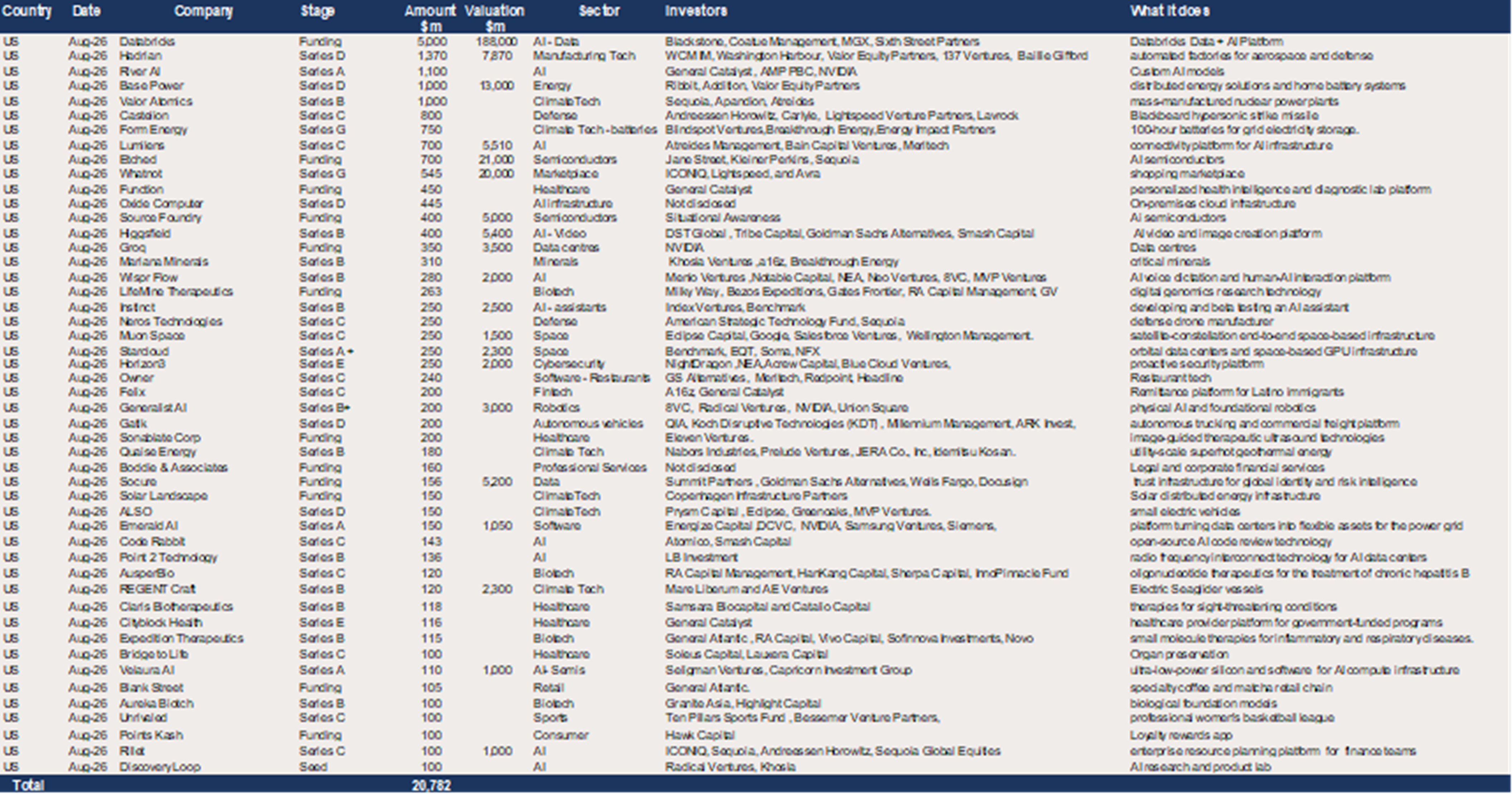
Source: Rothschild & Co
Source: Rothschild & Co
Europe – Solid August with $3.8bn raised
A very respectable total for the traditionally weakest month of the year in Europe.
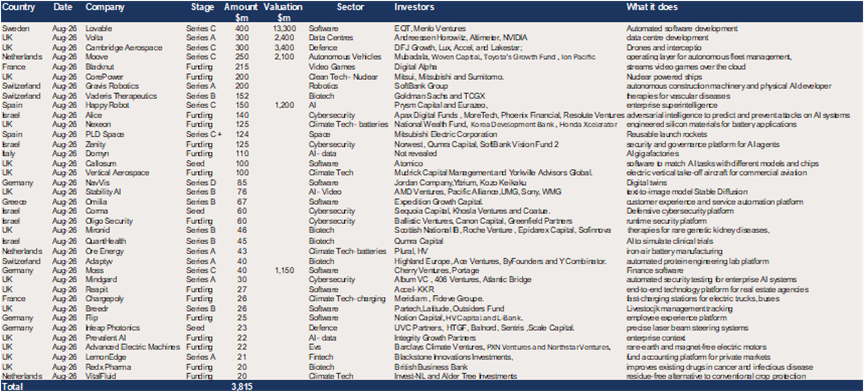
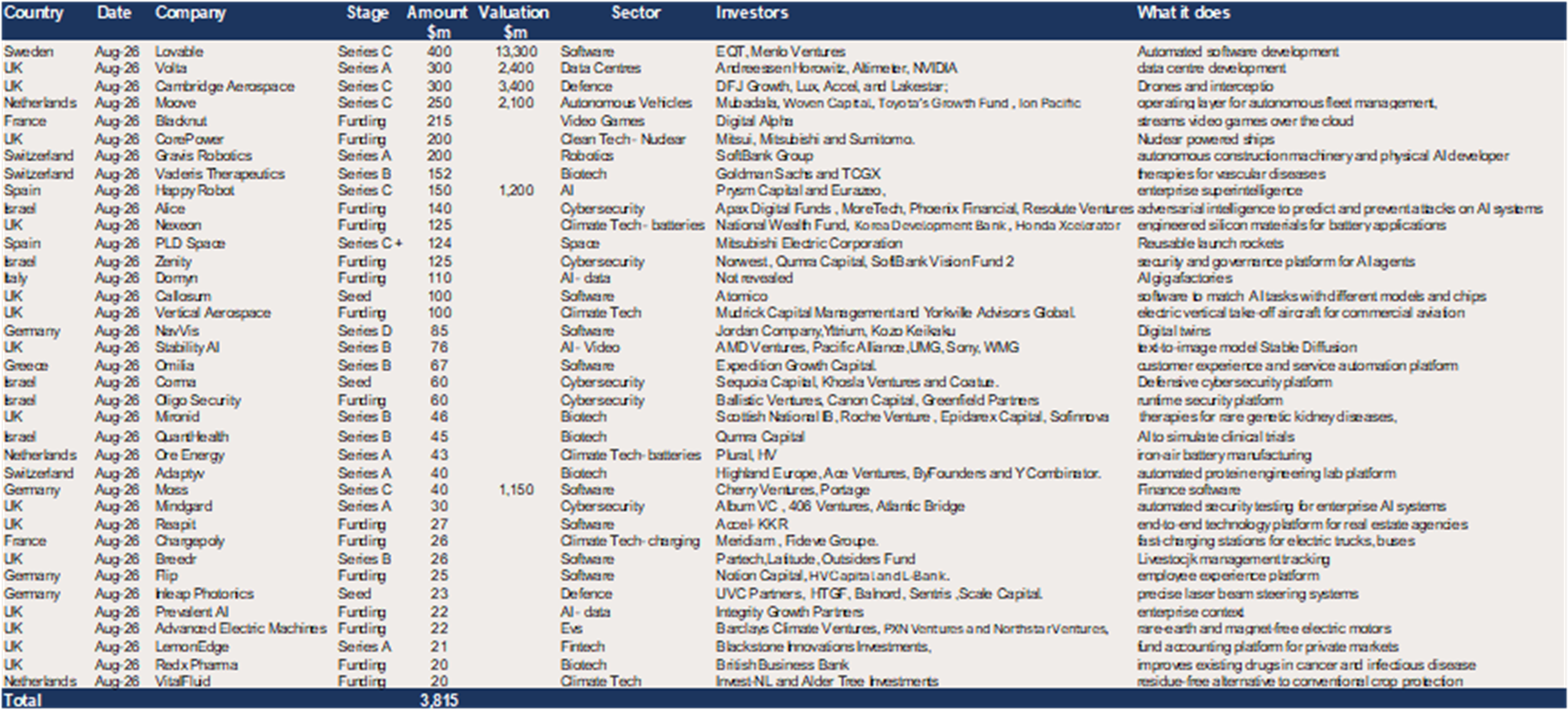
The $3.8bn raised by venture capital companies in August is a highly respectable total for what is a seasonally weak month. Indeed, August 2024 with just $833m is the only sub £1bn month in recent years. August 2026’s $3.8bn total was 4.5x higher than that total and 2x 2025’s $1.87bn. It brings the ytd to end August total to $52.6bn, 1.9x the same stage total in 2025.
It was the first month of 2026 without a $1bn plus deal. However, there were 16 $100m+ deals as opposed to four in August 2025, two in August 2024 and three in August 2023.
The biggest sector in August was Software with eight deals for a total of $770m. The biggest of these – and August’s biggest raise in Europe– was the $400m for Swedish vibe-coding business Lovable. Its Series C was led by EQT and Menlo Ventures and valued the company at $13.3bn.
The ascent of the Lovable valuation has been startling. In July 2025 it raised a $200m Series A at a valuation of $1.8bn. Five months later, in December 2025, its $330m Series B valued the business at a $6.6bn valuation. The latest round, a further eight months on, has more than doubled that valuation to $13.3bn. In just over two years the valuation has gone up sevenfold. The business was only launched in November 2024. Lovable says
‘Our product will become more proactive: understanding what people are trying to achieve, identifying what needs attention, and increasingly helping carry out the work without waiting to be prompted. Deeper integrations will connect Lovable more closely to an organization’s existing technology stack, allowing teams to build richer, more personalized dashboards and workflows across sales, operations, marketing, and beyond.’
Climate Tech was the second largest sector in Europe in August with $514m raised across six deals. The largest of these was $200m of funding for the nuclear-powered ships business, CorePower led by a trio of strategics, Mitsui, Mitsubishi and Sumitomo. Vertical Aerospace raised $100m from Mudrick Capital Management and Yorkville Advisors for its electric vertical take-off aircraft for commercial purposes.
Cybersecurity was the third largest sector in August with $415m raised across five deals. The largest was $140m for Alice which designs adversarial intelligence to predict and prevent attacks on AI systems. Israeli companies have dominated raise activity in Cybersecurity, and this was again the case in August with four of the five raises being for Israeli companies.
Other notable raises in the month included $250m for the global mobility and fintech business Moove that finances, owns, and operates ride-hailing and autonomous vehicles. It describes itself as a global mobility company building the operating layer for autonomous mobility. It operates across 13 countries and 29 cities, with approximately 42,000 vehicles and claims an ARR of $420m. Its $250m round was led by Mubadala.
Four AI businesses raised a total of $358m.Happy Robot led the way with a $150m raise for its autonomous AI agents that automate complex workflows for industries like logistics. The deal was led by Prysm Capital and Eurazeo. Italy’s Domyn raised $110m of equity and c$1bn of debt. The company is building the Colosseum supercomputer which runs 80 Nvidia GB200 NVL72 systems and c6,000 Grace Blackwell chips. Its AI gigafactory sells to banks, insurers, pharmaceutical companies, defence contractors, and governments. The company has said it wants to invest $10bn over three years and reach €1bn of revenue over the same period. Stability AI has a text to image model called Stable Diffusion. Its $76m raise was supported by AMD Ventures and Pacific Alliance as well as by three of the music majors. UMG, WMG and Sony.
AI Cloud infrastructure business Volta raised $300m led by Andreessen Horowitz and Altimeter Capital supported by Nvidia. Founded by Morgan Stanley and Brookfield alumnus Ricard Boada, the seven-month-old company was valued at $2.4bn. It has also lined up $5bn in customer financing to help its customers to buy Nvidia GPUs and signed a $10bn six-year cloud computing contract with an as yet unnamed AI developer.
Cambridge Aerospace completed its $300m Series C led by DFJ Growth, Lux Capital, Accel and Lakestar. The size of the raise was larger than the initially expected $200m and the valuation at $3.4bn considerably exceeded original expectations. The business was founded in 2024 and is focused on counter drone activity with its drone interceptor Skyhammer, missile interceptor Starhammer, and radar system, Looking Glass. In July, Cambridge Aerospace was one of three UK firms awarded contracts under the Low-Cost Air Defence Effectors program part of a five-nation initiative involving the UK, France, Germany, Italy and Poland.
Finally, Gravis Robotics received a $200m investment from SoftBank in what it calls the largest Series A in construction robotics history (arguably a slimly defined category). Gravis Robotics retrofits construction machines with autonomous technology. It acts as an operating system with software running on the Gravis Rack – its autonomous control kit – which has been installed across a range of machinery including Caterpillar, Case, Develon, John Deere, JCB, Hitachi, Sumitomo, Yanmar, Volvo, and more. The nuances of individual machines and how they interact with the ground allows Gravis to delivering up to a 30% boost in jobsite productivity compared to peak manual operation.
Europe – 37 $20m+ deals raised a $3.8bn in August
Source: Rothschild & Co
Source: Rothschild & Co
Fundraising outlook: c$43bn of impending raises
Pipeline is c$35bn in impending US deals and c$8bn in Europe.
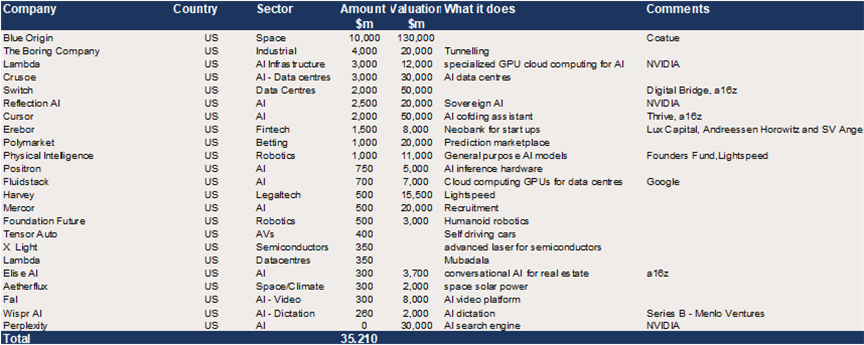
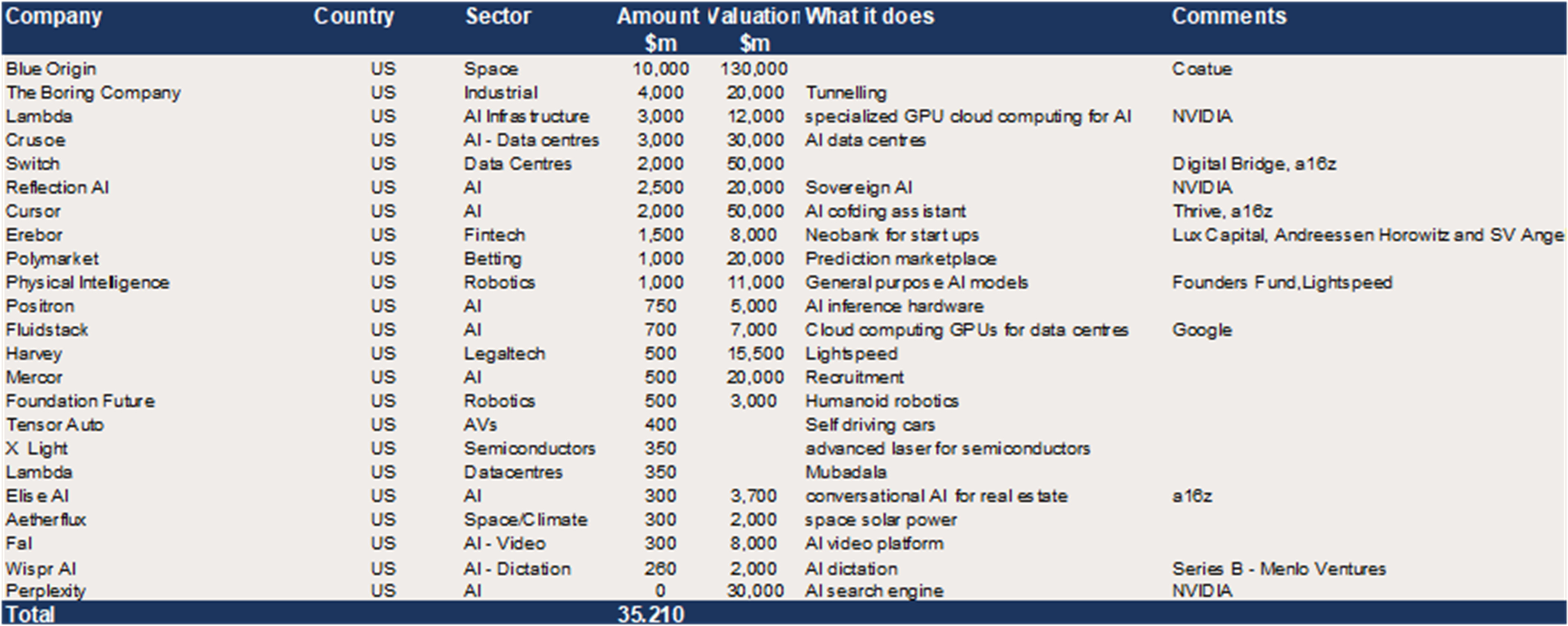
Our list of impending US raises rises again, from c$32bn at the end of July to $35bn at end August.
The new additions to the list are led by a potential $3bn raise for the AI infrastructure business, Lambda at a $12bn valuation with core support from Nvidia. The company offers specialised GPU cloud computing for AI. The fintech Erebor, a neobank for start-ups, is reportedly looking to raise $1.5bn at an $8bn valuation with the support of Lux Capital, a16z and SV Angel. The size of the predicted Polymarket raise has now risen to $1bn at a $20bn valuation. Legaltech Harvey is said to be raising $500m at a $15bn valuation in a deal led by Lightspeed. Elise AI, which is producing conversational AI for real estate agents is raising $300m at a $3.7bn valuation in a deal said to be led by a16z.
The main removal from the list is Databricks which raised $5bn in August – the expectation had been $3bn.
The list continues to be headed by Jeff Bezos’ space rocket venture Blue Origin. The company is reported to be looking to raise $10bn at a $130bn pre money valuation supported by Coatue and with Jeff Bezos contributing c$2bn.
Elon Musk’s The Boring Company with its planned tunnelling systems looking to see a raise of $4bn at a c$20bn valuation.
US Growth Equity – c$35bn in reported upcoming raises
Source: Rothschild & Co; press reports
Source: Rothschild & Co; press reports
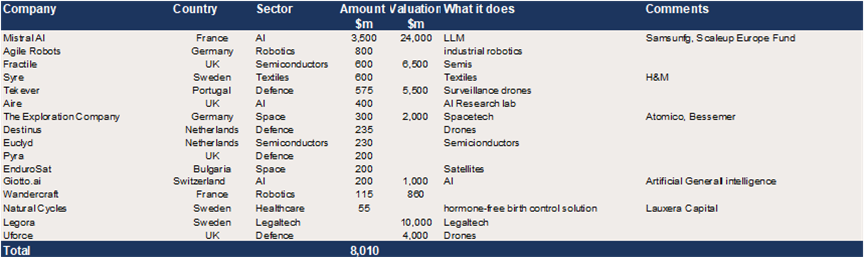
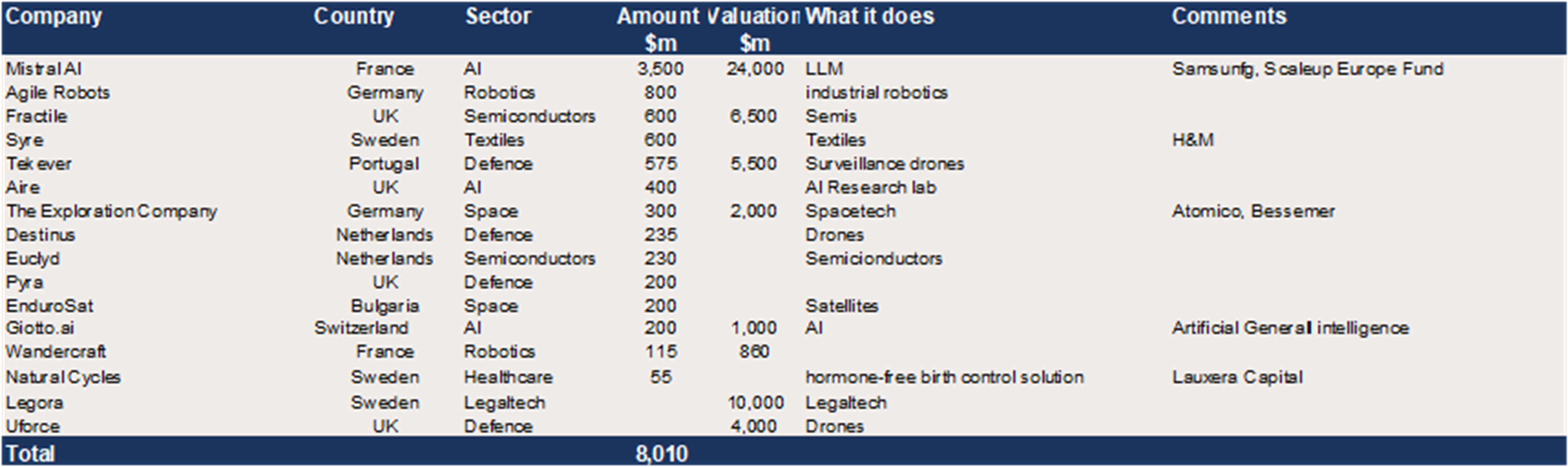
In Europe the total of identified impending raises stays at c$8bn.
At the top of the list is a deal announced already in early September. Mistral the French LLM business which is also building out its own datacentres announced in early September that it had raised $3.5bn at a valuation of $24bn in a round led by Samsung, the Scaleup Europe Fund and PSG Equity. Mistral’s last raise in September 2025 was led by ASML and valued the business at $13.8bn.
Dropping off the list is Italian LLM and AI infrastructure business, Domyn, which raised $1.1bn in a mix of debt and equity. Lovable comes off the list after its $400m Series C and Cambridge Aerospace after its $300m one.
Onto the list comes the UK semiconductor business Fractile, believed to be well advanced in a $600m funding round at a $65bn valuation. Fractile recently reached an initial agreement to supply $250m of its chips to Anthropic. The round is being led by Lightspeed, Redpoint, Thrive Capital and the Founders Fund. Portuguese defence drone company Tekever is reported to be raising $575m at a valuation of $5.5bn. Pyra, an as-yet-productless UK defence start up founded by Nick Blair, son of the former UK Prime Minister, is said to be raising $200m from as yet unknown investors.
Dutch semiconductor business Euclyd is looking for $115m plus to scale its AI inference hardware but is reported to have raised that to $230m after strong early demand. French robotics start up Wanderlust is raising c$115m. Swedish legaltech Legora and the UK defence business Uforce are also in the market seeking raises of as yet undisclosed size.
European Growth Equity – c$8bn in reported upcoming raises
Source: Rothschild & Co; press reports
Source: Rothschild & Co; press reports
Our views on the state of the venture capital markets
This revival of the growth equity market has been led by the US and by a surge of interest in artificial intelligence model providers and for companies using AI to transform a range of underlying industries.
At the same time the venture industry has re-adopted strong underlying approaches to investment with companies in most sectors striving to achieve a better balance of growth, profitability and cash flow. The underlying quality of the cohort of VC backed companies has improved.
Our summary of the outlook
- There is substantial interest in venture capital to fund artificial intelligence, both the foundation LLM models and the applications of AI and industries (data centres, quantum, semiconductors, new energy sources like nuclear and fusion) supporting the development of AI.
- The influence of AI is percolating through many other industries such as drug discovery, defence, robotics, legaltech, autonomous vehicles, and cybersecurity fuelling a broader advance in the growth equity market.
- Overall, the VC market is regaining confidence with the strength of interest with fintech, blockchain/crypto and biotech reviving strongly.
- There is a burgeoning interest in defence industries from investors with both the tense geopolitical political environment, the advances in AI applications and the experience of the combat in Ukraine contributing to investor focus. By contrast, ClimateTech, while still a substantial sector has become less prominent both as a result of some high-profile failures and being less favoured politically in the US under the current administration.
- Fund raising for venture capital firms remains subdued. Fund raising is concentrating into larger, established firms. US VC fundraising in 2025 was concentrated in larger firms and at near decade lows.
- The speed of the investment process has slowed down since 2021-22. The level of diligence on deals has stepped up. This is true even in the ‘hot’ parts of the market like AI. Outside these areas it is marked – processes take time, downside protection is sought.
- Valuation priorities have shifted with investors having moved away from a pure emphasis on revenue growth and revenue multiples. There is a sharp focus instead on the combination of growth and profitability (or a rapid path to it) and on free cash flow.
Read the previous editions: May 2022, June 2022, June 2022 (2), July 2022, August 2022, Sep 2022, October 2022, November 2022, December 2022, January 2023, February 2023, March 2023, April 2023, May 2023, June 2023, July 2023, August 2023, September 2023, October 2023, November 2023, December 2023, January 2024, February 2024, March 2024, April 2024, May 2024, June 2024, July 2024, August 2024, September 2024, October 2024, November 2024, December 2024, January 2025, February 2025, March 2025, April 2025, May 2025, June 2025, July 2025, August 2025, September 2025, October 2025, November 2025, December 2025, January 2026, February 2026, March 2026, May 2026, June 2026, July 2026, August 2026
Rothschild & Co: Selected recent deals in Growth Equity and Private Capital
A selection of recent deals on which we have advised: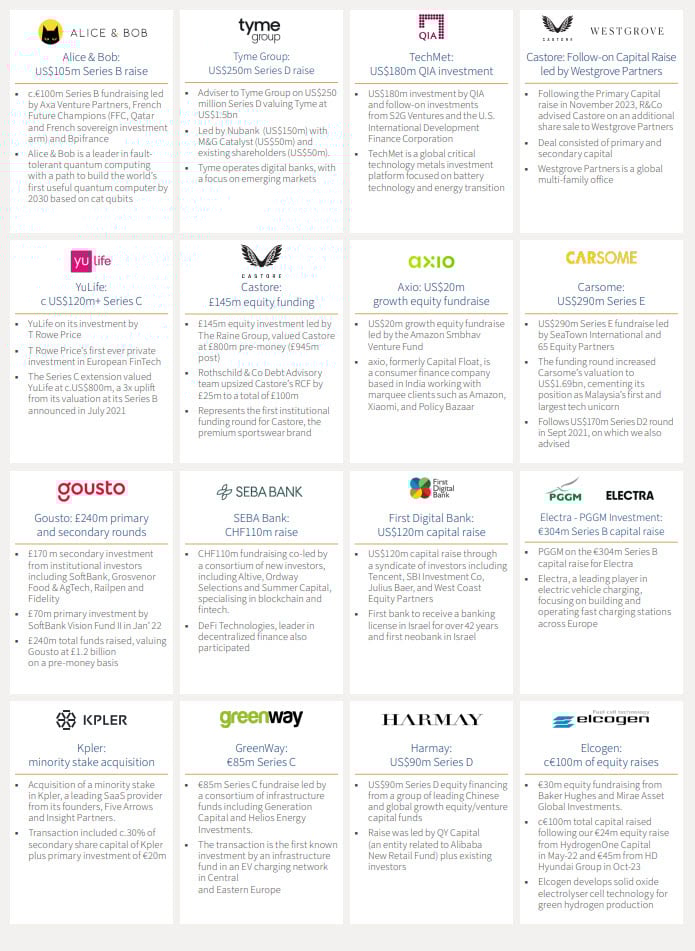
For more information, or advice, contact our Growth Equity team:
Mark Connelly
Co-Head of Global Market Solutions
+1 212 403 5500
+1 917 297 5131
Chris Hawley
Global Head of Strategic and Private Investors.
+44 20 7280 5826
+44 7753 426 961
Patrick Wellington
Vice Chairman of Equity Capital Markets Europe
+44 20 7280 5088
+44 7542 477 291
Antoine de Guillenchmidt
Co-Head of Equity Capital Markets Europe
+44 20 7280 5377
+44 7907 712 978
Pete Nicklin
Co-Head of Equity Capital Markets Europe
+44 20 7280 1668
+44 7912 395 294
Laura Klaassen
Head of Private Distribution
+44 7926 905 488
Thomas Chung
Head of Private Capital, North America
+1 212 403 5559
+1 917 594 7208
Cyrus Danesh
Director of Private Distribution
+44 20 7280 1085
+44 7718 205 387
This document is being provided to the addressed recipients for information only and on a strictly confidential basis. Save as specifically agreed in writing by Rothschild & Co Equity Markets Solutions Limited (“Rothschild & Co”) this document must not be disclosed, copied, reproduced, distributed or passed, in whole or in part, to any other party.
This document does not constitute an offer, inducement or invitation for the sale or purchase of securities, investments or any of the business or assets described in it.
This document has been prepared from publicly available information. This information, which does not purport to be comprehensive, has not been independently verified by us or any other party. The document does not constitute an audit or a due diligence review and should not be construed as such. The information provided should not be relied on for any purpose and should not in any way serve as a substitute for other enquiries and procedures that would (or should) otherwise be undertaken.
No representation or warranty, expressed or implied, is or will be made and, save in the case of fraud, no responsibility or liability is or will be accepted by us, as to or in relation to the accuracy, sufficiency or completeness of this document or the information forming the basis of the document or for any reliance placed on the document by any person whatsoever. No representation or warranty, expressed or implied, is or will be made as to the achievement or reasonableness of, and no reliance should be placed on, any projection, targets, estimates or forecasts and nothing in this document should be relied on as a promise or representation as to the future.
Law or other regulation may restrict the distribution of this document in certain jurisdictions. Accordingly, recipients of this document should inform themselves about and observe all applicable legal and regulatory requirements. This document does not constitute an offer inducement, or invitation to sell or purchase securities or other investments in any jurisdiction. Accordingly, this document does not constitute a Financial Promotion under the Financial Services and Markets Act 2000 (Financial Promotion) Order 2005 or equivalent legislation in other jurisdictions. This document is being distributed on the basis that each person in the United Kingdom to whom it is issued is reasonably believed to be such a person as is described in Article 19 (Investment professionals) or Article 49 (High net worth companies, unincorporated associations etc.) of the Financial Services and Markets Act 2000 (Financial Promotion) Order 2005 or is a person to whom this document may otherwise lawfully be distributed. In other jurisdictions, this document is being distributed on the basis that each person to whom it is issued is reasonably believed to be a Professional Investor as defined under the local regulatory framework. Persons who do not fall within such descriptions may not act upon the information contained in this document.