Insurance company approaching transaction

Our client is a 50-year-old insurance professional, married, with two children aged 12 and 14. He has worked within the insurance industry for the duration of his career and is currently a senior individual at an insurance business which has recently been sold in a private-equity backed deal. As a result of this, he is due to receive a significant lump sum, whilst also potentially re-investing into the new business.
Key objectives
Our client wanted to understand his options for investing and establish a plan for retirement given the renewed circumstances; transitioning from a 'river' (salary income) to a 'lake' (lump sum). His priorities were supporting his children with property purchases and leaving a meaningful legacy for his family whilst supporting their lifestyle expenditure throughout retirement.
How we helped
We began working with the client before the transaction had completed, helping them clarify what they could achieve. This involved introducing the client and their management team to a specialist adviser who provides advice to management teams going through Private Equity backed transactions.
Because this was the first time the client had received a sum of money of this quantum, we helped them take the time to think about long-term planning. We started by helping our client categorise and consider the risk and return profiles of his assets using our ‘Wealth Framework‘. Our client had already built a strong financial foundation by having a good mix of assets across different ‘pots’.
Solutions and options
We modelled a range of scenarios to assess how much capital might be needed to support their lifestyle and the impact of different scenarios on their portfolio values, such as house purchases or renovations. We considered how best to structure their finances, cognisant of future plans and introduced a trusted accountant and lawyer to help build out their personal advisory team.
Following the sale, the client upgraded their family home. We set aside a cash sum to cover expenditure over the next 2-3 years and allocated this to a range of deposit accounts and short-dated UK gilts, which we proactively manage for them to balance returns and liquidity. For additional peace of mind, we arranged a lending facility secured against their investments with us, for any unexpected expenditure.
They then earmarked a further sum for long-term investment. Our client appreciated our ‘bottom up’, differentiated, investment approach and we helped consolidate their existing investments and funds allocated from the sale into a long-term investment portfolio – their personal ‘nest egg’ – designed to support their family's lifestyle for decades to come.
With a long-term plan in place to continue to build his family’s wealth, we were able to start a discussion on how to then consider passing those assets down to his children (e.g. trusts or family investment companies) and the timing of these.
Outcome
As a result, our client now has a much better understanding of their plans, when they are able to retire and how they can pass assets onto their children.
The client has a long-term nest egg portfolio, implemented in a tax-efficient structure for the benefit of future generations.
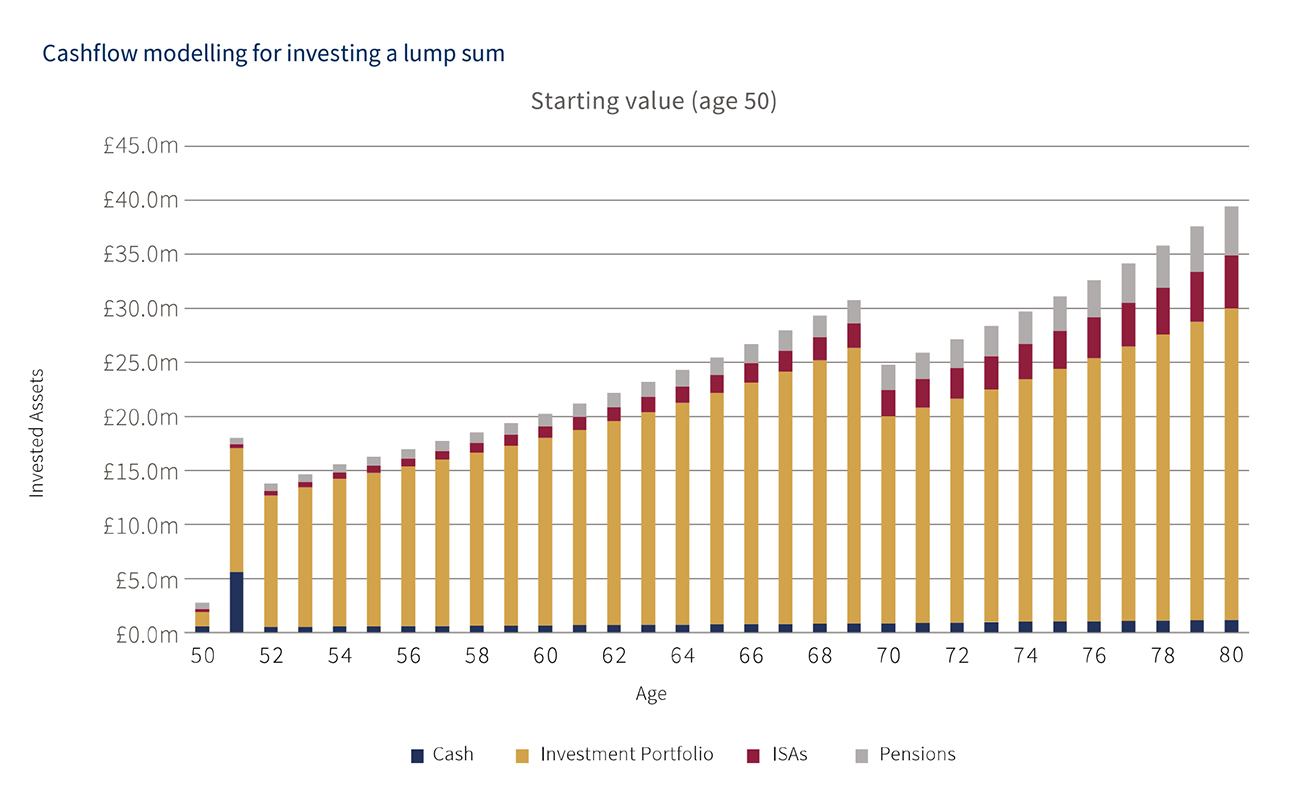
| Assumptions | Investment portfolio | ISAs | Pensions |
| Starting value (age 50) | £1,250,000 | £250,000 | £0 |
| Performance (balance for illustration) | 6.00% | 6.00% | 7.00% |
| Inflation | 3.00% | 3.00% | 3.00% |
Assumes annual withdrawals of £250k p.a. (gross) and a gift of £5m at the age of 70.
Source: Rothschild & Co, Bloomberg Data from 31 December 2002 to 31 December 2025.
The New Court Fund GBP inception date was 14 July 2015. Performance for periods prior to inception date is the Rothschild & Co Wealth Management UK Ltd GBP Balanced composite, adjusted to reflect the fund's 1% annual management charge and 0.06% operational costs. Performance data is net of fees. Data post 30 September 2007 is net of actual client fees incurred. Data prior is actual gross performance less current average client fees.
Past performance is not a reliable indicator of future performance and the value of investments and the income from them can fall as well as rise.
The above graphs are for illustrative purposes only. The information above is not intended and should not be construed as tax advice. Each investor should seek their own independent tax advice