Wealth Management: Company Insights – The Office

Q1. With a focus on well-located office spaces in Switzerland's main urban centres, how has the pandemic affected PSP's real estate portfolio?
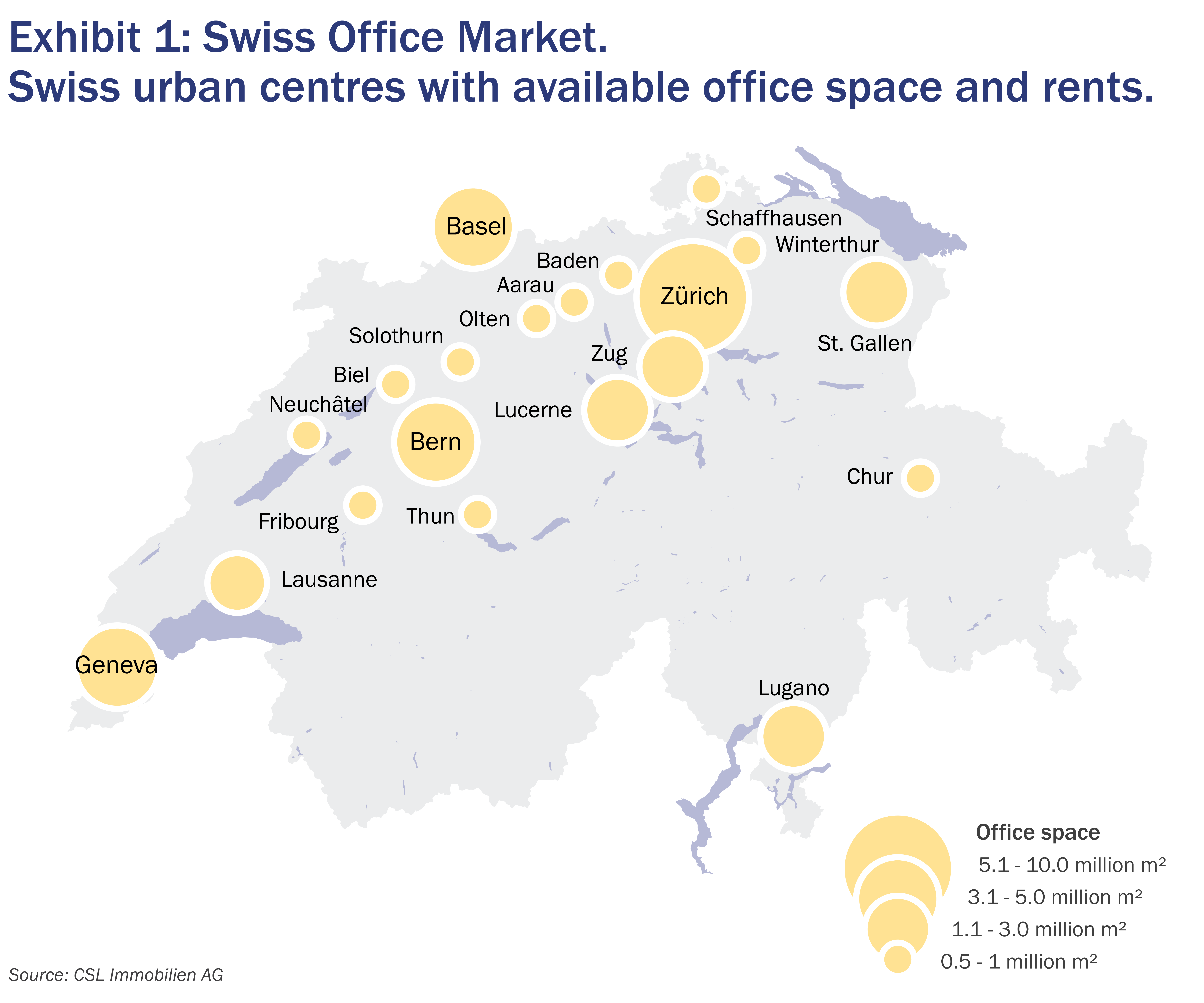
Office spaces in Switzerland's central business districts have seen little reduction in tenant demand during the pandemic. This is in part due to the relative scale of Swiss urban areas which offer lower density and shorter commute times vs. larger urban centres such as Paris, Berlin or London. In Switzerland, prime central office spaces remain an attractive proposition for businesses who wish to maintain visibility and client-facing facilities (see Exhibit 1 for an overview of Swiss office real estate).
Businesses in central business districts tend to have a high level of productivity and profitability, as well as employees who value the centrality of where they work. The impact of the pandemic on prime office real estate has therefore been marginal.
Where we have seen a shift is in mid-office locations and in smaller urban centres. For instance, in Biel – home to many marketing and IT functions – we've seen companies looking to re-arrange and optimise their office space and, at times, renegotiate rents. However, central business districts account for 80% of PSP's property portfolio, with just 20% exposed to suburban trends, so our real estate portfolio has responded well to the challenges of the last 18 months.
Q2. How are Switzerland's urban offices adapting to changing work-life patterns?
A key pressure point for many businesses is the use of meeting rooms. We've seen a growing number of tenants, such as Swisscom, create more collaborative spaces in their existing offices. The pandemic has, without a doubt, brought new opportunities for COOs to rethink the use of office spaces (see COO Rothschild & Co interview). As many businesses look towards hybrid working models, square metre needs are changing. Businesses are thinking not just about desk space but also about break-out and creative areas, as well as virtual conference booths.
Companies with higher purchasing power are likely to spend more on these ‘softer’ features, as a way of engaging and communicating with work forces. This does not mean that floor space demands are necessarily increasing. From our own experience, we created collaboration and break-out spaces in our Basel office and ended up with a 20% reduction in floor space requirements. This came about by using the office space more efficiently.
Q3. To what extent are non-pandemic factors changing Switzerland's inner-city urban landscape?
There is no doubt that a long-lasting and arguably bigger disruptor for commercial real estate in central urban areas is the rise of eCommerce. If you look at real estate for the luxury sector, the likes of Hermes, Gucci, Channel or Dolce & Gabbana are all responding to the pressure of eCommerce by converting their central stores into experience spaces. Larger brands are in fact moving to 10-15% higher rental rates in prime locations where resources will concentrate on fewer but bigger ‘experience’ stores which focus on marketing to customers in high-frequency areas.
Meanwhile non-high frequency stores will close, leading to an even stronger bifurcation between prime and non-prime segments of commercial real estate than that seen in rental rates for office real estate.
Q4. How well understood is the Swiss commercial real estate market?
I think it's important to remember that real estate – commercial, office or residential – is always a local story. You need to have the local knowledge and flavour when you invest. When it comes to Switzerland, we are a small but highly developed market where big trends can have an impact but are often more muted than in mega urban centres. That's why we saw a high rate of contract renewals in 2021 amongst our business tenants, despite the obvious challenges caused by the pandemic.
Giacomo Balzarini is the CEO of PSP Swiss Property and was interviewed by our Investment Insights and Equity Analyst teams at Rothschild & Co Wealth Management, Switzerland & Germany.
Where the views expressed in this interview are from PSP Swiss Property, they and are not made on behalf of Rothschild & Co.
Related Files
More Information