
Global Advisory

Expert M&A and capital markets advice

Wealth Management Switzerland

Dedicated to helping individuals and families preserve and grow their wealth over the long term

Asset Management

Global investment solutions and services to institutional clients, financial intermediaries and independent financial advisers

Five Arrows

Our alternative assets arm, managing funds dedicated to private equity and private debt

About us

Over 200 years at the centre of the world's financial markets

Careers

A company of opportunity, entrepreneurialism and growth

Location & language

Select Region Select Language

Wealth Management: Company Insights – The Office

Published date

Interview with PSP

Founded in 1999, PSP Swiss Property is a leading commercial real estate business invested primarily in office spaces in key Swiss economic centres, including Zurich, Geneva, Basel, Bern and Lausanne. In the wake of the Covid-19 pandemic, we discuss with PSP's CEO, Giacomo Balzarini, the future of the workplace and learn about our own Chief Operating Officer's plans for Rothschild & Co Bank AG offices.

Q1. With a focus on well-located office spaces in Switzerland's main urban centres, how has the pandemic affected PSP's real estate portfolio?

Office spaces in Switzerland's central business districts have seen little reduction in tenant demand during the pandemic. This is in part due to the relative scale of Swiss urban areas which offer lower density and shorter commute times vs. larger urban centres such as Paris, Berlin or London. In Switzerland, prime central office spaces remain an attractive proposition for businesses who wish to maintain visibility and client-facing facilities (see Exhibit 1 for an overview of Swiss office real estate).

Businesses in central business districts tend to have a high level of productivity and profitability, as well as employees who value the centrality of where they work. The impact of the pandemic on prime office real estate has therefore been marginal.

Where we have seen a shift is in mid-office locations and in smaller urban centres. For instance, in Biel – home to many marketing and IT functions – we've seen companies looking to re-arrange and optimise their office space and, at times, renegotiate rents. However, central business districts account for 80% of PSP's property portfolio, with just 20% exposed to suburban trends, so our real estate portfolio has responded well to the challenges of the last 18 months.
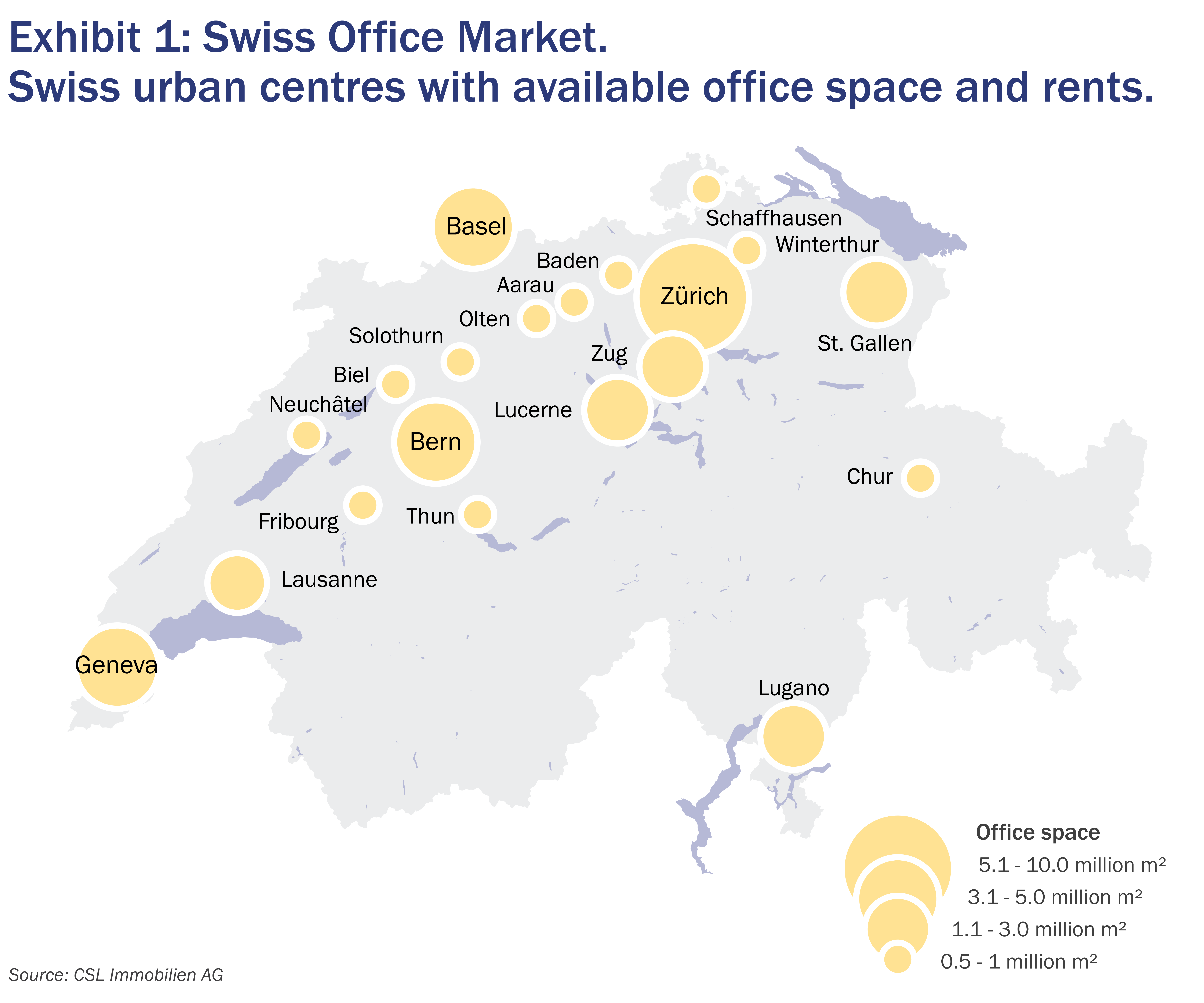
 

Company Insights PSP CH Map

Q2. How are Switzerland's urban offices adapting to changing work-life patterns?

A key pressure point for many businesses is the use of meeting rooms. We've seen a growing number of tenants, such as Swisscom, create more collaborative spaces in their existing offices. The pandemic has, without a doubt, brought new opportunities for COOs to rethink the use of office spaces (see COO Rothschild & Co interview). As many businesses look towards hybrid working models, square metre needs are changing. Businesses are thinking not just about desk space but also about break-out and creative areas, as well as virtual conference booths.

Companies with higher purchasing power are likely to spend more on these ‘softer’ features, as a way of engaging and communicating with work forces. This does not mean that floor space demands are necessarily increasing. From our own experience, we created collaboration and break-out spaces in our Basel office and ended up with a 20% reduction in floor space requirements. This came about by using the office space more efficiently.

Q3. To what extent are non-pandemic factors changing Switzerland's inner-city urban landscape?

There is no doubt that a long-lasting and arguably bigger disruptor for commercial real estate in central urban areas is the rise of eCommerce. If you look at real estate for the luxury sector, the likes of Hermes, Gucci, Channel or Dolce & Gabbana are all responding to the pressure of eCommerce by converting their central stores into experience spaces. Larger brands are in fact moving to 10-15% higher rental rates in prime locations where resources will concentrate on fewer but bigger ‘experience’ stores which focus on marketing to customers in high-frequency areas.
Meanwhile non-high frequency stores will close, leading to an even stronger bifurcation between prime and non-prime segments of commercial real estate than that seen in rental rates for office real estate.

Q4. How well understood is the Swiss commercial real estate market?

I think it's important to remember that real estate – commercial, office or residential – is always a local story. You need to have the local knowledge and flavour when you invest. When it comes to Switzerland, we are a small but highly developed market where big trends can have an impact but are often more muted than in mega urban centres. That's why we saw a high rate of contract renewals in 2021 amongst our business tenants, despite the obvious challenges caused by the pandemic.
 

View from the equity analysts

At Rothschild & Co, alongside PSP's swiss-focused real estate portfolio, we continue to gain insights on the wider real estate asset class as our Analysts also cover Partners Group. As Private Real Estate represents 15% of its USD 119bn portfolio, we reviewed the sector with Jessica Wichser, Partners Group’s Global Head of Private Real Estate Asset Management.

Partners Group's extensive global property portfolio is invested primarily across offices, housing, industrial and hospitality sectors. Jessica highlighted their robust processes for identifying the right targets via proprietary and systematic thematic investing approaches. Examples of investments are next generation offices or high-end, amenity-focused apartments.

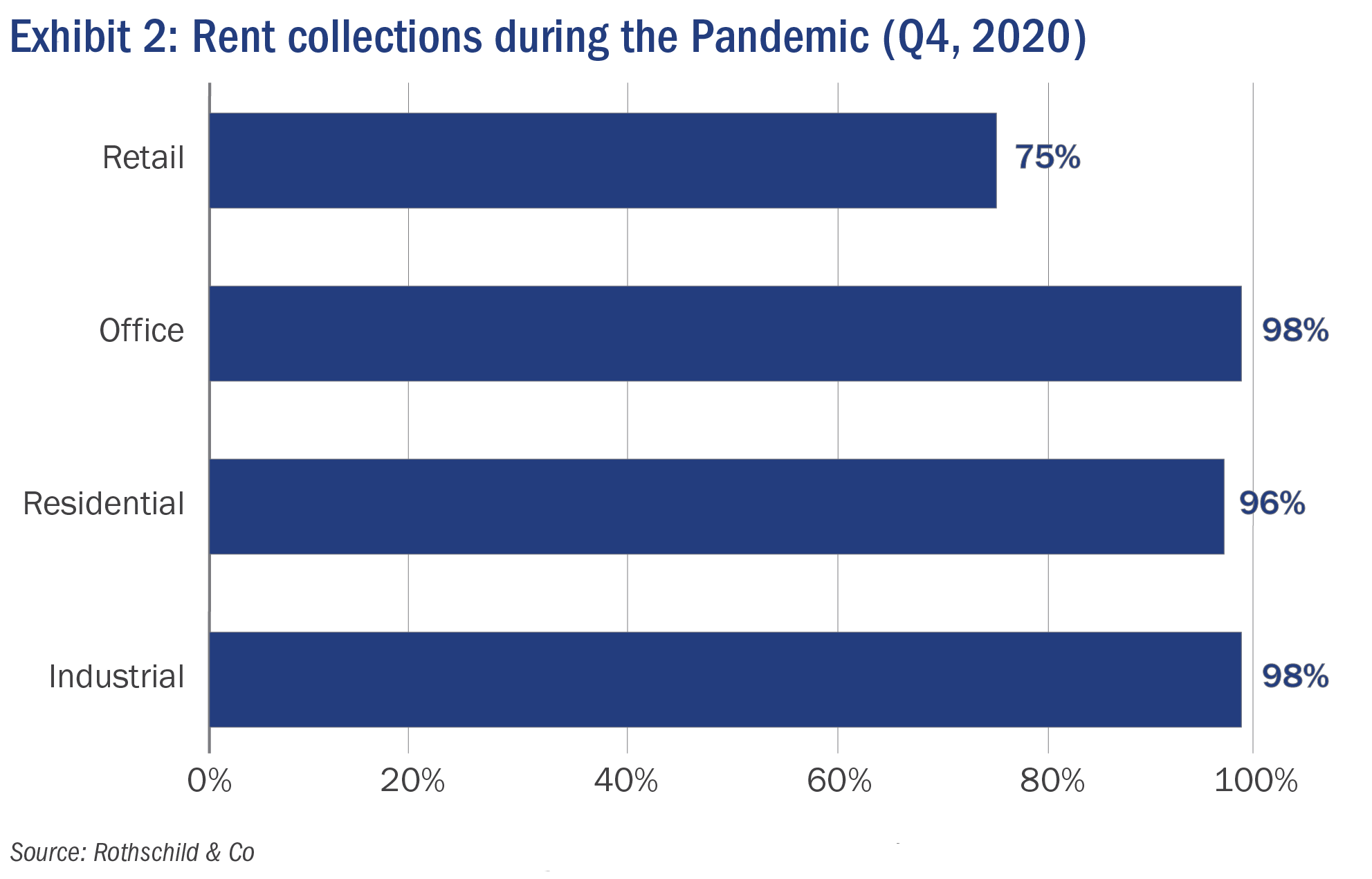
From a snapshot of rent collections during the end of 2020, we clearly see that retail has suffered disproportionately during the pandemic, whilst industrial, residential and office rental markets have remained largely unaffected.

Discussions like this with companies in our investment universe help us to better assess the impact of trends that may disrupt company earnings and impact share prices.


Interview with the Chief Operating Officer, Daniel Weber, of Rothschild & Co Bank AG

1. Turning to Rothschild Bank AG's offices, how have you responded to changes in work patterns over the last 18 months? 

The last 18 months have shown the importance of staying one step ahead in terms of office planning and preparation, so as to ensure smooth business operations. In early January 2020, we started to implement hygiene measures across our offices by reducing high-contact spaces. By February 2020, we asked vulnerable colleagues to work from home. By this stage we knew that we would have to make some significant changes to the office setup, and we started with home office for a pilot group on 6 March 2020. Ten days later, the entire business was operating remotely, and we remained in this virtual pattern until September 2020 when we rolled out hybrid working patterns which have ebbed and flowed depending on where we are in the infection cycle. Coupled with changes to the physical office space, we increased our communications to employees, sending no less than 11 bulletins to keep colleagues updated in the Feb – May 2020 period. We also took the opportunity over the summer months in 2021 to bring office teams together on our outdoor terrace. This allowed colleagues to meet new joiners and reconnect, whilst always ensuring compliance with government guidelines.   

2. What is Rothschild Bank AG's vision for the future of the office? 

Rothschild & Co is working on an agile working charter which will embrace the principles of hybrid work which we have put into practice over the last year. The office will remain the principal place of work as a space which brings colleagues together, fosters interaction and allows people to feel part of a culture which we have worked hard to create at Rothschild & Co. That said, we are working on re-designing our offices for a future of hybrid work and for the realities of learning to live with Covid-19. For example, we will install a greater number of small meeting rooms and small video-conference booths which allow people to step away from noisy places and meet virtually. Virtual will also remain the primary medium for meetings – it is both quicker and more efficient at bringing colleagues together regardless of where they are. Other ideas we are looking at include dedicated quiet or project spaces or places where people can have short meetings over a coffee. Of course, we will need to be patient and make these changes incrementally, testing their efficacy and popularity with colleagues. We prefer a gradual approach to shaping the future of the office rather than making wholesale changes without measuring their impact first.   


Giacomo Balzarini is the CEO of PSP Swiss Property and was interviewed by our Investment Insights and Equity Analyst teams at Rothschild & Co Wealth Management, Switzerland & Germany.
Where the views expressed in this interview are from PSP Swiss Property, they and are not made on behalf of Rothschild & Co.

Related Files

Important information

More Information

View more Wealth Insights