- Detalles del artículo
-
Towards a new world order ?
" Peace is not the absence of conflits, but the ability to deal with it " Gandhi
The expression "peace dividend" became part of political and economic vocabulary at the turn of the 1990s. It characterises the tendency of Western states to redirect part of their military spending towards social priorities, in the context of the end of the Cold War and the collapse of the Soviet bloc. This phrase, used by many politicians and economists, symbolises the optimism of an era when peace seemed assured and the reduction in threats made it possible to envisage a new era of prosperity and social progress.
Indeed, the decade following the fall of the Berlin Wall was marked by a profound transformation in the international balance of power. The disappearance of the Soviet threat, the dissolution of the Warsaw Pact and the reunification of Germany paved the way for a peaceful Europe, the enlargement of the European Union and the proliferation of free trade agreements. The United States, now the sole superpower, imposed a world order based on stability, the promotion of its democratic standards and the liberalisation of economic exchange.
« Peace dividends » : a lasting trend ?
In this context, military spending fell significantly. Between 1990 and 1998, global military spending fell by nearly 30%, from $1,411 billion to $1,014 billion (in constant dollars)[1]. In France, the share of GDP devoted to defence spending fell from 5.4% in 1960 to 1.9%[2] in 2008, representing annual savings of several billion euros. This trend is widespread in Europe: Germany, Spain, Italy and the UK also reduced their defence budgets, abolishing compulsory military service (France 1997, Spain 2001, Germany 2011) and closing numerous bases and barracks. This movement was accompanied by a wave of disarmament: 191[3] states signed the nuclear non-proliferation treaty, nuclear arsenals have been reduced, and international cooperation intensified as a result. Military personnel numbers have fallen sharply: from 550,000 in 1988 to less than 300,000 in 2020[4] in France.
In reality, these "dividends" are not only budgetary. They also translate into greater confidence, stability and international integration, which promotes growth and the spread of innovation. Western economies are taking advantage of reduced geopolitical risk to invest in healthcare, education, research and infrastructure modernisation. At the same time, life expectancy is increasing, inequalities are declining and cross-border talent mobility is growing.
Ultimately, globalisation is accelerating as a result of the reduction of customs barriers, the creation of free trade areas (NAFTA, the enlarged European Union, ASEAN, etc.), China's integration into the World Trade Organization (WTO) in 2001, and the explosion of trade flows. Global GDP increased by 4.3 between 1980 and 2024, while the volume of world trade increased by 8.1[5]. Over the period, Foreign Direct Investment (FDI) rose from $50 billion to $1.5 trillion[6], and technological and digital development transformed value chains. Companies optimised their production through global just-in-time manufacturing, tax and financial arbitrage has become increasingly common, and the rapid spread of innovation has become a driver of growth.
However, this “dividend” has not always been used to reduce debt or taxes. In many countries, it has been used to finance ever-increasing social spending, sometimes at the expense of strategic planning capacity and military resilience. Thus, the temptation to take advantage of the "peace dividends" without anticipating future risks has led to a certain vulnerability of Western economies to geopolitical shocks and supply disruptions.
The shift : rising conflict and fragmentation
Since the COVID-19 crisis, the international context has undergone a marked reversal. Rising geopolitical tensions, the fragmentation of trade and the return of armed conflict are calling into question the "peace dividends" regime. The wars in Ukraine, the Gaza Strip, Ethiopia, Myanmar and the Sahel illustrate the resurgence of conflict. In 2024, there were 61 active armed conflicts in 36 countries across the world. The number of battle-related deaths reached 740,000 between 2021 and 2024, a record since the end of the Cold War.[7]
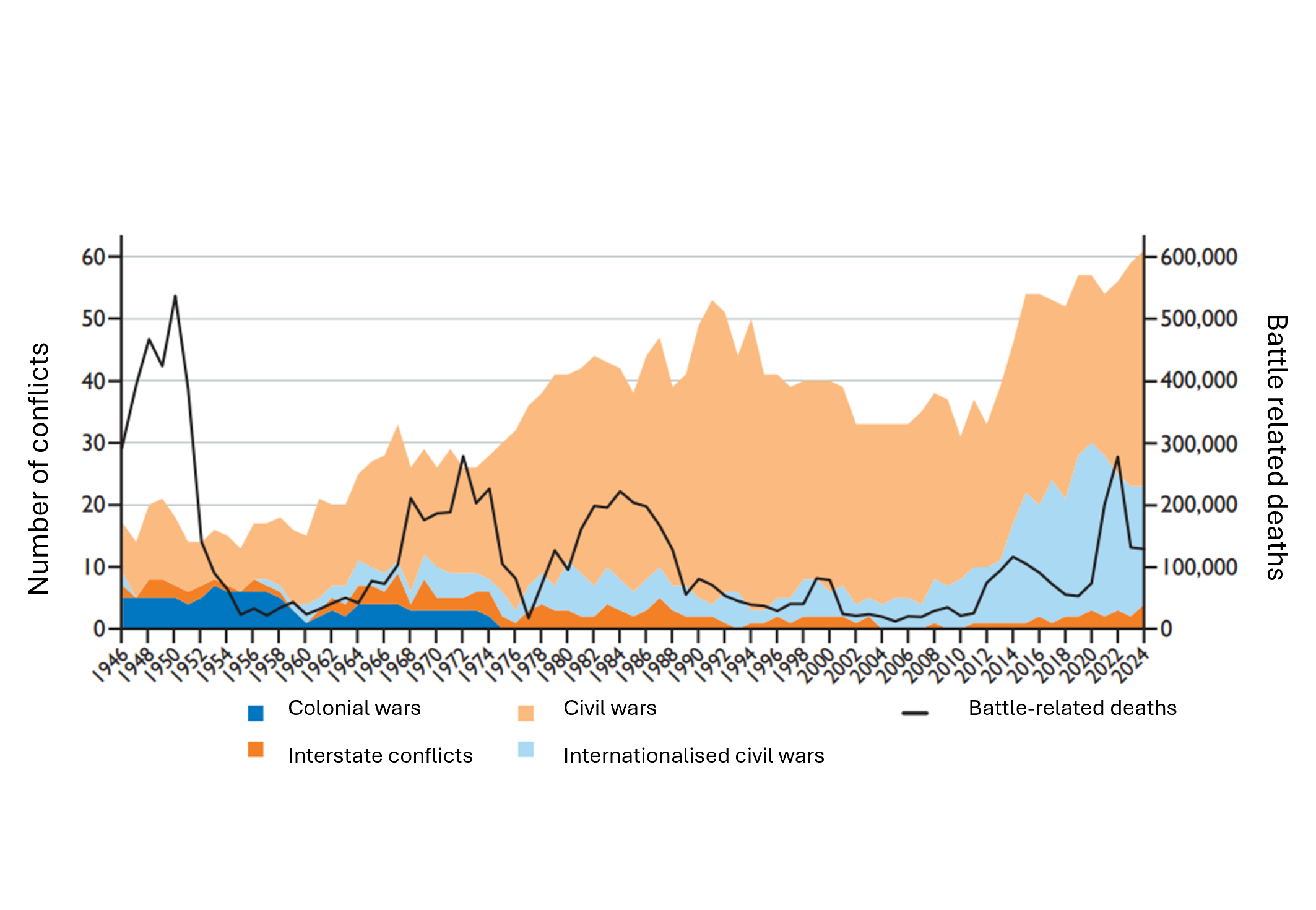
Chart: Number of armed conflicts involving states, by type of conflict, 1946–2024.
Source: Lacina and Gleditsch Battle Death Datasets (2005), UCDP/PRIO Armed Conflict Dataset, and UCDP Battle-Related Deaths Dataset (Pettersson et al, 2025).
Lastly, economic tensions, including the trade war between the United States and China, the proliferation of sanctions and tariffs, and the rise of protectionism, all point to a broader questioning of globalisation. The formation of competing blocs, the reconfiguration of supply chains and the diversification of foreign exchange reserves thus reflect growing geopolitical fragmentation. The United States, China, Europe and the broader BRICS countries are seeking to strengthen their strategic autonomy, secure their supplies and limit their dependence on external players. Industrial relocation, nearshoring[8] and friendshoring[9] are becoming priorities, while mistrust of trading partners is growing, as evidenced by the introduction of tariffs by the United States in the spring of 2025.
A new need for autonomy
In this new paradigm, security, resilience and strategic autonomy now take precedence over the sole pursuit of efficiency and productivity. Defence spending is therefore on the rise again: in 2024, global military spending reached $2.718 trillion, an increase of 9.3% compared to 2023, the largest annual increase since the end of the Cold War[10]. The historic target of 2% of GDP devoted to defence, set by NATO, is now considered insufficient in the face of growing threats. In 2025, several member countries, led by the United States and Germany in particular, are calling for this threshold to be raised to 2.5% or even 3% of GDP in the coming years. Europe, which has long benefited from the "peace dividend", must now reinvest heavily in defence and industrial sovereignty.
A new development is that the technological, energy, healthcare and food dependence of Western economies is becoming a central issue. By way of illustration, in terms of technology, Europe is heavily dependent on American cloud infrastructure, with nearly 70% of the market share held by three American companies and 92% of Western data hosted in the United States. Dependence on American and Asian semiconductors is also proving critical, with the European Union accounting for only 12.7%[11] of the global value chain. European initiatives, such as the Chips Act and the Action Plan for Artificial Intelligence (AI), aim to strengthen technological sovereignty, but there is still a significant gap to be closed.
In terms of energy, the war in Ukraine has highlighted Europe's critical dependence on Russian gas, which accounts for 45% of its natural gas imports[12]. The gradual cut-off of Russian supplies has forced the European Union to turn to other suppliers, notably the United States (LNG), Norway, Algeria and Saudi Arabia. However, this diversification remains fragile: although the new partners are more "friendly", they are themselves subject to geopolitical constraints and increased global competition. In this context, the development of renewable energies is becoming a strategic priority, not only for climate reasons, but also to reduce vulnerability to supply shocks. Europe must accelerate investment in solar, wind and nuclear energy and strengthen the storage and interconnection capacity of its networks to avoid excessive dependence, and guarantee long-term energy security.
Dependence on healthcare, particularly the production of medicines and active ingredients, is also a cause for concern. The Covid-19 crisis has starkly revealed the vulnerability of Western economies to the relocation of pharmaceutical production, particularly to Asia. During the pandemic, many European countries faced shortages of essential medicines, masks, protective equipment and even vaccines, due to a lack of local production capacity or sufficient strategic stocks. The crisis highlighted the need to relocate certain critical value chains, strengthen European production capacity and build up health reserves. Today, 40%[13] of medicines marketed in the European Union come from third countries and 60% to 80%[14] of active pharmaceutical ingredients are still produced in China or India. This exposes Europe to the risk of supply disruptions in the event of a new health crisis or geopolitical tensions. Health sovereignty is becoming a central issue, on a par with energy or technological sovereignty.
The strategic role of states
Confronted with these vulnerabilities, public policies must now adopt a much more interventionist stance. Governments are being forced to play (once again?) a leading role in industrial planning, securing supply chains and supporting strategic innovation. This involves massive investment in defence, energy transition and the relocation of certain critical production activities, as well as the establishment of regulatory frameworks that promote resilience and economic sovereignty. This return to a strategic state is accompanied by a proliferation of industrial policies, targeted subsidies and international agreements aimed at guaranteeing security of supply.
However, this transition is not without risk, particularly for countries with less fiscal leeway. Highly indebted countries or those with low fiscal capacity risk finding themselves in a deadlock: unable to finance the investments necessary for their adaptation, they could see their competitiveness eroded and their vulnerability to external shocks increase. This situation could accentuate economic divergences within the European Union itself and between the major global economic zones. Furthermore, the reorganisation of supply chains, industrial relocation and increased public spending are likely to fuel structurally higher inflation. The energy transition, in particular, requires massive investment and is accompanied by higher production costs, especially in a context where access to resources is becoming more competitive. There is therefore a risk of entering a regime where inflation remains persistently higher than the levels seen during the decades of "peace dividends", which will complicate the task of central banks and is likely to weigh on purchasing power.
How should portfolios be positioned in this environment?
Against a backdrop of monetary fragmentation, geopolitical uncertainty and increasing risks of sanctions, gold is emerging as an essential pillar of foreign exchange reserve diversification. This trend is particularly pronounced among central banks in emerging markets, which are seeking to reduce their dependence on the dollar and protect themselves against the risk of exclusion from international financial infrastructures such as the SWIFT system. Gold therefore offers protection against extreme shocks and breaches of confidence in traditional reserve currencies. In this segment, we believe that gold mines remain attractive, both from a valuation perspective and due to sustained demand for gold.
At the same time, in an environment where inflation could settle at a structurally higher level than before the pandemic, the risk premium demanded by investors is likely to remain high. As a result, sovereign bonds, particularly those with long maturities, should continue to offer high yields. At the corporate level, it is essential to favour companies with genuine pricing power, whether due to their dominant position, the scarcity of their solutions, their quality or, more broadly, their capacity for innovation. These players, which are able to maintain their margins and pass on cost increases, provide effective protection against inflation and market volatility.
Lastly, exposure to strategic themes such as defence and artificial intelligence (AI) is a key focus for portfolio construction. The global leaders in the AI value chain, now essential to the sovereignty and competitiveness of states, occupy a key position in a highly strategic sector. Their role, which is difficult to replace or "re-localise", gives them unique growth and resilience potential in the current context.
Portfolios must now combine resilience, the ability to adapt to inflation and exposure to key sectors of sovereignty and innovation in order to adapt to this new world order.
Let's hope that one day, in the near future, we will once again be able to enjoy the "dividends of peace" in our lives and in our portfolios!
[1] SIRPI: SIPRI Military Expenditure Database | SIPRI
[2] World Bank & SIPRI: Military spending (% of GDP) - France | Data
[3] United Nations Office for Disarmament Affairs: UNODA Treaties Database
[4] World Bank & International Institute for Strategic Studies: Armed forces personnel, total - France | Data
[5] INSEE & IMF & World Economic Outlook: The essentials of ...globalisation | Insee
[6] OECD: Foreign Direct Investment (FDI)
[7]Peace Research Institute Oslo: Rustad - Conflict Trends 1946-2024 - PRIO Paper.pdf
[8] Nearshoring involves a company relocating an activity to a country that is geographically close to its main market, rather than far away.
[9] Friendshoring refers to the strategy of locating key activities in countries considered to be political, economic or ideological "allies", regardless of their geographical proximity.
[10] SIPRI: Unprecedented rise in global military expenditure as European and Middle East spending surges | SIPRI
[11] European Council and Council of the EU: The European semiconductor sector - Consilium
[12] Toute l’Europe : Fact-checking] Is the European Union still dependent on Russian fossil fuels?
[13] For a Europe of medicines at the service of patients, Senate report of 20 October 2022.
[14] Study of API supply vulnerabilities for the European pharmaceutical industry, PWC for SICOS, LEEM and GEMME, July 2021.