Back to the future

Space, robotics and quantum technologies: long-Term opportunities supporting infrastructure and security
In recent years, Artificial Intelligence (AI) has taken centre stage, fuelled by spectacular promises and applications that are now very much a reality. We have already noted on several occasions that this revolution is underpinned by less visible building blocks, such as strategic metals, data centres and electricity grids. Recent developments invite us to broaden that perspective even further. SpaceX's initial public offering, the largest in market history, has crystallised expectations surrounding the space economy, satellite connectivity and orbital services. At the same time, the emergence of humanoid robots—the physical embodiment of AI—and the rapid advancement of quantum technologies have reignited visions once confined to science fiction, while raising very real questions about sovereignty, ethics and security. As with strategic metals, the key challenge for investors is to understand how these trends are already reshaping our economies and how to gain exposure to them in a prudent and selective manner, with a long-term perspective, by focusing on companies positioned at the heart of their respective value chains.
From the space race to factory robots
The 1960s were defined by the first space race, in which the stakes were as much geopolitical as they were scientific. The Apollo programme, which culminated in mankind's first steps on the Moon in 1969, embodied a nation's ability to harness its scientific research, industrial capabilities and financial resources in pursuit of a symbolic objective. At the same time, another, quieter revolution was taking shape on Earth: the emergence of industrial robots in the automotive industry. In 1961, the first programmable robot, Unimate, was installed on a General Motors assembly line to automate repetitive and hazardous tasks[1]. Within a few decades, automation had spread across manufacturing, turning the automotive industry into a proving ground for modern robotics. Initially, both revolutions were driven by large-scale public programmes or a handful of pioneering companies, making them difficult for individual investors to access other than through diversified conglomerates. Today, however, the landscape is very different. Space, robotics and quantum technologies are no longer simply technological showcases; they have become core components of the infrastructure underpinning an ever-growing share of the economy, from logistics and healthcare to finance and defence.
Space: satellites, data centres and sovereignty
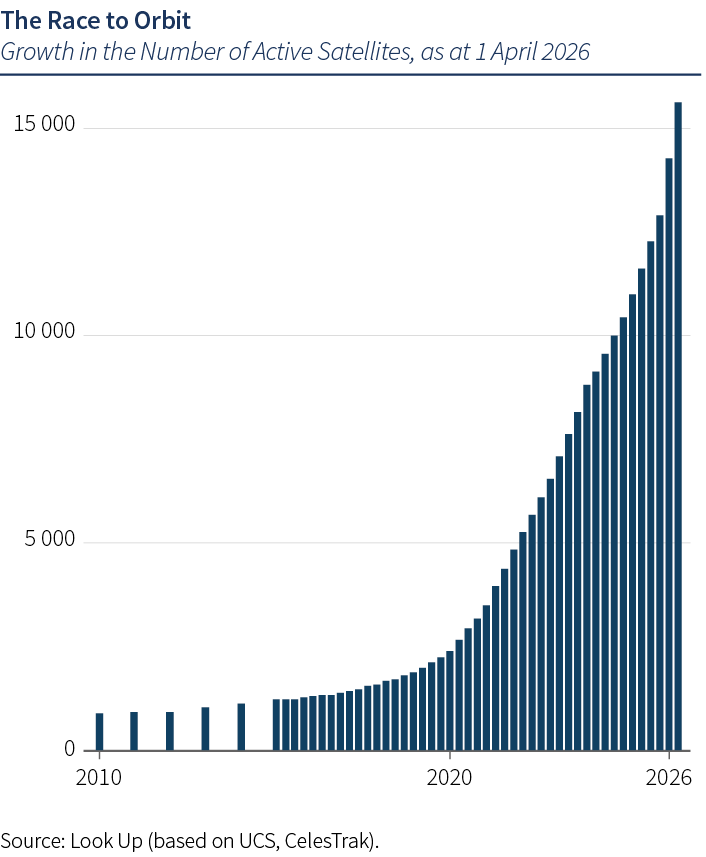
The number of operational satellites in orbit has increased almost eightfold since 2019, reaching 15,711, driven largely by the deployment of commercial low-Earth orbit constellations. SpaceX's Starlink constellation alone, which provides high-speed internet access, comprises more than 10,000 active satellites and accounts for almost two-thirds of all operational satellites currently in orbit worldwide[2]. These infrastructures support a growing range of services that are regarded as critical to our economies, including navigation and transport, electricity grids, supply chains, security, climate monitoring and natural disaster management. SpaceX's initial public offering highlights this transformation. Behind the image of reusable rockets lies a business model centred on the connectivity services provided by Starlink and the commercialisation of launch services for both public and private sector customers[3]. The information disclosed in the prospectus illustrates this shift: the satellite connectivity business has already become profitable, while substantial investment in launch systems and artificial intelligence continues to weigh on its consolidated results, without preventing it from achieving an unprecedented valuation for a technology IPO of this scale.
In addition to this satellite layer, attention is increasingly turning to the future of data centres. The rapid growth of AI is driving a sharp increase in demand for computing capacity, against a backdrop of mounting energy and environmental constraints. Some studies are exploring the concept of locating data centres partially in orbit to support specific computing workloads, taking advantage of the cooling conditions and connectivity available in space, although these projects remain experimental and technically challenging to implement. At the same time, the gradual emergence of quantum computing[4] is prompting a rethink of data security. Post-quantum cryptography, secure quantum communications and quantum-ready architectures are now becoming integral to investment strategies for critical infrastructure.
Space is also emerging as a key domain for sovereignty and defence. European and national initiatives, particularly in France, aim to secure space infrastructure, protect critical communications and strengthen surveillance capabilities, drawing in particular on quantum technologies for detection, navigation and secure communications[5].
Robotics: from the factory floor to humanoid robots
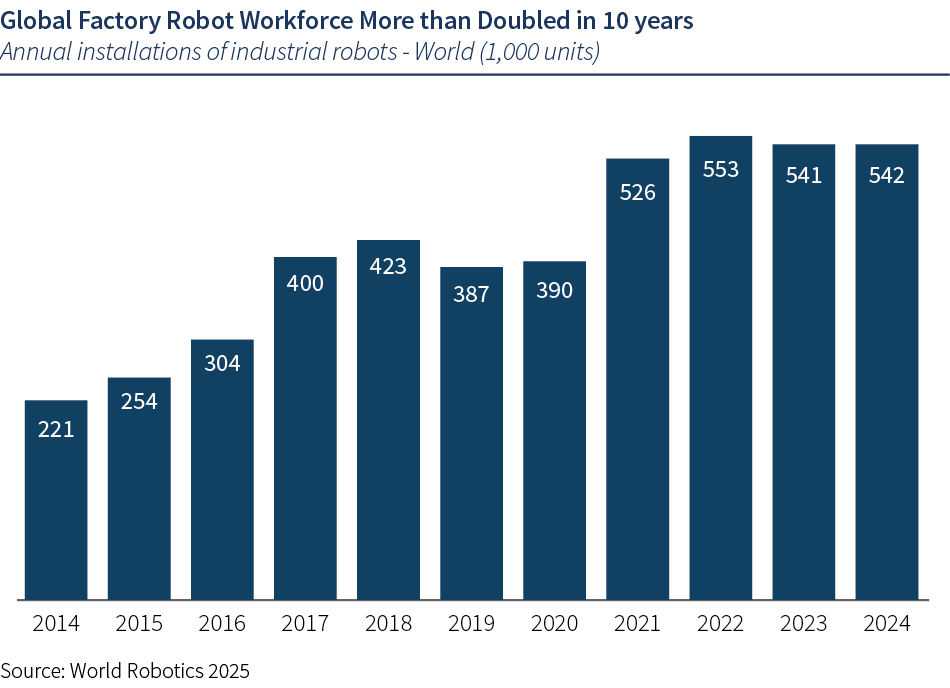
Industrial robotics remains a key driver of productivity. The global installed base now exceeds four million robots, with annual installations regularly reaching record levels, driven in particular by the automotive and electronics industries[6]. Beyond traditional welding and material handling robots, robotics is increasingly being deployed in warehouses, hospitals, care facilities, hospitality and agriculture. A new category is now attracting growing attention: humanoid robots, designed as general-purpose physical platforms for AI models. Market research suggests that this segment, while still relatively small, could be worth several billion dollars by 2030 and continue to expand well beyond that, driven by growing demand for automation and the integration of generative AI[7]. These humanoid robots are often described as the physical embodiment of AI. Whereas large language models are transforming knowledge work, these machines seek to extend automation into aspects of manual labour, particularly in structured environments such as warehouses and factories and, in time, into certain service roles, including maintenance, care and customer-facing functions.
In education, educational robots are already being used as learning tools for programming, science and language teaching, while academic research highlights both their potential and the new challenges they raise in terms of educational relationships and data protection. Healthcare represents another key area of application, encompassing surgical robotics, rehabilitation systems, assistance with repetitive tasks and service robots in geriatric care. The medical robotics market is expanding rapidly, driven by demographic ageing and shortages of qualified healthcare professionals[8]. Quantum technologies are also beginning to play a role in this field. Early research is exploring the use of quantum (or quantum-inspired) optimisation to improve path planning, molecular simulation and the personalisation of treatments, although these applications remain at the research stage for the time being[9].
Robotics, quantum technologies and ethical dilemmas
The rapid advancement of robotics and quantum technologies is accompanied by significant ethical challenges, particularly in the military sphere. Autonomous weapons systems, armed drones and robotic platforms capable of making increasingly complex decisions raise fundamental questions about the degree of autonomy we are willing to delegate to machines and about accountability in the event of errors or collateral damage. At the same time, quantum technologies are increasingly viewed as strategic assets. They promise highly secure communications, more precise sensing capabilities and, ultimately, computing power capable of undermining existing encryption systems. Against this backdrop, debates surrounding the international regulation of autonomous weapons, algorithmic transparency and the governance of quantum infrastructure are converging with more everyday concerns about educational and domestic robots, including data protection, technological dependence, the impact on employment and social cohesion. These challenges will not be resolved within a few quarters, but they already form part of the risk landscape in which companies operating in these sectors—and, by extension, the investors who finance them—must operate.
How should these themes be reflected in a portfolio?
The new space race, humanoid robots and quantum technologies illustrate just how rapidly the boundaries of the technological frontier are expanding—sometimes faster than our ability to fully grasp their implications. These themes cannot be ignored. They are already reshaping infrastructure, security and the organisation of our economies, and are likely to continue doing so for decades to come. That said, investing beyond the horizon does not mean chasing every new promise. It means maintaining a clear investment discipline, grounded in the quality of businesses, prudent risk allocation and alignment with each investor's long-term objectives. It is in this spirit that we approach space, robotics and quantum technologies—not as isolated "bets", but as components of a portfolio designed to withstand market cycles and shifting investment narratives.
Faced with these developments, we maintain the same approach that guides us across all major investment themes: distinguishing compelling narratives from economic reality and favouring companies that create sustainable value over the most heavily publicised projects.
[1] Stanford University, Robotics : a brief history
[2] 3rd edition of the Look Up – Le Point Quarterly Space Barometer. Data as at 1 April 2026.
[3] SEC, Form S-1 – Space Exploration Technologies Corp
[4] Quantum technologies encompass a range of technologies that exploit the principles of quantum physics to enhance computing, communications and sensing capabilities.
[5] NATO, Using Quantum Technologies to Make Communications Secure; Quantum Europe Strategy; OECD, National Strategies and Policies for Quantum Technologies.
[6] International Federation of Robotics, World Robotics 2025
[7] Roland Berger : Humanoid robots: Why the convergence moment is now
[8] World Economic Forum, « Robotics transforming healthcare »
[9] The Quantum Insider, « Quantum Computing Trends in 2025 »