Monthly Market Summary: February 2022
Investment Insights Team, Investment Strategist Team, Wealth Management
Summary: Widespread losses as Russia invades Ukraine
In February the escalation of the Ukraine crisis hit capital markets hard. Global equities fell 2.6% (in USD terms), while global investment grade bonds were down 2.1% (in USD). Key themes included:
- Russia's invasion of Ukraine increased the risk of wider conflict;
- Rising commodity prices and Western sanctions restrain the economic outlook;
- Central banks may reconsider policy tightening as growth prospects weaken.
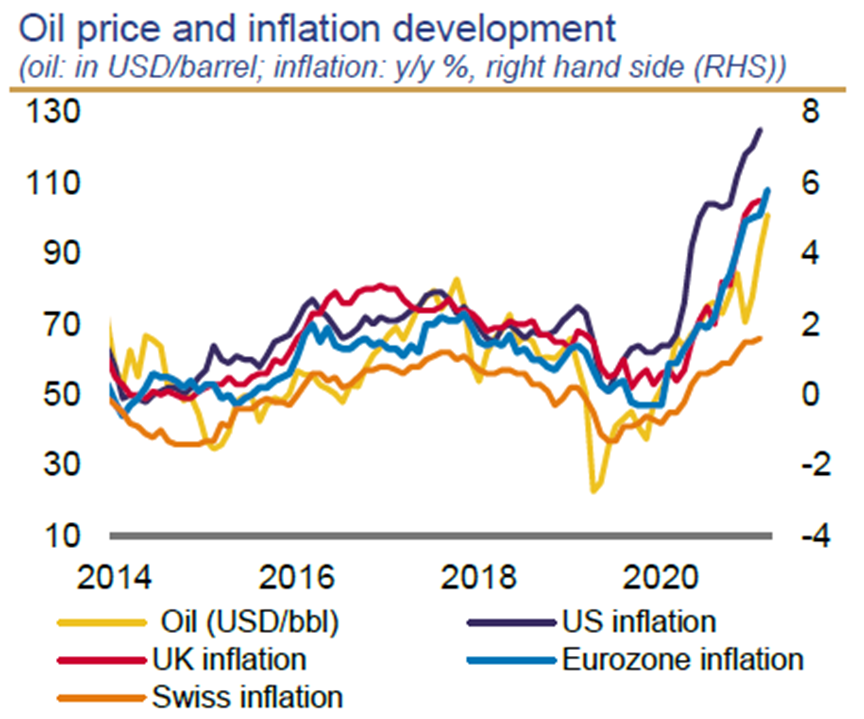
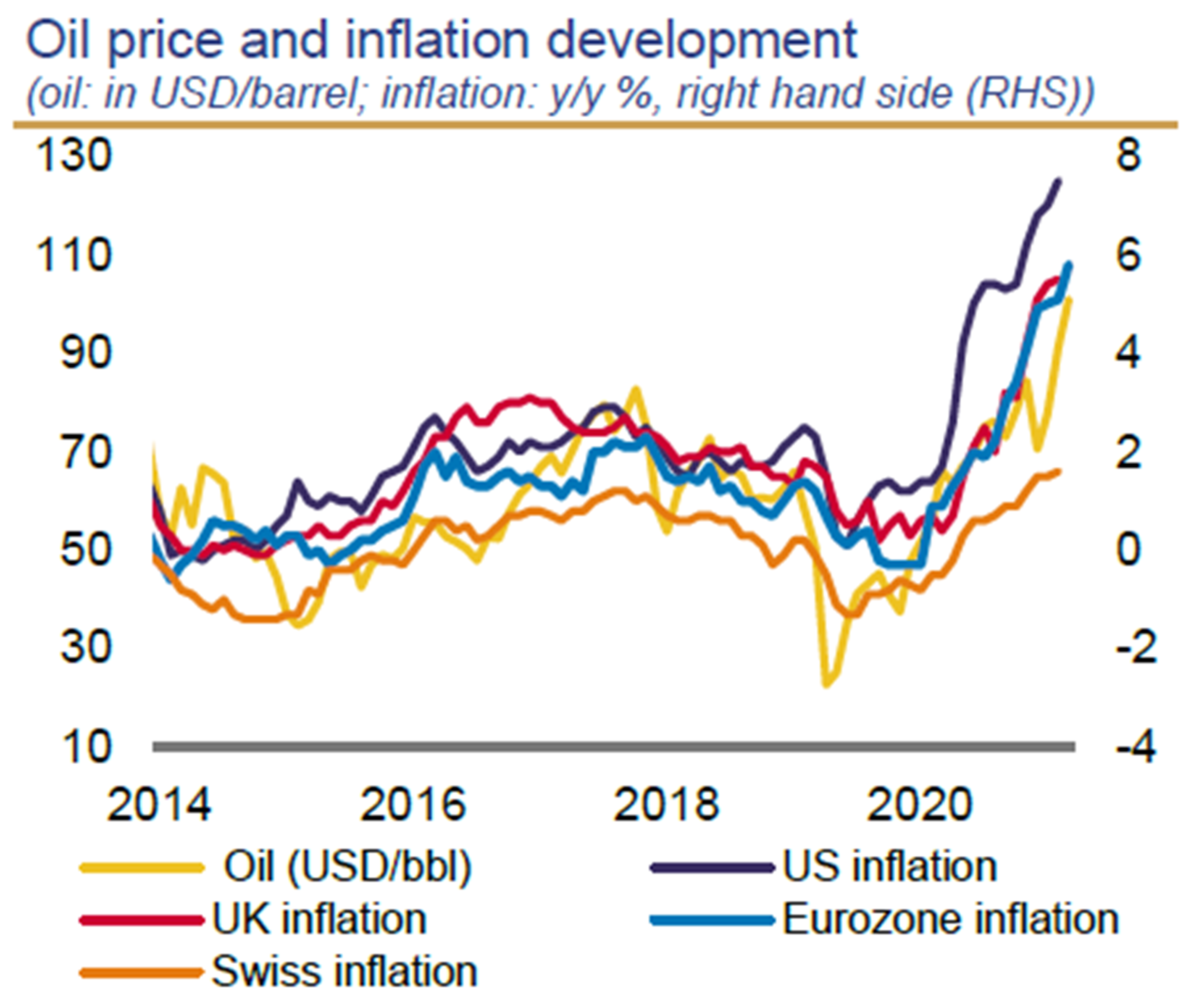
The attack on Ukraine with the potential of a further escalation between the Western world and Russia hit investor sentiment. While the EU and the US avoided direct military intervention, and continued to buy Russian oil, they imposed wide-ranging sanctions against Russia that will also disrupt Western economies. Global equity markets fell for a second consecutive month in February, though there was a modest rally at month-end. Stocks from companies with a high exposure to Eastern Europe underperformed, while companies from the oil, mining and arms industries were among the winners. Energy prices soared: Brent oil hit USD100 per barrel, the highest level in eight years, adding to current inflation and hitting consumer spending power and confidence. Safe haven assets such as government bonds and precious metals were in demand, with gold rising above USD1,900. Among currencies, the Swiss franc outperformed as a safe haven currency.
US: Economy in good shape; Fed still set to raise rates
Data reported in the month show the US economy to have had solid momentum going into this crisis, Retail sales (+3.8% MoM), industrial production (+1.4% MoM), durable goods orders (+1.6% MoM), and existing home sales (6.5M) were all strong in January, while the labour market remained tight, and inflation climbed to 7.5% YoY. FOMC minutes confirmed the Fed’s willingness to hike interest rates, though by month-end the Ukraine crisis had replaced interest rates as investors’ main concern. So far, data for February show momentum continuing – for example, the ISM Manufacturing PMI which climbed to 58.6 (from 57.6) or the ADP Employment Change with 475k hires. In politics, Biden applied pressure on Russia by adding to European sanctions, and by sending fiscal support to Ukraine and troops to eastern NATO states.
Europe: Growth gained speed, but is threatened by Russia’s attack
Ahead of the Russia’s attack the European economy was recovering from the Omicron corona wave and gaining speed. The Markit Composite PMI data improved significantly in February to 55.8 (from 52.3), driven by the recovery of the service sector (55.8 from 51.1). The attack on Ukraine clearly threatens this momentum, with the spike in energy prices and Europe’s exposure to the region. Sanctions will hit businesses, and households’ spending power and confidence will suffer. Already in February the estimate of the annual eurozone inflation rate reached a fresh high of 5.8% YoY. Money markets recognised however that if growth does weaken, the ECB may be less willing to raise interest rates.
ROW: Mixed news from China; Russian markets become uninvestable
The Caixin China General Manufacturing PMI rose to 50.4 in February (from 49.1) while China's cyberspace regulator plans new rules on internet services. Russia's stock market and the Ruble crashed due to sanctions and the country's international isolation. Turkey's GDP expanded by 9.1% in Q4 2021, but inflation now approaches 50% YoY.
Performance figures (as of 28/02/2022 in local currency)
| Fixed Income | Yield | 1 M % | YTD % |
|---|---|---|---|
| US 10 Yr | 1.83% | -0.3% | -2.7% |
| UK 10 Yr | 1.41% | -0.5% | -3.1% |
| Swiss 10 Yr | 0.26% | -1.2% | -2.8% |
| German 10 Yr | 0.13% | -1.2% | -2.5% |
| Global IG (hdg $) | 2.64% | -2.1% | -4.7% |
| Global HY (hdg $) | 6.26% | -2.4% | -2.6% |
| Equity Index | Level | 1 M % | YTD % |
|---|---|---|---|
| MSCI World($) | 360 | -2.6% | -7.4% |
| S&P 500 | 4,374 | -3.0% | -8.0% |
| MSCI UK | 13,239 | 0.8% | 2.7% |
| SMI | 11,987 | -2.0% | -6.9% |
| Eurostoxx 50 | 3,924 | -5.9% | -8.5% |
| DAX | 14,461 | -6.5% | -9.0% |
| CAC | 6,659 | -4.9% | -6.8% |
| Hang Seng | 22,713 | -4.6% | -2.9% |
| MSCI EM ($) | 579 | -3.0% | -4.8% |
| Currencies (trade-weighted, nominal) | 1 M % | YTD % |
|---|---|---|
| US Dollar | -0.2% | 0.6% |
| Euro | 0.2% | -0.6% |
| Yen | -0.3% | -0.4% |
| Pound Sterling | -1.1% | -0.5% |
| Swiss Franc | 0.9% | -0.8% |
| Chinese Yuan | 0.3% | 0.4% |
| Commodities | Level | 1 M % | YTD % |
|---|---|---|---|
| Gold ($/oz) | 1,909 | 6.2% | 4.4% |
| Brent ($/bl) | 100.99 | 10.7% | 29.8% |
| Copper ($/t) | 9,919 | 3.6% | 1.8% |
Source: Bloomberg, Rothschild & Co, 31/12/2014 – 28/02/2022
Source: Bloomberg, Rothschild & Co, 31/12/2014 – 28/02/2022
Related Files
Download the full Monthly Market Summary (PDF 197 KB)