How hot is your portfolio?

There is a 50:50 chance of average global temperature reaching 1.5 degrees Celsius above pre-industrial levels in the next five years, and the likelihood is increasing with time''
World Meteorological Organization (WMO)
09.05.2022
1. Investing aligned with a warmer world
The world’s expectations for the 26th UN Climate Change Conference of the Parties (COP26) were high. Whilst many commentators agreed that the conference had not gone far enough to mitigate climate change, parties to the agreement sought to limit a rise in temperature to +1.5C° compared to pre-industrial levels and in accordance with COP 21's Paris Agreement. The status quo nearly one year in? It will be discussed at COP27 in Egypt which is only 2 months away.
One point that hasn't changed in the meantime is that the world's window of opportunity to prevent climate breakdown is narrowing and decisive action is needed. It is therefore critical for investors to know how close, or far away, their investments are from these climate protection goals and to understand their portfolio's contribution to the global effort.
2. How do we contribute?
As investors sharpen their focus on the financial impact of climate change, we must see if our portfolios are aligned with global climate goals and how our clients' investments will impact future temperature rises. To do so, Rothschild & Co is expanding its investment process by a new approach that enables us to determine if a single company or a complete portfolio is aligned with a 1.5°C to 2°C rise in global temperatures. This also enables us to differentiate between companies or portfolios that are falling short on their targets and therefore misaligned. For the new metric Rothschild & Co has extended its partnership with MSCI ESG, a global, well-known ESG data provider.
|
Temperature Profiling
|
| MSCI ESG bases its calculations on one of several carbon budgets reported by the Intergovernmental Panel on Climate Change (IPCC), which provides policymakers with a scientific assessment on climate change on a regular basis. |
| MSCI ESG delivers the inputs and forward-looking data points which enable us to calculate the Implied Temperature Rise of investing in a particular company or portfolio. |
| This Implied Temperature Rise is calculated based on companies’ current and future carbon usage. |
| Future usage is measured by using carbon budgets. These are set so as to quantify the amount of CO2 a company can emit by 2070 without contributing to more than 2°C of warming. |
This approach can be applied to a complete portfolio or fund of fund. As a result, clients are able to understand the impact of their portfolios on the increase in global temperatures and whether or not their portfolios are aligned with a maximum +2°C increase in global temperatures.
To make this comprehensible, we take the example of the MSCI All Country World Index: Our portfolio management is now able to analyze the temperature by sector (consisting of all companies within it and their respective positive or negative contributions) (Chart 1). It becomes evident that certain sectors such as "Energy" still need to improve substantially, as the overall contribution to the global temperature rise of companies within the sector is very high. Reason is that there are not many companies that have a current and future carbon usage that is aligned with global temperature pathways of +2°C or below. The Communication Services sector on the other hand scores well as the overall temperature of the sector is very low. Reason is that there are many companies within it that contribute to a +2°C or below increase in global temperatures.
Chart 1: Example of Temperature Profiling MSCI All Country World Index Index*
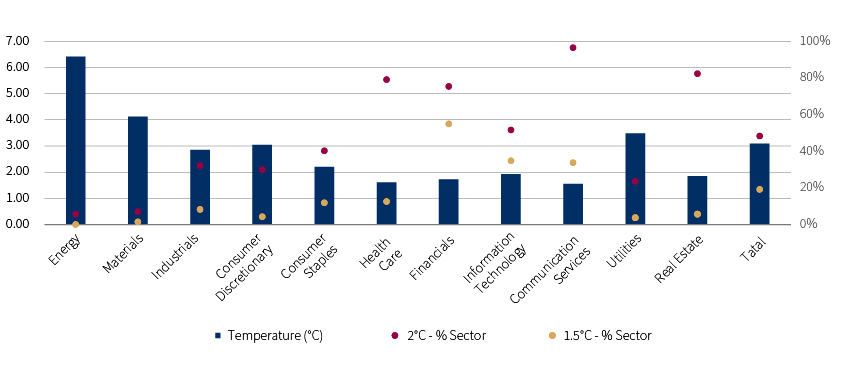
*The index is composed of companies from both developed and emerging markets countries worldwide.
Implementing the above in our clients' portfolios, clients can now look at the impact which specific asset classes or sectors within their portfolio have on global temperature increases. This degree of transparency helps with raising both awareness of the impact of their investments on the environment and empowers clients to become more active in their respective dialogues with portfolio managers.
3. Taking action
To conclude, how do our clients' portfolios contribute to a scenario where temperatures rise by 1.5°C to 2°C? If we take a balanced CHF portfolio in our flagship Mosaique strategy, we now know - using temperature mapping - that it contributes at present to a global +2.5°C temperature increase by 2100. That's below its benchmark but still causing more than 2°C of warming by the end of this century. By contrast, our LongRun strategy at present contributes to a global +1.8°C increase in temperatures. No reason to be complacent but an indicator that equities in that strategy are currently contributing to a below +2°C warming by the end of the century.
Methods like the one described above help us to determine how much warming our portfolio would potentially cause if the world economy was to operate like the companies within it and what constituents contribute the most or the least to a portfolio's temperature. As always - information is power and temperature mapping is an example of this doctrine in action.