November: Trump 2.0

Investment Communications Team, Investment Strategy Team, Wealth Management
Summary
Global equities rose by 3.7% in November (USD terms), while global government bonds returned 1.1% (USD, hedged terms). Key themes included:
- US stocks outperform after Republican clean sweep in US election;
- Central banks signal gradual approach to easing, as inflation stays above target;
- Political trouble in Germany and France amid budget-related issues.
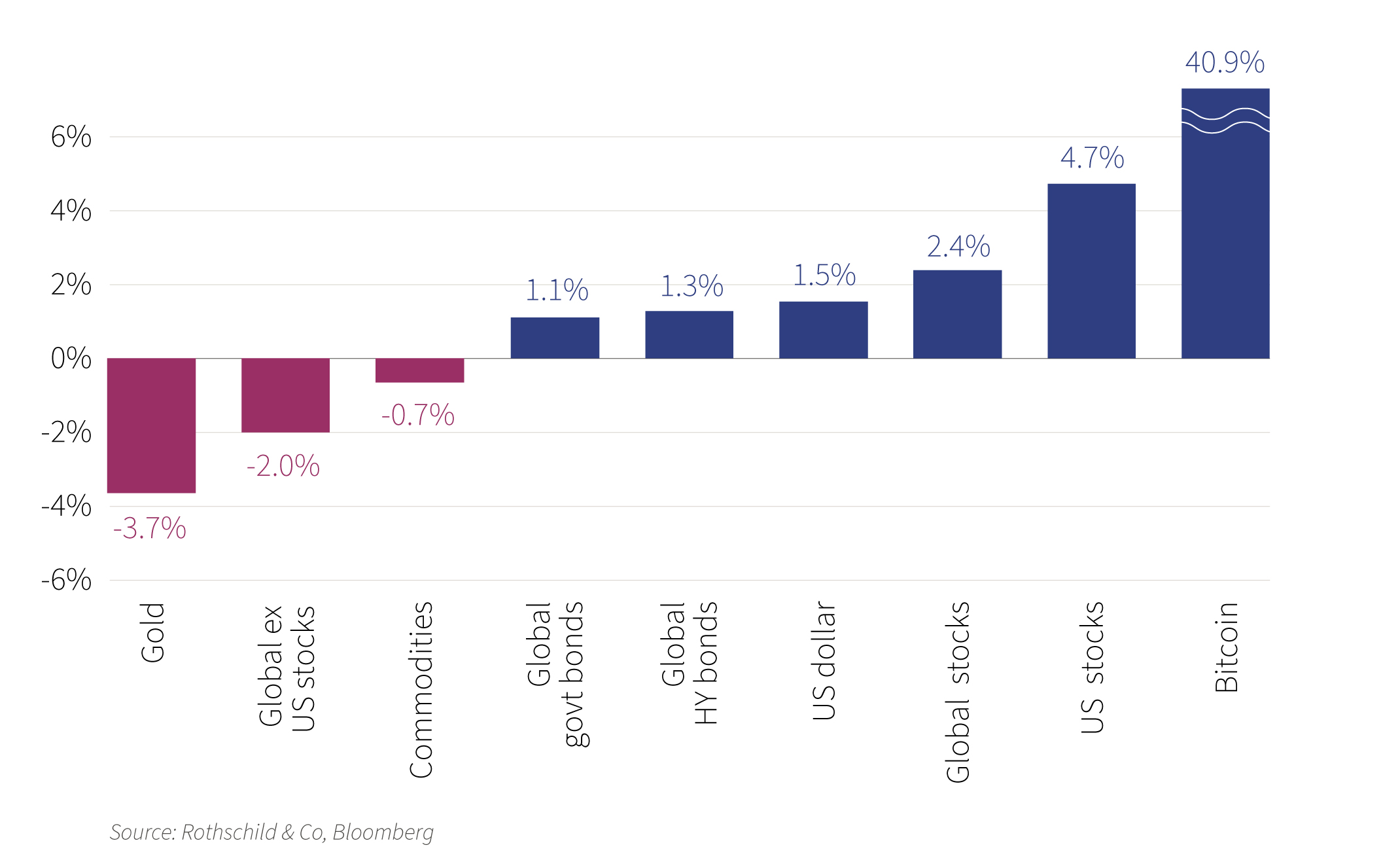
Key chart: Cross asset class returns
Since the US election (USD term, %)
Market: The Trump trade and ‘America First’
Global stocks briefly touched fresh highs in dollar terms following the US election, largely driven by the US. Stocks in continental Europe and Asia suffered most visibly in the face of Trump’s tariff threats, but those moves were exacerbated by a stronger dollar. US stock market participation also broadened, with cyclical and small cap stocks performing better. In fixed income, the 10-year US government bond yield completed a round trip, rising to 4.5% before ending the month lower, closer to 4.2%. European government bond yields experienced a larger decline, though the looming French budget vote (see below) prompted the spread between 10-year French and German government bonds to widen to levels not seen in more than a decade. In commodities, energy price action was mixed: Brent Crude oil was unchanged, though European wholesale gas prices rose to fresh year-to-date highs. Gold weakened, while bitcoin surged, flirting with the $100,000 threshold.
Economy: Sticky inflation
US activity appeared mixed in October according to the hard data, though timelier business surveys and labour market figures suggested a healthy picture in November. Indeed, early estimates for fourth-quarter GDP pointed to another quarter of expansion. Core inflation remained stubborn, unchanged at 3.3% (y/y) in October. In Europe, UK GDP was weaker than expected in the third quarter, edging higher by 0.1% (q/q). Moreover, activity appeared to soften in the eurozone and UK in November, according to the business surveys. Inflation remained above target in both regions – core inflation stayed above 3% in the UK (y/y) – but Swiss inflation was still muted. China’s stimulus measures seemed to have a modest impact on sentiment and activity to date, with firmer retail sales in October. Business surveys for the manufacturing sector improved slightly in November.
Policy and politics: The 47th US President I Fiscal policy in focus
On 20th January, Donald Trump will return to the White House after winning the electoral college. Trump not only won the popular vote, but the Republicans also cemented their control of Congress. The President-elect has already appointed his key cabinet positions (including some controversial picks), and was quick to threaten both Mexico and Canada with a 25% tariff on all products. Geopolitics remained uneasy as conflict in Ukraine intensified and hostilities in Syria reemerged, but a temporary ceasefire was agreed between Israel and Hezbollah. Biden and Xi held a meeting ahead of the G20 summit, while the outcome of COP 29 proved less fruitful, with a rushed last-minute agreement on financing for developing countries.
The Federal Reserve reduced its target rate for the second time to the 4.50-4.75% range, and signalled a cautious approach ahead. Similarly, the Bank of England cut its base rate again, to 4.75%. Fiscal developments moved centre stage, with budget-related fallouts causing political turbulence in Europe. Germany’s governing coalition broke down, with a federal election scheduled for February, while Macron’s government was on the cusp of a no-confidence vote in France (at the time of writing). Elsewhere, Chinese authorities announced further economic support, and the new coalition in Japan unveiled a post-election fiscal package.
Performance figures (as of 29/11/2024)
| Equity (MSCI indices $) | Month | Year |
|---|---|---|
| Global | 3.7% | 20.3% |
| US | 6.2% | 27.9% |
| Continental Europe ex. Switz. | -2.7% | 2.7% |
| UK | 1.4% | 10.6% |
| Switzerland | -2.2% | 2.1% |
| Japan | 0.7% | 8.7% |
| Pacific ex Japan | 2.8% | 10.9% |
| EM Asia | -3.7% | 11.7% |
| EM ex Asia | -3.1% | -6.6% |
| Fixed income | Yield | Month | Year |
|---|---|---|---|
| Global Govt (hdg $) | 3.04% | 1.1% | 3.7% |
| Global IG (hdg $) | 4.54% | 1.3% | 5.0% |
| Global HY (hdg $) | 7.28% | 1.3% | 10.9% |
| US 10Y ($) | 4.17% | 1.0% | 1.6% |
| German 10Y (€) | 2.09% | 2.5% | 1.9% |
| UK 10Y (£) | 4.24% | 1.8% | -1.2% |
| Switzerland 10Y (CHF) | 0.25% | 1.5% | 4.6% |
| Currencies (NEERs) | Month | Year |
|---|---|---|
| US Dollar | 1.5% | 6.3% |
| Euro | -1.5% | -0.2% |
| Pound Sterling | 0.2% | 4.1% |
| Swiss Franc | -0.1% | -0.7% |
Table note: NEERs under ‘currencies’ are the JP Morgan trade-weighted nominal effective exchange rates
| Commodities ($) | Level | Month | Year |
|---|---|---|---|
| Gold | 2,643 | -3.7% | 28.1% |
| Brent Crude oil | 73 | -0.3% | -5.3% |
| Natural gas (€) | 48 | 17.8 | 47.8% |
Source: Bloomberg, Rothschild & Co.