Scaling climate technology through strategic capital
What you need to know
- Entrepreneurs innovating in climate technology face a challenge when scaling their business, as they often need significant capital. Large firms are natural partners for these innovators
- Rothschild & Co invests for generations, seeking to grow and preserve our clients’ wealth in a sustainable way
- We believe there is a multi-decade opportunity to invest in companies enabling the path to a ‘net zero’ global economy
- Companies must adapt to an ever-changing world, but they can also shape it in a positive way. We support companies taking steps to address these risks and opportunities
When so much buzz surrounds high-profile Silicon Valley software companies, it can be easy to forget that many entrepreneurs are finding solutions to accelerate decarbonisation of the global economy through innovative climate technology.
These firms often face big decisions when scaling their business from prototype to broad market acceptance. More often than not, the next step in a company’s growth path is to move from a small test site to large scale manufacturing capability.
How do these companies find the skilled employees to accelerate their growth? How will they finance the manufacturing capabilities needed? How do they access strategic capital to scale into a larger business with a real impact on the wider world?
These are the questions facing firms which have progressed beyond the difficult early steps of development and are instead looking for a push to take them into profitability or boost their growth.
In this article we’ll outline the role Rothschild & Co plays as a wealth manager. We’ll explain how we’re purposeful with our ownership of companies, and how we take an active role to ensure companies are prepared for the future.
Our approach to investing
Our objective for our clients is simple. We aim to preserve and grow wealth over multiple generations.
Crucially, this ‘investing for generations’ approach encompasses more than just financial returns. Through our investments, we aspire to preserve both the wealth of future generations, and the environment and society they will inherit.
We’re investors with a very long-term view, and we take a ‘private equity approach’ to public market investing.
This is shown by our track record – the average shareholding period in a company is over seven years. This also means we’re in position to build up durable relationships with management teams and have meaningful discussions with them.
We’re investors with a very long-term view, and we take a ‘private equity approach’ to public market investing. "
Opportunities in climate technology
We believe there is a multi-decade opportunity to invest in the transition to a net-zero economy. Our aim is to identify companies that are ‘best in class’ in their respective industries, and are part of the solution towards a low-carbon economy.
These companies are often led by visionary management teams that look far into the future to find new opportunities.
Sometimes the innovation is developed in-house, but quite often these companies are looking externally to identify new technology that can be integrated and scaled up. We think of this as strategic capital, with larger firms looking to buy or partner with early and late-stage private companies.
Large companies are a natural partner for newer innovators, which often lack the resources – people power, factories or financing – to effectively scale their innovation to the next level.
Scaling can be a major challenge for firms working to decarbonise the economy. Companies developing software, for example, typically find it much easier to scale up their business – they simply roll out the software to more customers as the business grows.
But doing the same with climate technology can be much harder to achieve. The assets used to achieve decarbonisation tend to be hard assets, which makes it much more difficult. Consider the number of engineers that are needed, and the financing required, to help these companies advance down a self-sustaining path.
Adapting and shaping
Sustainability may have become a buzz word for investors in recent years, but we’ve been putting it at the heart of our investing decisions for much longer.
Through our analysis, we assess how a company is positioned in its industry and its ability to adapt to social and environmental risks. But we also consider future opportunities and how companies can shape the world around us. We can take an active role to nudge companies in the right direction.
Let’s take a closer look at one of our holdings, John Deere, the agricultural equipment manufacturer. Agriculture is responsible for more than a quarter of global greenhouse gas emissions1, meaning a company like Deere can play a pivotal role in developing the technology to reduce emissions.
In 2017 it bought a company called Blue River which applied machine learning techniques to agriculture. Since then, Deere has developed precision agriculture equipment that can dramatically reduce the use of nitrogen, herbicide and pesticide, whilst improving crop yields. This is both good for the farmer and for the environment. It also strengthens Deere’s market position as an innovative company to provides solutions to key issues.
This demonstrates our argument – that some of the largest companies in the world have the means to scale important technology which amplifies the impact of that innovation.
We believe all businesses must play a part in driving emissions lower across their business, their supply chain and their end markets, and this is especially true of larger companies. Put simply, if they don’t move, others will.
We believe all businesses must play a part in driving emissions lower across their business, their supply chain and their end markets, and this is especially true of larger companies."
Ready to begin your journey with us?
Citations
1 Environmental Impacts of Food Production, Our World In Data, 2022
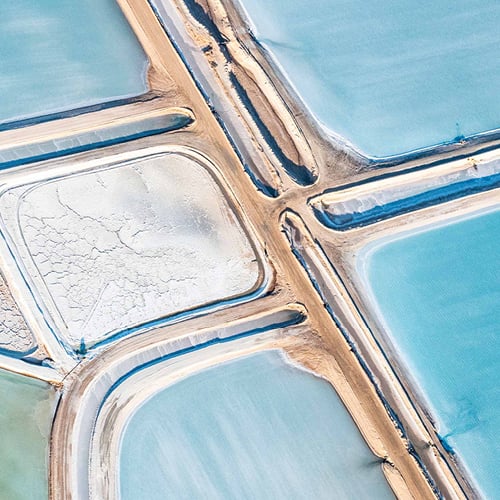
Cover: The Shark Bay salt operation in Western Australia, Getty Images.
Past performance is not a guide to future performance and nothing in this article constitutes advice. Although the information and data herein are obtained from sources believed to be reliable, no representation or warranty, expressed or implied, is or will be made and, save in the case of fraud, no responsibility or liability is or will be accepted by Rothschild & Co Wealth Management UK Limited as to or in relation to the fairness, accuracy or completeness of this document or the information forming the basis of this document or for any reliance placed on this document by any person whatsoever. In particular, no representation or warranty is given as to the achievement or reasonableness of any future projections, targets, estimates or forecasts contained in this document. Furthermore, all opinions and data used in this document are subject to change without prior notice.