Bitcoin ETFs: a token gesture
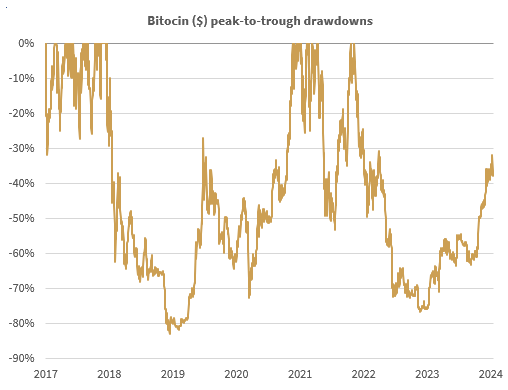
Something ‘big’ has just happened in cryptoland: the SEC, the US regulator, has approved the first US ‘spot’ Bitcoin ETF (in fact, nearly a dozen applications from various institutions). Bitcoin, volatile at the best of times, has responded in typically unpredictable fashion, down nearly a tenth since the announcement last week. Admittedly some of the ‘good news’ was likely in the price - the token surged 150% in 2023, in no small part due to a favourable US court ruling in October. But all of this follows a fall of nearly two-thirds in 2022 - at ~$43,000 today, Bitcoin is still well below its all-time 2021 high of $68,617. The ‘boom-and-bust’ cycle continues, it seems…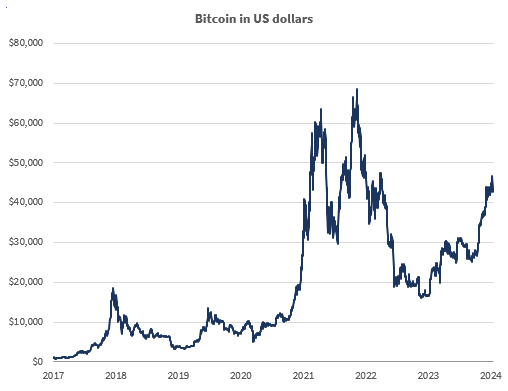
It’s important to note that exchange traded funds are not new to this space – the SEC approved applications for futures ETFs in 2021, to much fanfare. But these latest approvals pave the way for the first US product based on the underlying coin rather than a derivative (futures) contract linked to it.
To Bitcoin boosters this is an important milestone – and one that has been fiercely contested. The SEC’s approval is seen as legitimising and further propelling cryptocurrencies into the mainstream – particularly in the all-important US market. Indeed, many retail investors have been supposedly dissuaded by the clunky and lengthy transactional process – including registering a digital wallet, safely storing the irretrievable private keys, and finally converting fiat currency at cost. ETFs, which provide intraday liquidity, remove some of the major frictional challenges.
Of course, whether this has any real significance and can continue to revive Bitcoin is a moot point. The wider crypto space has faced something of an existential crisis. From question marks about its aggressive energy consumption to the practical challenges of a sluggish decentralised ledger – as well as the threat posed by the arrival of the official CDBCs (Central Bank Digital Currencies), which would run in parallel with legal tender. Not to mention the sector’s damaged credibility in the wake of FTX’s collapse.
To those who have proclaimed this approval as a “proof of concept”, the SEC’s ‘capitulation’ is not an endorsement of Bitcoin. Ironically, the recent hacking of the SEC’s X account and the premature announcement of these latest approvals only serve to reiterate the SEC’s decade long resistance to such products – market manipulation remains a key risk.
For us on the strategy team, this does blur the lines between Bitcoin’s role as a currency and that of an investment. Bitcoin was conceived as a democratised and independent alternative to fiat currencies – the antidote to monetary debasement and (‘spying’) central authorities. Yet, the arrival of these ETFs further undermines its egalitarian and decentralised credentials, inasmuch as they strengthen its links to the established financial and fiat system.
And while it may be more accessible as an investment, Bitcoin is a highly speculative one, and looks steadily less like a questionable medium of exchange. As Buffett once quipped about it: “You're just hoping the next guy pays more”. As a result, our crypto scepticism is unaltered: we still don’t believe that today’s digital currencies (including Bitcoin) are a credible asset class. They lack intrinsic value, and so are not a credible alternative to (for example) gold, and practical uses are in short supply.
Cryptocurrencies – and Bitcoin – remain an answer in search of a question.
Ready to begin your journey with us?
Speak to a Client Adviser in the UK or Switzerland
Past performance is not a guide to future performance and nothing in this article constitutes advice. Although the information and data herein are obtained from sources believed to be reliable, no representation or warranty, expressed or implied, is or will be made and, save in the case of fraud, no responsibility or liability is or will be accepted by Rothschild & Co Wealth Management UK Limited as to or in relation to the fairness, accuracy or completeness of this document or the information forming the basis of this document or for any reliance placed on this document by any person whatsoever. In particular, no representation or warranty is given as to the achievement or reasonableness of any future projections, targets, estimates or forecasts contained in this document. Furthermore, all opinions and data used in this document are subject to change without prior notice.