Monthly Market Summary: November 2023
 Investment Communications Team, Investment Strategy Team, Wealth Management
Summary: Stocks and bonds rebound strongly in November
Global equities rebounded by 9.2% in November (USD terms), as did global government bonds by 3.0% (USD, hedged terms). Key themes included:
-
- Economic resilience continued, alongside ongoing disinflation;
- Major central banks paused (again), but retained their hawkish outlook;
- US-China tensions appeared to ease following Biden-Xi meeting.
Global stocks recorded their strongest month in three years – nearly retracing the summer losses – in a broad-based rally that saw cyclical sectors outperform. Meanwhile, bond yields declined sharply: the US 10-year note yield fell by 60bps, delivering the best monthly return in more than 10 years. In the geopolitical sphere, US-China tensions appeared to thaw: a resumption in high-level military communication was agreed at the Biden-Xi meeting. Elsewhere, the temporary ceasefire in the Middle East allowed for the exchange of hostages. In commodities, Brent Crude oil prices fell for the second month in a row – despite further OPEC+ production cuts – to $82.83 p/b, while gold remained above $2,000.
US: Softer activity; Fed pause; Shutdown averted
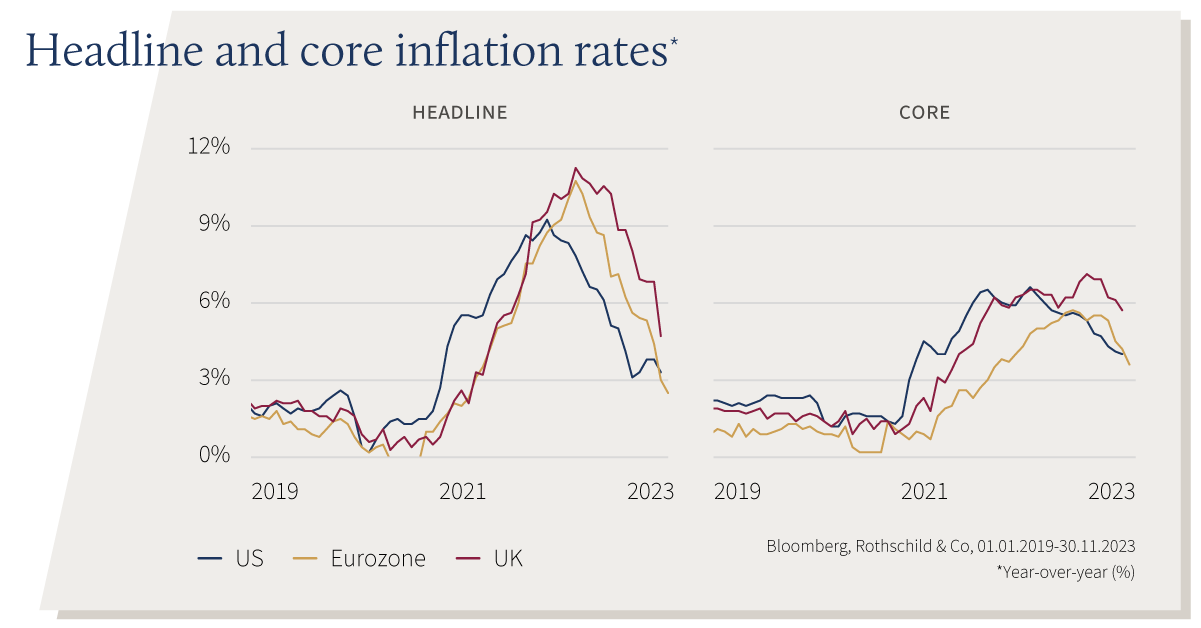
US activity softened in October: core retail sales only edged up by 0.1%, and industrial production declined by 0.6%. Meanwhile, the ISM manufacturing PMI remained at 46.7 in November, though the closely-watched New Orders index moved up to 48.3. Inflation data were better than expected in October: the headline rate declined to 3.2%, while the core rate edged lower, to 4%. The Federal Reserve left its target rate range unchanged at 5.25-5.50% – a second consecutive pause – but Powell was careful not to rule out further rate hikes. Finally, a government shutdown was temporarily averted – funding was extended to at least mid-January – but Moody’s put the US’ top credit rating on ‘negative’ outlook.
Europe: UK stagnates; Inflation cooling; Politics in focus
The UK economy stagnated in the third quarter, defying expectations of a contraction. Fourth quarter momentum was mixed, with UK retail sales unexpectedly falling (again) in October. By contrast, the timelier Composite PMIs improved in November in both the eurozone (47.1) and UK (50.1) – the latter returned to expansion territory. Euro area headline and core inflation declined further in November, to 2.4% and 3.6% (respectively), while the UK headline inflation rate fell by more than two percentage points to 4.6% in October, following Ofgem’s energy price cap reduction. The Bank of England once again held its base rate at 5.25%. In politics, Pedro Sánchez remained as Spain’s PM after a Catalan amnesty deal, while the far-right PVV unexpectedly became the largest party in the Dutch election. On fiscal policy, the UK Autumn Budget revealed modest stimulus, while Germany was forced to suspend its debt brake for the fourth consecutive year.
ROW: China’s recovery; Modest deflation (again); Japan’s fiscal support
China’s hard data beat expectations for the third consecutive month: retail sales grew by 7.6% (y/y) in October, as did industrial production by 4.6%. However, the survey data were slightly weaker than anticipated in November: the NBS manufacturing PMI edged lower to 49.4, though non-manufacturing activity remained ‘expansionary’ (50.2). While the property sector remained a drag on output, Beijing was reportedly weighing a plan for banks to offer unsecured loans to developers for the first time. The headline inflation rate dipped into deflation territory again, to -0.2% (y/y), echoing further food price declines. Elsewhere, Japan’s economy contracted by 0.5% (q/q) in Q3, following a strong second quarter. Japanese PM Kishida unveiled a stimulus package, which included temporary tax cuts, payouts to low-income households and energy-related subsidies.
Performance figures (as of 30/11/2023 in local currency)
| Fixed Income | Yield | 1M % | YTD % |
|---|---|---|---|
| US 10 Yr | 4.33% | 4.5% | -0.4% |
| UK 10 Yr | 4.17% | 2.7% | 0.5% |
| Swiss 10 Yr | 0.87% | 1.8% | 6.6% |
| German 10 Yr | 2.45% | 2.7% | 3.4% |
| Global Govt (hdg $) | 3.27% | 3.0% | 3.7% |
| Global IG (hdg $) | 5.23% | 4.7% | 5.1% |
| Global HY (hdg $) | 9.01% | 4.7% | 9.5% |
| Equity Index | Level | 1M % | YTD % |
|---|---|---|---|
| MSCI ACWI ($) | 370 | 9.2% | 16.7% |
| S&P 500 | 4,568 | 9.1% | 20.8% |
| MSCI UK | 14,334 | 2.3% | 3.7% |
| SMI | 10,854 | 4.5% | 4.3% |
| Euro Stoxx 50 | 4,382 | 8.1% | 19.4% |
| DAX | 16,215 | 9.5% | 16.5% |
| CAC | 7,311 | 6.3% | 16.3% |
| Hang Seng | 17,043 | -0.2% | -10.6% |
| MSCI EM ($) | 514 | 8.0% | 5.7% |
| Currencies (trade-weighted) | 1M % | YTD % |
|---|---|---|
| US Dollar | -2.6% | 0.5% |
| Euro | 0.3% | 3.9% |
| Yen | -0.4% | -9.6% |
| Pound Sterling | 1.5% | 5.6% |
| Swiss Franc | 1.1% | 4.8% |
| Chinese Yuan | 0.3% | -1.6% |
| Commodities | Level | 1M % | YDT % |
|---|---|---|---|
| Gold ($/oz) | 2,036 | 2.6% | 11.6% |
| Brent ($/bl) | 82.83 | -5.2% | -3.6% |
| Copper ($/t) | 8,388 | 4.5% | 0.3% |
Source: Bloomberg, Rothschild & Co.