Thematic Insights: Blue gold
Can you imagine a day without water? No shower, no coffee, no clean laundry? Difficult.
Water is essential to life. Yet more than 1 billion people lack access to water and almost 3 billion people experience water scarcity at least one month per year. By 2025, two-thirds of the world’s population may be facing water shortages[1] with severe consequences. Water scarcity impacts our lives and many economic activities. This makes the topic all the more important in times of climate change and its effects on the water cycle resulting in floods, rising sea levels or droughts. With an increase in population and ageing infrastructure, water is becoming a scarce resource and innovative technologies are needed to combat this issue.
|
Key takeaways
|
Source: World Economic Forum, Water, 22.03.2023.
Floating extremes
The year 2022 saw record-breaking droughts, temperatures, wildfires, floods and an all-time low in Antarctic Sea ice levels. Many of these events can be summed up in one word: extremes. While intense drought episodes affected regions of Europe, East Africa, China and South America, other communities had to deal with the consequences of excess precipitation. At the same time, epic floods hit Australia and Pakistan and countries such as Chad, Sudan and Nigeria.[2] This was followed by Europe's second warmest winter on record, forcing ski resorts to close because of lack of snow[3] and the ‘once in a century’ deadly floods in Italy in May 2023.[4] In March 2023, the UN held a major global conference on water, the first such event in 46 years. The conference addressed growing concerns about the outlook for global water security: by 2030 already, demand for fresh water could outstrip supply by 40%.[5]
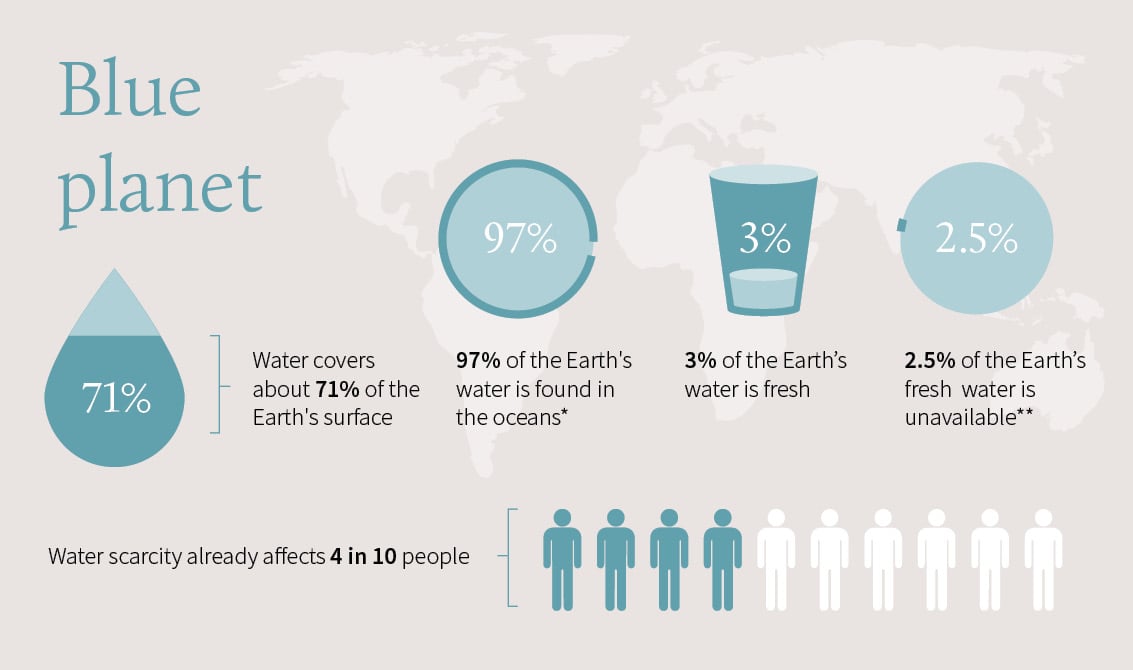
*too salty for drinking, growing crops, and most industrial uses except cooling.
**locked up in glaciers, polar ice caps, atmosphere, soil; highly polluted; or lies too far under the Earth's surface to be extracted at an affordable cost.
Sources: WHO, Bureau of Reclamation, 16.06.2023.
The investment case
The investment case for water is clear: water is one of the most precious resources, and it is likely to become a lot scarcer.
|
Increasing per capita water consumption and pollution are significant factors contributing to water scarcity, which is worsened by ageing and inefficient water infrastructure. Moreover, as the demand for water continues to escalate and the global water supply is constrained by the natural water cycle, climate change triggers more frequent and prolonged drought periods. Growing urbanisation (Chart 1), population migration to water-scarce regions, as well as enhanced living standards and dietary shifts towards water-intensive choices in developing nations (Chart 2), are driving substantial increments in water usage. |


Source: World population prospects 2019 report. 20.06.2023
Source: World population prospects 2019 report. 20.06.2023


Source: How much water is used in the production of a plant. 16.06.2023
Source: How much water is used in the production of a plant. 16.06.2023
To counteract this problem, there is an urgent need for investment in research, installation, and modernisation of the water supply infrastructure - and for companies that develop innovative solutions.
So, what companies address water scarcity while offering opportunities for to investors? Below we set out a few case studies to illustrate the far-reaching investments in water.
Veolia Environment
What does the company do?
Veolia provides drinking water and wastewater treatment services.
Why invest?
- The acquisition of the company Suez will be significantly value-accretive for Veolia thanks to high synergies despite the high price paid.
- The increasing exposure to hazardous waste will structurally increase the group's margins and returns on invested capital.
- Veolia's carbon emission reduction targets are aligned with the Paris agreement, keeping the world below +2°C of warming by the year 2100.
- Veolia generates positive impact revenues regarding wastewater treatment.

Geberit
What does the company do?
Geberit provides access to drinking water and drainage systems for homes.
Why invest?
- Geberit's brand reputation and tight-knit relationships with price-agnostic intermediaries supports its exceptional fundamentals, allowing the group to better navigate weaker construction spending and emerge in a stronger position than its mostly private (and smaller) peers.
- Geberit profits from spillover effect of already communicated price increases and declining raw material prices.
- Wholesalers prefer to stock the Geberit brand over competitors due to its wide product range and attractive trade discounts.
- Geberit generates positive impact revenues with a focus on water efficiency and water loss.
|
Addressing the global water scarcity challenge will require substantial investments and capital expenditures. It is for this reason, that our Advisory team at Rothschild & Co Wealth Management has dedicated time and resources to analysing this market and is ready to advise you on investing in this long-term trend. For further information on how to invest in this sector please contact your client adviser. |
[1] https://www.worldwildlife.org/threats/water-scarcity.
[2] https://www.copernicus.eu/en/news/news/observer-2022-year-extremes.
[3] https://www.reuters.com/business/environment/europe-experienced-second-warmest-winter-record-2023-03-08/.
[4] https://emergency.copernicus.eu/mapping/list-of-components/EMSR664.
[5] https://www.theguardian.com/environment/2023/mar/17/global-fresh-water-demand-outstrip-supply-by-2030.