Gold and gold mines : a golden bubble ?


Words are to thoughts what gold is to diamonds; necessary to contain them, but little is needed "
Voltaire, in Le Sottisier
Gold, between a glorious past and a strategic future
Since the end of prehistory, gold has embodied both wealth and stability. Used as currency since the 6th century BC, the yellow metal has motivated conquests and explorations, notably that of Aztec gold by Cortés in the 16th century. Closer to home, in the 19th century, the gold standard guaranteed the convertibility of paper money, before evolving into the gold exchange standard, then the gold-dollar system, established in 1944. The latter came to an end in 1971, marking the end of the dollar’s convertibility into gold. Lastly, since the 2008 financial crisis, gold has gradually regained an eminently strategic role: the central banks of China, India and Russia are strengthening their gold reserves, in particular to reduce their dependence on debt and the US dollar.
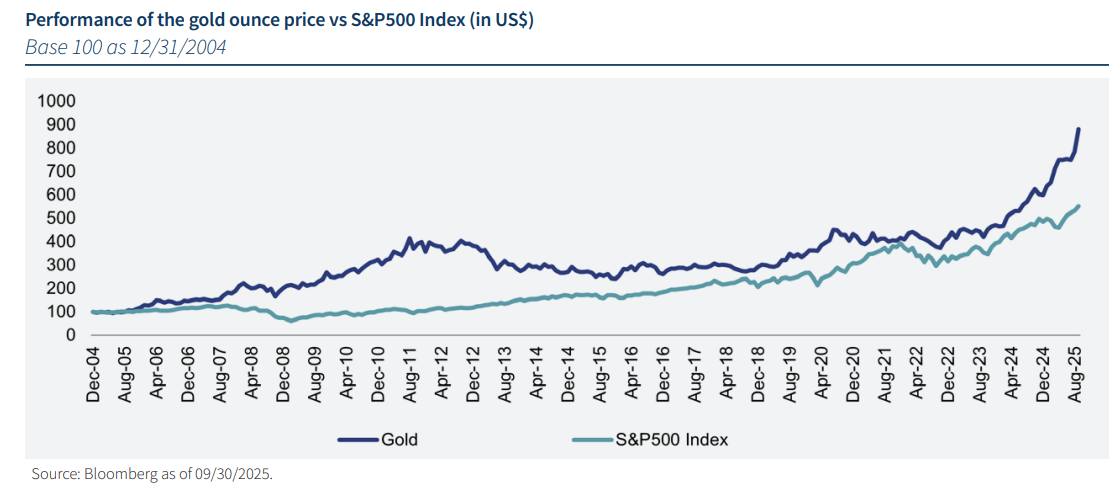
Since the beginning of this year, the price of gold has reached new highs, reaching USD 3,8581 per ounce at the end of September, an increase of nearly 47% in just nine months... This historic rise is mainly due to expectations of interest rate cuts by the US Federal Reserve, the weakness of the US dollar, the diversification of foreign exchange reserves by major central banks, and a general search for security in the face of rising macroeconomic and political risks, particularly the possibility of a US government shutdown.
Against this backdrop of a sharp increase in the price of gold bullion, gold mining stocks, long ignored, are regaining their lustre thanks to profit margins boosted by unexpected selling prices from producers!
A precious metal... including in asset allocation!
Although gold has not played a real monetary role, strictly speaking, since 1971, this “barbarous relic” remains a trusted asset that is highly sought after in times of crisis or economic slowdown: the yellow metal retains its unique status as a “safe haven”. Let’s put gold to the test: during the 20 quarters of the sharpest declines in the S&P 500 since 1967, gold prices have always outperformed US equities and proved resilient in the face of the simultaneous fall in equities and bonds during the painful episode of 2022.
Its low correlation with other asset classes makes it an effective diversification tool, capable of cushioning shocks and stabilising portfolios, even in periods of high inflation. Gold is particularly useful in portfolios denominated in currencies other than the US dollar, due to its often negative correlation with the dollar.
In a troubled environment, powerful and sustainable structural drivers
According to the World Gold Council—the gold industry’s market development organisation—global demand for gold remains robust and diversified: 49% for jewellery, 21% for investment, 23% for central banks and 7% for industry. The oldest precious metal remains unquestionably an “investment” asset, and in particular a reserve asset for central banks, which themselves held a total of more than 35,835 tonnes of gold in December 2024. France’s gold reserves (2,436 tonnes ) are the fifth largest in the world behind those of the United States, Germany, the IMF and Italy. These strategic purchases by central banks strengthen the resilience of sovereign portfolios and confirm gold’s status as the ultimate trusted asset. Central banks, particularly those in so-called “emerging” countries, are continuing to increase their reserves, motivated by a desire to break away from US dominance in terms of currency (de-dollarisation) and to seek security in the face of potential international sanctions.
On the other hand, the rise of gold-backed ETCs (Exchange Traded Commodities) has also transformed the market and the type of demand for the yellow metal, with more than USD 60 billion raised since the beginning of 2025, according to data from the World Gold Council, including a record USD 17.3 billion in September alone!
Gold mines: between opportunity, operational leverage and profitability
Although currently idolised by the financial markets, “physical” gold nevertheless attracts some criticism in terms of “investment.” First of all, this strategic asset generates neither dividends nor coupons. In short, it is an asset that creates no value in the economic or even moral sense. Furthermore, as its value is based on confidence and expectations, holding it incurs significant additional costs (storage space, secure safe, insurance, etc.) when compared to other assets.
These two factors may limit investors’ interest in taking the plunge when investing in an asset that generates no income and requires annual fees! While the “security” aspect may lead us to invest directly in bullion, the “opportunity” aspect may prompt us to take a closer look at gold mines, which are direct producers of the metal. Gold mining companies offer leverage on the rise in the price of the metal, or even on the price of gold alone.
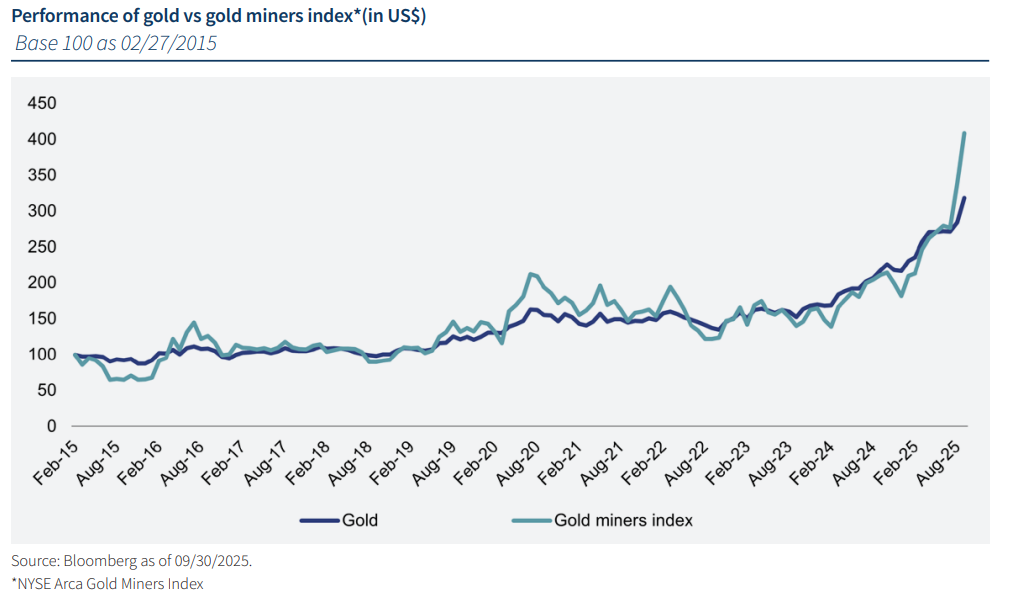
Since they extract the precious metal at relatively stable costs, their margins often grow faster than the price of gold...
Similarly, a selling price that has long been above the historical reference prices of recent years allows them to realise profits that were unthinkable just a few quarters ago!
As a result, gold mines, in a context where physical gold prices have just risen, are relatively undervalued in relation to their assets and cash flows. However, they are also more volatile and exposed to operational, geological, environmental, regulatory and other risks.
But after a decade of often disappointing stock market performance, the sector now has particularly solid fundamentals: high profitability, low debt, growing dividends, barriers to entry, concentration of players, attractive valuations, etc. For example, the price-to-earnings ratio (PE ratio) is estimated (for 2025) at between 13 and 15 for the leaders of the sector. According to Bloomberg data at the end of September 2025, this sector is showing strong stock market growth, in the wake of the appreciation of gold, with an increase (in USD) of 21% in September alone, and 128% since the beginning of the year1. Undeniably, the increasing scarcity of exploitable resources and rising extraction costs give established producers a competitive advantage. At the risk of a potential bubble in the sector...
Gold or gold mines: why choose?
As explained above, gold appears to be an essential asset in building a global asset allocation, just like real estate or currencies other than the euro.
So, should you choose between physical gold and gold mines?
We believe that physical gold and gold mining stocks are complementary. The former, because it significantly reduces the overall risk of an asset allocation. The latter (gold mining stocks) because it is a profitable and value-creating asset with attractive and “unique” performance potential, which also offers significant diversification within an equities portfolio.
However, selecting gold mining stocks requires rigorous analysis and an in-depth understanding of the mining sector...
In conclusion, we remain convinced that a strategy combining investment in physical gold and gold mining stocks not only reduces the overall risk to your assets, but also provides access to the potential benefits associated with historically high gold prices. And these prices may still rise further given the amount of money in circulation...
1. Source : Bloomberg as of 09/30/25