


 69 / 204

Rothschild & Co | Annual Report 2017
67
1. Overview
4. Financial statements
3.
Management report
2. Business review
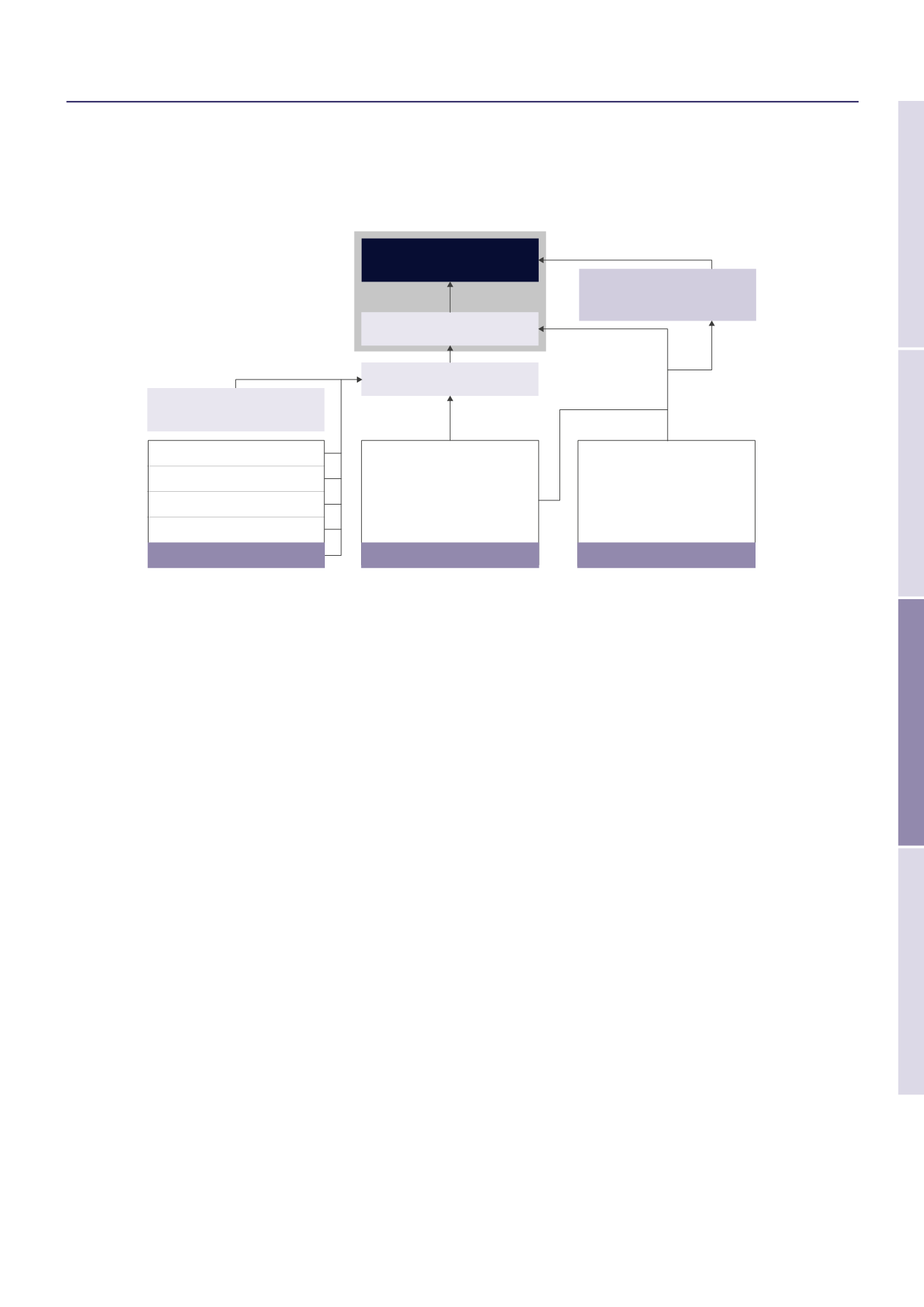
The chart below shows the internal control governance structure through which the Group seeks to comply with these obligations:
Rothschild & Co
Supervisory Board
Rothschild & Co Gestion
Group Executive Committee
Rothschild Global Advisory
Rothschild Private Wealth
Rothschild Asset Management
Rothschild Merchant Banking
First line of defence
Second line of defence
Legal, Compliance
and Risk
Internal Audit
Third line of defence
Committees of the Supervisory
Board: Risk, Audit and
Remuneration & Nomination
Group Assets and
Liabilities Committee
3.1 Rothschild & Co Supervisory Board
The Supervisory Board, through the workings and reporting of the Risk
Committee, the Audit Committee and the Remuneration and Nomination
Committee for matters which have an impact on risk management, ensures
the implementation by Executive Management as defined below in Section
3.2 of reliable procedures and processes for monitoring the internal control
systems of the Group in order to identify, assess and manage risk.
The Heads of the Compliance, Risk and Internal Audit functions report on
the performance of their duties to the Managing Partner, and, whenever it
is necessary in accordance with legal and regulatory provisions, to the
Supervisory Board.
3.2 Rothschild & Co Gestion SAS
The Managing Partner is responsible for the overall management of
Rothschild & Co, the Group’s holding company. This includes, among other
things, establishing the strategic direction of the business, supervising the
accounting and financial information, and directing the internal control
framework for Rothschild & Co and the Group’s entities on a consolidated
basis. The Managing Partner exercises its management and supervising
responsibilities through its Chairman, Mr. David de Rothschild, assisted by
the Management Board (
Conseil de gérance
).
In addition, a senior committee at Rothschild & Co, the Group Executive
Committee, assists the Managing Partner in the overall management,
the definition of the strategy of the Group and the direction of the Group
internal control framework, so that Rothschild & Co ensures its proper
implementation across the Group.
The Managing Partner, its Management Board and the Group Executive
Committee are referred to as “Executive Management” but for the
avoidance of doubt, the final decision-making authority rests with the
Managing Partner, represented by its Chairman.
Executive Management, reporting to the Supervisory Board, is responsible
for the Group’s overall internal control system. The Managing Partner
defines the general guidelines of the internal control and risk management
systems and monitors the actions implemented within the Group and the
local management committees of each business unit.
3.3 Group Executive Committee
The Group Executive Committee plays an active role in internal control
matters by assisting the Managing Partner in defining the general guidelines
of the internal control and risk management systems and monitoring
the actions implemented within the Group and the local management
committees of each business unit, enabling the Managing Partner on
behalf of Rothschild & Co to formulate:
• the Group strategy, long-term strategic projects and three-year business plan;
• the Group’s strategic capital determination and allocation; and
• the Group’s risk management and control framework.
The Managing Partner is represented at the Group Executive Committee
by five members of the Management Board of Rothschild & Co Gestion
(i.e. the Managing Partner of Rothschild & Co), Messrs. Nigel Higgins and
Olivier Pécoux, who co-chair the Group Executive Committee, plus Messrs.
Alexandre de Rothschild, Marc-Olivier Laurent and Robert Leitão.
3.4 Independent control functions
Internal control at Rothschild & Co consists of permanent and periodic
controls. While they are complementary, they are distinct and independent
of one another:
• permanent control is the overall process for monitoring the risks to
which the Group is exposed as a result of its ongoing activities and
operations. It is carried out by operational staff, and their line managers,
and by independent permanent control functions either within, or
independent of, these operational entities; and
• periodic control is the overall process for
ex post
verification of the
operations of the Group, based on investigations that are conducted by
the Group Internal Audit function, which performs periodic checks on an
independent basis on the design and the effectiveness of the two first
lines of defence.